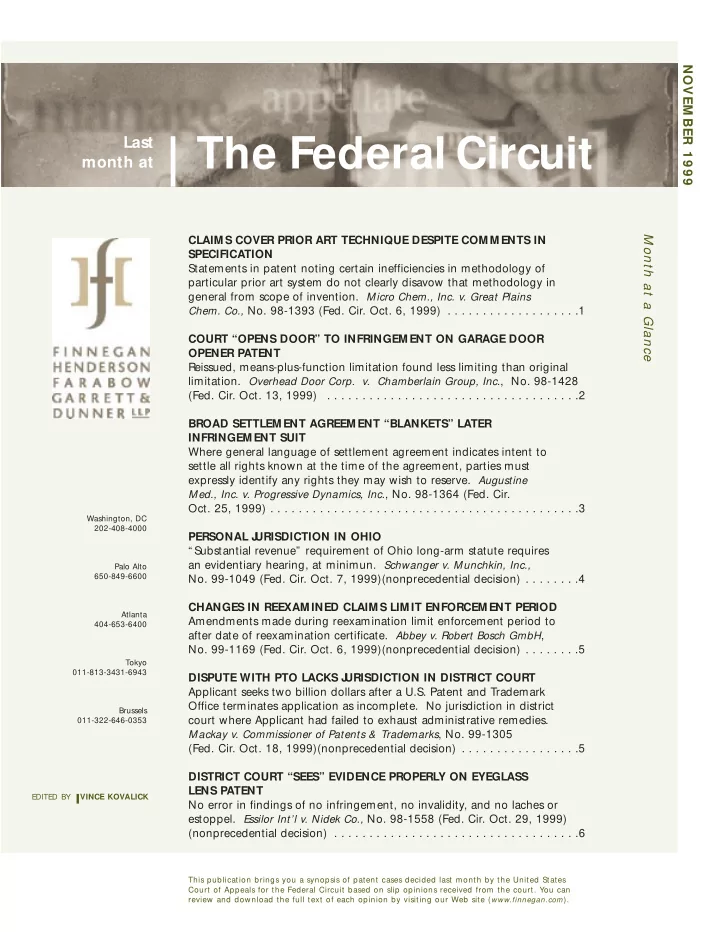
The Federal Circuit month at M ont h at a Glance CLAIM S COVER - - PDF document

the federal circuit
SMART_READER_LITE
LIVE PREVIEW

The Federal Circuit month at M ont h at a Glance CLAIM S COVER - - PDF document

NOVEM BER 1999 Last The Federal Circuit month at M ont h at a Glance CLAIM S COVER PRIOR ART TECHNIQUE DESPITE COM M ENTS IN SPECIFICATION Statements in patent noting certain inefficiencies in methodology of particular prior art system do


slide-1
SLIDE 1

EDITED BY VINCE KOVALICK This publication brings you a synopsis of patent cases decided last month by the United States Court of Appeals for the Federal Circuit based on slip opinions received from the court. You can review and download the full text of each opinion by visiting our Web site (www.finnegan.com). Washington, DC 202-408-4000 Palo Alto 650-849-6600 Atlanta 404-653-6400 Tokyo 011-813-3431-6943 Brussels 011-322-646-0353

CLAIM S COVER PRIOR ART TECHNIQUE DESPITE COM M ENTS IN SPECIFICATION Statements in patent noting certain inefficiencies in methodology of particular prior art system do not clearly disavow that methodology in general from scope of invention. Micro Chem., Inc. v. Great Plains

  • Chem. Co., No. 98-1393 (Fed. Cir. Oct. 6, 1999) . . . . . . . . . . . . . . . . . . .1

COURT “OPENS DOOR” TO INFRINGEM ENT ON GARAGE DOOR OPENER PATENT Reissued, means-plus-function limitation found less limiting than original

  • limitation. Overhead Door Corp. v. Chamberlain Group, Inc., No. 98-1428

(Fed. Cir. Oct. 13, 1999) . . . . . . . . . . . . . . . . . . . . . . . . . . . . . . . . . . . .2 BROAD SETTLEM ENT AGREEM ENT “BLANKETS” LATER INFRINGEM ENT SUIT Where general language of settlement agreement indicates intent to settle all rights known at the time of the agreement, parties must expressly identify any rights they may wish to reserve. Augustine

Med., Inc. v. Progressive Dynamics, Inc., No. 98-1364 (Fed. Cir.

  • Oct. 25, 1999) . . . . . . . . . . . . . . . . . . . . . . . . . . . . . . . . . . . . . . . . . . . .3

PERSONAL J URISDICTION IN OHIO “ Substantial revenue” requirement of Ohio long-arm statute requires an evidentiary hearing, at minimun. Schwanger v. Munchkin, Inc.,

  • No. 99-1049 (Fed. Cir. Oct. 7, 1999)(nonprecedential decision) . . . . . . . .4

CHANGES IN REEXAM INED CLAIM S LIM IT ENFORCEM ENT PERIOD Amendments made during reexamination limit enforcement period to after date of reexamination certificate. Abbey v. Robert Bosch GmbH,

  • No. 99-1169 (Fed. Cir. Oct. 6, 1999)(nonprecedential decision) . . . . . . . .5

DISPUTE WITH PTO LACKS J URISDICTION IN DISTRICT COURT Applicant seeks two billion dollars after a U.S. Patent and Trademark Office terminates application as incomplete. No jurisdiction in district court where Applicant had failed to exhaust administrative remedies.

Mackay v. Commissioner of Patents & Trademarks, No. 99-1305

(Fed. Cir. Oct. 18, 1999)(nonprecedential decision) . . . . . . . . . . . . . . . . .5 DISTRICT COURT “SEES” EVIDENCE PROPERLY ON EYEGLASS LENS PATENT No error in findings of no infringement, no invalidity, and no laches or

  • estoppel. E

ssilor Int’l v. Nidek Co., No. 98-1558 (Fed. Cir. Oct. 29, 1999)

(nonprecedential decision) . . . . . . . . . . . . . . . . . . . . . . . . . . . . . . . . . . .6

NOVEM BER 1999

The Federal Circuit

Last month at

M ont h at a Glance

slide-2
SLIDE 2

Claims Cover Prior Art Technique Despite Comments in Specification

Lawrence F . Galvin

[J udges: Rader (author), Plager, and Bryson] In Micro Chemical, Inc. v. Great Plains

Chemical Co., No. 98-1393 (Fed. Cir. Oct. 6,

1999), the Federal Circuit reversed a district court’s finding of noninfringement regarding four of five asserted claims of U.S. Patent No. 4,733,971 (“ the ‘971 patent” ), and affirmed both the district court’s finding of noninfringe- ment regarding the other claim and its grant

  • f summary judgment releasing the

Defendant’s president from personal liability for inducing infringement. The ‘971 patent concerns machines that control feed additives for livestock. The addi- tives include microingredients, such as vita- mins and medicine. Such machines use a number of mathematical approaches to cor- rectly measure and dispense the proper amount of microingredients from their individ- ual storage bins into a liquid-filled mixing ves-

  • sel. These approaches include the “ cumula-

tive-weigh” method, the “ loss-of-weight” method, and the “ weigh-dump” method. The cumulative-weigh method uses a compart- mented hopper located between the storage bins and the mixing vessel to sequentially weigh multiple microingredients prior to dis- pensing them en masse. The loss-of-weight method eliminates the hopper by individually measuring the weight loss from each storage bin as its respective microingredient is added directly into the mixing vessel. The weigh- dump method sequentially weighs each microingredient into a hopper and immediate- ly dumps that microingredient into the mixing vessel. Lextron, Inc. (“ Lextron” ), formerly the Great Plains Chemical Co., manufactures ani- mal health products and systems, including feed-additive control machines. Lextron origi- nally sold cumulative-weigh machines to con- trol feed additives. Micro Chemical, Inc. (“ Micro” ), owns the ‘971 patent. In response to Micro’s suit for infringement, Lextron stopped making cumu- lative-weigh machines, choosing instead to make weigh-dump machines based on a prior art process and device predating the ‘971 patent. The district court had narrowly interpreted the claims based on the preferred weigh machine described in the ‘971 patent specifi- cation and found neither identity of function nor equivalent structure in the Lextron weigh- dump machines. In reaching this conclusion, the district court had read a criticism of a par- ticular prior art weigh-dump method described in the background section of the ‘971 patent as disavowing any coverage of the weigh-dump method. On appeal, the Federal Circuit found that the district court’s claim construction had improperly incorporated both functional limi- tations not recited in the claims and structure beyond that necessary to perform the claimed

  • function. In particular, the district court had

improperly limited the function of the “ weigh- ing means” to cumulative weighing, then identified the corresponding structure to include the specific cumulative-weigh structure

  • f the preferred embodiment. The Court

ruled that the district court had also improper- ly read these limitations into the asserted method claims as well. The Federal Circuit ruled that statements in the ‘971 patent not- ing certain inefficiencies in a particular prior art system that used a weigh dump method did not clearly disavow the weigh-dump method in general. Finally, the Federal Circuit agreed that Lextron’s president should not be personally liable for inducing infringement. When he had first learned of the ‘971 patent, he took reasonable steps to avoid infringement, includ- ing consulting counsel in redesigning the accused machines.

page 01 L A ST M O N T H A T

T H E F E D E R A L C I R C U I T

FI N N EG A N H EN D ERSO N FA RA B O W G A RRET T D U N N ER L L P.

slide-3
SLIDE 3

1 9 9 9 N O V EM B ER

02 page

FI N N EG A N H EN D ERSO N FA RA B O W G A RRET T D U N N ER L L P.

Court “Opens Door” to Infringement on Garage Door Opener Patent

Vince Kovalick [J udges: Rader (author), M ichel, and Schall] In Overhead Door Corp. v. Chamberlain

Group, Inc., No. 98-1428 (Fed. Cir. Oct. 13,

1999), the Federal Circuit affirmed in-part a ruling by the district court on summary judg- ment (“ SJ ” ) that Overhead Door Corp. (“ Overhead Door” ) did not infringe certain claims of U.S. Patent No. Re. 35,364 (“ the ‘364 patent” ), but vacated in-part and remanded because the district court had erred in concluding as a matter of law that certain claims could not cover the accused structure under the doctrine of equivalents (“ DOE” ) or as structural equivalents under 35 U.S.C. sec- tion 112 ¶ 6. The ‘364 patent concerns a remote con- trol garage door opening system with a portable transmitter. Before the ‘364 patent, garage door opening systems required users to manually install transmitter codes using manual switches. The codes uniquely link a portable transmitter to a receiver system. The ‘364 patent eliminates manual code switches in the transmitters and permits garage door

  • pener systems to learn the identity of multi-

ple transmitters with different codes. Overhead Door’s accused garage door

  • peners—marketed as the “ Intellicode”

system—use factory-programmed identifica- tion codes instead of manual switches and learn to identify multiple transmitters. The Intellicode features software that determines the memory location for each new code. Thus, it does not use a manual, mechanical memory selection switch. The infringement dispute, on cross motion for SJ , centered on interpretation of several claim limitations concerning the memory selection switches and the associated codes. The Chamberlain Group, Inc. (“ Chamberlain” ), asserted infringement of sev- eral original claims and several that had been

  • reissued. The original claims include the claim

term “ memory selection switch,” while the reissued claims define the switch as a “ switch means.” On appeal, the Federal Circuit agreed with the district court that “ memory selection switch” as used in the original claims means a mechanical device separate from a micro-

  • processor. The Court concluded that this

interpretation harmonized the specification and the prosecution histories of the original and reissue applications. During reissue, Applicants had added the asserted claims that define the switches as “ switch means” and argued that this language included both elec- tronic as well as mechanical switches, given the disclosure of certain algorithms in the specification. Because the accused Intellicode system selects memory locations using a software pro- gram, not a mechanical switch, the Federal Circuit affirmed the SJ

  • f no literal infringe-

ment for the original claims. The Court ruled, however, that the district court had erred in deciding on SJ that the Intellicode did not infringe under the DOE because the record contained considerable evidence that the Intellicode’s software-driven, memory selection system was insubstantially different from and interchangeable with a mechanical switch. Drawing all reasonable inferences in favor of Chamberlain, the Federal Circuit concluded that this genuine issue of material fact pre- cluded SJ

  • f noninfringement under the DOE.

Giving a broader reading to the reissue claims, as argued during reissue, the Court ruled that switch means as used in the reis- sued claims also covers the software-based embodiments described in the ‘364 patent. The Court concluded that the Intellicode con- stitutes a different structure than the software disclosed in the ‘364 patent because it uses a different algorithm to perform the recited

  • function. Viewing the evidence in a light most

favorable to the nonmovant, Overhead Door, the Federal Circuit concluded that a genuine issue of material fact concerning the differ- ences between the disclosed algorithm and the Intellicode prevented SJ

  • f literal infringe-

ment.

slide-4
SLIDE 4

The Federal Circuit affirmed SJ

  • f literal

infringement of several other claim limitations and remanded the case for further proceed- ings.

Broad Settlement Agreement “Blankets” Later Infringement Suit

Walter W. Brown

[J udges: Gajarsa (author), M ayer, and Rader] In Augustine Medical, Inc. v. Progressive

Dynamics, Inc., No. 98-1364 (Fed. Cir. Oct. 25,

1999), the Federal Circuit upheld a district court grant of summary judgment (“ SJ ” ) dis- missing claims for patent infringement based upon a settlement agreement (“ Agreement” ) between the two parties in an earlier lawsuit. The Court concluded that the language of the Agreement covered future claims and consti- tuted a general release, neither party having reserved any specific right to sue in the future. Augustine Medical, Inc. (“ AMI” ), had ini- tially sued Progressive Dynamics, Inc. (“ PDI” ), in 1993 in Minnesota federal district court alleging unfair competition and several related claims, but not alleging patent infringement. The product at issue was PDI’s convective warming blanket that would also later be the subject of AMI’s patent infringement suit. The parties subsequently entered into the Agreement in 1995. Several months after signing the Agreement, AMI sued PDI and several inde- pendent Defendants for infringement of sever- al patents, all of which had issued prior to the first lawsuit. PDI moved for SJ based upon the

  • Agreement. The district court granted PDI’s

motion, and AMI appealed. The Federal Circuit reviewed the decision

  • n two grounds. First, the Court considered

whether the second action for patent infringement was covered by the Agreement. Second, the Court considered AMI’s assertion that the district court’s dismissal of the suit constituted a grant of an implied license to PDI. With regard to the Agreement, the Court interpreted the pertinent language to deter- mine whether it barred AMI’s claims for patent

  • infringement. In particular, the Court focused
  • n the following language:

AMI does hereby . . . release and forev- er discharge PDI from any and all man- ner of action or actions . . . that AMI and/or its owners . . . have, have had,

  • r may have against PDI upon or by

reason of or relating to any acts, omis- sions or statements made by PDI on or before the date of this Settlement Agreement . . . .

Augustine Med., Inc., slip op. at 2 (emphasis

in original). The Court sustained the district court’s finding that the phrase “ may have” is future

  • riented, thereby covering a possible future

AMI claim. AMI, however, claimed that this passage was directed only to claims arising “ on or before the date of this Agreement,” whereas their suit was only directed to infring- ing acts occurring after the Agreement. The Court countered by asserting that the phrase “ relating to” referenced acts made by PDI after the Agreement. Specifically, because the PDI blankets sold after the Agreement were identical to those sold before the Agreement, AMI’s infringement claims were clearly “ relat- ed to” actions PDI had taken on or before the date of the Agreement. The Court also rejected AMI’s argument that, because patent infringement is a contin- uing tort, each act of infringement constitutes a separate, individual cause of action. The Court said that this law cannot “ override the unambiguous language of a Settlement Agreement that releases all possible future claims related to the matters settled by the Agreement.” Augustine Med., Inc., slip op. at 4. The Court bolstered its interpretation by focusing on the Agreement as a general

page 03 L A ST M O N T H A T

T H E F E D E R A L C I R C U I T

FI N N EG A N H EN D ERSO N FA RA B O W G A RRET T D U N N ER L L P.

slide-5
SLIDE 5

1 9 9 9 N O V EM B ER

04 page

FI N N EG A N H EN D ERSO N FA RA B O W G A RRET T D U N N ER L L P.

release, citing the Supreme Court’s decision in

United States v. William Cramp & Sons Ship & E ngine Bldg. Co., 206 U.S. 118, 128 (1907),

which held that general language indicates an intention to settle all rights and any intention

  • therwise must be made clear by the parties.

AMI, therefore, should have manifested its intention to leave the possibility of patent infringement claims open but did not.

Personal J urisdiction in Ohio

Howard Levine

[J udges: Plager, Schall, and Gajarsa (per curiam)] In Schwanger v. Munchkin, Inc., No. 99- 1049 (Fed. Cir. Oct. 7, 1999)(nonprecedential decision), the Federal Circuit reversed a deci- sion by the U.S. District Court for the Northern District of Ohio that dismissed a patent infringement action initiated by Debra Schwanger et al. (“ Schwanger” ) for lack of personal jurisdiction over Munchkin, Inc. (“ Munchkin” ); Wal-Mart, Inc. (“ Wal-Mart” ); and Meijer. Munchkin, a California corporation, sold medicine dispensers to retailers Meijer and Wal-Mart in California. Meijer and Wal-Mart then sold Munchkin’s dispensers in Ohio in packaging bearing Munchkin’s trade name and a nationwide toll-free telephone number. Munchkin has no office, employees, telephone numbers, assets in Ohio, or any other contact with the state. In 1995 Munchkin’s sales to Wal-Mart totaled $ 68,539. The district court, declining to conduct an evidentiary hearing, had found that these facts failed to satisfy Ohio’s long-arm statute and the Sixth Circuit’s test for determining whether the exercise of personal jurisdiction satisfied federal due process. The Federal Circuit reversed. In examining the Ohio long-arm statute, the Federal Circuit held that the lower court had improperly interpreted the statute to require direct con- tact with the state. Rather, the Federal Circuit concluded, the statute provides jurisdiction where the defendant acting outside of Ohio, caused tortious injury in Ohio, and provided that the defendant derives substantial revenue from goods used in the state. According to the Court, this two-part test requires, “ at mini- mum,” an evidentiary hearing to determine if the defendant obtained “ substantial value” from its sales in Ohio. Thus, the Federal Circuit remanded on these issues. Regarding whether the assertion of juris- diction would violate federal due process, the Federal Circuit ruled that the lower court erred as a matter of law by applying Sixth Circuit law rather than Federal Circuit law. The Federal Circuit explained that it uses a three- part test to determine whether the assertion of personal jurisdiction violates federal due process: (1) whether the defendant purpose- fully directed its activities at residents of the forum; (2) whether the claim arises out of or relates to those activities; and (3) whether assertion of personal jurisdiction is reasonable and fair. The Court found that Munchkin’s ship- ment of accused products into Ohio through Wal-Mart, a well-established distribution chan- nel, established purposeful minimum contacts necessary to establish personal jurisdiction. The Court also found that Ohio has signifi- cant interest in discouraging patent infringe- ment within the state, and concluded that the burden on Munchkin to litigate in Ohio had not been outweighed by Schwanger’s and Ohio’s interests, particularly as technological progress in travel has lessened the burden of defending a lawsuit in a foreign jurisdiction. Accordingly, the Federal Circuit held the exercise of personal jurisdiction over Munchkin comports with the requirements of federal due process.

slide-6
SLIDE 6

Changes in Reexamined Claims Limit Enforcement Period

Robert J . O’Connell

[J udges: Plager (author), Schall, and Gajarsa] In Abbey v. Robert Bosch GmbH, No. 99- 1169 (Fed. Cir. Oct. 6, 1999)(nonprecedential decision), the Federal Circuit affirmed a district court’s grant of summary judgment (“ SJ ” ) of noninfringement and SJ that certain original and reexamined claims of the asserted patent are not identical.

  • Mr. Harold Abbey (“ Abbey” ) brought suit

against several Defendants, alleging that fuel- injection systems used in certain Mercedes- Benz automobiles infringed Abbey’s U.S. Patent No. 4,387,685 (“ the original ‘685 patent” ). Robert Bosch, GmbH (“ Bosch” ), intervened as a Defendant and requested that the U.S. Patent and Trademark Office (“ PTO” ) reexamine the original ‘685 patent. During reexamination, the Examiner rejected several claims as unpatentable in view of several prior art references not cited during the original

  • prosecution. After unsuccessful appeals,

Abbey obtained allowance of its claims by amending the claims to include additional limitations. After the reexamination, Defendants moved for SJ

  • f noninfringement and partial SJ

that Abbey could enforce the claims of the reexamined ‘685 patent only from the date of the reexamination certificate because the reex- amined claims were not identical to those of the original ‘685 patent. The district court granted both motions, and Abbey appealed. On the infringement issue, the Federal Circuit agreed that the claims unambiguously recite a spool containing both an interior and an exterior passage. Although Abbey’s origi- nally filed claims did not require an interior passage, he had canceled his original claims in response to a prior art rejection and submitted a new claim reciting a spool with an interior passage and defining an exterior passage. Because the accused devices do not con- tain an interior passage, the Court agreed that the devices do not literally infringe. Further, the Court found that the doctrine of equiva- lents was limited by prosecution history estop- pel, because when Abbey amended his claim to include an inside passage he had surren- dered coverage of the Defendants’ solid plug devices, which do not have an interior pas- sage. With respect to the SJ regarding the reex- amined claims, the Federal Circuit agreed that the scope of the claims was substantively changed, such that Abbey could enforce his patent only from the date of the reexamina- tion certificate.

Dispute with PTO Lacks J urisdiction in District Court

Robert J . O’Connell

[J udges: Lourie, Rader, and Bryson (per curiam)] In Mackay v. Commissioner of Patents &

Trademarks, No. 99-1305 (Fed. Cir. Oct. 18,

1999)(nonprecedential decision), the Federal Circuit affirmed the United States District Court for the District of Columbia’s dismissal

  • f Donald Mackay’s (“ Mackay” ) claim that the

U.S. Patent and Trademark Office (“ PTO” ) had willfully negated his patent for lack of jurisdic- tion. Mackay claims to have invented a portable electric tidal generator. After Mackay had filed a patent application with the PTO, the PTO notified him that his patent application was incomplete and thus could not be accorded a filing date. Mackay did not submit the required materials; therefore, the PTO termi- nated its application. Mackay filed a brief complaint citing no particular cause of action but seeking two bil- lion dollars from the PTO. (Mackay later requested that the two billion dollars be

page 05 L A ST M O N T H A T

T H E F E D E R A L C I R C U I T

FI N N EG A N H EN D ERSO N FA RA B O W G A RRET T D U N N ER L L P.

slide-7
SLIDE 7

1 9 9 9 N O V EM B ER

06 page

FI N N EG A N H EN D ERSO N FA RA B O W G A RRET T D U N N ER L L P.

awarded in the form of one dollar gold pieces.) The district court had assumed that Mackay was seeking relief under either the Federal Tort Claims Act (“ FTCA” ) or the Administrative Procedure Act (“ AP A” ). Under an FTCA claim, the district court could not find jurisdiction because Mackay did not allege that he had exhausted his administrative remedies before filing its action in the district

  • court. In particular, Mackay had not filed a

petition with the Commissioner of Patents and Trademarks to contest the PTO’s failure to assign a priority date. Under an AP A claim, the district court con- cluded that it did not have jurisdiction to hear Mackay’s claim for monetary damages because the AP A waives sovereign immunity of the United States only for actions seeking relief

  • ther than monetary damages and also

requires that a plaintiff first exhaust its admin- istrative remedies. The Federal Circuit agreed with the dis- trict’s analysis and affirmed that the district court lacked jurisdiction.

District Court “Sees” Evidence Properly on Eyeglass Lens Patent

Thalia V. Warnement

[J udges: M ayer, Smith, and Rich (heard oral arguments) (per curiam)] In E

ssilor International v. Nidek Co., No. 98-

1558 (Fed. Cir. Oct. 29, 1999)(nonpreceden- tial decision), the Federal Circuit affirmed the district court’s finding of noninfringement of U.S. Patent No. 4,596,091 (“ the ‘091 patent” ) and affirmed the district court’s decision that the ‘091 patent was not invalid; that the patent owner, Essilor International (“ Essilor” ), did not engage in unfair competition; and that laches and equitable estoppel did not apply. The ‘091 patent is directed to a machine for automatically grinding a bevel on the edge

  • f an eyeglass lens. Claim 1, the only inde-

pendent claim at issue, requires that the claimed invention have a “ control means” including a means for storing a collection of predetermined beveling or grooving paths and means for comparing two reference paths with the collection of predetermined paths and for selecting a path from the collection intermediate the two reference paths. Essilor asserted that the predetermined beveling path includes equations for calculating a beveling path stored in the control unit of the accused devices. The Federal Circuit, agreeing with the dis- trict court, concluded that the plain meaning

  • f a “ predetermined beveling path” is a bevel-

ing path that has been previously set, not a path represented by an equation that needs the input of additional information before the path can be determined. Thus, the Court found no literal infringement. As to equiva- lence, the Federal Circuit concluded that the district court had not erred in the conclusion that the accused devices operated in a sub- stantially different way than the claimed invention. Next, the Federal Circuit addressed the issue of invalidity. Nidek Co. and Santinelli International, Inc. (collectively “ Nidek” ) assert- ed that the ‘091 patent was invalid under 35 U.S.C. section 112 for lack of enablement, for failure to disclose the best mode, and for fail- ure to adequately disclose a structure corre- sponding to the means-plus-function language

  • f the “ control means” limitation. With

respect to enablement, they argued that the ‘091 patent did not describe the predeter- mined paths or how to perform the claimed comparing and selecting functions. The Federal Circuit agreed with the district court that the predetermined paths were based on prior art paths and that the comparing and selecting functions could be readily accom- plished by writing suitable software to perform the relatively common calculations. With respect to the best mode, Nidek con- tended that the ‘091 patent failed to disclose that the predetermined paths were based on known paths. However, the Federal Circuit stated that one of ordinary skill in the art

slide-8
SLIDE 8

would have understood the “ typical paths” recited in the patent to include the known paths. With respect to the means-plus-function limitations, the Federal Circuit upheld the dis- trict court’s decision that one of ordinary skill in the art would have understood what portions of the disclosed control unit would perform the claimed functions and that the functions could be accomplished using computer programs. Finally, Nidek asserted that laches and equi- table estoppel should have precluded Essilor’s infringement action and that Essilor was guilty

  • f unfair competition. Using the abuse of dis-

cretion standard of review, the Federal Circuit found no abuse of discretion by the district court in its determination that the four-year delay in bringing suit was reasonable because Essilor and Nidek were attempting to negotiate a solution to avoid litigation and neither party had suffered material prejudice as a result of the

  • delay. Under the same standard of review, the

Federal Circuit agreed with the district court’s dismissal of the unfair competition claim against Essilor, noting that the lawsuit was a good faith attempt by Essilor to enforce its patent rights.

CHARLIE’S CORNER

Reissue Application Procedures The PTO has simplified many aspects of reissue application practice, including some requirements relating to the reissue oath/decla-

  • ration. These simplifications, however, should

not obscure several important requirements unique to reissue applications that could affect the validity of a reissue patent. The original reissue oath/declaration needs to identify only one error in the original patent that provides a basis for reissue. When the reis- sue application does not seek to enlarge the scope of the claims of the patent, the reissue

  • ath/declaration may be made by the assignee
  • f the entire interest. When the scope of the

claims is enlarged, the inventors must sign the

  • ath/declaration and the application must be

filed within two years of the grant of the origi- nal patent. Once the prosecution of the reissue applica- tion results in a determination that all claims are patentable, a supplemental reissue oath/decla- ration may be required before the application can be allowed. If additional defects or errors are corrected in the reissue application after the

  • riginal oath/declaration is filed, a supplemental

reissue oath/declaration must be filed unless the errors are simply spelling, typographical, or oth- erwise editorial in nature. 37 C.F .R. § 1.175(b)(1). The content of the supplemental

  • ath/declaration is very simple. See M.P

.E.P . § 1414.01. Where amendments were made to a reissue application after filing the original oath/declara- tion, and the claims are otherwise in condition for allowance, the PTO should reject all claims subsequently amended until a supplemental

  • ath/declaration is filed. The failure of the PTO

to make the rejection, however, does not relieve applicant from the requirement to file the sup- plemental oath/declaration. An oversight can be fatal to the validity of the reissue patent. Recall the fate of the reissue patentee in Nupla

  • Corp. v. IXL Manufacturing Co., 114 F

.3d 191, 42 USPQ2d 1711 (Fed. Cir. 1997), where all claims in the reissue patent were declared invalid because the reissue applicant did not comply with the reissue oath/declaration requirements. Other requirements that are unique relate to the presentation of an amendment in a reis- sue application. In addition to the required for- mat for amending the specification and claims in a reissue application, each amendment must set forth the status (i.e., pending or canceled) of all patent claims and all added claims as of the date of the amendment. 37 C.F .R. § 1.121(b)(2)(ii). Each claim amendment must be accompanied by an explanation of the sup- port in the disclosure of the patent for the

  • amendment. 37 C.F

.R. § 1.121(b)(2)(iii). Even a simple editorial amendment should be addressed as merely an editorial change.

page 7 FI N N EG A N H EN D ERSO N FA RA B O W G A RRET T D U N N ER L L P.

DISCLAIMER:

The case summaries reflect the understanding

  • f the authors only and are not meant to con-

vey legal opinions or advice of any kind. The firm disclaims any liability for any errors or

  • missions in these summaries. This promotion-

al newsletter does not establish any form of attorney-client relationship with our firm or with any of our attorneys.