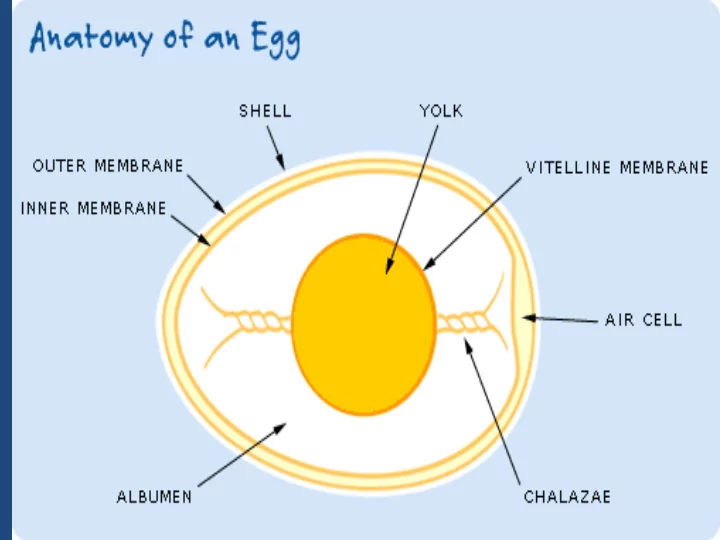
SLIDE 1
SLIDE 2
SLIDE 3
SLIDE 4 The Entire Chick Came From Just One Egg
SLIDE 5 Nutrient Composition of Whole Hen’s Egg
60 g
65 -68.5
- 3. Kilocalories (kilojoules)
70 (293)
6.3
0.36
4.8
- 7. Polyunsaturated fat (g)
1
- 8. Monounsaturated fat (g)
1.8
1.6 10.Cholesterol (mg) 185 11.Choline (mg) 126 12.Vitamin A (IU) 270 13.Vitamin D (IU) 41 14.Vitamin E (mg) 0.5
SLIDE 6 Biological Value (BV)
- This is a measure of the proportion of absorbed protein from a food which
becomes incorporated into the proteins of the organism's body
- It captures how readily the digested protein can be used in protein
synthesis in the cells of the organism
- Proteins are the major source of nitrogen in food. BV assumes protein is
the only source of nitrogen and measures the proportion of this nitrogen absorbed by the body which is then excreted
- The remainder must have been incorporated into the proteins of the
- rganism’s body
- A ratio of nitrogen incorporated into the body over nitrogen absorbed
gives a measure of protein 'usability'
SLIDE 7
SLIDE 8
SLIDE 9
SLIDE 10
SLIDE 11 Net Protein Utilization (NPU)
- The net protein utilization, or NPU, is the ratio
- f amino acid converted to proteins to the
ratio of amino acids supplied
- This figure is somewhat affected by the
salvage of essential amino acids within the body, but is profoundly affected by the level of limiting amino acids within a foodstuff
SLIDE 12 Determination of NPU
- Experimentally, this value can be determined
by determining dietary protein intake and then measuring nitrogen excretion. One formula for NPU is:
- NPU = ((0.16 × (24 hour protein intake in
grams)) - ((24 hour urinary urea nitrogen) + 2)
- (0.1 × (ideal body weight in kilograms))) /
(0.16 × (24 hour protein intake in grams))
SLIDE 13
SLIDE 14 Net Protein Utilization (NPU)
- As a value, NPU can range from 1 to 0, with a
value of 1 indicating 100% utilization of dietary nitrogen as protein and a value of 0 an indication that none of the nitrogen supplied was converted to protein
- Certain foodstuffs, such as eggs or milk, rate
as 1 on an NPU score
SLIDE 15
SLIDE 16
SLIDE 17 Nutritive Benefits of Eggs
- A very good source of inexpensive, high quality
protein
- More than half the protein of an egg is found in
the egg white along with vitamin B2 and lower amounts of fat and cholesterol than the yolk
- The whites are rich sources of selenium, vitamin
D, B6, B12 and minerals such as zinc, iron and copper
- Egg yolks contain more calories and fat. They are
the source of cholesterol, fat soluble vitamins A, D, E and K and lecithin - the compound that enables emulsification in fatty foods
SLIDE 18 Nutritive Benefits of Eggs
- Some brands of egg now contain omega-3
fatty acids, depending on what the chickens have been fed
- Eggs are regarded a 'complete' source of
protein as they contain all eight essential amino acids; the ones we cannot synthesize in
- ur bodies and must obtain from our diet
SLIDE 19 Fatty Acids Composition of Eggs
The fatty acid composition of eggs depends on the feed
- Wheat
- Oats
- Supplement
- Flaxseed
- Limestone
- Canola oil
- Groundnut oil (high oleic acid content)
- Soya bean (linoleic acid) or linseed oil (α-linolenic acid)
- Incorporation of groundnut versus linseed into the diet raised the
arachidonic acid content of the eggs
- Feeding the linseed diet produced higher contents of
eicosapentaenoic and docosahexaenoic acid
SLIDE 20
SLIDE 21
Gene Expression
SLIDE 22 Choline and The Brain
- Choline’s vital role in the production of the neuro-chemical
acetylcholine provides a host of cognitive benefits
- It is most well known as a memory enhancer, but that is
just one of dozens of positive effects it can have on the mental landscape
- A brain’s ability to remain plastic is another way of
describing intelligence, with the potential to adapt to and thrive in new situations
- All of this begins with healthy amounts of acetylcholine,
which in turn requires choline to produce that is abundantly found in eggs
SLIDE 23 Choline and The Brain
- Perhaps the most important effect is
enhanced neuroplasticity in the physical structure of the brain
- This refers to the ability of neurons to form
new connections through synapses, which happens when we have new experiences or make new connections of logic or insight about facts, sensory stimulus, and emotion.
SLIDE 24
SLIDE 25
SLIDE 26
SLIDE 27
SLIDE 28
SLIDE 29
SLIDE 30
SLIDE 31
SLIDE 32 Egg is a Memory Enhancer
- 1. Better memory
- 2. Recall of facts, feelings of mental
clarity,
- 3. Ability to reason and articulate
thoughts clearly
- 4. Coherent verbal skills, and logical
thinking
SLIDE 33 Egg is a Memory Enhancer
5.Choline leads to enhanced focus and the mind’s ability to concentrate 6.Faster reaction times to stimulus
- 7. Crucial for various learning
SLIDE 34 Egg is a Memory Enhancer
- Due to choline sharpening of
concentration, the consumption of eggs may be a beneficial adjunct therapy for symptoms of
- Attention Deficit Hyperactivity
Disorder (ADHD) or Attention Deficit Disorder (ADD)
SLIDE 35
SLIDE 36
A Rich Source of Choline
SLIDE 37
SLIDE 38
SLIDE 39
SLIDE 40
SLIDE 41
SLIDE 42 Specific Dynamic Action
- Thermal effect of food (abbreviated as TEF), also known as specific
dynamic action (SDA) of a food or dietary induced thermogenesis (DIT),
- It is the amount of energy expenditure above the resting metabolic
rate due to the cost of processing food for use and storage.
- It is one of the components of metabolism along with resting
metabolic rate and the exercise component.
- A commonly used estimate of the thermal effect of food is about
10% of one's caloric intake, though the effect varies substantially for different food components.
- For example, dietary fat is very easy to process and has very little
thermal effect, while protein is hard to process and has a much larger thermal effect
SLIDE 43
SLIDE 44
SLIDE 45
Oxygen Consumption in SDA
SLIDE 46 Nutritional Key Points
- Eggs are a very good source of inexpensive, high quality protein
- More than half the protein of an egg is found in the egg white
along with vitamin B2 and lower amounts of fat and cholesterol than the yolk.
- The whites are rich sources of selenium, vitamin D, B6, B12 and
minerals such as zinc, iron and copper. Egg yolks contain more calories and fat.
- They are the source of cholesterol, fat soluble vitamins A, D, E
and K and lecithin - the compound that enables emulsification in recipes such as hollandaise or mayonnaise.
SLIDE 47 Nutritional Key Points
- Some brands of egg now contain omega-3 fatty acids, depending
- n what the chickens have been fed.
- Eggs are regarded a 'complete' source of protein as they contain
all eight essential amino acids; the ones we cannot synthesize in
- ur bodies and must obtain from our diet.
- One large egg contains:
78 calories 6.3g protein 5.3g fat 1.6g saturated fat 212mg cholesterol (see my blog below about cholesterol): http://scientificlogic.blogspot.my/2010/05/eggs-are-bad-for- health.html
SLIDE 48 Nutritional Key Points
- The nutritional value of eggs lies chiefly in their providing
proteins of good biological value; an average-sized egg (60 g) provides approximately 7 g of proteins
- These proteins are rich in essential amino acids, with a
very good balance between those amino acids, so that egg protein can be regarded as a reference protein.
- To exemplify, 2 eggs provide as much protein as 100 g of
meat or 100 g of fish.
SLIDE 49 Nutritional Key Points
- The energy value for an average egg (60 g) is
approximately 376 kJ (90 kcal)
- The lipid content is 7 g, most of those lipids
being contained in the yolk. 2/3 of the fatty acids are unsaturated. An egg also contains 180 mg of cholesterol
- An egg is rich in vitamins A, D, & E, and trace
elements iron and zinc
SLIDE 50 Health Concern
- The main safety concern of eggs is risk of
salmonella food poisoning
- The best protection is to cook eggs at a high
enough temperature for a long enough period of time, meaning poached, scrambled and hard boiled eggs carry a much lower salmonella risk
- Another safety concern regarding eggs is that
they are a common food allergen, particularly among young children.
SLIDE 51 Salmonella infections
There are two species of Salmonella:
- Salmonella bongori and Salmonella enterica
- Salmonella enterica is further divided into six
subspecies and over 2500 serovars
- Salmonella cause illnesses such as typhoid
fever, paratyphoid fever, and food poisoning (Salmonellosis)
SLIDE 52
Salmonella typhi
SLIDE 53
Salmonella typhi
SLIDE 54
Salmonella typhi
SLIDE 55
Presentations of Typhoid
SLIDE 56
Rose Spots
SLIDE 57
Rashes of Typhoid
SLIDE 58
Rashes of Typhoid
SLIDE 59
Biotin
Biotin, also known as vitamin H or B7 is a water-soluble, sulphur- containing vitamin It is often grouped along with the B- group of vitamins Biotin can be produced in the body as well as obtained from foods
SLIDE 60 Biotin
Metabolism of all macronutrients Involves in energy production, fat synthesis, amino acid metabolism, and glycogen synthesis
Produced by microorganisms in the intestines Found in most foods
SLIDE 61
SLIDE 62
SLIDE 63
Biotin Deficiency
Natural biotin deficiency is not known Similar clinical presentations as in thiamine and in riboflavin deficiencies Avidin found in raw egg white can block the abortion of biotin
SLIDE 64
SLIDE 65
SLIDE 66
Biotin Deficiency in Rats
SLIDE 67
SLIDE 68
SLIDE 69
SLIDE 70
SLIDE 71
SLIDE 72
SLIDE 73
SLIDE 74 No Health Problem
- There is no health problem with
Salmonella infection and avidin-biotin blockers in eggs
- Avidin is thermo-labile. It is completely
deactivated and destroyed by heat
SLIDE 75
Simple Home Test for Eggs (Float Test)
SLIDE 76
Simple Home Test for Eggs (Float Test)
SLIDE 77
Egg Candling
SLIDE 78
Chick’s Embryonic Development
SLIDE 79
SLIDE 80
Egg Candling
SLIDE 81
SLIDE 82 Food Quality Control
- Physical Examination and Grading
- Chemical Analysis
- Microbiological Assays
- Organoleptic and Sensory
Evaluation
- Statistical Analysis in QC
SLIDE 83
Food Sensory Evaluation
SLIDE 84
Organoleptic Evaluation
SLIDE 85
Microbiological Assays
SLIDE 86
Microbiological Assay of Eggs
SLIDE 87
Laboratory Evaluation of Quality of Eggs
SLIDE 88
Analytical Food Chemistry and Quality Control
SLIDE 89 Food Quality Control Analytical Procedures
SLIDE 90
Food Quality Control
SLIDE 91
Food Microbiology Bacteriological Assays
SLIDE 92 Summary
- Helps weight loss
- Increases muscle mass
- Lowers blood pressure
- Lowers risk of heart disease and stroke
- Reduces triglycerides and lowers risk of heart
disease (Scientific Logic: Eggs are Good or Bad for Health: Dr Lim Ju Boo)
- One egg contain more than 100 mg of choline
- Builds cell membrane and brain signaling molecules
and pathways
- Reduces risk of cataracts and macular degeneration
- Increases night vision and prevents blindness
SLIDE 93 Summary
- Eggs protect against fatty liver, slow growth,
macular degeneration (degeneration of the macula area of the retina in the eyes.
- This is responsible for central vision for reading,
face recognition and detailed vision, edema (water retention), and various skin lesions
- Eggs promote healthy growth of nails, hair and
skin
SLIDE 94 Summary
- Eggs are cancer-protective, especially for breast
cancer
- Eggs are very rich in sulfur-containing amino
acids methionine which is a very crucial amino- acid in blocking damaging free radicals
- These are directly linked to the pathogenesis of
heart disease, cancers, DNA damage, and all degenerative disorders, and accelerated aging
SLIDE 95 Summary
- Eggs are rich in tryptophan, selenium, iodine, and
riboflavin (vitamin B2)
- Eggs selenium content is cardio-protective against
Keshan disease, cardiomyopathies (diseases involving the heart muscles, cardiomegaly (enlarged heart), myocardial dysfunction (poor heart function) and death from heart failure
- Eggs are protective against Kashin-Beck disease
(osteoarthropathy), myxedematous endemic cretinism (mental retardation)
SLIDE 96 Thank You for Your Patience
JU-BOO LIM
BSc (Medical Physiology & Chemistry) Post-Graduate Dip Nutrition (Lond) MSc (Food Tech. & Food Quality Control) MD (Cal) PhD Medicine (Lond) Fellow Royal Society of Public Health Fellow Royal Society of Medicine
SLIDE 97
British Postgraduate Award
Yudkin Prize Dept of Nutrition Queen Elizabeth College University of London England
SLIDE 98
British Postgraduate Award
Nuffield Fellow Dept of Medicine University of Cambridge England
SLIDE 99
British Postgraduate Award
Freedom From Hunger Campaign Prize Dept of Food Science and Food Technology University of Reading England
SLIDE 100
A Brief CV of Ju-Boo Lim
Formerly
Research Nutritionist and Food-Medical Toxicologist Massachusetts Institute of Technology Cambridge United Sates of America
SLIDE 101 A Brief CV of Ju-Boo Lim
Formerly
- Sr. Medical Research Officer
Institute for Medical Research Ministry of Health Malaysia
SLIDE 102
Currently
Special Nutrition-Medical-Science Adviser Chief Consultant Technical Advisory Board The Dynapharm Pharmaceutical International Group (DNG)
SLIDE 103 Hobbies and Pastime
- Astronomy
- Nature Study
- Microscopy
- Plays the violin and the flute
- Reading books, articles and scientific journals
- Writing educational articles for blogs, magazines
and newsletters
- Attending lectures and giving educational talks
- Participates in scientific-medical conferences and
presents papers