The effects o of t technology gy o on migr gration a and i - - PowerPoint PPT Presentation

the effects o of t technology gy o on migr gration a and
SMART_READER_LITE
LIVE PREVIEW

The effects o of t technology gy o on migr gration a and i - - PowerPoint PPT Presentation

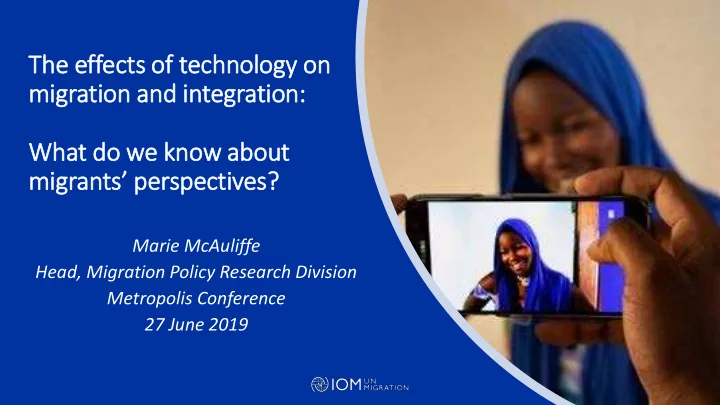
The effects o of t technology gy o on migr gration a and i integration: What t do we k know a about t migrants s pe persp spec ectives? s? Marie McAuliffe Head, Migration Policy Research Division Metropolis Conference 27


slide-1
SLIDE 1

The effects o

  • f t

technology gy o

  • n

migr gration a and i integration: What t do we k know a about t migrants’ s’ pe persp spec ectives? s?

Marie McAuliffe Head, Migration Policy Research Division Metropolis Conference 27 June 2019

slide-2
SLIDE 2

Tech chnology as a game ch changer

  • Digital technology is fundamentally reshaping economies, social interactions

and collective security

  • The Fourth Industrial Revolution1

‐ Velocity ‐ Breadth and depth ‐ Systems impact

  • ICT impacting all areas of society

e.g. financial sector, political/governance, health sector, communications, transportation, services, socialization… …and migration

1 Schwab, 2017.

Disclaimer: Views expressed are the presenter’s and do not necessarily reflect those of IOM

slide-3
SLIDE 3

Migran ants i include…

258 m 8 million i n interna nationa nal migrants, s, or just 3 3.4% 4% o

  • f globa

bal p popul ulation n (UN DESA, 2017) ‐ Includes all foreign born regardless of demography, policy category or immigration status 740 740 m million i inter ernal m migrants s (UNDP, 2009); 41 m million I IDPs (IDMC, 2019) Higher concentrations of migrants in some regions/countries ‐ traditional “immigration” countries (e.g. Canada, Australia, US, NZ) ‐ traditional “guest worker” countries (e.g. UAE, Qatar, KSA) ‐ Refugee/displacement countries (e.g. currently Syria, Turkey, Afghanistan, Uganda)

slide-4
SLIDE 4

Global internet and mobile telephone access, 1995 to 2014

Source: ITU data; graph from IOM World Migration Report 2018, p. 153

10 20 30 40 50 60 70 80 90 100 1995 2000 2005 2010 2014 Internet users (per 100 people) Mobile cellular subscriptions (per 100 people)

slide-5
SLIDE 5

Migration & & technology o y overview

  • Technology increasingly used throughout the ‘migration cycle’
  • Key areas:
  • Migrant decision making and preparation
  • The act of migrating: the ‘appification’ of migration and mobility
  • Border management technology
  • Integration, reintegration and migrants’ (digital) (virtual) (transnational)

identities

  • Migration, technology and public debates
  • Analysing migration dynamics: technology in migration research and analysis
slide-6
SLIDE 6

Migration & & technology o y overview

  • Technology increasingly used throughout the ‘migration cycle’
  • Key areas:
  • Migrant decision making and preparation
  • The act of migrating: the ‘appification’ of migration and mobility
  • Border management technology
  • Integration, transnational
  • Migration, technology and public debates
  • Analysing migration dynamics: technology in migration research and analysis
slide-7
SLIDE 7

‘’Migrant tech ech’’ What it mea eans…. ….

  • 1. Migrants’ use of technology
  • 2. Technology developed by migrants to

support others navigate migration and integration processes Can also encompass migrants working in the tech sector

Sources: UNU, 2018; UNESCO, 2019.

Photo: themepap

slide-8
SLIDE 8

‘’Migrant tech ech’’ …why it matters

Important because: ‐ empowers those who are exploited/abused (or at risk of) ‐ expands access to migrant services (e.g. legal advice) ‐ supports protection of migrants throughout the cycle ‐ migrant voices can be heard ‐ points to gaps, weaknesses and problems in systems ‐ can improve quality of services/experiences for migrants and non‐ migrants

Sources: UNU, 2018; UNESCO, 2019.

slide-9
SLIDE 9

Migrant decis ecisio ion‐makin ing & IC ICT

  • Growing body of academic and applied research1

‐ Builds on ‘decision making’ literature ‐ Focus on irregular migration and migrant smuggling ‐ Role of non‐state actors’ / online interactions with migrants ‐ Information ‘campaigns’/social media in origin and transit ‐ Demographic aspects (age and gender)

  • Key findings

‐ ICT increasingly prevalent, although access uneven ‐ Trust in information/content (close friends, family, ethnic group highest) ‐ Can compound social pressures to migrate

Examples: Crawley & Hagen‐Zanker, 2018; Jayasuriya, McAuliffe & Iqbal, 2016; Mbaye, 2017; Maroufof, 2017; Triandafyllidou, 2017

slide-10
SLIDE 10

Appification of m migration

  • Fundamentally changing migrants’

navigation of systems/processes

  • Recent events have brought the

issue into sharp relief

‐ Displacement from Venezuela ‐ Migrant ‘caravans’ through Central America ‐ Mass movement to and through Europe in 2015/2016

  • Real‐time information available on personal devices

Photo: IOM

slide-11
SLIDE 11

Tech & & integration

Tech is becoming pivotal in successful integration. Migrants use tech to:

  • Reconnect and maintain sociocultural networks back home;
  • Familiarize themselves with and adjust to new environments;
  • Explore information and provide various support services;
  • Retrieve health information;
  • Enhance children’s education;
  • Entertain people in their leisure time.

What Motivates Immigrants for ICT Adoption and Use?: A Systematic Review of the 21st Century Literature (2001-2017) by Bhanu Bhakta Acharya, University of Ottawa

slide-12
SLIDE 12

Tech & h & transn snational f families es

  • Mobile money apps to remit
  • Skype and WhatsApp parenting
  • Social change

‐ feminization of migration ‐ family decision‐making ‐ children left behind ‐ children as household providers ‐ split families

Sources: Beazley, 2017; Hoang, 2019; Khoo, Platt and Yeoh, 2017; Lam, 2019.

Photo: Travis Isaacs

slide-13
SLIDE 13

Key i issues f for

  • r m

migrants

  • Empowerment and self‐agency
  • Social connections – home, transit,

destination

  • Economic advancement –

households/communities

  • Quality of information/advice
  • Risk & unsafe journeys
  • (Mis)trusted sources
  • Personal data
  • Access to ICT

Photo: K.C. Wong

slide-14
SLIDE 14

Key i issues f for

  • r policy
  • licy and p

practi tice ce

  • Migrant vulnerability and exploitation / Safety from

persecution

  • Irregular migration and border management / Unsafe

migration (abuse, migrant deaths)

  • Regulation / ‘fake news’ and ‘disinformation’
  • Tailoring information and services / competition for talent
slide-15
SLIDE 15