The Effect of Velocity Aberration on ACS Image Processing Colin Cox - - PDF document

the effect of velocity aberration on acs image processing
SMART_READER_LITE
LIVE PREVIEW

The Effect of Velocity Aberration on ACS Image Processing Colin Cox - - PDF document

2002 HST Calibration Workshop Space Telescope Science Institute, 2002 S. Arribas, A. Koekemoer, and B. Whitmore, eds. The Effect of Velocity Aberration on ACS Image Processing Colin Cox and Ron Gilliland Space Telescope Science Institute, 3700


slide-1
SLIDE 1

2002 HST Calibration Workshop Space Telescope Science Institute, 2002

  • S. Arribas, A. Koekemoer, and B. Whitmore, eds.

The Effect of Velocity Aberration on ACS Image Processing

Colin Cox and Ron Gilliland Space Telescope Science Institute, 3700 San Martin Drive, Baltimore, MD 21218 Abstract. The apparent scale change due to velocity aberration, although small, has measurable effects on the wide field images of the ACS. Over a one orbit period the scale can vary by as much as 5 parts in 100,000. Across a long diagonal of the ACS field of view this amounts to about 0.3 pixels. This is sufficient to degrade the registration needed for cosmic ray rejection. Images taken six months apart could have scale differences as large as 12 parts in 100,000 leading to misregistrations up to 1.4 pixels. We plan to add a velocity aberration scale correction factor to image headers which may be used in the cosmic ray rejection algorithm and the dither package. 1. Introduction The Hubble Space Telescope has an orbital speed about the Earth of about 7 km a second, and the Earth’s orbital velocity about the Sun is approximately 30 km a second. The net velocity causes stellar image displacements of some tens of arcseconds. In Figure 1 α represents the angle between the telescope direction of motion relative to the Sun and the direction of a star in barycentric coordinates. α′ is the angle measured towards the instantaneous apparent direction and is given by tanα′ =

  • 1 − β2 sin α

cos α + β Differentiating this expression gives dα′ dα =

  • 1 − β2

1 + β cos α This gives the change of scale along the radial direction defined by the intersection of the plane containing the velocity and pointing vectors with the field of view. In the tangential direction the scale change is sinα′/ sinα which comes out to be exactly the same factor. Hence the scale change is isotropic over the field of view. When α is acute and cos α is positive, α′ is less than α and dα′

dα is less than 1. The stars

apparently bunch together slightly, and more stars are viewed in a given pixel area. So the plate scale increases by the reciprocal of dα′

dα The magnitude of this effect is of order 1 part

in 104 and can vary by 5 parts in 105 within an orbit. Typically this can cause a difference

  • f order one pixel across the diagonal of the ACS Wide Field Camera, with its 4096 by 4096

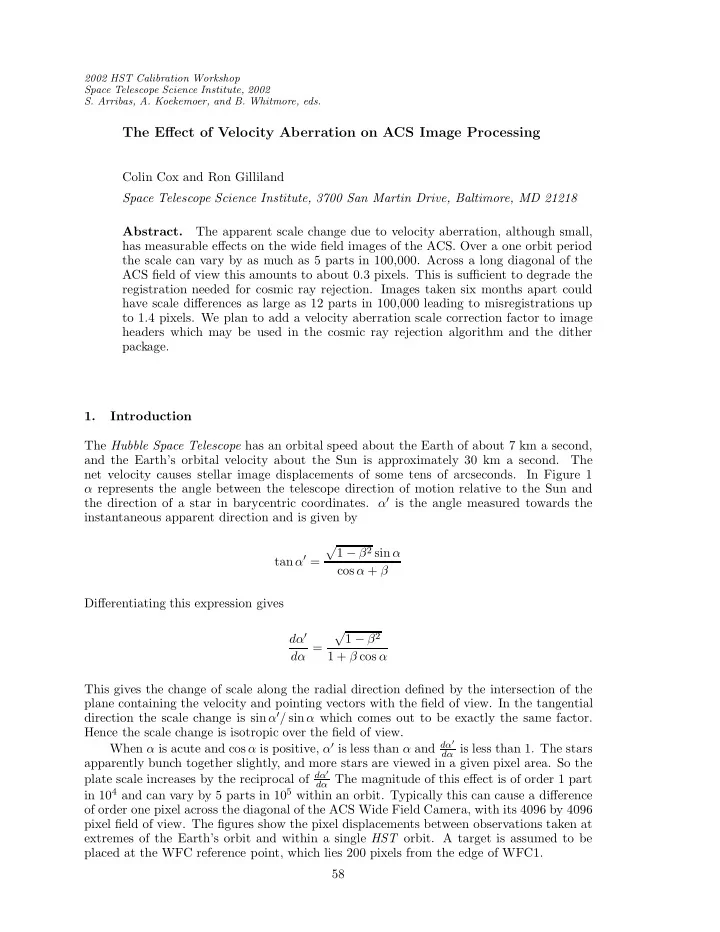
pixel field of view. The figures show the pixel displacements between observations taken at extremes of the Earth’s orbit and within a single HST orbit. A target is assumed to be placed at the WFC reference point, which lies 200 pixels from the edge of WFC1. 58

slide-2
SLIDE 2

The Effect of Velocity Aberration on ACS Image Processing 59 Figure 1. Velocity aberration angular change.

0.02 0.04 . 6 . 8 0.10 0.10

1024 2048 3072 4096 1024 2048

PIXEL SHIFTS

WFC1

Maximum shift due to HST orbit

0.10 . 2 0.30 . 4 . 4

1024 2048 3072 4096 1024 2048 Maximum variation due to Earth’s orbit

WFC1

1024 2048 3072 4096 1024 2048

0.04 0.06 0.08 0.10 0.12 0.12

WFC2

1024 2048 3072 4096 1024 2048

0.2 0.3 0.4 . 5 0.5

WFC2

Figure 2. Pixel shifts caused by scale changes.

slide-3
SLIDE 3

60 Cox & Gilliland

  • 2
  • 1

1 2 3 x

Pixel counts Model profile

Figure 3. Pixel count errors caused by shifts. 2. Discussion The measurements which brought attention to this effect occurred during a flat field moni- toring program which made several observations of 47 Tucanae. Two observations 50 min- utes apart indicated plate scale differences of 3.7×10⁻⁵. This was later found to be perfectly consistent with the expected velocity aberration induced value. The HST pointing and control system is based on guiding relative to nearby stars in the field of view. These are displaced similarly to the target star which makes the system largely auto-correcting. Nevertheless, small corrections are continuously made to keep the primary target on a fixed pixel. Nothing can be done on board to correct for the scale variations and indeed, parallel targets can easily move by several pixels during a long exposure. The significance of this effect is relatively minor, especially when compared with the

  • ther distortions present. However, the effect is larger than the residual error after correcting

for geometric distortion and it is easily allowed for by applying a scale factor to the images. We intend to revisit our distortion solution and apply this velocity aberration correction to each measurement image and obtain a new solution. An analysis that is expected to be sensitive to small misregistrations is that of cosmic ray rejection. In any region where the signal has a steep slope, such as in the tail of a bright star, a displacement of one image with respect to another, even by a few tenths of a pixel, can be seen as an amplitude difference between matching pixels and interpreted as a cosmic ray hit. To avoid such false positives which cause us to discard good data, we have to set a high threshold, thereby increasing the risk of false negatives, and missing genuine cosmic ray events. We intend to revise the cosmic ray rejection software to allow for misregistrations due to this and other causes. A new keyword will be supplied in science image headers; namely the factor by which the image should be corrected to a barycentric coordinate system. This will be used in the PyDrizzle software which performs cosmic ray rejection as part of its image

  • combination. We might also see a slight improvement in the reconstructed stellar images

with the more accurate registration that now becomes possible throughout the image. References Auri` ere, M. 1982, A&A, 109, 301