SLIDE 1
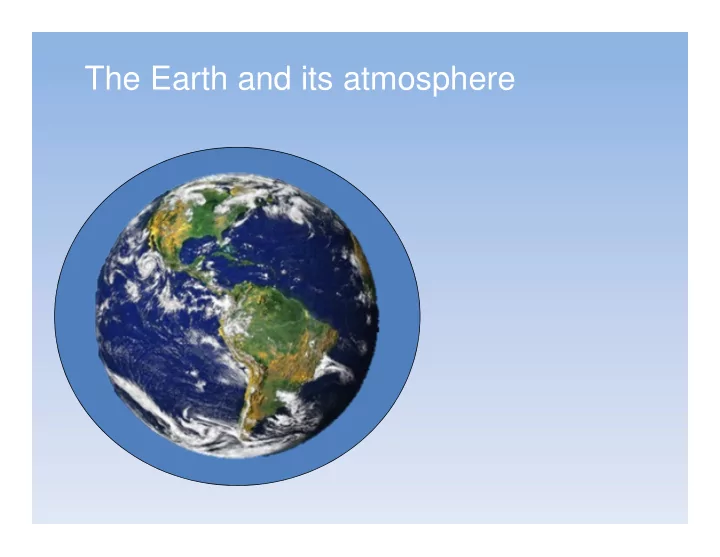
The Earth and its atmosphere
SLIDE 2 The large H2O greenhouse effect is controlled by temperature – H2O saturation doubles with every 10°C Increase As a result It is concentrated in the lower atmosphere
The most potent greenhouse gas is H2O - vapor
SLIDE 3
The CO2 greenhouse gas effect is concentrated in the polar regions ! ! !
CO2 is evenly distributed throughout the atmosphere
Particularly in the Arctic !
SLIDE 4
John Cook, from IGPP 2007 data; ~93% to oceans continues (NOAA/NODC, 2012)
Melting ice absorbs ~2% Only ~2% stays in atmosphere ~2% warms the land
SLIDE 5 Oceans, 0-700 m depth Oceans, 700-2000 m depth Atmosphere + land + ice melting
Change in heat content, 1958-2011
20 15 10 5
(NOAA 2012 data, Nuccitelli et al. 2012 plot)
5-year moving averages 1960 1970 1980 1990 2000
1022 Joules
(Increasing heat, not
shown, goes deeper than 2000 m)
SLIDE 6
0.8562 m3 (95 cm x 95 cm x 95 cm)
SLIDE 7
10oC = (50oF) 7.8 cc 20oC = (68oF) 15 cc 30oC = (86oF) 27.7 cc 40oC = (104oF) 49.8 cc @ 30oC +1oC = 8% increase in vapor
SLIDE 8 Climate Changes from Ocean Sediment Cores, since 5
41K 100 K 3.0Ma 4.0Ma 2.0Ma 1.0Ma 5.0Ma When CO2 levels get below ~400-600 ppm Orbital parameters become more important than CO2 the last time inferred temperatures will have been this high – once equilibrium is reached, will have been 3-5 million years ago or more
*
we are now about here
SLIDE 9
China has the largest fossil fuel emissions today. However, climate change is driven by cumulative emissions, so developed nations, especially the U.S., have greatest responsibility.
http://www.columbia.edu/~jeh1/