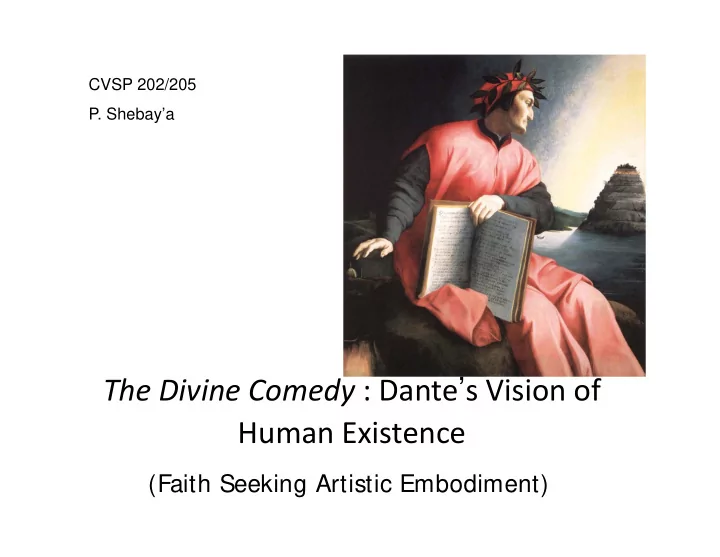
SLIDE 1 The Divine Comedy : Dante’s Vision of Human Existence
CVSP 202/205
(Faith Seeking Artistic Embodiment)
SLIDE 2
SLIDE 3
SLIDE 4
Florence
SLIDE 5
SLIDE 6 Barbarossa’s Empire I taly in the 12th Century
SLIDE 7
The Sword & The Crook
SLIDE 8
The Aeneid
SLIDE 9
Dante meets Beatrice
SLIDE 10
Dante amidst hell, purgatory, and earthly paradise
SLIDE 11
Virgil Virgil & Dante in the Inferno
SLIDE 12
Hell:
Despair Stagnation Absolute Isolation
SLIDE 13
Purgatory:
Preparation for Heaven Cleansing Return to
“original
innocence” Solidarity & communion
SLIDE 14
Heaven:
Bliss Total fulfilment Perfect communion
SLIDE 15
SLIDE 16 1. ALLEGORICAL INTERPRETATION “To elucidate, then, what we have to say, be it known that the sense
- f this work is not simple, but on the contrary it may be called polysemous,
that is to say, “of more sense than one”; for it is one sense which we get through the letter, and another which we get through the thing the letter signifies; and the first is called literal, but the second allegorical or mystic. And this mode of treatment, for its better manifestation, may be considered in this verse: “When Israel came out of Egypt , and the house of Jacob from a people of strange speech, Judea became his sanctification, Israel his power.” For if we inspect the letter alone the departure of the children of Israel from Egypt in the time of Moses is presented to us; if the allegory, our redemption wrought by Christ; if the moral sense, the conversion of the soul from the grief and misery of sin to the state of grace is presented to us; if the anagogical, the departure of the holy soul from the slavery of this corruption to the liberty of eternal glory is presented to us. And although the mystic senses have each their special denominations, they may all in general be called allegorical, since they differ from the literal and historical...
SLIDE 17
1. ALLEGORICAL INTERPRETATION (Continue) When we understand this we see clearly that the subject round which the alternative senses play must be twofold. And we must therefore consider the subject of this work as literally understood, and then its subject as allegorically intended. The subject of the whole work, then, taken in the literal sense only, is 'the state of souls after death', without qualification, for the whole progress of the work hinges on it and about it. Whereas if the work be taken allegorically, the subject is 'man', as by good or ill deserts, in the exercise of the freedom of his choice, he becomes liable to rewarding or punishing justice.” “The end of the whole and of the part may be manifold, to wit, the proximate and the ultimate, but dropping all subtle investigation, we may state briefly that the end of the whole and of the part is to remove those living in this life from the state of misery and lead them to the state of felicity.” (Selections from the Letter to Can Grande)
SLIDE 18
Why Dante?
T. S. Eliot : ongoing influence; (Seven) Vernacular Medieval Synthesis Separation of Church and State…
SLIDE 19
Basic Items
Title, Author… Basic story line, D, V, B, H,P,T‐P, C‐P,H as symbols P and H Allegorical method Five areas of interest Soul /Society
SLIDE 20 HISTORY (linear) human and individual
- From Earthly Paradise (Eden) to Celestial
Paradise (Paradiso) via Inferno and Purgatorio
- Creation‐Fall‐ Law/Prophets‐Redemption‐
Consummation
- Understanding the past (Inferno)
Attention to the present (Purgatorio) Expectation towards the future (Paradiso)
SLIDE 21 Linear history (ctd.)
- Existential perspective : Dante’s own life and
conversion
- Four human conditions : innocence – fallen –
redeemed ‐ glorified ( or damned )
- Dynamic process from slavery to freedom via
faith (Beatrice) and reason (Virgil), determined by human free will /love [everyone gets what s/he chooses/loves]
- “Know Thyself” necessarily involves knowing
your place in human history as well as understanding your own personal history
SLIDE 22 LOVE natural, rational, divine
- Natural = instinctive , not free , no praise or blame
- Rational = based on reason , free , accountable
- Divine = God’s love experienced by the human
- restores human innocence / freedom (Adam/Eve)
- empowers rational love to achieve desired human
project
- Freedom increases responsibility and the possibility of
more radical constructive as well as destructive impact (the use or abuse of “divine” power is the heart of ‘heavenly’ and ‘hellish’ human life )
SLIDE 23 – Liberality (money to serve humanity) – Self‐control – Chastity
“SEVEN”
– Pride – Envy – Wrath – Humility ( free servant of all ) – Generosity ( admiration ) – Meekness ( strength under control )
– Sloth (indifference to others)
– Avarice (money) – Gluttony ( food) – Lust (sex)
proper love
food and sex
SINS VIRTUES
– Zeal (commitment /active concern for all )
SLIDE 24 CARITAS the fulness of authentic Love
- AGAPE = God’s love for the human
- EROS = human love desiring self‐fulfillment
- CARITAS = agape fulfilling eros
– Giving eros the right ‘spirit’ ( humility protecting against pride ) – Giving eros the right ‘perspective’ ( clarifying the true value/hierarchy of ‘goods’). Example : authentic love is superior to intellectual prowess ;
- rdinary humans can be more fulfilled than
philosophers, mystics…
SLIDE 25 Caritas(authentic love) ctd.
- CARITAS summarizes the project of human life :
a concrete way of living / relating (not a search for purely self‐centered actualization and satisfaction ).
- CARITAS comprises the optimal balance of
all human capacities (intellectual, artistic, socio‐ political…). Virgil and Beatrice
SLIDE 26
HUMAN EXCELLENCE (fulfilment)
Theological Virtues FAITH ( access to full wisdom ) HOPE ( gives motivation to courage ) LOVE (caritas) ( motivation for self‐control ) Natural Virtues GOODNESS JUSTICE WISDOM COURAGE SELF‐CONTROL
Faith, Hope, and Love provide fully human spirit to Goodness
Complete
SLIDE 27