The Diplomas Now Partnership Core Function Related Resources Math - - PowerPoint PPT Presentation

the diplomas now partnership
SMART_READER_LITE
LIVE PREVIEW

The Diplomas Now Partnership Core Function Related Resources Math - - PowerPoint PPT Presentation

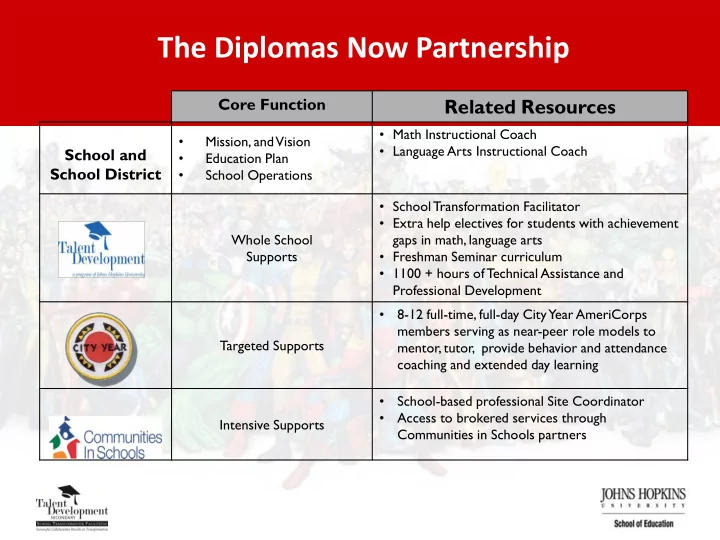
The Diplomas Now Partnership Core Function Related Resources Math Instructional Coach Mission, and Vision Language Arts Instructional Coach School and Education Plan School District School Operations School


slide-1
SLIDE 1

Core Function

Related Resources

School and School District

  • Mission, and

Vision

  • Education Plan
  • School Operations
  • Math Instructional Coach
  • Language Arts Instructional Coach

Whole School Supports

  • School Transformation Facilitator
  • Extra help electives for students with achievement

gaps in math, language arts

  • Freshman Seminar curriculum
  • 1100 + hours of Technical Assistance and

Professional Development Targeted Supports

  • 8-12 full-time, full-day City

Year AmeriCorps members serving as near-peer role models to mentor, tutor, provide behavior and attendance coaching and extended day learning Intensive Supports

  • School-based professional Site Coordinator
  • Access to brokered services through

Communities in Schools partners

The Diplomas Now Partnership

slide-2
SLIDE 2

Data Supports

  • Easy access to student data on the

Early Warning Indicators

  • Benchmarks tied to national and state

standards

  • On-site facilitator to leverage EWI data

Professional Development Supports

  • Job-embedded coaching - Math and

English instructional coaches

  • Professional learning community
  • Professional development linked to

grade/subject specific instructional practice

Student Supports

Interventions to address early warning indicators of

  • Attendance
  • Behavior
  • Course Performance

The Diplomas Now Model

Multi Tiered Response to Intervention Model

  • 8 to 12 City Year AmeriCorps members: whole

school and targeted academic and socio- emotional supports

  • Communities In Schools on-site coordinator: case

managed supports for highest need students

75-90 students

Teacher Team (4 teachers)

  • Whole school attendance,

positive behavior, college- going culture

  • Strengthening student

resiliency

Organizational Supports

  • Inter-disciplinary and subject

focused common planning time

  • Bi-weekly EWI meetings
  • On-site school transformation

facilitator

Instructional Supports

  • Double dose math & English
  • Extra help labs
  • Common college preparatory or

high school readiness curricula

slide-3
SLIDE 3

DI DIPLOMAS LOMAS NOW OW—ADDIT DDITIONAL IONAL CON CONSIDE IDERATIONS RATIONS ARO ROUND UND THE HE 4 PIL ILLARS LARS

slide-4
SLIDE 4

Pillar I—Teaming

  • Corps members and CIS Site Coordinators should

participate in all team meetings, not just EWI

– Help plan events and incentives – Discuss identity and culture of team – Support instructional activities – Engage in collegial professional development

  • Family outreach efforts should be communicated

with and coordinated with the team (parents should be receiving coherent messages about their students)

slide-5
SLIDE 5

Pillar II– Curriculum, Instruction, and Assessment

  • Tutoring should not be happening in isolation—teachers,

coaches, and corps members should be planning regularly (ideally weekly) around how to support student growth in class

– Identifying extra-help/support activities aligned to objectives – Determining how to “preview” new materials – Planning corps members’ role during the class period (minimize ad hoc decisions) – Divide and conquer

  • Teams should be looking at the intersection of grades and

assessments (Are kids with As and Bs showing growth? Are kids who are flat failing?)

slide-6
SLIDE 6

Pillar II—Curriculum & Instruction

  • Communities In Schools can work with

teachers to think about ways to enhance/extend lessons outside of the classroom

– Off-Campus Learning – Partner presentations/discussions – Service Learning Opportunities

slide-7
SLIDE 7

Pillar III—Tiered Student Supports

  • Tier II and Tier III will often/normally happen in parallel, not

sequentially

– Most students in need of Tier III supports should be simultaneously receive CIS and City Year support – We all have a responsibility to serve students with IEPs and students who are learning English—some misconceptions here

  • No assumption that academics will improve because of

emotional/social support

  • There are no “tier II students” or “tier III students”, only tier

II and tier III levels of support

  • Let what’s best for the kid drive tiered student supports,

not what’s best for the paperwork

slide-8
SLIDE 8

Pillar III—Tiered Student Supports

  • Trend analysis is essential—you aren’t going to

provide more than 30% of the students with individualized support at any given time

  • Sometimes an F is just an F
  • Push teachers to own solutions
  • Remember that students can and will go off

track throughout the year

  • Determine when a student can come off the

focus list

slide-9
SLIDE 9

Pillar IV—Can Do Culture

  • More important than EWI—all EWI can do is

provide scaffolds for kids who need extra help meeting the expectations of the school.

slide-10
SLIDE 10

Pillar IV– Can Do Culture

  • Have to balance nagging and nurturing

– Boot Camp vs. Summer Camp

  • Remember the starting line and the finish line
  • Adult beliefs are more critical to school culture

than student beliefs

  • Students have to have a sense of ownership in

their own learning

  • This is about relationships, not programs
slide-11
SLIDE 11

OV OVERVIE VIEW W OF OF THE I3 STUD UDY

slide-12
SLIDE 12

Investing in Innovation (i3)

  • $30M federal grant + $6M match through generous support of the

PepsiCo foundation

  • 60 schools in 10+ districts reaching 57,000 students
  • Conduct randomized experimental study validating the impact of the

model, and focusing on the conditions necessary to:

  • Achieve 80% grad rates in high schools
  • Reduce by 66% the number of students entering high school

below grade level

Diplomas Now- Investing in Innovation Fund Winner

1,700 Applicants 49 Grantees

“Cutting-edge ideas that will produce the next generation for reform.”

  • Secretary of Education Arne

Duncan

Chicago Public Schools, Detroit Public Schools, Los Angeles Unified School District, Miami-Dade Public Schools, Louisiana Recovery School District, School District of Philadelphia, New York City Department of Education, District of Columbia Public Schools, Seattle Public Schools, Partnership for Los Angeles Schools, Northeast Independent School District (TX), Richland County School District One (SC), Southwest Independent School District (TX) , San Antonio Independent School District (TX), Whitehall City School District (OH)

District Partners

State Departments of Education of Louisiana, South Carolina and New York, Union Park High Schools, Deloitte Consulting, School Loop, Pearson PreVent, the City of Philadelphia. Other Partners

slide-13
SLIDE 13

Key aspects of national i3 initiative Identify some of the most promising school improvement initiatives Provide support for them to scale up nationally Research their effectiveness using the most rigorous methodologies available Document lessons learned about implementation during the scale-up process Publicize study results to influence national and state policy

National Evaluation: Overview

slide-14
SLIDE 14

Study will compare student outcomes in schools that implement DN to student outcomes in schools that do not. Assignment to these groups is accomplished through

  • randomization. Eligible schools are assigned DN or Non-DN

status via a lottery:

  • DN schools implement the DN model
  • Non-DN schools pursue any other school reform initiatives

National Evaluation: Research Design

slide-15
SLIDE 15

Student records data: Collected directly from district; transcripts, standardized assessment results, attendance, disciplinary data Surveys: Students and staff in DN and Non-DN schools; student engagement, school climate, availability of support services,

  • etc. (annual administration)

Case studies: 25% of DN schools across the nation; annual site visits (2-3 days) consisting of interviews and observations

National Evaluation: Data Collection

slide-16
SLIDE 16

National Evaluation: Goal Setting for 2012-2013

Attendance Of students that were off-track at the first data point: 50% or more move on-track Behavior Of students that were off-track at the first data point: 50% or more move on-track ELA/Literacy Of students that were off-track at the first data point: 50% or more move on-track Math Of students that were off-track at the first data point: 50% or more move on-track Overall EWI Distribution: At least 67% (two-thirds) of ALL students within DN focus grades have no EWIs at the end of the school year.

slide-17
SLIDE 17

Goal Setting: Example

150 Students in 6th grade: No more than 49 students off-track in the 6th grade

  • n the last day of school (all indicators combined)

Indicator # of students off- track @ beginning

  • f year

# of students off- track on last day of school Attendance 18 9 Behavior 21 10 ELA Performance 15 7 Math Performance 24 12

slide-18
SLIDE 18

The bottom line on I3 Validation

  • We have to look at both the reduction in the

number of kids who had off-track indicators to begin with AND the success of the overall cohort(s) throughout the whole year

  • The I3 study will not look directly at test scores or
  • ther metrics, but these are highly related to the
  • ff-track indicators
  • I3 study will validate model solely on the

decrease in off-track indicators (won’t validate based on fidelity)