The Digital Doctor: Hope, Hype & Harm at the Dawn of Medicines - - PDF document

the digital doctor
SMART_READER_LITE
LIVE PREVIEW

The Digital Doctor: Hope, Hype & Harm at the Dawn of Medicines - - PDF document

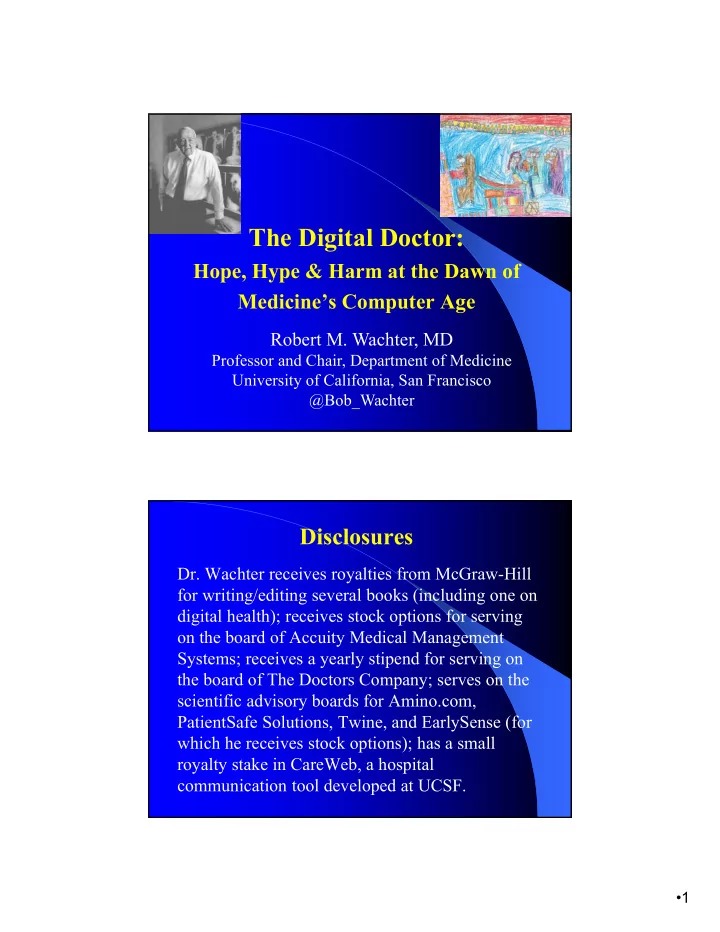
The Digital Doctor: Hope, Hype & Harm at the Dawn of Medicines Computer Age Robert M. Wachter, MD Professor and Chair, Department of Medicine University of California, San Francisco @Bob_Wachter Disclosures Dr. Wachter receives


slide-1
SLIDE 1
  • 1

Robert M. Wachter, MD

Professor and Chair, Department of Medicine University of California, San Francisco @Bob_Wachter

The Digital Doctor:

Hope, Hype & Harm at the Dawn of Medicine’s Computer Age

Disclosures

  • Dr. Wachter receives royalties from McGraw-Hill

for writing/editing several books (including one on digital health); receives stock options for serving

  • n the board of Accuity Medical Management

Systems; receives a yearly stipend for serving on the board of The Doctors Company; serves on the scientific advisory boards for Amino.com, PatientSafe Solutions, Twine, and EarlySense (for which he receives stock options); has a small royalty stake in CareWeb, a hospital communication tool developed at UCSF.

slide-2
SLIDE 2
  • 2

Why I Decided to Explore Health IT

slide-3
SLIDE 3
  • 3

“The Challenge That Will Dominate Your Career…”

Office of the National Coordinator for Health IT

~75%

EHRs in US Hospitals, 2008-2015

$30 billion in federal incentives under HITECH

$ $

slide-4
SLIDE 4
  • 4

Pressure to deliver high- value care The digitization of the U.S. healthcare system

The Big Picture: Two Transformational Trends

The Dominant Issue Today Prediction: The Dominant Issue in 2025

slide-5
SLIDE 5
  • 5

Richard Baron on the Trauma of Computerizing His Philadelphia Office Practice “The staff came to work

  • ne day and nobody knew

how to do their job.” The Demise of Radiology Rounds

“The man who ruined radiology” – Paul Chang’s dad

slide-6
SLIDE 6
  • 6

Digital Radiology as the Canary in the Coal Mine

The digitization of the thing creates the

  • pportunity for infinite distribution (at no cost)

Social relationships and communication patterns that previously depended on gathering around the thing will wither Power relationships mediated by who controls the thing will be renegotiated What happens when the thing isn’t the film, it’s the medical record…

Residents’ Room Vs. The Ward

slide-7
SLIDE 7
  • 7

A 7-year-old Girl’s Depiction of her MD Visit

Toll E. The cost of technology. JAMA 2012

slide-8
SLIDE 8
  • 8

2014 Advertisement For AZ ER Job

Arizona General Hospital will be coming to The Grand Canyon State later this year!! Located in Laveen, Arizona, AGH is a 40,000 square-foot boutique general hospital. Services offered include:

  • Emergency Room
  • Radiology Suite inc. CT, X-Ray, and Fluoroscopy
  • Two State-Of-The-Art Operating Rooms
  • Outpatient Surgery
  • 16 Inpatient Rooms
  • NO ELECTRONIC MEDICAL RECORD

What Went Wrong?

Adaptive vs. technical change Connecting the parts The digital squeeze

  • n physicians

The Productivity Paradox

slide-9
SLIDE 9
  • 9

Health IT: The Mother of all Adaptive Problems

“… problems that require people themselves to change. In adaptive problems, the people are the problem and the people are the solution. And leadership then is about mobilizing and engaging the people with the problem rather than trying to anesthetize them so that you can just go off and solve it on your own.” – Ronald Heifetz, Kennedy School of Government

The Four Stages of Health IT

  • 1. Digitizing the record
  • 2. Connecting the parts
  • a. Enterprise system to enterprise system
  • b. Third-party apps to enterprise systems
  • c. Patient-facing systems to enterprise systems,

and to one another

  • 3. Gleaning meaningful insights from the

data

  • 4. Converting these insights into action that

improves value

slide-10
SLIDE 10
  • 10

The Digital Squeeze on Physicians

EHRs as unique and powerful enablers of…

Central/ Corporate Control Democratization, Questioning of Expertise

“You can see the computer age everywhere but in the productivity statistics.”

  • - Nobel Prize winning economist Robert Solow, 1986
slide-11
SLIDE 11
  • 11

The Two Keys for Unlocking the Productivity Paradox

Improvements in the technology Reimagining the work itself

What Do We Need to Do?

Connect the digital pieces Learn to use our data for improvement, build decision support Build skills, culture, governance to reimagine the work

– As much about teamwork, QI, systems as IT – Need new workflows, personnel, leadership – Need to optimize after initial training/Go Live

Retain sense of optimism: it’ll get better

slide-12
SLIDE 12
  • 12

Choluteca Bridge, Honduras

Hurricaine Mitch, 1998