SLIDE 1 CS 5614: Database Management Systems 5
The DB Industry
RDBMSs are a runaway success of simple theoretical ideas ‘Big 3’ Database companies are among the largest in the s/w industry
Oracle, Informix, Sybase Other Market Forces: Microsoft, IBM
Exciting area for R&D too (3 Turing awards)
Charles W. Bachman (1973) Edgar F
. Codd (1981)
James N. Gray (1998)
New applications and paradigms
Biological databases Semistructured data, Web-ebabled databases Multimedia and other forms of data Data Warehousing, Information Integration On-line Analytical Processing Data Mining Electronic Commerce
CS 5614: Database Management Systems 6
Example Scenario
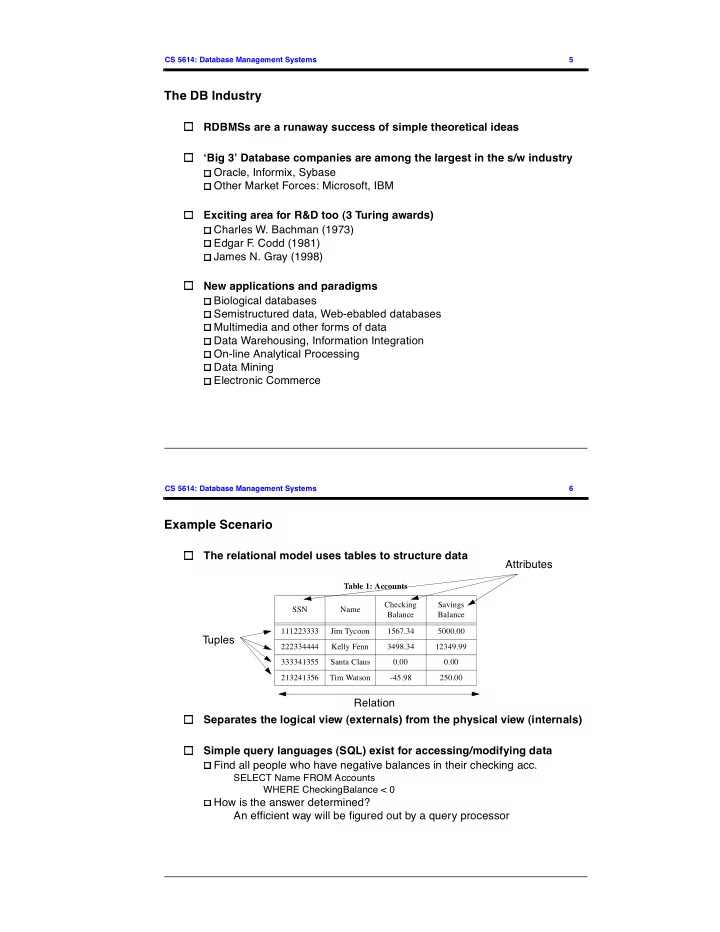
The relational model uses tables to structure data Separates the logical view (externals) from the physical view (internals) Simple query languages (SQL) exist for accessing/modifying data
Find all people who have negative balances in their checking acc. SELECT Name FROM Accounts WHERE CheckingBalance < 0 How is the answer determined?
An efficient way will be figured out by a query processor
Table 1: Accounts SSN Name Checking Balance Savings Balance 111223333 Jim Tycoon 1567.34 5000.00 222334444 Kelly Fenn 3498.34 12349.99 333341355 Santa Claus 0.00 0.00 213241356 Tim Watson
250.00
Tuples Relation Attributes
SLIDE 2
CS 5614: Database Management Systems 7
Three Aspects of Database Systems
Implementation
How do you build a system such as ORACLE?
Design
How do you model your data and structure your info. in a database?
Programming
How do you use the capabilities of a DBMS?
CS 5614 includes topics that address all aspects!
CS 5614: Database Management Systems 8
Course Outline
Module 1: Data Modeling
Entity-Relationship (ER) approaches Specifying Constraints The Relational Model Converting ER to “R” Perfecting Schemas Normalization Applications
Module 2: Query Processing etc.
Relational Algebra Datalog SQL (Intergalactic dataspeak) Recursion in Queries Logic and Databases Database Tuning Plan Selection Query Compilation
SLIDE 3
CS 5614: Database Management Systems 9
Course Outline (Contd.)
Module 3: Transaction Processing
Concurrency Control Serializable Schedules Conflicts Locking Mechanisms Properties of Locking Mechanisms Recovery Strategies Logging, Resolving Deadlocks OLTP Active and Rule-Based Elements
Module 4: Information Integration
Mediator-Based Approaches, Wrappers Data Warehousing (CUBE operator) OLAP Data Mining etc.
CS 5614: Database Management Systems 10
DBMS Architecture (Simplified) (courtesy UW)
SLIDE 4
CS 5614: Database Management Systems 11
DBMS Architecture (Expanded) (courtesy MUW)
CS 5614: Database Management Systems 12
Memory Hierarchy
(courtesy MUW)
SLIDE 5
CS 5614: Database Management Systems 13
Storage Manager
Memory Hierarchy
Primary (Caches, Main Memory) Secondary (Disks) Tertiary (Tapes)
DBMS Storage = {Secondary + Tertiary}: Why?
Nonvolatility Addressability (the Y32 problem) Cost
Disks: Operational Data, Tapes: Archival Data
why?
Storage Manager = File Manager + Buffer Manager
File Manager: Secondary Storage Buffer Manager: Main Memory
CS 5614: Database Management Systems 14
Structure of a Disk
100 times cheaper, 2000 times slower Data must be in memory for DBMS to operate on it
(not counting main memory database systems)
The unit of data transfer between disk and main memory = 1 block access time = seek time + rotational delay + transfer time courtesy RR
SLIDE 6
CS 5614: Database Management Systems 15
More about Disks
Uses Indexes for Managing Data
Indexes implemented by B-trees
Each Node of a B-Tree = 1 Disk Block (212 = 4096 bytes) Why B-Trees? Why not Binary Search Trees?
1 5 8 6 7 9 12 3
CS 5614: Database Management Systems 16
Buffer Manager
courtesy RR
SLIDE 7
CS 5614: Database Management Systems 17
Query Processor
Find the balances of all accounts of Santa Claus
vs.
Find the balances of all accounts of SSN: 333341355
Which is more efficient?
RDBMSs are declarative!
One of the main reasons for their runaway success specify what you want; not how to do it
CS 5614: Database Management Systems 18
Transaction Manager
Enforces ACID Properties
Atomicity Consistency Isolation Durability
Locking (addresses I)
Lock individual tuples Lock whole relation
Logging (addresses D)
performed on nonvolatile storage
Commitment (addresses A, D)
SLIDE 8
CS 5614: Database Management Systems 19
Active Database Elements
Follow the ‘Event-Condition-Action’ Paradigm
Helps a database to be reactive Helps a database to incorporate domain specific knowledge Available in most current commercial systems
What Distinguishes an Active Database Element?
Features that are “traditionally” implemented in application programs
Constraints
Integrity Constraints
Triggers
Alerters or Monitors Authorization Statistics Gathering Views
CS 5614: Database Management Systems 20
Module 1: Database Modeling
Why?
To determine structure of the system before implementation
Start with {Ideas, Thoughts} in English
Classes, Objects, Relationships, Constraints, Decisions etc.
Use a “design language”
E/R Model: Entity-Relationship Modeling
Convert to Relations (for an RDBMS)
in a fairly standardized and “automatic” manner
SLIDE 9
CS 5614: Database Management Systems 21
Entity-Relationship Modeling
Simple Diagrammatic approach to data modeling
Very similar to Object Oriented Modeling Classes = Entity Sets Objects = ‘Entitys’ Attributes = Properties
A Relationship = A table of associated connecting entities
Table 2: Taking Name SID Number Instructor Ab Kader 231432345 9999 Mark Ab Kader 231432345 9998 Dave
Students
Courses Taking Name Sid Number Instructor
CS 5614: Database Management Systems 22
Three-Way Relationships
Exercise: How do you connect TAs to the rest of the diagram?
What are your assumptions?
Students
Courses Taking Name Sid Number Instructor TAs Name Office
SLIDE 10
CS 5614: Database Management Systems 23
A ‘Hello-World’ for Database Systems (courtesy Widom) A ‘Hello-World’ for Database Systems (courtesy Widom) Bars Beers Drinkers Name Address License Name Manuf. Name Address Serves Frequents Likes
CS 5614: Database Management Systems 24
Multiplicity of Relationships Many-Many Many-One One-One
SLIDE 11
CS 5614: Database Management Systems 25
Representing a “-one” relationship
In E-R diagrams
Use a pointed arrow towards the “one” set
What to do with one-one relationships?
Use a pointed arrow towards both sets!
Simple, right? :-)
CS 5614: Database Management Systems 26
Relationship Roles
when an entity set/class appears more than once in a relationship
Label the edges with roles to distinguish
Why is there an arrow on only one side of the relationship? Arrow notation gets cumbersome when we have more than 2/3 sets Person Father
child parent
SLIDE 12
CS 5614: Database Management Systems 27
More Role Examples
An Arrow on Both Sides
Is this relation symmetric?
What if we replace husband and wife by “spouse”? Person Married
husband wife
CS 5614: Database Management Systems 28
A Symmetric Role Example
‘Friend’ is symmetric, ‘Married’ is not! How do you encode symmetricity?
in E/R: No existing way, unless you invent your own shorthand
Person Friend
SLIDE 13
CS 5614: Database Management Systems 29
Attributes on Relationships
Sometimes helpful to attach attributes to relationships Shorthand for three-way relationship
Can “push” classroom into another entity set
Professors Courses Classroom Teaches
CS 5614: Database Management Systems 30
Like so...
Notice the arrow!
Not sufficiently general to support all possibilities
Professors Courses Teaches Classroom Room
SLIDE 14
CS 5614: Database Management Systems 31
Converting Multiway Relationships to Binary
Why would we want to do this? Create new entity sets for representing tuples of a relationship
One entity set tuple for every relationship tuple
Recall the Student/Course/TA example
Students Courses Taking Name Sid Number Instructor Name Office TAs
CS 5614: Database Management Systems 32
Turning a Relationship Inside Out
Easy in E/R
Students Courses TAs “Taking” Notice the arrows!
taker giver helper
SLIDE 15
CS 5614: Database Management Systems 33
Good Design Principles
Be Faithful to requirements
Talk to your client!
Don’t talk too much
Avoid redundancy Save space and minimize inconsistency
Simplify life; do not complicate matters Think about the end-user(s) Find an appropriate way to say things
Pick the right kind of element {entity set/relationship}
Consider tradeoffs in design decisions
CS 5614: Database Management Systems 34
Inheritance in Database Modeling
Examples
Ales are a kind of beer CS courses are a kind of courses Mammals are a kind of animals
Subclass = special case = more properties = fewer entities Inheritance in E/R
Use a triangle ISA link between rectangles Object belongs to both classes
SLIDE 16
CS 5614: Database Management Systems 35
Multiple Inheritance
Examples
“Who Killed Roger Rabbit” is a cartoon AND a murder mystery Platypus has properties of both a mammal AND a non-mammal CS/MATH 5485 is cross-listed as a CScourse AND a Mathcourse Square is a rectangle AND a rhombus AND a quadrilateral
Gets Messy
Left to implementations to figure out disputes and conflicts
CS 5614: Database Management Systems 36
Keys
Set of attributes whose values can belong to at most 1 entity/object
SID is a key for Students
In E/R Model
Every Entity Set should have a key Underline the respective attributes
Referential Integrity
Stricter than Keys
Requires that exactly one object exists in a certain role
Enforcing Mechanisms
Forbid deletion of a referenced object If a referenced object is deleted, delete all that reference it When a new object is created, require that an existing object be related
Referential Integrity in E/R Diagrams
Use rounded arrow entering the relevant entity set
SLIDE 17
CS 5614: Database Management Systems 37
Referential Integrity Example
Studios Presidents Runs
CS 5614: Database Management Systems 38
Weak Entity Sets
Situation where a set’s key does not come (completely) from itself
comes from the key(s) of one or more sets to which it is connected
to by a many-one relationship Primary Causes of Weak Entity Sets
Elimination of multiway relationships Hierarchy of Entity Sets (not inheritance)
Representing Weak Sets in E/R Diagrams
Use double border for Weak Entity Set Use double border for Many-One Relationships that
contribute some portion of the key
SLIDE 18
CS 5614: Database Management Systems 39
Weak Sets Example
Key for Dependent = {Name,SSN}
Note: keys can come only via many-one (or one-one) connections
Can extend this to a “chain” of weak links Employee Name SSN Dependent Name Policy Cost
CS 5614: Database Management Systems 40
The Relational Model
Why?
DB implementations are based on it (SQL, etc.) Extremely simple: only one concept (the relation/table) A good match for how we think about our data (mostly :-)) Has an elegant mathematical design theory
Start with E/R
Convert to Relations “Normalize” Relations to improve choices for a particular design
SLIDE 19
CS 5614: Database Management Systems 41
Example
Simple Correspondences
Table = Relation Column Headers = Attributes Rows = Tuples
Relation Schema
Identifies name, attributes etc. e.g., Student(name, id, academic_level, address) Does the order matter? also notice the underline above!
Relation Instance = Current Set of Tuples in the Relation Schema Database Schema = A Set of Relation Schemas
Table 3: Students
name id academic_level address Mark 1 Senior 123 Maple St, Blacksburg Kathy 2 Senior 30 Nostreet, Christiansburg David 3 Junior 49 Deadend, Blacksburg
CS 5614: Database Management Systems 42
DDL and DML
DDL: Data Definition Language
Use to specify relational schema
DML: Data Manipulation Language
Use to specify relation instances can also query/modify/insert/delete relation instances
Most modern versions of SQL serve these purposes
SLIDE 20
CS 5614: Database Management Systems 43
Converting from E/R to Relations (1)
Easier than other design languages! :-)
Most of the hardwork done for us already
Each entity set gets its own relation Each relationship also gets its own relation
Contains key attributes of connecting entity sets + relationship attributes
Students Courses TAs HomeworkTA ProjectTA takes
CS 5614: Database Management Systems 44
Converting from E/R to Relations (2)
What about Weak Entity Sets?
For each such set, include all the attributes that form its key Easily recognizable by many-one relationships (via double diamonds)
What about the Double Diamond Relationships?
Can safely omit (!) Why?
Handling Inheritance
Every subclass gets its own relation Every such relation will have both inherited and non-inherited attributes No separate relation created for ISA connection Information disbursed across various entity sets
Can collapse a whole ISA hierarchy into one huge relation
Saves space, preserves all info. in a single relation Uses NULLs to represent “inappropriate” entries Best of both worlds
SLIDE 21
CS 5614: Database Management Systems 45
Functional Dependencies
X -> A on R
Assertion that when two tuples agree on X, they also agree on A specifies a schema-level constraint on R useful as an aid to “normalization”
Example Student(name, id, academic_level, advisor_id, favorite_advisor) id -> name id -> academic_level id -> favorite_advisor but not id -> advisor_id even though id was a key for Student in E-R ! Moral of the Story: Keys for Relations are different from Keys for E-R
CS 5614: Database Management Systems 46
Functional Dependencies (More General Stuff)
In general, key determines all other attributes
Be careful about the way you converted from E-R to relations
Shorthand Notations
Combine FDs with common LHSs by concatenating their RHSs Omit the commas and curly braces around attributes
Intuitive Meaning
If FD not of the form Key -> other attributes,
then the relation has too much stuff
SLIDE 22 CS 5614: Database Management Systems 47
Keys for Relations
K is a Key for Relation R iff
K determines all other attributes of R No proper subset of K determines all other attributes called “Superkey” if only the first condition is satisfied
Example Student(name, id, academic_level, advisor_id, favorite_advisor) id advisor_id -> name academic_level favorite_advisor
id advisor_id is a key for Student Neither id nor advisor_id by itself determines all other attributes No other key for this example id advisor_id name is an example of a superkey Neither id nor advisor_id can be on the right of any FD,
so, they must be part of any superkey Doesn’t sound good to have advisor_id be part of a key, right?
Patience: we will show how to solve that problem soon! :-)
CS 5614: Database Management Systems 48
How does one identify FDs?
From
“keyness” many-one relationships from the english description of the problem domain
Example
“A professor cannot teach in two places at the same time”
professor_id time -> classroom Reduce Trivial FDs
- nes which have the same attribute appearing on both LHS and RHS
SLIDE 23
CS 5614: Database Management Systems 49
Normalization
Final Goal = Boyce-Codd Normal Form (BCNF)
R is in BCNF if for every nontrivial FD X->A in R, X is a superkey
Advantages
Removes redundancy Removes update anomalies Removes deletion anomalies
CS 5614: Database Management Systems 50
Examples of Problems
Back to Student
“???” means redundant; can figure out from other tuples
id -> name academic_level favorite_advisor advisor_id -> advisor_room Update Anomaly
What happens if we update the favorite_advisor of Mark?
Deletion Anomaly
If 350 is not the advisor for anybody, we lose his room info! :-) name id academic_level advisor_id advisor_room favorite_advisor Mark 1 Senior 349 McBryde 630 350 ??? 1 ??? 350 McBryde 629 ??? Kathy 2 Senior 146 McBryde 640 146 ??? 1 ??? 351 McBryde 641 ??? ??? 1 ??? 352 McBryde 642 ??? ??? 2 ??? 351 ??? ??? David 3 Junior 349 ??? 349
SLIDE 24
CS 5614: Database Management Systems 51
The Root Cause of the Problem
Each of the FDs id -> name id -> academic_level id -> favorite_advisor advisor_id -> advisor_room has a LHS that is a proper subset of the key! (id advisor_id)
A BCNF violation!
Moral of the Story: Inferring FDs is very important in identifying pitfalls
CS 5614: Database Management Systems 52
Inferring FDs
Given FDs X1 -> A1 X2 -> A2 X3 -> A3 ... Xn -> An Does a new FD Y->B hold? Solution: Compute the Closure of Y and see if it contains B!
SLIDE 25
CS 5614: Database Management Systems 53
Computing the Closure of Y
Algorithm Set Y’ = Y If an FD X->A holds and X belongs in Y’ then add A to Y’ Example A->B, BC-> D A’ = AB, B’ = B, C’ = C, D’ = D, (AC)’ = ABCD
So, AC is a key! (why?)
keep looping to Step 2 when Y’ cannot be changed anymore
CS 5614: Database Management Systems 54
More on Inferring FDs
Example: F = AB->C, C->D, D->A What FDs follow from this? Do it Systematically (Brute Force; exponential complexity) A’=A, B’=B (nothing new) C’=ACD (add C->A) D’=AD (nothing new) (AB)’=ABCD (add AB->D, skip all supersets of AB, why?) (AC)’=ACD (nothing new) (AD)’=AD (nothing new) (BC)’=ABCD (nothing new, skip all supersets of BC) (BD)’=ABCD (add BD->C, skip all supersets of BD) (CD)’=ACD (nothing new) skip ABC, because it is a superset of AB (ACD)’=ACD (nothing new) skip BCD, because it is a superset of BC as well as BD Answer: C->A, AB->D, BD->C
SLIDE 26
CS 5614: Database Management Systems 55
Decomposing Relations
Needed to remove anomalies
Given relation R and FDs F Decompose R so that BCNF violations X->A are removed
Algorithm
Expand X->A so that the right side includes X’ Decompose R into X’ and (R-X’) U X Find FDs for the decomposed relations
CS 5614: Database Management Systems 56
Back to Student
Consider the BCNF violation id -> name academic_level favorite_advisor Decompose Student to Student1(id name academic_level favorite_advisor) Student2(id advisor_id advisor_room) Project FDs down to these two relations
For Student1, id ->name, id->academic_level and
id->favorite_advisor No problems here! Why? :-)
For Student2, id advisor_id is the key
but advisor_id->advisor_room still violates BCNF What is the solution?
SLIDE 27
CS 5614: Database Management Systems 57
Yet Another Decomposition
Decompose Student2 this time Consider the BCNF violation advisor_id -> advisor_room Decompose Student2 to Student21(advisor_id advisor_room) Student22(id advisor_id) Rename Student21 etc. to something more appropriate Final Relations Student1(id name academic_level favorite_advisor) Student21(advisor_id advisor_room) Student22(id advisor_id)
All are in BCNF! (see for yourself); no more redundacies or anomalies!
CS 5614: Database Management Systems 58
Normalization
Simplest Case: BCNF
Encountered previously
Why?
Guarantees that certain kinds of problems cannot arise BCNF guarantees removal of redundancy due to functional dependencies
Other Normal Forms
3NF (weaker than BCNF) 4NF (stronger than BCNF)
SLIDE 28
CS 5614: Database Management Systems 59
Review of BCNF
For every BCNF violating FD A-> B
split relation into two parts first part contains {A,B} second part contains everything except B
After Splitting
check if the newer relations are in BCNF (how?) else split them again!
What happens if we split according to some other rule?
we might not be able to recover the original relation Lossy decomposition!
Need not split a 2-attribute relation R(a,b)
It’s always in BCNF! why?
CS 5614: Database Management Systems 60
Example
Consider Movie(title theater city) theater -> city title city -> theater Keys are: {title, city} {theater, title} What happens if we split? Movie1(theater, city) Movie2(theater, title) This is a lossy decomposition!
When we join them back, we might get corrupt data! The original FDs may no longer be obeyed
SLIDE 29
CS 5614: Database Management Systems 61
Root Cause of the Problem
There is a FD that has part of a key on the right hand side!
Normally key attribute(s) should appear only on the left!
Solution
Relax our BCNF condition (called 3NF)
A relation R is in 3NF if
For every nontrivial FD X->A, X is a superkey or A is part of a key
For our example Movie(title theater city) theater -> city title city -> theater
The first FD has a part of a key (city) on the right The second FD is not a BCNF violation, anyway! so, no splitting!
CS 5614: Database Management Systems 62
Another interesting example
Consider Student(name id address car)
where one Student can have many addresses and many cars
Like so..
Assume that Mark has two addresses and two cars We are forced to repeat every combination Y
et, there is no BCNF or 3NF violation!
Table 4: Student Name id Address Car Mark 1 Blacksburg Pontiac Mark 1 Christiansburg Honda Mark 1 Blacksburg Honda Mark 1 Christiansburg Pontiac
SLIDE 30
CS 5614: Database Management Systems 63
Multivalued dependencies
Written as: id ->-> address id ->-> car
i.e., one id implies many addresses i.e., one id implies many cars but id->name is a normal FD
Generalization of regular FDs How to split?
Similar to regular splitting procedure
Student1(id address) Student2(id car) Student2(id name)
CS 5614: Database Management Systems 64
Multivalued dependencies (contd.)
Notice that in Student1(id address)
id->-> address still holds we ignore it, since it involves all attributes of Student1 this is called a trivial multivalued dependency!
4NF
removes redundancies due to multivalued dependencies
4NF implies BCNF implies 3NF Rules about multivalued dependencies
transitivity (If A->->B, B->->C, then A->-> C) Every FD is a MD (why?) If A->->B is a MD for R, then A->->C is also an MD
where C includes all attributes of R not among the As or Bs
SLIDE 31 CS 5614: Database Management Systems 65
Other Normal Forms
1NF
requires that every column has an atomic value
2NF
primarily of historical interest
5NF
uses a further generalization of MDs called JDs! :-)
- utside the scope of CS5614!
CS 5614: Database Management Systems 66
Summary of Normal Forms
Desired Properties of “Breakups”
Removal of Redundancy Lossless Join Decomposition Dependency Preservation
BCNF
Guarantees the first two
3NF
Guarantees the second two
Always Aim for
BCNF Lossless Join Dependency Preservation
If not possible, accept
3NF Lossless Join Dependency Preservation