
SLIDE 1
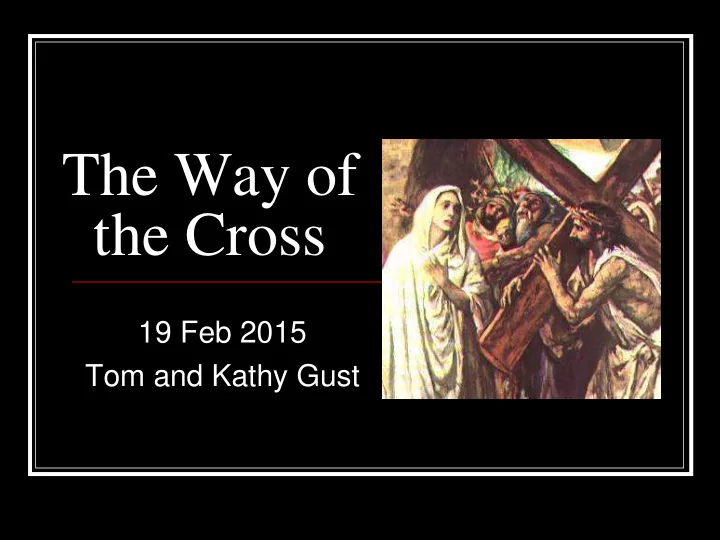
The Way of the Cross
19 Feb 2015 Tom and Kathy Gust
the Cross 19 Feb 2015 Tom and Kathy Gust The Stations of the - - PowerPoint PPT Presentation
The Way of the Cross 19 Feb 2015 Tom and Kathy Gust The Stations of the Cross Via Crucis (The Way of the Cross) Via Dolorosa (The Way of Sorrow/Suffering) What is a devotion? A personal way of expressing our love for God
19 Feb 2015 Tom and Kathy Gust
The Stations of
the Cross
Via Crucis (The
Way of the Cross)
Via Dolorosa
(The Way of Sorrow/Suffering)
A personal way of expressing our love for
God
Practices through which Catholics find life
in God
Practices through which Catholics express
that life in God and their love of God
Rosary, novenas, pilgrimages, retreats,
Way of the Cross
To make a pilgrimage,
in spirit, to the main scenes of Christ’s suffering and death
Each station presents a
picture or image representing one of the events of Christ’s suffering, death and resurrection
"People can relate to a crucified Christ displayed in Catholic Churches, as each one of us has a cross to carry. None of us can relate to a risen Christ, as none of us has ever risen from the dead."
Mississauga ON Assumption Catholic Cemetery
Cemetery Stations
Circleville, OH Saint Charles Borromeo Church, Saint Charles, Missouri
The Shrine of Our Lady of Peace Stations of the Cross - Santa Clara, CA Our Lady of Fatima Catholic Church, Elba, NY Monte Serrat Stations
Brazil
presented in your handouts (L5)
Goal of the Biblical Stations: To emphasize that together the sufferings and resurrection of Christ are one redemptive mystery
Many different prayers can be used Many different ways to focus the devotion
Mary’s journey with Jesus through His Passion Plight of the Poor Scripturally based The devotion as written for children, etc. etc.
Pray without words—meditate on the images
New prayers commissioned annually for Pope
Tradition tells us that Mary
retraced the way of the Cross, everyday
Pilgrims flocked to Holy Land to
retrace Christ’s steps
When visiting the Holy Land
became dangerous, Christians began building replicas of the holy places closer to home
Middle ages—Christians were
captivated by Christ’s suffering and humanity. They connected his suffering with their own.
1686 Pope Innocent XI granted
the Franciscans the exclusive right to build stations
Pope Clement XII extended the
right to non-Franciscan churches in 1731
18th Century—St. Leonard of
Port-Maurice, a Franciscan, erected stations and promoted the devotion in over 500 churches in Italy
Over time the number of stations
has ranged from 5 to 42
18th Century the devotion
became fixed at 14 stations
(from L5 handout, p. 594 Sunday Missal)
(from L5 handout, p. 594 Sunday Missal)
(from L5 handout, p. 594 Sunday Missal)
Leaders—High Priest Caiaphas)
(at St. Thomas More)
(at St. Thomas More)
(at St. Thomas More)
The title “Stabat Mater” is an abbreviation of the
first line of the hymn—Stabat Mater dolorosa— “at the cross her station keeping”
13th Century hymn attributed to St. Bonaventure The 3 line verses form a prayer that take us
through Mary’s sufferings to the sufferings of Christ by whose mercy we hope to attain the glory of Paradise.
Pictures by Jackie De Bruin
Traditional Rock of the Agony surrounded by a wrought iron Crown of Thorns in front of the altar in the Basilica of the Agony
Garden of Gethsemane—has 8 ancient olive trees
4th Station: The Armenian-Catholic Church of Our Lady of the Spasm—marks the place where Mary encountered Jesus
Carrying the cross through the streets
5th Station: Simon of Cyrene helps Jesus carry the cross
6th Station: the Church
Probably the site of the house of Veronica who wiped the face of Jesus with her veil
Carrying the cross up some stairs
9th Station: the column built into the door of the Coptic Church of St. Helen It marks the site where Jesus fell for the 3rd time
Entrance to the Church of the Holy Sepulchre (the last five stations are in the Basilica)
Courtyard of the Basilica of the Holy Sepulchre The stone stairway leads to the Chapel of the Disvestiture at the 10th station
11th Station: Mosaic above the altar—Jesus is nailed to the cross
12th Station: Greek Orthodox Chapel marks the site of the crucifixion Below the altar, on either side is a fissure in the rock believe to have been caused by an earthquake at the time of Jesus’ death
Silver Icon of Mary stands on glass covering the fissure in the rock
13th Station: the Stone of Unction where Jesus’ body was laid for anointing. Rose oil is poured on it