
SLIDE 1
The Cosmological Bootstrap
Daniel Baumann
University of Amsterdam Web Seminar, April 2020
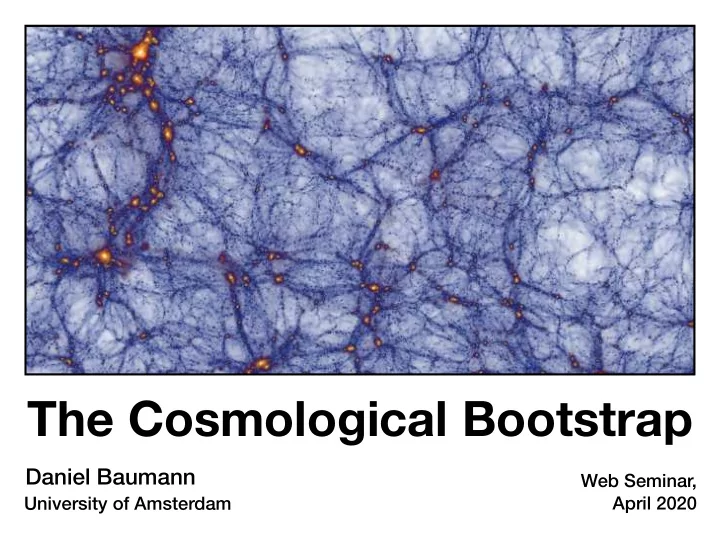
The Cosmological Bootstrap Daniel Baumann Web Seminar, University - - PowerPoint PPT Presentation
The Cosmological Bootstrap Daniel Baumann Web Seminar, University of Amsterdam April 2020 Based on work with Nima Arkani-Hamed, Hayden Lee, Guilherme Pimentel, Carlos Duaso Pueyo and Austin Joyce The physics of the early universe is encoded
The Cosmological Bootstrap
Daniel Baumann
University of Amsterdam Web Seminar, April 2020
Based on work with
Nima Arkani-Hamed, Hayden Lee, Guilherme Pimentel, Carlos Duaso Pueyo and Austin Joyce
The physics of the early universe is encoded in spatial correlations between cosmological structures at late times: A central challenge of modern cosmology is to construct a consistent history of the universe that explains these correlations.
The correlations can be traced back to primordial correlations at the beginning of the hot big bang. To explain the observed fluctuations in the CMB, these fluctuations must be created before the hot big bang!
t = 0
t = 0
What is the space of consistent histories?
Similar questions have been asked for scattering amplitudes:
In that case, the rules of quantum mechanics and relativity are very constraining.
?
Does a similar rigidity exist for cosmological correlators? Goal: Develop an understanding of cosmological correlators that parallels our understanding of flat-space scattering amplitudes.
The connection to scattering amplitudes is also relevant because the early universe was like a giant cosmological collider:
Chen and Wang [2009] DB and Green [2011] Noumi, Yamaguchi and Yokoyama [2013] Arkani-Hamed and Maldacena [2015] Arkani-Hamed, DB, Lee and Pimentel [2018]
particle creation particle decay
time space
During inflation, the rapid expansion can produce very massive particles (~1014 GeV) whose decays lead to nontrivial correlations.
10 billion yrs << 1 sec
At late times, these correlations will leave an imprint in the distribution
Goal: Develop a systematic way to predict these signals.
Any Questions?
The Cosmological Bootstrap
Outline
New Developments
The Cosmological Bootstrap
Bootstrap Philosophy
S = Z d4x L 1 2∂µφ∂µφ − 1 2m2φ2 + · · ·
equations of motion spacetime evolution Feynman diagrams
Physical Principles Observables
(Lorentz, locality, …) locality Lorentz parameters
Lagrangian equations of motion spacetime evolution Feynman diagrams
Physical Principles Observables
(Lorentz, locality, …)
Bootstrap Philosophy
Modern scattering amplitudes programme
See Yu-tin’s book.
A(s, t) = X anmsntm + g2 s − M 2 PS ✓ 1 + 2t M 2 ◆
The S-Matrix Bootstrap
contact interactions exchange interactions
M, S The structure of scattering amplitudes at tree level is fixed by Lorentz invariance, locality and unitarity:
The Challenge
hφφφφi =
complicated function
shown for conformally coupled scalars
∼ Z dtd˜ t ei(k1+k2)tei(k3+k4)˜
t G
k1 + ~ k2|, t, ˜ t
The Cosmological Bootstrap
In the cosmological bootstrap, the primordial correlators are determined from consistency conditions alone:
Arkani-Hamed, DB, Lee and Pimentel [2018] DB, Duaso Pueyo, Joyce, Lee and Pimentel [2019] DB, Duaso Pueyo, Joyce, Lee and Pimentel [2020] Arkani-Hamed and Maldacena [2015] Arkani-Hamed, Benincasa, and Postnikov [2017] Sleight and Taronna [2019] Sleight [2019]
If inflation is correct, then all primordial correlations live on the boundary
Inflation De Sitter
m4 → √εH
De Sitter Inflation
k4 → 0
Inflationary three-point functions are obtained from de Sitter four-point functions by evaluating one of the external legs on the background: We can therefore study de Sitter four-point functions as the fundamental building blocks of inflationary correlators.
¯ φ(t)
Symmetries
If the couplings between particles are weak, then the primordial correlations inherit the symmetries of the quasi-de Sitter spacetime:
}
Momentum conservation in Fourier space
}
Determine the allowed deformations (or shapes) of the correlators.
~ k3 ~ k4 ~ k1 ~ k2
A En + · · ·
Kinematics
k1 k2 k4 k3 k1 k2 k3 k4
AMPLITUDE
The kinematical data of correlators and amplitudes is similar:
Raju [2012] Maldacena and Pimentel [2011]
Ward Identities
This is the analog of Lorentz invariance of the amplitude: Invariance under dilatations and SCTs imply the following Ward identities:
0 = " 9 −
4
X
n=1
⇣ ∆n − ~ kn · @~
kn
⌘# F 0 =
4
X
n=1
" (∆n − 3)@~
kn − (~
kn · @~
kn)@~ kn +
~ kn 2 (@~
kn · @~ kn)
# F
These Ward identities dictate how the strength of the correlations changes as we change the external momenta:
Ward Identities
Singularities
Arkani-Hamed, DB, Lee and Pimentel [2018]
lim
E→0
En
Contact solutions only have total-energy poles.
(EL)m
Exchange solutions have additional partial-energy poles.
lim
EL→0
The solutions to the Ward identities can be classified by their singularities:
EFT EXPANSION SPIN EXCHANGE
Exchange Solutions
There are distinct solutions for distinct microscopic processes during inflation:
Arkani-Hamed, DB, Lee and Pimentel [2018]
Exchange Solutions
There are distinct solutions for distinct microscopic processes during inflation:
Arkani-Hamed, DB, Lee and Pimentel [2018]
= Dn
Remarkably, all solutions can be reduced to a unique building block.
m = √ 2H M, S = 0
WEIGHT-SHIFTING OPERATORS
v ≡ s k3 + k4 u ≡ s k1 + k2
F = 1 s ˆ F(u, v)
where we have introduced
k1 k4 k3 k2
and .
Seed Solution
s
v ≡ s k3 + k4 u ≡ s k1 + k2
F = 1 s ˆ F(u, v)
where we have introduced
k1 k4 k3 k2
and .
(∆u − ∆v) ˆ F = 0
where .
Seed Solution
s
(∆u + M 2) ˆ F = ˆ Fc
CONTACT SOLUTION MASS OF THE EXCHANGE PARTICLE
= =
For tree exchange, the conformal Ward identity reduces to:
Seed Solution
(∆u + M 2) ˆ F = ˆ Fc
For tree exchange, the conformal Ward identity reduces to:
Seed Solution
Need boundary conditions to solve this ODE:
Absence of singularity in the folded limit:
I.
Correct normalization in the collapsed limit:
II.
= regular = 3pt x 3pt
F = X
m,n
cmn(M) u2m+1 ⇣u v ⌘n + π cosh(πM) g(u, v)
Seed Solution
F 2|1|3
2|0|1"
1 2, 1 5+2iM 4, 5−2iM
4−
, 5−2iM
4, 1
2 + iM 3 2 + iMv2 # (uv)
1 2 ±iM 2F1"
1 4 ± iM, 3 4 ± iM1 ± iM
#
2F1"
1 4 ± iM, 3 4 ± iM1 ± iM
#
Arkani-Hamed, DB, Lee and Pimentel [2018]
The explicit solution for the seed function is
Noumi, Yamaguchi and Yokoyama [2013] Arkani-Hamed and Maldacena [2015] Arkani-Hamed, DB, Lee and Pimentel [2018]
The Collapsed Limit
In the collapsed limit, the solution oscillates:
= sin[M log(s/k12)] lim
s→0
eiMt ⇒
Particle Production
These oscillations are a key signature of particle production during inflation: Oscillations in the superhorizon evolution become oscillations in the boundary correlations at late times.
Cosmological Collider Physics
Centre-of-mass energy (GeV) Cross section (nb) Momentum ratio
Correlation strength
This signal is the analog of resonances in collider physics:
Any Questions?
New Developments
So far, we have studied the correlations of scalar fields. Now, we would like to extend the bootstrap to spinning correlators, especially to massless fields with spin.
Arkani-Hamed, DB, Lee and Pimentel [2018] DB, Duaso Pueyo, Joyce, Lee and Pimentel [2019] DB, Duaso Pueyo, Joyce, Lee and Pimentel [2020]
Massless Particles in Flat Space
gravity electromagnetism
spin 2 = GR spin 1 = YM
Beyond Feynman Diagrams
Parke and Taylor [1985] De Witt [1967]
− − + = ✓ h12i3 h13ih23i ◆S A4 A3 1 (p1 + p2)2 A3
(p1 + p2)2 → 0
The Four-Particle Test
Benincasa and Cachazo [2007] McGady and Rodina [2010]
σµ1...µS hµν
S = { 0 , 1
2 , 1 , 3 2 , 2 }
YM GR SUSY
Massless Particles in de Sitter Space
scalar tensor
γij φ
partially massless
Σi1...iS
Beyond Feynman Diagrams
= X
n
Sn
Two Approaches
DB, Duaso Pueyo, Joyce, Lee and Pimentel [2020]
In our new paper, we derive a large class of spinning correlators in de Sitter space. We use two different approaches:
1) Spin-raising operators 2) Singularities
scalar seed spinning correlator
In the following, I will describe the second approach.
A4 E F3 × A3 ER A3 × F3 EL
Singularities of Cosmological Correlators
Singularities occur when energies add up to zero.
Raju [2012] Maldacena and Pimentel [2011] Arkani-Hamed, Benincasa, and Postnikov [2017]
The four-point function is controlled by three singularities:
A Simple Example
= ~ ⇠1 · ~ k2 EL ~ ⇠3 · ~ k4 ER(k34 − s) = ~ ⇠3 · ~ k4 ER ~ ⇠1 · ~ k2 EL(k12 − s) lim
EL→0lim
ER→0EL ≡ k12 + s ER ≡ k34 + s E ≡ k12 + k34 s k1 k2 k3 k4
Consider Compton scattering in de Sitter space.
A Simple Example
hJJis = (~ ⇠1 · ~ k2)(~ ⇠3 · ~ k4) ELERE
ELER
E→0
− − − − → S
= ~ ⇠1 · ~ k2 EL ~ ⇠3 · ~ k4 ER(k34 − s) = ~ ⇠3 · ~ k4 ER ~ ⇠1 · ~ k2 EL(k12 − s) lim
EL→0lim
ER→0EL ≡ k12 + s ER ≡ k34 + s E ≡ k12 + k34 s k1 k2 k3 k4
Consider Compton scattering in de Sitter space.
A More Complicated Example
fixed by factorisation fixed by total energy singularity fixed by conformal symmetry
= (~ ⇠1 · ~ k2)2(~ ⇠3 · ~ k4)2 1 E2
LE2 R✓2sk1k3 E2 + 2k1k3 + ELk3 + ERk1 E ◆ 1 ELER ✓2k1k3 E3 + k13 E2 + 1 E ◆
Consider Compton scattering of gravitons.
= 1 E2
LE2 R✓2k1k3 E2 + EL E ◆ N(~ ⇠1, ~ ⇠3,~ k2,~ k4) + 1 ELER ✓2k1k3 E3 + k13 E2 + 1 E ◆ M(~ ⇠1, ~ ⇠3,~ k2,~ k4) = (~ ⇠1 · ~ k2)2(~ ⇠3 · ~ k4)2 1 E2
LE2 R✓2sk1k3 E2 + 2k1k3 + ELk3 + ERk1 E ◆ 1 ELER ✓2k1k3 E3 + k13 E2 + 1 E ◆
A More Complicated Example
fixed by total energy singularity fixed by conformal symmetry fixed by factorisation
Consider Compton scattering of gravitons.
One Channel Is Not Enough
s-channel t-channel u-channel
Ai φ φ φ e2 e4 e3 A e2
E→0E ✓h12ih¯ 2¯ 4ih41i ST h14ih¯ 41i 2k1 1 T ◆ not Lorentz-invariant
Consider the correlator of one photon and three scalars:
flat-space amplitude
One Channel Is Not Enough
e4
1 E ✓ e2 h12ih¯ 2¯ 4ih41i ST (e2 + e4)h14ih¯ 41i 2k1 1 T ◆ + Lorentz-violation disappears when
e2 + e4 = 0
charge conservation
s-channel t-channel u-channel
Ai φ φ φ e2 e4 e3 Consider the correlator of one photon and three scalars:
Gi
A φa
Gj
B φb
T A
ac
T B
cb
T A
bc
T B
ca
f ABC T C
ab
T (A
ac T B) cb
Discovering Yang-Mills
the couplings satisfy the Lie algebra:
[T A, T B]ab = f ABCT C
ab
+
contact
+ +
s-channel t-channel u-channel
Consider two gluons and two scalars:
Equivalence Principle (without falling elevators)
hij φ φ φ κ2 κ4 κ3
s-channel t-channel u-channel
κ2 = κ3 = κ4
Consider one graviton and three scalars:
κ2
c
Equivalence Principle (without falling elevators)
all gravitational couplings are universal:
+ + +
contact s-channel t-channel u-channel
κa κb
κa = κb = κc
Consider two gravitons and two scalars:
Ruling Out Theories
We hope to report on such no-go results in the future. The bootstrap approach will also allow us to rule out theories:
Any Questions?
Future Challenges
We have only scratched the surface of a fascinating subject:
Observational Cosmology Inflation Scattering Amplitudes Cosmological Collider Physics CFT/Holography
Cosmological Bootstrap Much more remains to be discovered.
Open Problems
Thank you for your attention!
Do these insights translate to cosmological correlators?
Dramatic progress in the study of scattering amplitudes:
lim
E→0
=
1 En
Insights from the modern scattering amplitudes programme must therefore be relevant for cosmology.
Raju [2012] Maldacena and Pimentel [2011]
Amplitudes live inside correlators.
What is the goal?
IR UV
Define observational targets. Relate low-energy predictions to high-energy physics:
under- standing
non-perturbative
?
tree-level (some loops) de Sitter space anti-de Sitter space flat space
What are the rules?
The closer we get to the real world, the less we understand:
Causality
Scattering amplitudes Cosmological correlators
tree-level tree-level
Consistent time evolution is encoded in the analytic structure (poles and branch cuts) of amplitudes and correlators:
Locality
Locality is encoded in factorization: Scattering amplitudes Cosmological correlators
(EL)m
lim
EL→0
Unitarity
Unitarity is encoded in positivity: Scattering amplitudes Cosmological correlators
Landscape vs Swampland
The ultraviolet completion of scattering amplitudes is highly constrained by these basic physical principles:
Exchange of Spinning Particles
Strategy
We wish to find differential operators that relate scalar exchange to spin exchange:
spin-raising
It turns out that the spin raising is best implemented in embedding space and then Fourier transformed.
CFTs in Embedding Space
Consider the following embedding of d-dimensional Euclidean space into (d+2)-dimensional Minkowski space:
Dirac [1936] Costa, Penedones, Poland and Rychkov [2011]
CFTs in Embedding Space
Lorentz transformations in embedding space become conformal transformations on the Euclidean section:
Dirac [1936] Costa, Penedones, Poland and Rychkov [2011]
CFTs in Embedding Space
Dirac [1936] Costa, Penedones, Poland and Rychkov [2011]
Conformal correlators in embedding space are simply the most general Lorentz-invariant expressions with the correct scaling behavior: where .
Spin-Raising Operator
where Correlators of spinning fields can be written in terms of scalar seeds. For example: . , In Fourier space, this becomes
Karateev, Kravchuk and Simmons-Duffin [2018] Costa, Penedones, Poland and Rychkov [2011]
.
Using this spin-raising operator, we have
spin-raising
scalar-exchange solution polarization tensor spin-exchange solution
which can be written as
Arkani-Hamed, DB, Lee and Pimentel [2018]
,
e.g.
Bootstrapping Spin Exchange