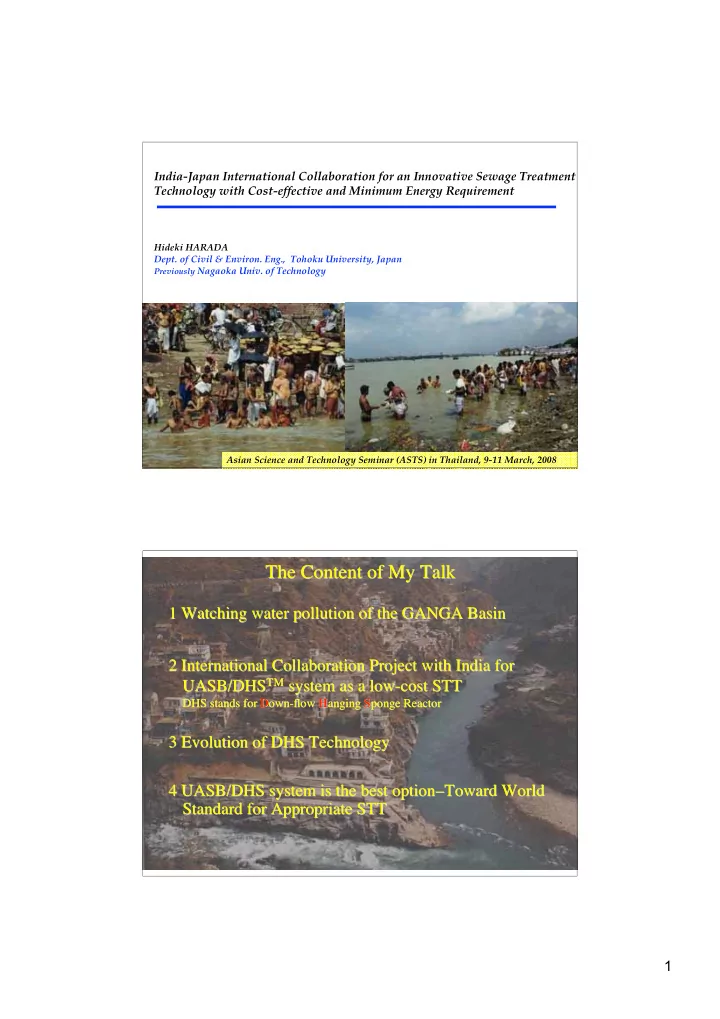
The Content of My Talk The Content of My Talk 1 Watching water - - PDF document

the content of my talk the content of my talk
SMART_READER_LITE
LIVE PREVIEW

The Content of My Talk The Content of My Talk 1 Watching water - - PDF document

India-Japan International Collaboration for an Innovative Sewage Treatment Technology with Cost-effective and Minimum Energy Requirement Hideki HARADA Dept. of Civil & Environ. Eng., Tohoku University, Japan Previously Nagaoka Univ. of


slide-1
SLIDE 1

1

India-Japan International Collaboration for an Innovative Sewage Treatment Technology with Cost-effective and Minimum Energy Requirement

Hideki HARADA

  • Dept. of Civil & Environ. Eng., Tohoku University, Japan

Previously Nagaoka Univ. of Technology

Asian Science and Technology Seminar (ASTS) in Thailand, 9-11 March, 2008

The Content of My Talk The Content of My Talk

1 Watching water pollution of the GANGA Basin 1 Watching water pollution of the GANGA Basin 2 International Collaboration Project with India for 2 International Collaboration Project with India for UASB/DHS UASB/DHSTM

TM system as a low-cost STT

system as a low-cost STT

DHS stands for DHS stands for D Down-flow

  • wn-flow H

Hanging anging S Sponge Reactor ponge Reactor

3 Evolution of DHS Technology 3 Evolution of DHS Technology 4 UASB/DHS system is the best option 4 UASB/DHS system is the best option– –Toward World Toward World Standard for Appropriate STT Standard for Appropriate STT

slide-2
SLIDE 2

2

slide-3
SLIDE 3

3

Urban Drainage Urban Drainage

Scene 3: Delhi, India

flows flows Urban Drainage Urban Drainage

Scene 3: Delhi, India

slide-4
SLIDE 4

4

into the into the Yamuna Yamuna without treatment without treatment Urban Drainage flows Urban Drainage flows

Scene 4: Delhi, India Water Quality Standard for Bathing Pollution of the YAMUNA RIVER, DO and BOD

slide-5
SLIDE 5

5 Ganga Ganga Action Plan (GAP), then Action Plan (GAP), then Yamuna Yamuna Action Plan (YAP) Action Plan (YAP) Actions

  • Construction of sewage treatment plants (STP)
  • Public Toilets
  • Crematoria
  • River Front Facility (Bathing ghats)
  • Industrial pollution- Control by existing environmental law
  • Agricultural source- by concerned ministry (reduce pesticides)
  • Biological Regeneration

Yamuna YAP

1993 1996 2001

Ganges GAP-I GAP-II

1986 1991 2001

Phases Started : 1986 (5 year plan, later extended)

slide-6
SLIDE 6

6

(Stabilization Pond)

From GAP to YAP, from ASP to UASB From GAP to YAP, from ASP to UASB

Abandoned Activated Sludge Plant

slide-7
SLIDE 7

7

slide-8
SLIDE 8

8 4 UASB Reactors Each UASB has a size of 32m! 24m, receiving 10 MLD (10000 m3/day, or 70,000 I.E) Fate of Byproduct, Biogas and Excess Sludge

slide-9
SLIDE 9

9 HRT=8 hr BOD removal 60% Remaining BOD 80 20 mg/L Discharge Standard BOD <30 mg/L TSS < 50 mg/L F-coli < 10,000 MPN/100 mL UASB effluent is introduced to 1 day HRT of Final Polishing Unit FPU (stabilization pond). Polishing pond is working as an algae growth pond.

slide-10
SLIDE 10

10

40 MLD Capacity

slide-11
SLIDE 11

11

Harada et al (2005), Jour. of Environ. Management

slide-12
SLIDE 12

12 Visit of Indian Government Delegation to Nagaoka, Feb. 2002

slide-13
SLIDE 13

13 DHS reactor under construction, December 2001, at Karnal, India

slide-14
SLIDE 14

14

slide-15
SLIDE 15

15

Sending Graduate-students to Karnal STP site since Oct. 2002

Fuel is, of course, cow-dung Put into curry-pot

slide-16
SLIDE 16

16

Overall Summary Result of 5-ys non-stop operation

slide-17
SLIDE 17

17

slide-18
SLIDE 18

18

slide-19
SLIDE 19

19 General Advantages of DHS post-treatment System

  • No need of External Aeration, much less energy requirement
  • No clogging, no back-washing, no laborious maintenance
  • Much less amount of Excess Sludge
  • Less Area Requirement
  • High Performance at equivalent HRT to Activated Sludge

Process

slide-20
SLIDE 20

20

slide-21
SLIDE 21

21

Hanging sponge in air

Polyurethane foam (PUF)

DHS concept

(downflow)

Wastewater

air air

No need of External aeration input

slide-22
SLIDE 22

22

Evolution of DHS Process

slide-23
SLIDE 23

23 BOD removal by Activated Sludge process throughout Japan Influent BOD (mg/l) Effluent BOD (mg/l)

Statistics of Japan Sewage Works, 2001

slide-24
SLIDE 24

24 BOD removal by (UASB+DHS) system (Karnal, India)

C-BOD5 removal in Karnal; Dec. 2002 to Dec. 2003 UASB & DHS BOD (mg/l) Raw sewage BOD (mg/l)

Power consumption for sewage treatment

Power consumption per amount of sewage; 0.46 kWh/m3 Pumping Water treatment Sludge treatment Others

Statistic of Japan Sewage Works, 2001

Aeration Sludge treatment Pumping Others 15.0% 48.9% 22.8% 12.4%

Total power consumption Pumping Water treatment Sludge treatment Others Total; x103 kWh/yr 5,956,000 896,000 2,913,000 1,359,000 739,000 Percentage 100.0 15.0 48.9 22.8 12.4 per WW amount treated; kWh/m3 0.46 0.07 0.22 0.1 0.06 per capita; kWh/capita/yr 73.5 Amount of treated water; m3 Population; capital 13,019,790,000 81,076,000

slide-25
SLIDE 25

25

0.4 7230 Japan 1.6 1846 Brazil 1.3 2206 World 0.2 14153 UAE 1.6 1778 Mexico 3.1 954 Columbia 5.9 497 Philippines 6.2 473 India 7.1 413 Pakistan 7.7 379 Indonesia 8.8 333 Vietnam 9.7 301 Sri Lanka 20.9 140 Laos 21.7 130 Myanmar 28.3 103 Bangladesh 44.0 66 Nepal

  • (kWh/capita·year)

Country

CIA World Fact Book (2003)

How much power should be required for Sewage Treatment, if Activated Sludge Process is employed?

Annual Power Requirement for Sewage Treatment Per Capita Annual Power Consumption

Per capita Annual Sewage Amount =175 liter day-1=63.4 m3 capita-1 yr-1 Per capita Annual Power Requirement for Sewage Treatment=63.4 m3 capita-1 yr-1! 0.46 kwh m-3=29.2 kwh capita-1 yr-1

Conclusive Remarks Conclusive Remarks

1. Our Proposed UASB-DHS combined system exhibited an excellent performance, producing Effluent BOD less than 10 mg/L with a HRT of

  • nly 8 h (UASB 6 h and DHS 2h) that is equivalent to that of conventional

ASP. 2. The UASB-DHS combined system requires

  • no external forced aeration,
  • no laborious maintenance,
  • less sludge production,
  • less land area,
  • resulting in reducing running cost into only 1/5-1/10 of

conventional ASP. 3. The UASB-DHS combined system may offer the best option for low-cost and low-energy treatment of municipal wastewater under tropical/sub- tropical climate.

slide-26
SLIDE 26

26