The CLIVAR Eastern Boundary Upwelling Systems (EBUS) Research - - PowerPoint PPT Presentation

the clivar eastern boundary upwelling systems ebus
SMART_READER_LITE
LIVE PREVIEW

The CLIVAR Eastern Boundary Upwelling Systems (EBUS) Research - - PowerPoint PPT Presentation

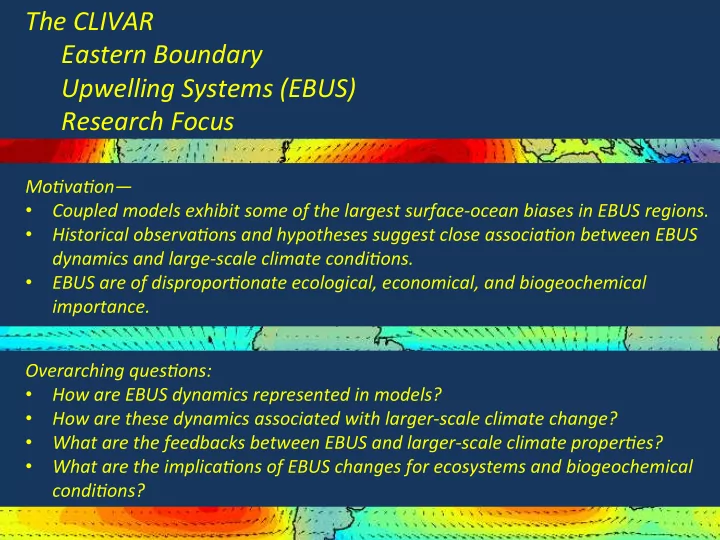
The CLIVAR Eastern Boundary Upwelling Systems (EBUS) Research Focus MoEvaEon Coupled models exhibit some of the largest surface-ocean biases in EBUS regions. Historical observaEons and hypotheses suggest close associaEon between EBUS


slide-1
SLIDE 1

The CLIVAR Eastern Boundary Upwelling Systems (EBUS) Research Focus

Overarching quesEons:

  • How are EBUS dynamics represented in models?
  • How are these dynamics associated with larger-scale climate change?
  • What are the feedbacks between EBUS and larger-scale climate properEes?
  • What are the implicaEons of EBUS changes for ecosystems and biogeochemical

condiEons? MoEvaEon—

  • Coupled models exhibit some of the largest surface-ocean biases in EBUS regions.
  • Historical observaEons and hypotheses suggest close associaEon between EBUS

dynamics and large-scale climate condiEons.

  • EBUS are of disproporEonate ecological, economical, and biogeochemical

importance.

slide-2
SLIDE 2
  • fig. by Thomas Toniazzo

California Current Humboldt Current

4, semi-permanent, eastern boundary upwelling systems

Canary Current Benguela Current

slide-3
SLIDE 3

SST biases in CGCMs largest in EBUS regions

BAMS, 2016, doi:10.1175/BAMS-D-15-00274.1 adapted from Toniazzo and Woolnough, 2014

SE Atlantic SST bias particularly pronounced

Prevailing winds and currents advect those biases downwind and affect the low cloud cover downstream

slide-4
SLIDE 4

Anthropogenic changes in wind intensity are fairly subtle…

Rykaczewski et al. (2015)

slide-5
SLIDE 5

Anthropogenic changes in wind intensity are fairly subtle…

Upwelling intensity tends to increase in the poleward halves… … but decrease in the equatorward portions of the upwelling systems. Rykaczewski et al. (2015)

slide-6
SLIDE 6

Links between large-scale climate processes and EBUS What processes control the atmospheric dynamics associated with EBUS? How are these processes represented in global and regional models? What mechanisms relate EBUS atmospheric and oceanic variability to large- scale climate patterns? What are the effects of upwelling on the regional and global air temperatures, precipitation and wind patterns? How can the temporal and spatial variability of upwelled waters be described? Biogeochemical responses and consequences What key physical and biological processes control primary production, air-sea CO2 flux, and carbon export in EBUS? What are the relative contributions of EBUS to large-scale productivity and intensity of oxygen minimum zones? How will natural and anthropogenic factors influence carbon cycling and deoxygenation in EBUS? How do mixing, stratification, and source-water properties influence the composition of the plankton community and survival of larval fishes?

Broad quesEons

CLIVAR RF CLIVAR RF with SCOR WG

slide-7
SLIDE 7

“Eastern Boundary Upwelling Systems: Assessing and understanding their changes and predicting their future” The school will stimulate discussion and new ideas concerning the mechanisms that influence the responses of EBUSs to climate variability and change. The school will be followed by an EBUS Research Focus meeting.

2019 ICTP “Summer School” on EBUS

slide-8
SLIDE 8

Show schedule and describe its structure.

DAY 1 Monday, July 15 DAY 2 Tuesday, July 16 DAY 3 Wednesday, July 17 DAY 4 Thursday, July 18 DAY 5 Friday, July 19 09:00-09:45

IntroducFon of Lecturers and ParFcipants Processes determining cloudiness distribuFons in EBUS regions: Part 1 (P. Zuidema) Response of the ocean to wind fields (M. Schmidt) Large-scale biogeochemistry and plankton ecology in EBUS (R. Rykaczewski) Equatorial and coastal wave teleconnecFons in the EBUSs (A. Lazar)

09:45-10:30

Eastern Boundary Upwelling Systems: importance and criFcal processes (co-Organizers)

  • Atm. circulaFon and

coastal topography (R. Garreaud) Transport and mixing at the ocean mesoscale (A. Bracco) Role of (sub)Mesoscale for biogeochemistry and ecology in EBUS (I. Frenger) Variability and equatorial teleconnecFons (R.Garreaud, A. Miller)

10:30-10:45 Break Break Break Break Break 10:45-11:30

Historical variability in EBUS and consideraFons about their future (R. Rykaczewski) Drivers of coastal along- shore winds and their variability (T. Toniazzo) Processes controlling SSTs (A. Lazar) Biogeochemical Models in EBUS (I. Frenger) Downscaling of climate change impacts on EBUS biogeochemistry (F. Chai)

11:30-12:15

Climatology of the atmospheric circulaFon (T. Toniazzo) Cloud impacts across Fme scales (R. Garreaud) Transport and mixing at the ocean submesoscales (A. Bracco) Upwelling impacts on the world’s largest fishery, the Peruvian anchoveta (F. Chai) EBUS biases and uncertainFes in global and regional models (T. Toniazzo, R. Farne5)

12:15-13:00

Climatological ocean dynamics (M. Schmidt) Processes determining cloudiness distribuFons in EBUS regions: Part 2 (P. Zuidema) Coupled atmosphere-

  • cean feedbacks

(A. Miller) Data assimilaFon; adjoint models (A. Miller) Alongshore winds in IPCC model projecFons (R. Rykaczewski)

13:00-16:00 Lunch/Swim Lunch/Swim Lunch/Swim Lunch/Swim Lunch/Swim 16:00-17:30

The NetCDF format, data sources, and analysis tools (Introduc5on: M.Schmidt, supervision: Lecturers) Data Analysis/Case Study (Introduc5on: R. Garreaud,

  • R. Rykaczewski, T.Toniazzo,
  • P. Zuidema; supervision:

Lecturers) ParFcipants’ Poster Session The ICTP regional coupled model and the West Africa EBUS (R. FarneE) Debate on clmate change in EBUS: selecFon of hypotheses from the literature (Students)

17:30-17:45 Break Break Break Break Break 17:45-19:00

Welcome RecepFon Data Analysis/Case Study (supervision: Lecturers) ParFcipants’ Poster Session TBD (A. Lazar,

  • R. FarneE)

Debate on climate change in EBUS: discussion on hypotheses (Students)
slide-9
SLIDE 9

Friday evening “debate” How will EBUS respond to future climate change? Different, mutually inconsistent hypotheses have been proposed. Based on the literature and what you learn during the week, we hope to have a group discussion, LED BY YOU, about some of these ideas. What are the merits of hypotheses of future change in EBUS? What are weaknesses or shortcomings of the ideas? What steps need to be taken to help better understand EBUS responses?

2019 ICTP “Summer School” on EBUS

slide-10
SLIDE 10

Some potentially useful papers: Bakun, A, BA Black, SJ Bograd, M García-Reyes, AJ Miller, RR Rykaczewski, and WJ

  • Sydeman. 2015. Anticipated effects of climate change on coastal upwelling ecosystems.

Current Climate Change Reports 1:85-93, doi:10.1007/s40641-015-0008-4. Brady, RX, NS Lovenduski, MA Alexander, M Jacox, and N Gruber. 2019. On the role of climate modes in modulating the air–sea CO2 fluxes in eastern boundary upwelling systems Biogeosciences 16:329-346, doi.org/10.5194/bg-16-329-2019. García-Reyes, M, WJ Sydeman, DS Schoeman, RR Rykaczewski, BA Black, AJ Smit, and SJ Bograd. 2015. Under pressure: Climate change, upwelling and eastern boundary upwelling ecosystems. Frontiers in Marine Science 2:109, doi:10.3389/fmars. 2015.00109. Muñoz, RC and R Garreaud. 2005. Dynamics of the low-level jet off the west coast of subtropical South America. Mon. Weather Rev. 133:3661-3677. https://drive.google.com/drive/folders/1kesLephEOaNtqdtuZn21K064O0ZkvAK3

2019 ICTP “Summer School” on EBUS

slide-11
SLIDE 11

Some potentially useful papers (cont.): Seabra, R, V Rubén, AM Santos, M Gómez-Gesteira, C Meneghesso, DS Wethey, and FP

  • Lima. 2019. Reduced nearshore warming associated with Eastern Boundary Upwelling
  • Systems. Frontiers in Marine Science 6, doi:10.3389/fmars.2019.00104

Toniazzo, T, SJ Abel, R Wood, CR Mechoso, G Allen, and LC Shaffrey. 2011. Large-scale and synoptic meteorology in the south-east Pacific during the observations campaign VOCALS-REx in austral Spring 2008. Atmos. Chem. Phys. 11:4977-5009. Wang, D, TC Gouhier, BA Menge, and AR Ganguly. 2015. Intensification and spatial homogenization of coastal upwelling under climate change. Nature 518:390-394. Zuidema, P, P Chang, B Medeiros, BP Kirtman, R Mechoso, EK Schneider, T Toniazzo, I Richter, RJ Small, K Bellomo, P Brandt, S de Szoeke, JT Farrar, E Jung, S Kato, M Li, C Patricola, Z Wang, R Wood, and Z Xu. 2016. Challenges and prospects for reducing coupled climate model SST biases in the eastern tropical Atlantic and Pacific Oceans: The U.S. CLIVAR Eastern Tropical Oceans Synthesis Working Group. Bulletin of the American Meteorological Society, doi:10.1175/BAMS-D-15-00274.1.

2019 ICTP “Summer School” on EBUS

slide-12
SLIDE 12

Some background on our key quesEons…

slide-13
SLIDE 13
  • fig. by Thomas Toniazzo

along-shore windstress (lines) => Ekman divergence wind stress curl (color) => Ekman pumping Coarse-resolution models are typically too dissipative, overestimating upwelling induced by wind-stress curl.

Basic theory a_ributes the eastern boundary oceanic upwelling to the low-level wind spaEal structure

slide-14
SLIDE 14

doi:10.1175/BAMS-D-15-00274.1, see Patricola and Chang, 2017, Climate Dynamics for more

southeast Atlantic example

Scatterometer, with 10-km res., ID’s 2 distinct coastal jets, missed in coarser models.

Wind-stress maximum is placed too far

  • ffshore in coarse

models, excessive cyclonic wind- stress curl forces warm, southward current (Xu et al. 2014; Small et al. 2015); too diffuse thermoclines reinforce the SST bias.

slide-15
SLIDE 15
  • fig. by Thomas Toniazzo

northern hemisphere 25N-35N southern hemisphere 25S-35S ERA-Interim data. omega=contours; meridional wind=color South America/Andes South Africa North Africa North America

Subsidence is driven by radiative cooling over the EBUS in approximate balance with baroclinic meridional poleward winds

slide-16
SLIDE 16

Relationship between low cloud cover and the coastal jets varies between the EBUS regions, affects the EBUS surface energy balance

cloud cloud wind speed wind speed

slide-17
SLIDE 17

Nevertheless, each EBUS will be affected differently by topography/bathymetry e.g., the atmospheric structure establishing the capping stability inversion and its relationship to cloudiness

The coastal SE Pacific has a high cloud cover capping the oceanic upwelling region, with a strong diurnal cycle in the cloud top height driven by the neighboring land heating => impacts the surface energy budget

Zuidema et al., 2009, JCLI

slide-18
SLIDE 18

in contrast, extensive SE Atlantic coastal clearings more likely linked to strong coastal subsidence producing very low inversions => surface moisture cannot reach its lifting condensation level aircraft ascents/ descents out

  • f Walvis Bay
  • ne in-situ

data source

  • fig. by Thomas Toniazzo
slide-19
SLIDE 19

Improvements in model resolution reduce SST bias overall, but…..

Isabel Porto da Silveira AGU 2017 presentation, Zuidema, Kirtman

high vs low resolution CCSM4-RSMAS,

SST(day=2-5) - SST(day=1), initialized January 1, 27 year ensemble (NAMME)

0.10 ocean 0.50 atm 1.1250 ocean 0.90 atm reduced SST biases sign of coastal SST biases has flipped !

slide-20
SLIDE 20

We currently think (speculate) the cause is related to precipitation on east Andes, encouraging atmospheric ascent

high-res low-res atmospheric vertical velocity

reasonable to expect SE Atlantic fast-SST error growth will depend differently

  • n resolution

in this model

17S 27S 37S

slide-21
SLIDE 21

2018 Ocean Sciences Meeting: Session EP34B – Biophysical Dynamics of Eastern Boundary Upwelling Ecosystems in a Changing Ocean: Closing the Gap Between Wind Stress and Ecosystem Productivity Co-chairs Ryan Rykaczewski, Enrique Curchitser, Ruben Escribano, and Michael Jacox 2018 ECCWO symposium: Session 7 – Eastern Boundary upwelling systems: diversity, coupled dynamics and sensitivity to climate change” Co-chairs Ivonne Montes and Ryan Rykaczewski

slide-22
SLIDE 22

Any advice from ARP?

slide-23
SLIDE 23

extra slides

slide-24
SLIDE 24

inter annual variability (of SST?) inter seasonal variability

slide-25
SLIDE 25
  • fig. by Thomas Toniazzo

(SCOW) but, each EBUS will be affected differently by topography/ bathymetry