The Civil society Strategic Action Programme for the sustainable - - PowerPoint PPT Presentation

the civil society strategic action programme for the
SMART_READER_LITE
LIVE PREVIEW

The Civil society Strategic Action Programme for the sustainable - - PowerPoint PPT Presentation

The Civil society Strategic Action Programme for the sustainable management of the Caribbean and North Brazil Shelf Large Marine Ecosystems Cover photo courtesy: Natalie Boodram Photo credit: Natalie Boodram Con ontents 1. What is


slide-1
SLIDE 1

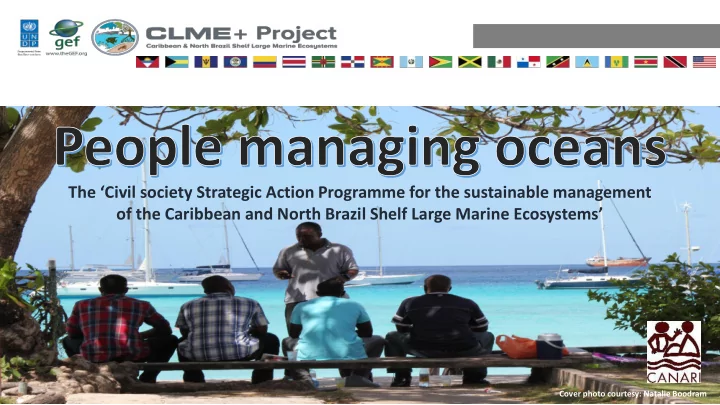
The ‘Civil society Strategic Action Programme for the sustainable management

  • f the Caribbean and North Brazil Shelf Large Marine Ecosystems’

Cover photo courtesy: Natalie Boodram

slide-2
SLIDE 2

Con

  • ntents
  • 1. What is “People managing
  • ceans”?
  • 2. Why is it important?
  • 3. How was it developed?
  • 4. What’s in it?
  • 5. How will it be implemented?
  • 6. Why should civil society endorse

it?

Photo credit: Natalie Boodram

slide-3
SLIDE 3

What is “People managing

  • ceans”?
slide-4
SLIDE 4

People managing oceans

= The Civil Society Action Programme for the Sustainable Management of the Shared Living Marine Resources of the Caribbean and North Brazil Shelf Large Marine Ecosystems (CLME+ C-SAP)

A regional programme for 2018-2030 to strengthen the role, participation and ownership

  • f civil society in management, conservation,

wise use / stewardship, and governance of costal and marine resources

  • 8 strategies
  • 90 associated actions
slide-5
SLIDE 5

Where are we talking about?

The Caribbean and North Brazil Shelf Large Marine Ecosystems

(Source: www.clmeproject.org)

slide-6
SLIDE 6

Who are we talking about when we say “civil society”?

  • Civil society organisations (CSOs) - including

non-governmental organisations (NGOs) and community-based organisations (CBOs)

  • Formal and informal organisations
  • Operating at the regional, national and

local/community levels

  • Including environmental, fisherfolk, women

and youth groups

  • Community-based small and micro

enterprises (SMEs) which have a role to play and/or are likely beneficiaries

Photo credit: CANARI

slide-7
SLIDE 7

Why is it important?

slide-8
SLIDE 8

Why is this important?

Provides a framework for how civil society will contribute to implementation of the politically endorsed regional programme

Aims for a healthy marine environment that provides benefits and livelihoods for the well- being of the people of the region A parallel sub-plan that provides a framework for how civil society will help to address the priorities and actions CLME+ SAP CLME+ C-SAP

slide-9
SLIDE 9

Why is this important to YOU?

  • It’s a framework to help civil society to

link what we are already doing to government priorities

  • It’s a vision to help civil society to

prioritise and focus our work

  • It’s a guide for donors, governments,

researchers and other partners who provide financial and technical support to civil society

slide-10
SLIDE 10

How was it developed?

slide-11
SLIDE 11

A programme developed “by civil society and for civil society”

Photos credit: CANARI

slide-12
SLIDE 12

Wha hat was as the the pr process for

  • r

de development?

  • Development of a Participation and Communication

Strategy

  • Preparation of a database of CSOs and SMEs
  • Preparation of a database of existing relevant

programmes, projects and initiatives targeting CSOs and SMEs

  • Facilitation of a regional workshop in January 2018

with 18 CSOs and SMEs from 14 countries

  • Circulation of a draft C-SAP in May 2018 via direct

emails to the 18 CSOs and SMEs for review

  • Revision of the draft C-SAP based on comments

received

  • Translation of the document
  • Outreach to promote endorsement by civil society -

via targeted emails, regional listservs, social media, virtual webinars, face-to-face meetings, and 3 small grants to leading CSOs/networks

  • Outreach to raise awareness and promote the use of

the C-SAP - via targeted emails and face-to-face meetings
slide-13
SLIDE 13

So what’s in it?

slide-14
SLIDE 14

Strategy 1: Implement ecosystem-based management of reef and associated ecosystems (e.g. seagrass beds, mangroves, reef slopes and coastal lagoons) Strategy 2: Implement an ecosystem-based approach for pelagic fisheries Strategy 3: Implement ecosystem-based management of the Guianas-Brazil continental shelf with special reference to the shrimp and groundfish fishery

Strategies 1-3 are specifically focused

  • n engaging and enabling civil society

to contribute to the management of the three key ecosystem types

Photo credit: CEBSE

slide-15
SLIDE 15

Strategies 4-7 focus on strengthening civil society’s role in participatory governance and management of all three ecosystem types

Strategy 4: Strengthen civil society’s role to conduct and participate in research and monitoring for management of the coastal and marine environment Strategy 5: Strengthen civil society’s participation in governance of the coastal and marine environment Strategy 6: Develop and enhance livelihoods based on the sustainable use of coastal and marine resources Strategy 7: Enhance communication to raise awareness and advocate for issues impacting the coastal and marine environment

Photo credit: CANARI

slide-16
SLIDE 16

Strategy 8 addresses the implementation of the C-SAP

Strategy 8: Facilitate C-SAP implementation, monitoring, evaluation and learning.

Photo credit: CANARI

slide-17
SLIDE 17

How will it be implemented?

slide-18
SLIDE 18

How will implementation need to be supported?

Small Grants Coordination Mechanism to support the implementation of priority actions identified in the C-SAP Database of civil society organisations and relevant projects, programmes and initiatives Knowledge sharing via online platforms Capacity building of civil society

Photo credit: CANARI

slide-19
SLIDE 19

How can you support C-SAP implementation?

Putting the pieces of the puzzle together

✓ Align your work with the appropriate strategies of the C-SAP ✓ Use the C-SAP as a framework to inspire your work ✓ Reference the C-SAP to prove relevance

  • f your work (to donors, governments)

✓ Get others to support implementation of the C-SAP (donors, governments)

slide-20
SLIDE 20

Why should civil society endorse it?

slide-21
SLIDE 21

Why should you endorse the C-SAP?

✓ Demonstrate that civil society should be taken seriously as an implementing partner in sustainable development ✓ Show our commitment to working in partnership with governments and

  • thers

✓ Unify civil society action ✓ Encourage others to support implementation of the C-SAP (donors, governments)

Validation of civil society’s role

Photo credit: CANARI

slide-22
SLIDE 22

How can you endorse the C- SAP?

https://www.surveymonkey. com/r/CLME-C-SAP

✓ Name of civil society

  • rganisation

✓ Contact information

Sign the online form

Photo credit: CANARI

slide-23
SLIDE 23

People managing oceans Thank you!

Access the documents at www.canari.org Download the full C-SAP document English and Spanish and the C-SAP factsheet English and Spanish

Photo credit: CANARI

slide-24
SLIDE 24

The development of the C-SAP is an activity under the Engaging Civil Society in CLME+ SAP Implementation project which is being executed by the Caribbean Natural Resources Institute (CANARI) as a component of the CLME+ Project. The five-year (2015 – 2020) CLME+ Project is being implemented by the United Nations Development Programme (UNDP) and co-financed by the Global Environment Facility (GEF). CLME+ Project co-executing partners: For more information about the Engaging Civil Society in CLME+ SAP Implementation project, including development of the C-SAP, contact Ms. Nicole Leotaud, Executive Director, CANARI at nicole@canari.org