The Circuit Court The circuit court is the trial court of general - - PDF document

the circuit court
SMART_READER_LITE
LIVE PREVIEW

The Circuit Court The circuit court is the trial court of general - - PDF document

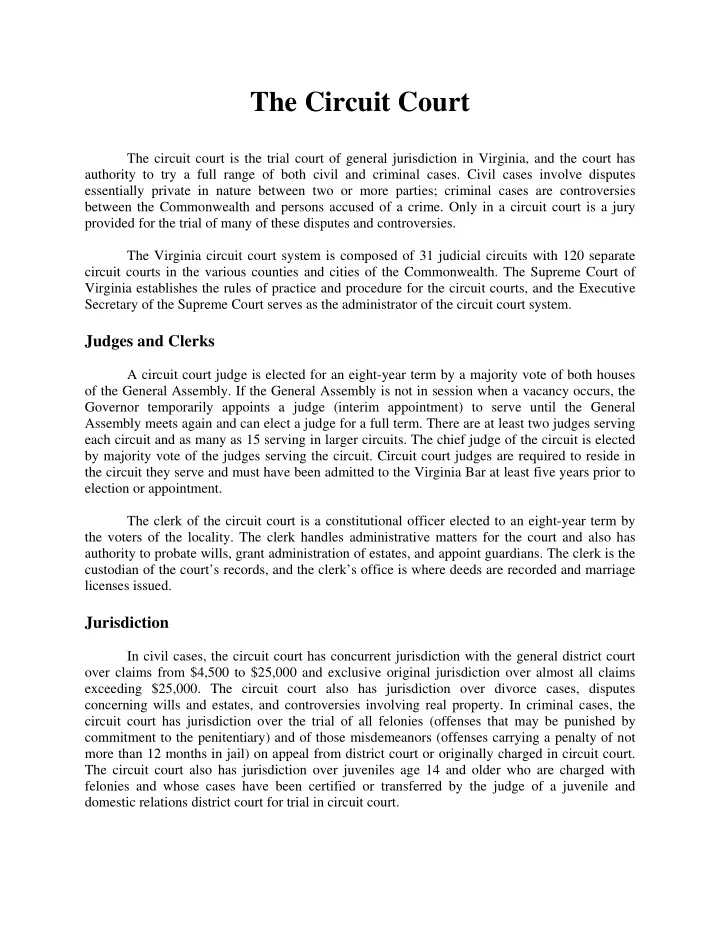
The Circuit Court The circuit court is the trial court of general jurisdiction in Virginia, and the court has authority to try a full range of both civil and criminal cases. Civil cases involve disputes essentially private in nature between two


slide-1
SLIDE 1

The Circuit Court

The circuit court is the trial court of general jurisdiction in Virginia, and the court has authority to try a full range of both civil and criminal cases. Civil cases involve disputes essentially private in nature between two or more parties; criminal cases are controversies between the Commonwealth and persons accused of a crime. Only in a circuit court is a jury provided for the trial of many of these disputes and controversies. The Virginia circuit court system is composed of 31 judicial circuits with 120 separate circuit courts in the various counties and cities of the Commonwealth. The Supreme Court of Virginia establishes the rules of practice and procedure for the circuit courts, and the Executive Secretary of the Supreme Court serves as the administrator of the circuit court system.

Judges and Clerks

A circuit court judge is elected for an eight-year term by a majority vote of both houses

  • f the General Assembly. If the General Assembly is not in session when a vacancy occurs, the

Governor temporarily appoints a judge (interim appointment) to serve until the General Assembly meets again and can elect a judge for a full term. There are at least two judges serving each circuit and as many as 15 serving in larger circuits. The chief judge of the circuit is elected by majority vote of the judges serving the circuit. Circuit court judges are required to reside in the circuit they serve and must have been admitted to the Virginia Bar at least five years prior to election or appointment. The clerk of the circuit court is a constitutional officer elected to an eight-year term by the voters of the locality. The clerk handles administrative matters for the court and also has authority to probate wills, grant administration of estates, and appoint guardians. The clerk is the custodian of the court’s records, and the clerk’s office is where deeds are recorded and marriage licenses issued.

Jurisdiction

In civil cases, the circuit court has concurrent jurisdiction with the general district court

  • ver claims from $4,500 to $25,000 and exclusive original jurisdiction over almost all claims

exceeding $25,000. The circuit court also has jurisdiction over divorce cases, disputes concerning wills and estates, and controversies involving real property. In criminal cases, the circuit court has jurisdiction over the trial of all felonies (offenses that may be punished by commitment to the penitentiary) and of those misdemeanors (offenses carrying a penalty of not more than 12 months in jail) on appeal from district court or originally charged in circuit court. The circuit court also has jurisdiction over juveniles age 14 and older who are charged with felonies and whose cases have been certified or transferred by the judge of a juvenile and domestic relations district court for trial in circuit court.

slide-2
SLIDE 2

The circuit court has appellate jurisdiction over all appeals from the general district court and the juvenile and domestic relations district court. Appeals from these district courts are heard de novo; that is, the cases are tried from the beginning as though there had been no prior

  • trial. The circuit court’s appellate jurisdiction also extends to appeals from certain administrative

agencies.

Grand Juries

The circuit court has the authority to impanel regular, special, and multi-jurisdiction grand juries. A regular grand jury is composed of five to seven citizens of the city or county where the circuit court is located; it is convened at each term of the court for two purposes: (1) to consider indictments prepared by the Commonwealth’s Attorney (the grand jury determines whether there is probable cause to believe that the person accused has committed the crime charged in the indictment and should stand trial), and (2) to investigate and report on any condition that involves or tends to promote criminal activity, either in the community or by any governmental authority, agency, or official. The grand jury hears only the Commonwealth’s side

  • f the case and does not determine the guilt or innocence of the accused.

Members of a regular grand jury must be citizens of Virginia who are at least 18 years of

  • age. They must have been residents of the Commonwealth for one year and of the county or city

in which they are to serve for at least six months. Between 60 and 120 citizens “of honesty, intelligence, impartiality and good demeanor” are summoned annually by the circuit court to serve as grand jurors during the year. A special grand jury is composed of seven to eleven citizens and is summoned by the circuit court. The qualifications for members of a special grand jury are the same as for a regular grand jury. A special grand jury may be impaneled by the circuit court (1) at any time upon the court’s own motion, (2) upon the recommendation of the members of a regular grand jury, or (3) upon the request of the attorney for the Commonwealth to investigate and report on any condition involving criminal activity and to consider bills of indictment. A multi-jurisdiction grand jury involves more than one jurisdiction and is primarily used to investigate drug law violations. It is composed of seven to eleven citizens who are 18 years of age or older and have been residents of Virginia for one year and residents of one of the jurisdictions named in the application for six months. The Chief Justice of the Supreme Court, or any justice designated by the Chief Justice, may order the impaneling of a multi-jurisdiction grand jury for a term of twelve months upon the application of two or more attorneys for the

  • Commonwealth. The impaneling order also designates special counsel who will assist the multi-

jurisdiction grand jury.

Counsel

All litigants (parties) in circuit court cases may be represented by an attorney, or they may choose to proceed pro se (on their own behalf). Those who wish to hire their own attorney may obtain the names and phone numbers of local lawyers from the Virginia State Bar’s Lawyer Referral Service by calling (800) 552-7977 (toll free) or (804) 775-0808. In all felony cases and

slide-3
SLIDE 3

in any misdemeanor case involving the possibility of a jail sentence, an indigent (poor) defendant may have a lawyer appointed by the court. In such a case, the court must first determine that the defendant cannot afford a lawyer. The Commonwealth pays the court-appointed lawyer, but if the defendant is found guilty, the amount will be charged to the defendant as part of the court costs and entered as a judgment against the defendant. In criminal proceedings, the Commonwealth is represented by the Commonwealth’s Attorney who prosecutes the case.

Procedure

To begin a civil action in a circuit court, the person bringing the case (plaintiff) files a complaint in the circuit court clerk’s office. The person against whom the case is brought (defendant) has 21 days after being served with process (notified of the suit) to respond to the

  • complaint. The defendant’s response is called an answer. A defendant who does not respond

within the allotted time is in default, which means the facts alleged in the complaint are deemed admitted and judgment may be awarded to the plaintiff. A defendant in a civil case also has other options for a response, including a counterclaim against the plaintiff or a cross-claim against another defendant. Both of these pleadings (claims) also require a response within 21 days. In a criminal case involving a felony, the person accused usually is arrested on a warrant and brought before a magistrate. The magistrate may either commit the accused to jail pending a hearing or release the accused on bail. A preliminary hearing is then held in district court to determine if there is probable cause to believe the accused has committed the crime charged. If probable cause is found, the case is certified (sent) to the grand jury. If the grand jury also finds probable cause, an indictment is returned. Following indictment, the accused is arraigned; that is, the charges are read and the accused enters a plea of guilty, not guilty, or nolo contendere (no contest). An accused may be first charged with a felony by grand jury indictment; in such cases, no preliminary hearing is held in district court.

Jury vs. Non-Jury

The Constitution guarantees an accused the right to a jury selected from a cross-section of the community. The venire, or list of prospective jurors summoned for a particular term of court, must reflect the composition of the community as a whole and may not discriminate by race, color, creed, or sex. In the final selection of a jury, prospective jurors may be removed from the panel if they have expressed or formed any opinion, bias, or prejudice that might interfere with their rendering a fair and impartial verdict. Also, each side is allowed to strike three or four jurors (depending on the type of case) for no given cause. Members of a circuit court jury are selected from a master list prepared by jury commissioners appointed by the circuit court. The master list is developed by random selection from the voter registration list and other lists of citizens of the city or county, which the circuit court serves.

slide-4
SLIDE 4

In criminal prosecutions, the accused is entitled to a trial by jury only on a plea of not

  • guilty. On a plea of guilty or nolo contendere, the case is heard and determined by the judge. An

accused who pleads not guilty may, with the consent of the court and the Commonwealth’s Attorney, waive the right to a jury trial and have the case decided by the judge. In civil matters, cases involving non-monetary claims (such as divorce and estate administration) are generally heard by a judge alone. Most civil cases involving monetary claims may be heard by the judge or, at the request of any party, by a jury.

Fines, Costs and Fees

Fines collected in circuit court for the violation of state laws are paid into the state treasury where they are credited to the Literary Fund. The Literary Fund is a permanent and perpetual school fund established and required by the Constitution of Virginia. Fees for civil actions are payable by the person filing the claim. In criminal cases, fees and costs are collected from the defendant if found guilty. If the defendant is acquitted or the case is not prosecuted, fees and costs are paid either by the Commonwealth or the locality. Examples of costs include compensation for court-appointed attorneys, witnesses, money for the Criminal Injury Compensation Fund, blood analysis, jurors, and interpreters. Fees for recording

  • r filing documents are paid by the party filing the document.

Appeals

The final decision of the circuit court may be appealed to either the Supreme Court of Virginia or the Court of Appeals of Virginia, depending upon the type of case involved. Death penalty, lawyer disbarment, and most civil cases are appealed to the Supreme Court. Death penalty and disbarment case appeals are a matter of right, while civil appeals are commenced by filing a petition for appeal. Traffic infraction, criminal (except death penalty), and domestic relations cases are appealed to the Court of Appeals. Criminal and traffic infraction appeals are by petition for appeal, while domestic relations cases are as a matter of right.

slide-5
SLIDE 5

THE VIRGINIA JUDICIAL SYSTEM

CLERK EXECUTIVE SECRETARY MAGISTRATE SYSTEM SUPREME COURT OF VIRGINIA

Court of Final Resort Chief Justice and 6 Justices

CIRCUIT COURTS

Highest Trial Court with General Jurisdiction 31 Circuits – 120 Courts

GENERAL DISTRICT COURTS

Trial Court with Limited Civil/Criminal Jurisdiction Courts in all 32 Districts

JUVENILE & DOMESTIC RELATIONS DISTRICT COURTS

Trial Court with Limited Civil/Criminal Jurisdiction Courts in all 32 Districts

COURT OF APPEALS

Intermediate Appeals Court 11 Judges

COMMITTEE ON DISTRICT COURTS JUDICIAL COUNCIL JUDICIAL CONFERENCE OF VIRGINIA (COURTS OF RECORD) JUDICIAL CONFERENCE OF VIRGINIA

FOR DISTRICT COURTS

Judicial Policy Making Bodies

STATE BOARD OF BAR EXAMINERS

Lawyer Licensing

VIRGINIA STATE BAR

Lawyer Discipline Lawyer Referral Service

JUDICIAL INQUIRY AND REVIEW COMMISSION

Judge Discipline

VIRGINIA CRIMINAL SENTENCING COMMISSION

Sentencing Guidelines

Web site revision 8/2016

slide-6
SLIDE 6

VIRGINIA’S JUDICIAL SYSTEM Notice Regarding the Americans with Disabilities Act and Requests for Accommodations by Persons with Disabilities The Americans with Disabilities Act (ADA) of 1990 was enacted to ensure that all qualified individuals with disabilities enjoy the same opportunities that are available to persons without disabilities. It guarantees equal opportunity for individuals with disabilities in public accommodations, employment, transportation, state and local government services, and

  • telecommunications. The ADA directly affects state courts as providers of public programs and services. In accordance with the

requirements of Title II of the Americans with Disabilities Act of 1990, 42 U.S.C. § 12101 et seq., the Supreme Court of Virginia and the courts of the Commonwealth of Virginia (collectively referred to as “Virginia’s Judicial System”) will not discriminate against qualified individuals with disabilities on the basis of disability in its services, programs, or activities. Virginia’s Judicial System does not discriminate on the basis of disability in its hiring or employment practices and complies with all regulations promulgated by the U.S. Equal Employment Opportunity Commission under Title I of the ADA. Effective Communication: Virginia’s Judicial System will generally, upon request, provide appropriate aids and services for qualified persons with disabilities so they can participate equally in Virginia’s Judicial System programs, services, and activities, including qualified interpreters, and other ways of making information and communications accessible to people who have speech, hearing, or vision impairments. Modifications to Policies and Procedures: Virginia’s Judicial System will make all reasonable modification to policies and programs to ensure that people with disabilities have an equal opportunity to enjoy all of its programs, services, and

  • activities. For example, individuals with service animals are welcomed in Virginia’s courts, even where pets are generally

prohibited. Requests for Accommodation: A request for accommodation should be made to the relevant clerk if the request relates to a pending case or activity of a particular court. Otherwise, the request should be made to the ADA Coordinator at the address

  • below. Procedures for making a request, as well as a form for doing so, are available through the ADA Coordinator and on

Virginia’s Judicial System website, www.vacourts.gov. No requirement to alter programs and services: The ADA does not require Virginia’s Judicial System to take any action that would fundamentally alter the nature of its programs or services or impose an undue financial or administrative burden. Complaints regarding accessibility: Complaints concerning a program, service, or activity of a circuit court clerk's office should be directed to that clerk. Other complaints will be handled pursuant to grievance procedures adopted by the Office of the Executive Secretary. The procedures are available through the ADA Coordinator, and on Virginia’s Judicial System website, www.vacourts.gov. No surcharge: Virginia’s Judicial System will not place a surcharge on a particular individual with a disability or any group of individuals with disabilities to cover the cost of providing auxiliary aids/services or reasonable modifications of policy, such as retrieving items from locations that are open to the public but are not accessible to persons who use wheelchairs. Questions about this Notice – Please submit your questions to: ADA Coordinator Renée Fleming Mills, Ph.D. Office of the Executive Secretary Supreme Court of Virginia 100 N. 9th Street Richmond,Virginia 23219 Fax: 804-786-0109 E-mail: ADACoordinator@vacourts.gov

ADA Master 4/19