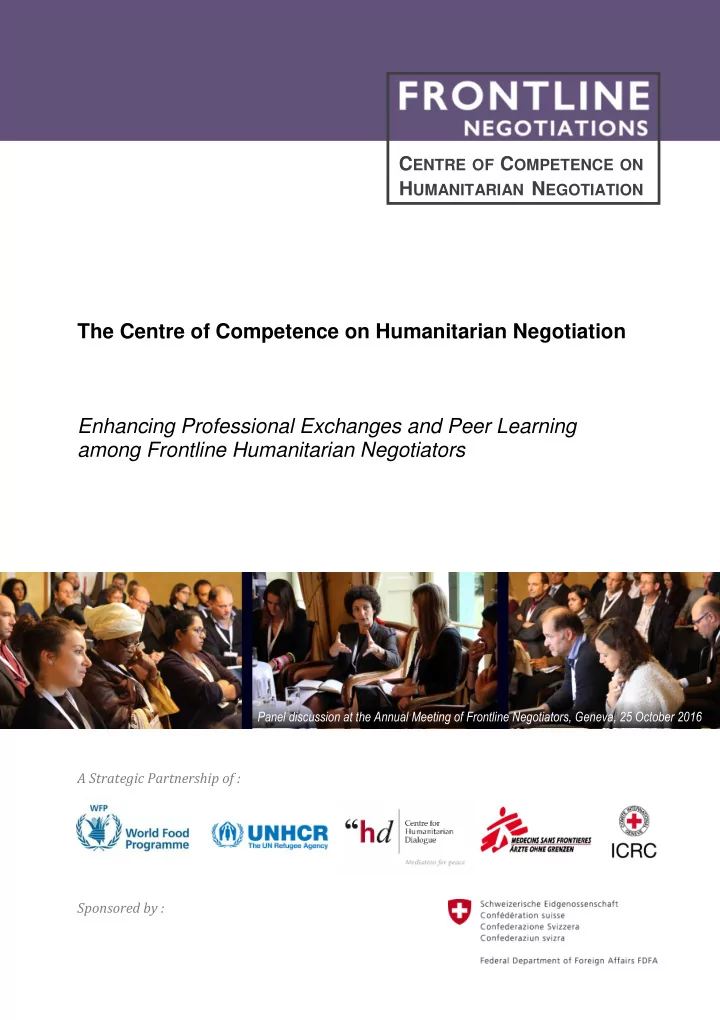
SLIDE 1
The Centre of Competence on Humanitarian Negotiation Geneva January 2017 2 / 8
Frontline humanitarian negotiations take place in highly contextual, confidential and personal
- environments. As a result, humanitarian
negotiators as talented they may be often work in isolation from each other and enjoy only limited access to information and discussions
- n peer practices.
Yet, professionals engaged in humanitarian negotiations increasingly recognize commonalities in negotiation practices in complex environments – both within a given conflict and across conflict situations. The multiplicity of humanitarian actors and their growing interdependence on the ground imply a greater need for sharing of experience and peer learning in assistance and protection negotiations. Indeed, negotiators are increasingly aware of the impact of other negotiation efforts on the outcome of their own. Humanitarian negotiations are inherently chal- lenging taking place with often-unpredictable actors under considerable time pressure as well as political, security and institutional con-
- straints. As humanitarian organizations expand their operational outreach and en-
gage with a growing number and variety of actors, the task of negotiating access has become a central part of their activities and the crucial point at which humanitarian principles intersect with field practices. International humanitarian law and the underlying humanitarian principles provide an important framework for such
- negotiations. Humanitarian
negotiations imply a shared sense
- f
responsibility among the parties toward reaching the desired huma- nitarian outcome as well as a common understanding
- f each other’s motivations
and goals. Defining Humanitarian Negotiation Humanitarian negotiations are defined as interactions with parties to a conflict and other relevant actors aimed at establishing the presence
- f
humanitarian agencies in conflict environments, ensuring their access to vulnerable groups and facilitating the delivery
- f
assistance and protection
- activities. These negotiations take
place at the field level for the most part and involve both state and non-state actors. They encompass an advocacy component relative to the protection of affected popul- ations as well as a transactional component in setting the logistical and tactical parameters
- f