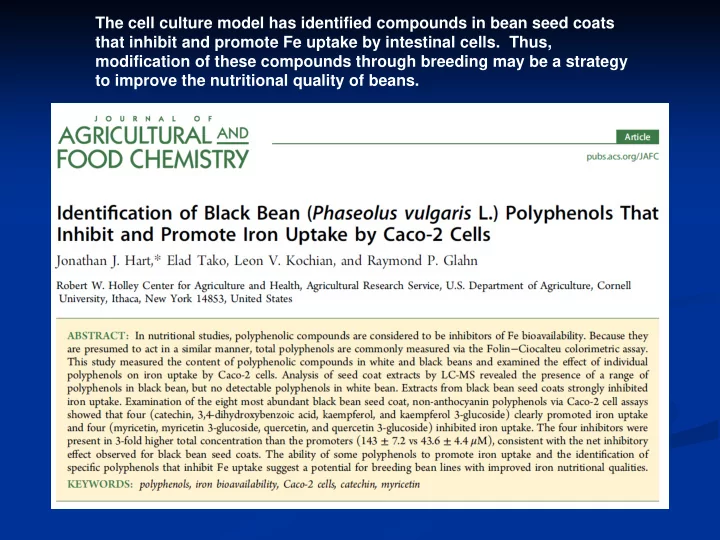
The cell culture model has identified compounds in bean seed coats that inhibit and promote Fe uptake by intestinal cells. Thus, modification of these compounds through breeding may be a strategy to improve the nutritional quality of beans.
The cell culture model has identified compounds in bean seed coats - - PowerPoint PPT Presentation
The cell culture model has identified compounds in bean seed coats that inhibit and promote Fe uptake by intestinal cells. Thus, modification of these compounds through breeding may be a strategy to improve the nutritional quality of beans. To
12 Entries 4 Market classes 3 Different cooking classes Representing: East and South Africa, Caribbean, North America Measured post-harvest & after 1 year in storage Encompasses the cooking time spectrum measured in the ADP (18 – 90 min) Grown in US, Africa and Puerto Rico To address the need for faster cooking beans with improved Fe nutrition, ARS scientists selected 12 promising varieties from the Andean Diversity Panel for further development. This group is known as the “The Health & Nutrition Panel Model.” Studies on harvest, cooking time, nutritional quality and consumer acceptability are ongoing in Uganda, East Lansing, Michigan and Ithaca, NY
Cranberry Red Mottled L Red Kidney Yellow
ADP 469 PI527521 17 mins ADP 452 INIAP425 18 mins ADP 512 Ervilha 18 mins ADP 521 Cebo, Cela 18 mins ADP 518 Mant. Blanca 19 mins ADP 520 Chumbo Cela 23 mins ADP 523 Canario, Cela 26 mins ADP 111 Uyole 98 26 mins ADP 781 L11YLO12 27 mins ADP 779 CDC-Soi 30 mins ADP 513 Canario 32 mins Y11405 J. Kelly 32 mins ADP 468 PI527521 35 mins ADP 522 Amarelo, Cela 73 mins ADP 761 Uyole 04 21 mins DBY-28-1 J. Myers 34 mins
A Yellow Diversity Panel (Goal: 50+ Genotypes)
Figure 4. Scatter plot showing a strong relationship between the cooking time of yellow genotypes (n = 14) and iron bioavailability measured as the production of Caco-2 cell ferritin protein (determined by ELISA) following in vitro digestion of lyophilized cooked whole seed. Two fast cooking white kidney genotypes are included as reference controls. Values include two field replicates per entry for season 2015 at Montcalm Research Farm, MI.
Fast-cooking trait is linked to higher Fe bioavailability!
Field Locations in Uganda
Three districts (Hoima, Kamuli, and Masaka) representing 3 agro-ecological zones in Uganda
Cooking Time Across 9 Field Locations in Uganda
10 20 30 40 50 60 70
1 2 3 4 5 6 7 8 9
Cooking Times (min)
Field Location
Ervilha PI527521
ID District Site 1 Hoima Kyamaleera 2 Kakindu 3 Tugonzengane 4 Kamuli Katugezeeku 5 Tweweeyo 6 Tweyunge 7 Masaka Balitwewunya 8 Rakai AgaliAwamu 9 Kiyovu ADP 512 Ervilha Fast Cooking ADP 468 PI527521 Slow Cooking Bean Harvest in Rakai, Dec 2015 Photo: K. Cichy, USDA-ARS
Bean pasta: Fast cooking / high color lines
FIGURE 1 Light microscopy pictures
- f cotyledon cells from (a)cooked
beans and (b) from human ileal content recovered 3 h after ingestion of the beans. Digestion of Carbohydrate from White Beans (Phaseolus vulgaris L.) in Healthy Humans. Noah et al. (1998) J. Nutr.
Figure 3. A microscopic image of cooked trypan blue stained cotyledon cells from white (navy) bean seeds following in vitro gastric and intestinal digestion (magnification 80Å~). This image illustrates how the low pH and enzymes of the gastrointestinal tract have little effect on the intact cell wall
- structure. Glahn et al., Food Funct. 2016
DOI: 10.1039/c6fo00490c
Fact: Fe in Beans Seed Coat: 4 - 20% Embryo: approx. 1 - 4% Cotyledon: 71 - 95% Conclusion: The cotyledon cell wall is a bioavailability factor, assuming that the major site of Fe absorption is the upper small intestine and that more distal Fe absorption capabilities are minimal.