
SLIDE 1
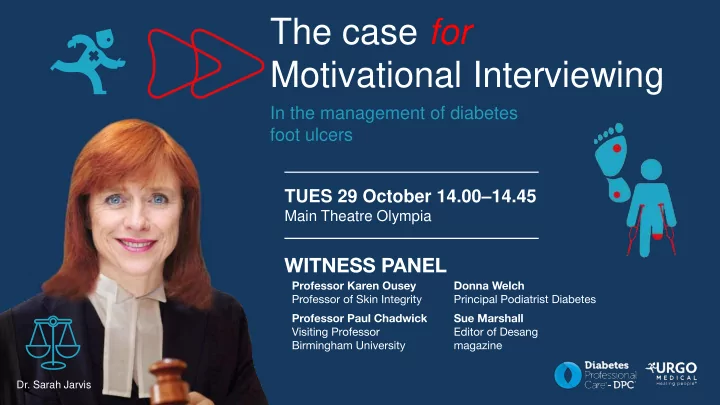
The case for Motivational Interviewing
In the management of diabetes foot ulcers
- Dr. Sarah Jarvis
TUES 29 October 14.00–14.45
Main Theatre Olympia
The case for Motivational Interviewing In the management of - - PowerPoint PPT Presentation
The case for Motivational Interviewing In the management of diabetes foot ulcers TUES 29 October 14.00 14.45 Main Theatre Olympia Dr. Sarah Jarvis Motivational Interviewing vs Scare Tactics Welcome Dr. Sarah Jarvis Motivational
In the management of diabetes foot ulcers
TUES 29 October 14.00–14.45
Main Theatre Olympia
The case AGAINST Motivational Interviewing
Prof Paul Chadwick
Visiting Professor Birmingham University 4
20%
15%
5%
20% Increased risk Regular ‘foot protection’ 5% Active ulcers or infection Revascularisation or amputation Multidisciplinary foot care team management 60% Low risk Routine annual screening 15% High risk
Ivory tower / real world Is it the profession
Evidence
9% 87% 4%
Patients
Do you want us to continue to use the poster and leaflet campaign with patients (T=55)
No Yes Abs 14% 72% 14%
Clinicians
Do you want to continue to use the poster and leaflet campaign with patients (T=29)
No Yes Abs
(Fox & Smith, 2018)
X X X X ?
DFD-prevention is lacking (Binning et al. 2018)
research GAP!
The case FOR Motivational Interviewing
Prof Karen Ousey
Professor of Skin Integrity University of Huddersfield 18
Professor of Skin Integrity University of Huddersfield
professional every year
In one year the diabetes transformation fund has led to an extra:
staff in inpatient teams
available
programmes
across 80 hospitals
DUK:
at King’s College Hospital
amputations had halved
reducing ‘diabetes burnout’
What is it?
➢ How we speak to people ➢ Listening and understanding ➢ The person who has the problem has the answer to solving it ➢ People only change their behaviour when they feel ready - not when they are told to do so ➢ Solutions - person centred are the most enduring and effective
Process
view
change
about, change
steps that the individual is willing to take
Resist the urge to change the individual’s course of action through didactic means
Understand it’s the individual’s reasons for change, not those of the practitioner, that will elicit a change in behaviour
Listening is important; the solutions lie within the individual, not the practitioner
Empower the individual to understand that they have the ability to change their behaviour2
not get a DFU
I will wear the correct footwear
wearing no shoes
Menu of diabetes topics YOUR MEDICATIONS YOUR FOOD YOUR EXERCISE YOUR BLOOD SUGAR MONITORING Please pick one topic for discussion today
than other people without the condition
complications from diabetes
lot of behaviour change for most patients
reflex” and overly rely on a directing style
person who is ambivalent about it, a natural response is to defend the other side
The case AGAINST Motivational Interviewing
Donna Welch
Principal Podiatrist Diabetes
Donna Welch
Principal Podiatrist Diabetes
The case FOR Motivational Interviewing
Sue Marshall
Editor of Desang magazine 35
In the management of diabetes foot ulcers