
SLIDE 1
The Brain
Part 1/3
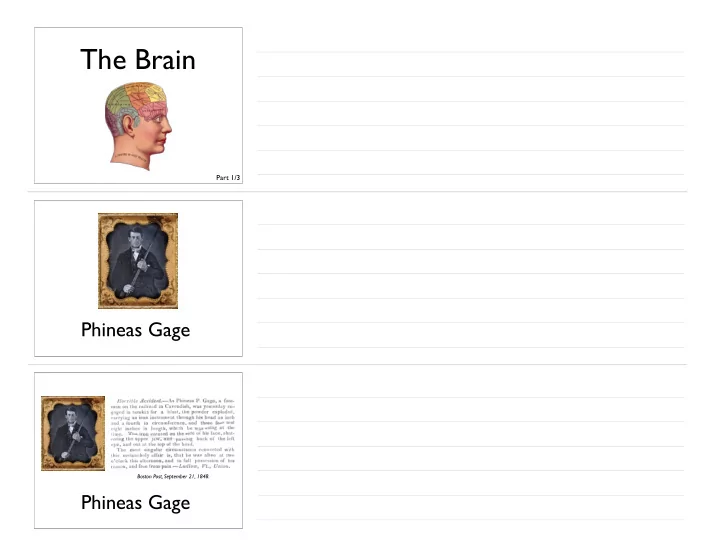
Phineas Gage Phineas Gage
Boston Post, September 21, 1848.
The Brain Part 1/3 Phineas Gage Boston Post, September 21, 1848. - - PowerPoint PPT Presentation
The Brain Part 1/3 Phineas Gage Boston Post, September 21, 1848. Phineas Gage You 17th Century BC Ancient Egyptians report first surgeries, including brain (Edwin Smith surgical manuscript) but didnt seem to think it was very
Part 1/3
Boston Post, September 21, 1848.
17th Century BC
Ancient Egyptians report first surgeries, including brain
(Edwin Smith surgical manuscript)
…but didn’t seem to think it was very important!
Aristotle (4th Century BC)
Brain: Cooling mechanism for blood Heart: The seat of intelligence
What is the relation between brain and mind? How does the brain work? How is it organized? How do we investigate the brain to answer psychological questions?
What is the relation between brain and mind? How does the brain work? How is it organized? How do we investigate the brain to answer psychological questions?
The Astonishing Hypothesis is that “You”, your joys and your sorrows, your memories and your ambitions, your sense of personal identity and free will, are in fact no more than the behavior of a vast assembly of nerve cells and their associated molecules…you’re nothing but a pack of neurons. This hypothesis is so alien to the ideas of most people alive today that it can be truly called astonishing.
The belief that, while bodies are material, minds are immaterial
Rene Descartes
(1596-1650)
“I knew that I was a substance the whole essence or nature of which is to think, and that for its existence there is no need of any place, nor does it depend on any material thing … that is to say, the soul by which I am what I am, is entirely distinct from my body.”
Dualism is a natural, intuitive view…
Dualistic Language
“my arm” “my hair” “my heart” “my brain”
…but it is wrong about the mind
Mind-Altering Drugs Other Animals
…but it is wrong about the mind
Brain Damage = Mind Damage
…but it is wrong about the mind
What is the relation between brain and mind? How does the brain work? How is it organized? How do we investigate the brain to answer psychological questions?
What is the relation between brain and mind? How does the brain work? How is it organized? How do we investigate the brain to answer psychological questions?
Up next: Part 2/3
Part 2/3
What is the relation between brain and mind? How does the brain work? How is it organized? How do we investigate the brain to answer psychological questions?
What is the relation between brain and mind? How does the brain work? How is it organized? How do we investigate the brain to answer psychological questions?
The brain is organized
Franz Josef Gall
(1758-1828)
Wrong about bumps & traits Right about localization & specialization
Right about localization & specialization
Cerebral Cortex
Frontal Lobe Temporal Lobe Parietal Lobe Occipital Lobe
reasoning planning motivation movement language bodily awareness mostly vision memory reward meaning
much more…
… … … …
Sagittal Horizontal Coronal
Basal Ganglia
habitual action
Thalamus
sensory gateway
Hippocampus
long-term memory
Cerebellum
fine motor skills
Amygdala
emotion (especially fear)
Hypothalamus
homeostasis
Cell Body Axon Dendrites
Axon Terminals
Synapse
~100,000,000,000 neurons
Steven Pinker
“Brain cells fire in patterns”
1000010111001011000011101001 1101110010010011000111100101
What is the relation between brain and mind? How does the brain work? How is it organized? How do we investigate the brain to answer psychological questions?
What is the relation between brain and mind? How does the brain work? How is it organized? How do we investigate the brain to answer psychological questions?
Up next: Part 3/3
Part 3/3
What is the relation between brain and mind? How does the brain work? How is it organized? How do we investigate the brain to answer psychological questions?
What is the relation between brain and mind? How does the brain work? How is it organized? How do we investigate the brain to answer psychological questions?
“Nature’s Experiments”
Stroke
Wilder Penfield
(1891-1976)
Treated epilepsy by destroying brain tissue where seizures originated Under local anesthesia, stimulated brain; asked patients what they felt
Wilder Penfield
(1891-1976)
“a mother told me she was suddenly aware, as my electrode touched the cortex, of being in the kitchen listening to the voice of her little boy who was playing outside in the yard” “Map” of body
Cortical Magnification
increased sensitivity
Karl Lashley
(1890-1958)
JHU Class of 1911
Removed pieces of brain from rats No matter where tissue was taken from, rats could still learn a maze! Equipotentiality: One part of the brain can carry out functions lost by destruction of other parts
Karl Lashley
(1890-1958)
JHU Class of 1911
functional Magnetic Resonance Imaging
Blood Flow Seconds
2 4 6 8 10 12 14 16
Event What fMRI detects
A measure of the consequences, several seconds later, of many neurons firing
Where (and how much) your brain is doing something
Love happens in…your brain! …what else could you blame?
Fusiform Face Area
Faces are processed in your brain Your brain has a specialized “face perception” center
vs.
Wrong about bumps & traits Right about localization & specialization
Franz Josef Gall
(1758-1828)
Fusiform Face Area Can fMRI tell us things we couldn’t know otherwise? Yes!
Can fMRI tell us things we couldn’t know otherwise? Yes!
Karl Lashley
(1890-1958)
JHU Class of 1911
Removed pieces of brain from rats No matter where tissue was taken from, rats could still learn the maze!
Karl Lashley
(1890-1958)
JHU Class of 1911
Removed pieces of brain from rats No matter where tissue was taken from, rats could still learn the maze! Can’t do anything like this in humans…
Marina Bedny
JHU Class of 2001 (Now a Prof. here in PBS!)
Can fMRI tell us things we couldn’t know otherwise? Yes!
Can fMRI tell us things we couldn’t know otherwise? Yes!
Vegetative State
unresponsive wakefulness Can recover in weeks, or remain for decades (Persistent Vegetative State) “lights are on but nobody’s home”
Motor planning Spatial navigation
“Imagine playing tennis…” “Imagine walking through your house…”
“Do you have any sisters?” YES: Imagine playing tennis NO: Imagine walking through your house 5/6 questions “correct”!
(6th showed no activity)
Just 1 out of 55 patients
5/6 still not that great
(would happen 11% of the time by chance alone)
Could still be a dream-like state