
SLIDE 1
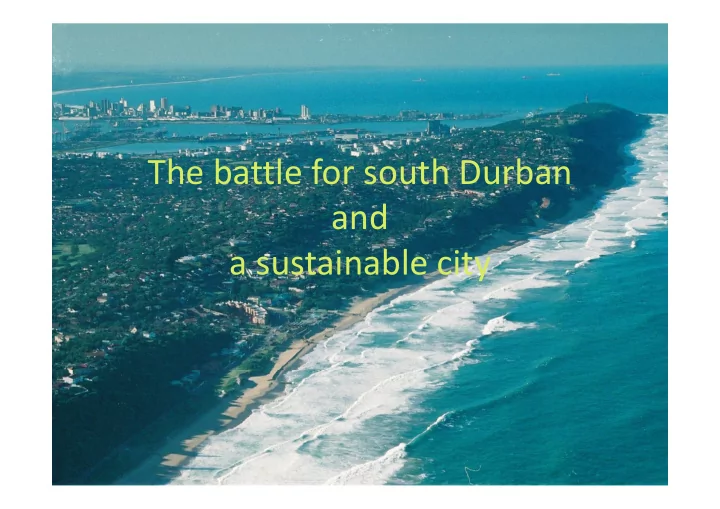
The battle for south Durban and a sustainable city Environmental - - PowerPoint PPT Presentation
The battle for south Durban and a sustainable city Environmental & community impacts 1950s Why south Durban communities are fed up more than 100 year of oppression Indentured labour system to secure labour for sugar estates 1858
1950s
sugar estates 1858 first arrivals – 1911 100 000 Indian immigrants remain making a living in market gardening, fishing and hawking
Natal poll tax in 1904, forcing unmarried black men
to seek waged work in the city. Subject to regulations including worker registration fees, a 9pm curfew, designated residential barracks and strict penal system for any ‘disorderly’ conduct.
Maydon Wharf, followed by the Congella industrial estate.
expanded the municipal boundaries to include the south Durban basin – jurisdiction of town planning legislation to designate the area as industrial
eastern shores of the bay at Island View for fuel storage tanks, railway was constructed around the bay.
acres at Wentworth in 1925 and another 425 acres from the Bayhead south in 1931 for large- scale industrial and worker housing developments.
swiftly in the areas that had been identified for industry
railways, shipping and industry be integrated in south Durban and that reclamation, dredging and canalisation take place to provide usable industrial land.
for Durban in 1952
reducing the water area of the bay by half.
covert Council acquired 148 acres of land in Clairwood in the 1960s, resulting in creeping industrialisation and the gradual degradation of the area.
alongside the Umlaas canal for a paper factory.
The suburb of Clairwood has been an exceptional in resisting industrialisation. Settled by Indian immigrants in the 1920s, people worked hard to develop their own housing and cultural amenities. The Apartheid Council’s attempts to rezone Clairwood as an industrial area, beginning in 1956, met with growing resistance. In the early 1960s, government began a more covert campaign to coerce people out of Clairwood through surreptitious land purchases and expropriation – within 21 months many communities were destroyed and relocated as the first residents in the new ‘Indian area’ of Chatsworth. Clairwood’s population dwindled from an estimated 50000 in the early 1960s to a mere 6000 by 1970. In this way the Council acquired 148 acres of land in Clairwood for industry.
not studies
Agenda 21 – were not included.
Organic Carbon’s (VOC’s), Nitrous Oxides (NOx’s) and heavy metal’s as a result of heavy industrial development in South Durban.
accepted despite the SEA air pollution study finding that SO2 concentrations were 2-4 times higher than WHO standards.
than stricter pollution control and enforcement, the consultants proposed the relocation
develop a new international airport to the north of Durban. In the face of community
expansion into residential areas and at the airport site. The socio-economic impacts
South Durban Basin Spatial Development Framework December 2004
Currently broad strategic spatial development planning for: Southern planning region: Umlaas Canal south to the eThekwini boundary Draft plans submitted to Council. Public consultation at end of 2008 for final approval in December. Central planning region: Umlaas canal north to the Umgeni River mouth. Still at a rudimentary stage, but will take the South Durban Spatial Development Framework into account.
single mothers.
properly designed housing to stem the tide of social problems (drug trafficking, shebeens, gangs and violence. ) “Dilapidation contributes to a sense of neglect and hopelessness”
longest
problems that bring pests
Greater subsidies for basic services for the poor including water, electricity, schooling – cross- subsidise from high users
industries)
and SAPREF (Shell and BP) oil refineries, Island View chemical tank farm, the Mond paper mill and the AECI chemical At least 500 000 people impacted
R250 bill for Port expansion alone Claim 130 000 jobs ??? [R1.9 million/job created]
breeding ground for reef associated and migratory marine fish.
species of endangered, migratory birds rest and feed here. (9 species are already extinct.)
Umgeni 1987