
SLIDE 1
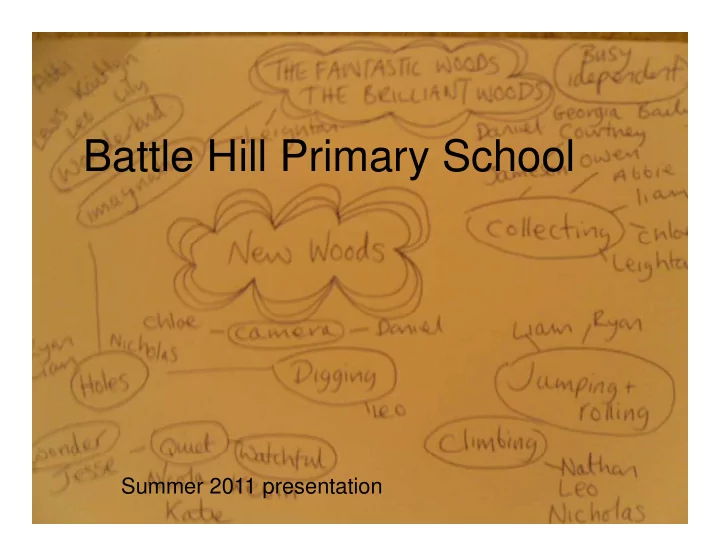
Battle Hill Primary School y Summer 2011 presentation Battle Hill - - PowerPoint PPT Presentation
Battle Hill Primary School y Summer 2011 presentation Battle Hill Primary School Th The percentage of pupils entitled to take free t f il titl d t t k f school meals is twice the national average. The percentage of pupils with
allow more time to get ready allow more time to get ready.
laid out and the parents help children to get ready laid out and the parents help children to get ready.
social time and allows time for staff to see how relations work social time and allows time for staff to see how relations work between the parents and children.
t e beg g e ad 3 pa e ts atte d t e st S g t es meeting, now on a weekly basis parents are asking questions and showing an interest in the woodland experience.
in The Beehive.
It is also where we carry out our i htli t k sightlines tasks.
into the Beehive and then the junk into the Beehive and then the junk modelling area outside, however this led to the children not making much use of either area, so we decided to merge the two areas together and this merge the two areas together and this has now been done successfully.
afternoon, the children spend time discussing their morning in the woods, g g , reflecting on the photos and any special things they have found.
‘that’s me” aspect of the photos and talk about why they have chosen to do something and how they can move something and how they can move forward with that task. They are really beginning to share the experience that their friends have had in the woods.
children to ask more open ended ti i di d questions, encouraging discovery and engagement
have approximately 20 minutes on the bus to discuss the have approximately 20 minutes on the bus to discuss the morning.
Sightlines time Sightlines time
woods
and children are not involved – how can we involve them?
Now our lower ability core group have become the educators
f ff? inform and educate other staff?
In 1956 Rachel Carson wrote In 1956 Rachel Carson wrote “If a child is to keep alive his inborn sense of wonder...he needs the companionship
can share it, rediscovering with him the joy,mystery and excitement of the world we live in” we live in
Daniel suggests to Jessie he takes the found treasure ‘Back to school and make ‘loveliness’
Some children take time to become familiar and confident with the a a a d co de t t t e woodland setting and the routines associated with it. But as they do, they develop ownership of the wood, which encourages relaxation and comfortableness with it, a relationship with their woodland setting at their own pace.
“Imagination is more important than knowledge. For knowledge is limited to all we know and understand, while imagination embraces the entire world and all there ever will be to know and understand” Albert Einstein and all there ever will be to know and understand Albert Einstein
Building a spaceship Building a spaceship Building houses on the new world Setting a trap to catch a fox
Liam ‘Lets build a spaceship’ Nathan ‘Need long long wings’ f f Nathan stayed on task for most of the session telling anyone who would listen how they had built the spaceship and the adventures he would have on a new world. he would have on a new world. Nathan to Leighton and Ryan ‘We spent a lot of money on it. I’m only having good people on my spaceship.’ g g p p y p p Nathan ‘Now get in, that’s the best bit. I’m the driver.’ He presses onto a pine cone ‘Take off. PREPARE FOR TAKE OFF’ Bailey ‘10 9 8 7 6 5 4 3 2 1 blast off’
Jameson ‘We’re going to the moon’ Nathan ‘We’re going to a new world to live O
had everyone organised building houses Nathan ‘We’ve got this for our new world. It’s the top of the roof’ top of the roof Bailey held up leaves ‘We have to eat’ Nathan ‘The new world is cool. We have to have police to watch that people are not going to be police to watch that people are not going to be naughty in our world.’
borrow you to watch everybody. If anyone destroys it come straight away!’
Leighton ‘Me and Mr Williams walked into
Me and Mr Williams walked into another woods we had to come back cos it was scary. We heard it. I didn’t smell it but Mr Williams did! We had but Mr Williams did! We had to be very quiet. We saw some feathers so the bird must have been eaten by the y
so we came back. I’m going to see if we can find it next week ’ week.
The children have ideas on how best to catch a fox
Leighton “Get some junk make a pretend one put him in a cave and then the real fox will find him. Or dig a big beach cave and then the real fox will find him. Or dig a big beach hole like I did at the beach last week then he would fall in.” Nathan “Well I have an idea, if we hide he won’t see us, th h h j t t i k hi ” then when he comes we can jump out, trick him.” Leighton “Yeah lets make a big tent to hide in, we could leave fox food. Nathan “They eat birds and rabbits” Leighton “No get a worm then the birds would come Leighton No get a worm, then the birds would come
Nathan “If you get a bird on your finger then you lick it you’ll get sick! I know, when we’ll find him -when it’s time to get busy!” Leighton “Shall we be army boys and catch him?” Leighton Shall we be army boys and catch him? Nathan “No we’ll use our imaginations’”
Adam thinks maybe the best way to catch a fox is to dig a hole Adam ‘A really, really big hole’ Leo ‘Well the Fox is this big (held
Adam I need a bigger hole. Sandra look I’ve made a big hole. My hole will still be here next week. I am making a deep hole, when the fox comes in we’ll trap him. The ground is to hard to dig so the boys do some problem solving coming to the conclusion that if you quietly sit up high the fox will come to you. Nathan ‘I can see up high. Cant see anything but trees. I can see far
THERE!
Ryan asks “Will we ever catch the fox?”
A fox stole is introduced to the children. Their response is one of curiosity and d wonder Is he real? Is he dead? Is he alive? Why is he like this? Why is he like this? I want to kiss him, Will he bite me?
Back in school there are more questions about the fox. Nicolas inspects it with a magnifying glass and asks ‘Why is it so flat and where is it’s bum and where’ hi t il? his tail? Liam “I know, old ladies wear him around their necks like necklaces.” Owen “How do you know that?” Liam “Bob told me!” Liam Bob told me! We talk about whether it’s a good idea to kill animals and wear them Courtney says “But if it was still alive it would claw and bite you!” Lewis “If he was still alive he could jump on you” Lewis If he was still alive he could jump on you Nathan wants to know who killed him “Maybe it was Robin Hood with his arrows” Lewis asks ‘Why would Robin Hood kill a Fox? That’s not what he does” Nathan “Well someone did kill him I know that!”
At school we talk about how to catch the fox using different methods. The children made books drawing up their plans. B il ‘Thi i th f t d f h d Baily ‘This is the fox trap made of hard
sellotape, string and sellotape to make it stronger ‘ stronger Nathan ‘My idea is to build a big hole and the fox goes in’ Adam ‘Up in the sky use a ladder’ Nathan ‘The ladder wont be strong enough. The only thing that will work is an animal The only thing that will work is an animal
climb out.’ Nathan showed his book to Leighton Adam ‘And I was thinking of we could do that. Pointed to pic. I thought about this, the fox alks o er there and falls in walks over there and falls in. Leighton showing Adam his work “That ones wood and that ones metal.”
In supporting the children enquires they systemically explored and bi d di f d i i ti ll d l combined many mediums from drawing, painting, collage and clay modeling, to constructing with natural, found and open ended materials.
And last week a new narrative is told Leighton ‘We saw a fox , it was dead, someone killed it. So it wasn’t real anymore. It was from olden days, when they didn’t have no telly’ y y , y y Lily ‘I seen a black fox, I did this(stroked it) and it didn’t bite, my fox got black fur and claws, and black, black eyes.’ Lily later draws a picture of her fox and leaves the picture for it ‘The fox will find it and say ,“Is that me?” He’ll take it with his claws and take it to his hole for his friends. The fox is l’ real’ Nathan talking to one of the children who doesn’t go to the woods ‘That’s a dead fox It’s not real anymore I think he was sad when he was That s a dead fox. It s not real anymore. I think he was sad when he was dead’ Owen ‘It is real!’ Nathan ‘No, it was real, now its dead. It’s a real fox it had a sad life then got turned into a scarf!’
p y g g children
knowledge now
f f the urbanisation of their lifestyle takes a long time