SLIDE 1
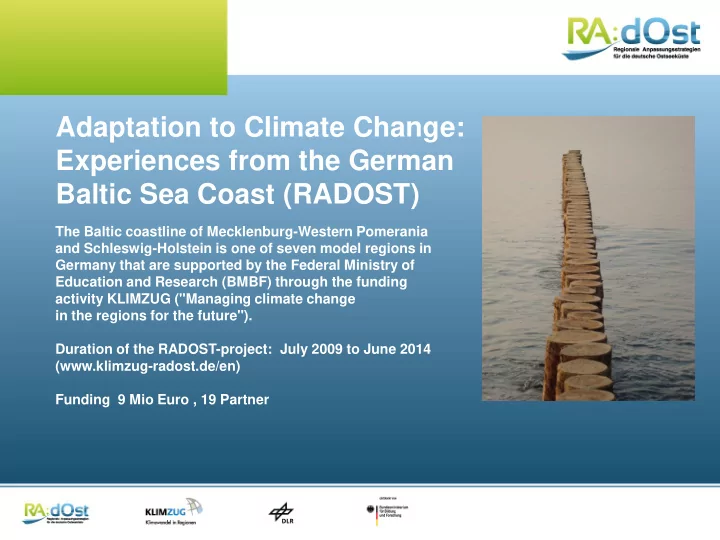
Adaptation to Climate Change: Experiences from the German Baltic Sea Coast (RADOST)
The Baltic coastline of Mecklenburg-Western Pomerania and Schleswig-Holstein is one of seven model regions in Germany that are supported by the Federal Ministry of Education and Research (BMBF) through the funding activity KLIMZUG ("Managing climate change in the regions for the future"). Duration of the RADOST-project: July 2009 to June 2014 (www.klimzug-radost.de/en) Funding 9 Mio Euro , 19 Partner
SLIDE 2
Content
I Background and objectives: RADOST- project II Why an international exchange between the Baltic Sea and the Chesapeake Bay? III Next steps
SLIDE 3 Schlei Trave Warnow Peene Oder Denmark Poland
Themes: Coastal Protection Tourism/Beach Management Water Management/ Agriculture Ports/ Maritime Economy Nature Conservation/ LandUse Renewable Energies Rostock Darss Oder Estuaries Bay of Lübeck Bay of Kiel Lubmin Adlergrund
Geographic Areas
SLIDE 4 Problems Facing the German Baltic Sea Region
- Sea level rise
- Storm surge heights
- Coastal erosion
- Increased wind speeds
- Saline intrusion in water tables
- Alteration in water quality
- Loss in species/ invasive
species
Source: Hans von Storch, HZG
Medium and long-term threat to coastal communities and cities
SLIDE 5 Coastal Erosionen After Extreme Events
Source: Bay of Kiel Alliance
SLIDE 6 Water and Beach Quality
Source: M. Mossbauer Source: www.crackajack.de/.../uploads/ 2008/03/1-11.jpg Source: G. Niedzwiedz
SLIDE 7 Guiding adaptation action at the German Baltic Sea Coast
Adaptation is described as a ‚Process of Dialogue‘ (Lonsdale et al2009:22). A wide range of stakeholders are needed to provide integrated, linked-up solutions to climate/environmental problems. Municipalities, regional (even national) government departments, transport authorities, utilities (energy and water), conservation groups, health officials, businesses, emergency services, climate, social, ecological and economic researchers and others. Goal of RADOST: To support planners, decision makers, communities in dealing with the challenges of adapting to climate change by
involvement in understanding the problem;
examples;
resources;
- Supporting network building;
SLIDE 8
Geo-morphological similarities
Die Chesapeake Bay: The little sister of the Baltic See….
SLIDE 9
„Ask the Audience“: Regional Workshops at the East Coast of the U.S.
SLIDE 10
Personal exchange between coastal stakeholders: Workshops in Maryland (Annapolis) and Schleswig-Holstein (Timmendorf Beach)
SLIDE 11 List of guiding principles for good adaptation
Source: ETC/ACC Technical Paper 2010/6 November 2010, A. Prutsch, T. Grothmann, I. Schauser, S. Otto, S. McCallum.
SLIDE 12
Adaptation to Climate Change: Experiences from the German Baltic Sea Coast (RADOST) www.klimzug-radost.de/en grit.martinez@ecologic.eu