
SLIDE 1
The atomic structure of ancient grain boundaries
Mat Langford* (UoN and UTK) Asia-Pacific Analysis and PDE Seminar October 26, 2020.
*All original work is joint with Theodora Bourni (UTK) and Giuseppe Tinaglia (KCL).
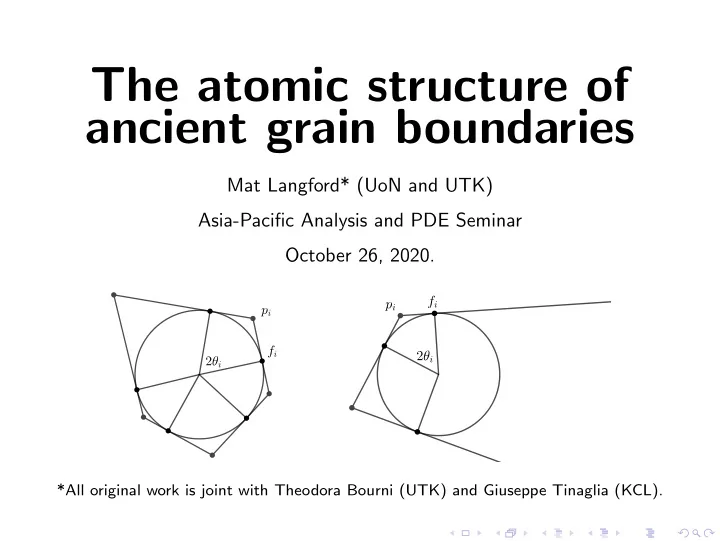
The atomic structure of ancient grain boundaries Mat Langford* (UoN - - PowerPoint PPT Presentation
The atomic structure of ancient grain boundaries Mat Langford* (UoN and UTK) Asia-Pacific Analysis and PDE Seminar October 26, 2020. *All original work is joint with Theodora Bourni (UTK) and Giuseppe Tinaglia (KCL). Democritean atomism
Mat Langford* (UoN and UTK) Asia-Pacific Analysis and PDE Seminar October 26, 2020.
*All original work is joint with Theodora Bourni (UTK) and Giuseppe Tinaglia (KCL).
Democritus and the early atomists (Leucippus, Epicurus) held that – The material cause of all things that exist is the coming together of “atoms” and “void”. – Atoms are eternal and indivisible. – Atoms can cluster together to create things that are perceivable. – Differences in shape, arrangement, and position of atoms produce different phenomena. We will present an atomistic picture of ancient mean curvature flows with the Grim Reaper as the fundamental building block.
1 / 23
Grim Reaper Stationary line Angenent oval Shrinking circle Theorem [Daskalopoulos–Hamilton–ˇ Seˇ sum, Bourni-L.Tinaglia, X.-J. Wang] These are the only convex ancient solutions to curve shortening flow.
The shrinking circle is entire (it sweeps out all of space). The Grim Reaper and Angenent oval sweep-out slab regions. A deep theorem of X.-J, Wang states that that non-entire ancient mcfs necessarily lie in slabs.
2 / 23
The Angenent oval is formed from two Grim Reapers in a very specific way. At {(x, y) ∈ R2 : cos x = et cosh y} The asymptotic Grim Reapers G+
t
lim
s→−∞(At+s − P+(s)) and G− t
lim
s→−∞(At+s − P−(s))
move with the same speed and thus have the same scale.
3 / 23
The Angenent oval is formed from two Grim Reapers in a very specific way. At {(x, y) ∈ R2 : cos x = et cosh y} The asymptotic Grim Reapers G+
t
lim
s→−∞(At+s − P+(s)) and G− t
lim
s→−∞(At+s − P−(s))
move with the same speed and thus have the same scale.
Such a configuration is not allowed.
3 / 23
A “flying wing” translator flying alongside a Northrop “flying wing” aircraft. Theorem [Bourni-L.Tinaglia, Hoffman et al., Spruck–Xiao, X.-J.
Wang] The bowl solitons, Grim planes and flying wings are the only non-flat convex
translating mean curvature flows in R3.
For each θ ∈ (0, π
2 ), there is a convex translator W θ defined in
(− π
2 , π 2 ) × R2 which moves vertically with speed sec θ and is asymptotic
to two Grim planes (of width π) which make the same angle θ with R2. Again, only examples with asymptotic Grim planes of the correct width (equivalently, vertical speed) are admissible. *Yi Lai recently posted on arXiv a beautiful construction of an analogous family of steady Ricci solitons.
4 / 23
There is an analogous family of O(1) × O(n − 1)-invariant flying wings in Rn+1 for each n ≥ 3. They are the only O(1) × O(n − 1)-invariant examples [Bourni-L.-Tinaglia, Hoffman et al. X.-J. Wang]. There is also an O(1) × O(n)-invariant analogue of the Angenent oval in Rn+1 for each n ≥ 2 (the “ancient pancake”). It is the only O(n)-invariant example [Bourni-L.-Tinaglia, X.-J. Wang].
The “radius” of the ancient pancake is r(t) = −t + (n − 1) log(−t) + cn + o(1).
Once again, only examples with asymptotic Grim hyperplanes of the correct width are found. The ancient pancake is a very useful “barrier”, and will play a major role in what follows.
5 / 23
The second major tool we need is the differential Harnack inequality for ancient solutions (with bounded curvature in each timeslice*). It immediately implies that: – the family of support functions σ(·, t) : Sn → R of {Mt}t∈(−∞,ω) is concave with respect to t, – H∗(z) lim
s→−∞ H(z, s) < ∞ exists for each normal direction z,
– σ∗(z) lim
s→−∞
1 −s σ(z, s) exists for each z, – σ∗(z) = H∗(z), – M∗ lim
s→−∞
1 −s Ωs exists, where ∂Ωt = Mt, and – σ∗ is the support function of M∗. We refer to M∗ as the squashdown of {Mt}t∈(−∞,ω).
*We henceforth make the assumption supMt H < ∞ whenever Mt is noncompact.
6 / 23
Ancient solution Squashdown Angenent oval the interval [−1, 1] Grim Reaper halfline [−1, ∞) × {0} Ancient pancake unit disk B1 Grim hyperplane halfspace {X : X, e1 ≥ −1} Flying wings circumscribed cone
7 / 23
The differential Harnack inequality also ensures that the spacetime translated flows Mj
t Mt+sj − X(zj, sj) , sj → −∞,
subconverge to a translator with bulk velocity v satisfying − v, z = H∗(z). In particular, H∗(z) > 0 whenever z = ±e1.
8 / 23
Theorem [Bourni-L.-Tinaglia] There exists a convex ancient mcf {MP
t }t∈(−∞,ω) in Rn+1 with MP ∗ = P for every regular polytope P ⊂Rn.
{MP
t }t∈(−∞,ω) is reflection symmetric across the hyperplane {x = 0}
and inherits the symmetries of P. *The asymptotic translators of {MP
t }t∈(−∞,ω) are related to P in the
If P is unbounded, then {MP
t }t∈(−∞,ω) evolves by translation.
*This is far from immediate: two halfspaces with normals z and w will support the same face of M∗ if |X(z, t) − X(w, t)| ≤ o(−t) as t → −∞. But they will only support the same asymptotic translator if |X(z, t) − X(w, t)| ≤ O(1) as t → −∞.
9 / 23
We also obtain examples out of (some) irregular polytopes. Theorem [Bourni-L.-Tinaglia] There exists a convex ancient mcf {MP
t }t∈(−∞,ω) in Rn+1 with MP ∗ = P for every simplex P ⊂Rn.
{MP
t }t∈(−∞,ω) is reflection symmetric across the hyperplane {x = 0}
but admits no further symmetries unless P does. The asymptotic translators of {MP
t }t∈(−∞,ω) are related to P in the
If P is unbounded, then {MP
t }t∈(−∞,ω) evolves by translation.
10 / 23
The basic idea is to take a limit of old-but-not-ancient solutions obtained by flowing suitable configurations of Grim hyperplanes: Consider a circumscribed polytope P ⊂ Rn, i.e. a convex set of the form P =
{X ∈ Rn : X, zf ≤ 1} , F ⊂ Sn−1 finite. For each R > 0, consider the boundary MR of the convex body ΩR
(Ωf + Rzf ), where Ωf is the convex region bounded by the Grim hyperplane in Rn+1 which passes through the origin and translates in direction −zf .
11 / 23
General nonsense yields a convex solution to mcf which is smooth and locally uniformly convex at interior times and C 1,1 up to the initial time. (When P is unbounded, we use a “doubling argument” [Kotschwar].) Using the initial Grim planes as outer barriers and the ancient pancake as an inner barrier, we find that lim
R→∞
T 0
R
R = 1 , where T 0
R is the time that the flow reaches the origin.
Denote by {MR
t }[αR,ωR) the old-but-not-ancient solution obtained by
time-translating so that the origin is reached at time 0.
12 / 23
By construction, the initial configuration satisfies HR(z) ≥ z, v for each vertex v ∈ V of P. Since both sides are Jacobi fields, the inequality is preserved under the
HR(z, t) ≥ max
v∈V z, v = σP(z) ,
where σP is the support function of P. Integrating then yields −σR(z, t) − σR(z, s) t − s ≥ σP(z) . This ensures that the squashdown of the limit (if it exists) contains P.
13 / 23
In order to obtain a limit, we need a uniform (in R) lower bound for the inradius of MR
t .
The initial configuration satisfies, by construction, |wR| ≥ π 2 (1 − HR) , (†) where wR X, e1. The maximum principle then yields (†) for t > αR. On the other hand, a delicate barrier argument using the ancient pancake and the “Harnack” inequality yields, for any h ∈ (0, 1) min
MR
t ∩Bn Ch (p) HR ≤ Che−h2r
for r ≥ rh and points p which are distance at least ∼ r from the “edge”
t .
The desired inradius lower bound follows.
14 / 23
General nonsense now yields an ancient solution {MP
t }t∈(−∞,ω) whose
squashdown contains P. In order to show that MP
∗ = P, we need to stop the “faces” from
“moving away” as R → ∞.
1 −t MR t , t ∼ −∞, losing a face as R → ∞.
15 / 23
This can be achieved in some cases via a barrier argument using the ancient pancake {Πt}t∈(−∞,0). Indeed, since {MR
t }t∈(αR,ωR) and {Πt}t∈(−∞,0) both reach the origin at
time 0, they must intersect for all t < 0, by the avoidance principle. With a bit more work, we can deduce that the intersection must happen “near the edge”. It follows that at least one face of M∗ supports Sn−1. In fact, by moving the centre of the pancake, we find that Sn−1 is inscribed in M∗ This suffices to conclude that M∗ = P when P is regular, or a simplex.
16 / 23
The squashdowns of all these examples circumscribe Sn−1. Theorem [Bourni-L.-Tinaglia] Let {Mt}t∈(−∞,ω) be a convex ancient mcf in Rn+1. If {Mt}t∈(−∞,ω) is defined in (− π
2 , π 2 ) × Rn, then
its squashdown circumscribes {0} × Sn−1.
Such configurations are not admissible.
ancient pancake and, of course, the differential Harnack estimate.
17 / 23
Theorem [Bourni-L.-Tinaglia] For each regular, circumscribed cone C, there exists a convex eternal mcf {Mt}t∈(−∞,∞) to mean curvature flow which sweeps out (− π
2 , π 2 ) × Rn, is reflection symmetric across the
hyperplane {0} × Rn, and whose squash-down is the circumscribed truncation P of C. Since the squashdown of a convex translator is a cone, we conclude that Corollary White’s conjecture is false: there exist convex eternal solutions to mcf which do not evolve by translation.
18 / 23
Consider the old-but-not ancient solution {MR
t }t∈[0,ωR), MR t = ∂ΩR t ,
corresponding to P constructed earlier. Using barrier arguments and the “Harnack” inequality, we can show that – ωR = ∞, – the limits σ∗
R(z) lim s→∞
1 s σR(z, s) and H∗
R(z) lim s→∞ HR(z, s) exist,
– σ∗
R(z) = −H∗ R(z), and
– M∗
R lim s→∞
1 s ΩR
s = P−1
{X : X, z ≤ −1}.
19 / 23
It follows that HR(ˆ v, t) increases from 1 at t = 0 to |v| as t → ∞, where v is the vertex of C and ˆ v v/|v|. Using pancake barriers and the “Harnack” inequality, we find that tR,ε → ∞ as R → ∞ , where tR,ε is the first time that HR(ˆ v, ·) reaches 1 + ε ∈ (1, |v|). Now spacetime translate so that XR(ˆ v, 0) = 0 and HR(ˆ v, 0) = 1 + ε, and take R → ∞. The width estimate implies that the limit is defined in (− π
2 , π 2 ) × Rn, and
hence M∗ circumscribes Sn−1. Since H(ˆ v, 0) = 1 + ε > 1, the limit cannot be a Grim hyperplane. The “Harnack” estimate, barrier arguments and the structure of P then imply that P ⊂ M∗ ⊂ C. Since H(ˆ v, 0) = 1 + ε < |v|, M∗ C. In particular, M∗ is not a cone. A little more work yields M∗ = P.
20 / 23
Let {Mt}t∈(−∞,∞) be a convex eternal mcf. By the differential Harnack inequality, – H∗(z) lim
s→∞ H(z, s) ∈ (0, ∞] exists for each z,
– σ∗(z) lim
s→∞
1 s σ(z, s) ∈ [−∞, 0) exists for each z, – σ∗(z) = −H∗(z), – M∗ lim
s→∞
1 s Ωs exists, where ∂Ωt = Mt, and – σ∗ is the support function of M∗. We refer to M∗ as the forward squashdown of {Mt}t∈(−∞,ω).
21 / 23
Theorem [Bourni-L.-Tinaglia] Let {Mt}t∈(−∞,∞) be a convex eternal mcf in Rn+1. If {Mt}t∈(−∞,ω) is defined in (− π
2 , π 2 ) × Rn, then
M∗ = (M∗)−1
{X : X, z ≤ −1} , where F∗ is the set of outward normals to M∗ which support Sn−1. The main tools in the proof are... barriers and the Harnack inequality! Corollary If M∗ is a cone, then Mt evolves by translation. Proof: H(ˆ v, t) is constant in t since it is monotone (by the Harnack ineq.) and H∗(ˆ v) = σ∗(ˆ v) =−σ∗(ˆ v) = H∗(ˆ v). So the claim follows from the rigidity case of the Harnack inequality.
22 / 23
Theorem [Bourni-L.-Tinaglia] Let {Mt}t∈(−∞,ω) be a convex ancient mcf in R3. If {Mt}t∈(−∞,ω) is defined in (− π
2 , π 2 ) × R2, then it
is reflection symmetric across {0} × R2. Thus, our irregular examples admit the smallest possible symmetry groups. This is proved using a “tilted plane” Alexandrov reflection argument inspired by Korevaar–Kusner–Solomon (cmc surfaces) exploiting the uniqueness of asymptotic translators at faces (Grim planes). The argument would work in higher dimensions if we had a better understanding of the asymptotic translators (uniqueness of Grim hyperplanes at facets is not enough).
23 / 23