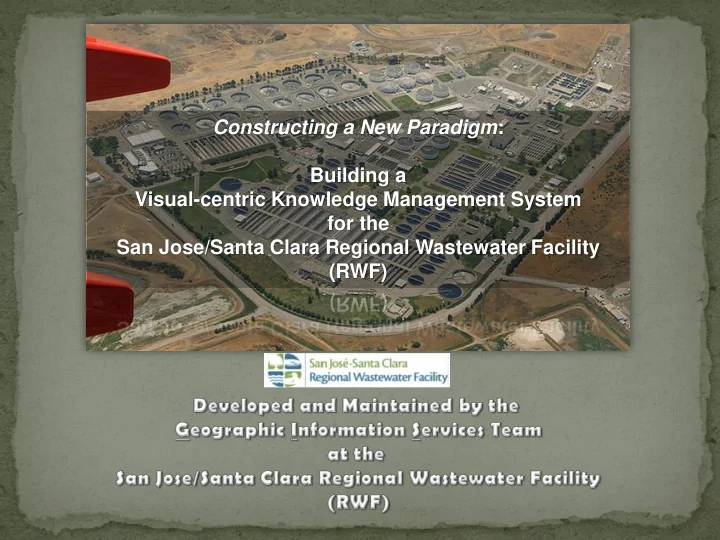
One Size Does Not Fit All: The Adventures of Building a GIS for the Inner Workings of a Sewage Treatment Plant Constructing a New Paradigm: Building a Visual-centric Knowledge Management System for the San Jose/Santa Clara Regional Wastewater Facility (RWF)
The Adventures of Building a GIS for the Inner Workings of a Sewage - - PowerPoint PPT Presentation
One Size Does Not Fit All: The Adventures of Building a GIS for the Inner Workings of a Sewage Treatment Plant Constructing a New Paradigm : Building a Visual-centric Knowledge Management System for the San Jose/Santa Clara Regional Wastewater
A geographic information system (GIS) lets us visualize, question, analyze, and interpret data to understand relationships, patterns, and trends.
What is GIS?
Why use GIS?
Cost Savings from Greater Efficiency Better Decision Making Improved Communication Better Record Keeping A Visual Based Medium for Knowledge Management
From this… to this…GIS database Finally…to this…Web Map Application
Data/Documents Management System Before GIS
GIS
UNDERGROUND SERVICE ALERT (USA) SYSTEM DIAGRAMS & SCHEMATICS ASSET MANAGEMENT (CMMS) CUSTOM APPLICATION PROGRAMMING ENTERPRISE DATABASE MANAGEMENT HYDRAULIC MODELING WEB MAP VIEWER CUSTOMIZATION SUBSURFACE UTILITY ENGINEERING (SUE) TECHNIQUES
How GIS is Used
Capture Valve and Pipe Information Capture Buried Utility locations and key characteristics Disseminate critical knowledge in a visual format Integrate Critical Systems Integrate key documents, drawings, and diagrams Capture abandoned above and below ground infrastructure Tool to train new staff Key element in Intelligent Document Management System Integration with Asset Management/CMMS Links to Videos and Photos past and present Identify exposed buried utilities
Software and Tools used:
Software
- ArcGIS for Desktop - Advanced
- ArcGIS for Server - Enterprise
- ArcGIS for Schematics
- ArcGIS Web AppBuilder
- InfoWorks ICM
- InfoWater
- Microsoft SQL Server
- Microsoft Visio
Global Positioning System
- Trimble Geo6000 w/ Sub-Dm Option and GPS Base Station
Ground Penetrating Radar
- GSSI UtilityScan DF w/ Ruggedized Cart
Pipe/Cable Locator
- RadioDetection RD8000
- FlexiTrace and Sondes
The following slides will illustrate some of the key elements
- f the
RWF’s GIS-based Knowledge Management Program
WebMap Viewers Dynamic Diagrams/Schematics Hydraulic Modeling Geotagged Photos RWF Subsurface Utilities Damage Prevention Program Electrical System Linkages
GIS-based Web Map Viewers – the visual medium of knowledge management
CIP ENGINEERING & PLANT MASTER PLAN OPERATIONS & MAINTENANCE UNDERGROUND SERVICE ALERT (USA) AND DIG SAFELY SAFETY AND HAZARDS AWARENESS Software Used: ArcGIS for Desktop, ArcGIS for Server, and ArcGIS Web AppBuilder
Hearing Protection Zones
GIS-based Smart Diagrams/Schematics – shun dumb diagrams
Diagrams linked to centralized GIS
- database. As
database changes, so do diagrams. Software Used: ArcGIS for Desktop ArcGIS for Schematics Microsoft Visio
GIS-based Hydraulic Models
Model hydraulics of flows into, within, and thru your Plant for any system Software Used: ArcGIS for Desktop InfoWorks ICM and InfoWater
Secondary Scum (SSM) Secondary Scum (SSM) No.4 Water (WTR4) Chlorine Solution (CS) Abandoned -
Geotagged Photos of Exposed Buried Utilities
3,000 Geotagged Photos in GIS Database 2,000+ locations inside RWF Each photo is tagged with high-accuracy GPS coordinates Can easily identify what utility is buried where and how deep Photos complement drawings and GIS
Tools and Transport used for the RWF Subsurface Utilities Damage Prevention Program
Ground Penetrating Radar (GPR) Global Positioning System (GPS) Pipe/Cable Locator “We do not locate, mark, and forget. We locate, mark, capture, and store!” Tim Hayes, RWF GIS Supervisor
Electrical System Knowledge Capture
Link Manhole Foldout Diagrams to EMH Locations in Electrical WebMap Create Foldout Diagrams for all Handholes and Manholes Field Verify all Pull Boxes Generate Single Line Diagrams using GIS
Results of RWF GIS-centric approach to Knowledge Management
Everyone is more safe. Staff have an easy way to utilize and disseminate critical knowledge when they need it most. Money and time has been saved. Significantly lower risk of knowledge being lost when staff leave. New staff get oriented to facility faster. Everyone has higher morale. A positive medley of tangibles and intangibles