
SLIDE 1
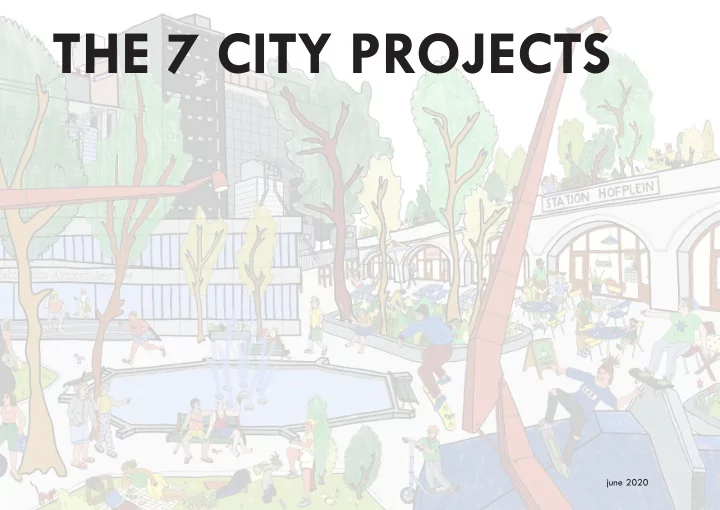
THE 7 CITY PROJECTS
june 2020
THE 7 CITY PROJECTS june 2020 IMPACT ON THE CITY Integral score - - PowerPoint PPT Presentation
THE 7 CITY PROJECTS june 2020 IMPACT ON THE CITY Integral score Corona has given us an added sense of how important an attrac- The perspectives derived from the environmental vision have been tive and green outdoor space is for all
june 2020
IMPACT ON THE CITY
Corona has given us an added sense of how important an attrac- tive and green outdoor space is for all Rotterdammers. The next seven city projects will involve us introducing more green lungs to the city of Rotterdam. Attractive public places where residents and visitors can meet, exercise and spend their leisure time. And at the same time, offer solutions for other important challenges facing the city. In this time of corona, we want to help Rotterdam get back on its
solutions to the challenges that are essential to the well being of
ding homes in places where, up to now, it has been either diffjcult
for spending time, taking strolls and enjoying leisure activities. In addition, the seven city projects will generate more employment, an attractive business climate for entrepreneurs and more space for festivals and, of course, tourism. Integral score The perspectives derived from the environmental vision have been used as a compass for the seven city projects in order to provide insight into the integral approach of the project. This allows us to give direction and make choices regarding the most important themes of the city.
STARTING PRINCIPLES OF THE 7 CITY PROJECTS:
ALEXANDERPLEIN
The Alexander Hub is an urban junction. It is an important pu- blic transport hub in the Rotterdam system with Intercity status, a direct connection to motorways and a place with city centre
past, with the result that 64% of the space is dedicated to vehicle infrastructure. The recreational quality also leaves much to be desired. At the moment, the Alexander Hub is mainly a place to work or shop, and the area also fulfjls a regional function in this respect. Howe- ver, there are hardly any programmatic and spatial connections to the Rotterdam Oost districts. Apart from the already mentioned shopping, there are no other urban functions, such as pleasant, at- tractive terraces. The potential to become a more multifunctional urban centre is enormous.The Alexander Hub is a place where it is possible to live (on a large scale). Where you don’t just want to pass through, but actually want to stay. An important condition for this is a healthy and attractive living environment that is brought about through a resilient new urban programme. This will create a heart for the eastern part of Rotterdam with a multifunctional ur- ban working and living environment. Starting at Alexanderplein. The main opportunities The large amount of outdoor space now allocated to infrastruc- ture offers opportunities to increase the recreational quality at strategic locations in the short term. In addition, various stakehol- ders are investing in the area (e.g. NS, Ret, ProRail, MRDH and Klépierre). If we want to turn Alexanderplein into a fully-fmedged central urban area, it will in a large part depend on the way in which densifjcation, infrastructure, outdoor space, real estate development and the use of the various functions reinforce each
The station area, in combination with Prins Alexanderplein, forms a strategic location within the Alexander Hub. The investments made by third parties are already clearly visible here through the renovation of Rotterdam Alexander station. By making a quality intervention in the outdoor space at this location and pro- gramming it over a long period of time, the Municipality recog- nises that this area has the potential to become a high-quality central area. This will set a tone that can be achieved in the short
lopments and become an attractive place for visitors to the area. Consider the undeniable qualities of Alexanderplein as a super- hub; the metro lines, intercity station, proximity to motorways, all the amenities, its proximity to attractive greenery and its connecti-
terdam its own identity as a new central urban hub. By combining this with a good intertwining with adjoining districts, the residents
attractive (urban) outdoor space should connect local residents, travellers and regional visitors.
existing situation new situation
ROTTERDAM OOST
MEETING UP
MORE CIRCULAR
WORKERS
WATER STRUCTURES
PEDESTRIANS
AND OPPORTUNITIES FOR AN ATTRACTIVE LIVING ENVIRONMENT productive city inclusive city healthy city circulair city compact city
COMPACT CITY The designation of the Alexander Hub as one of the new multifunctional urban hubs in Rotterdam is an enormous opportunity to realise a more diverse programme. More housing, social and cultural facilities in addition to the retail and offjces that the area already has. Much of the space in the Alexander Hub is earmarked for mobility and undeniably adds value to the location, but a different programme requires a different layout. In addition to more programmes, more greenery, more space for meeting up, enjoying oneself and experiencing things. The Alexanderplein as a City Lounge. Or a new heart for East. HEALTHY CITY The focus is fjrst and foremost on air quality, external safety and noise pol-
not appropriate at the moment to add large and diverse programmes. The domination of the area by vehicles will also have to change in order to give pedestrians and cyclists more space of greater quality. Things that suit a mix
CIRCULAR CITY With the transformation of the Alexander Hub, there is an opportunity to turn it into a circularity cluster. The ‘Green Business Club’ in the area has a large number of partners who want to actively work on this. INCLUSIVE CITY By adding another programme, a mix of programmes can be created that is not only interesting at certain times, but can give a longer and more las- ting effect. A programme that is also inviting if you live in the surrounding districts and naturally means that you go to the Alexander Hub for more than just shopping. PRODUCTIVE CITY Education, retail and work. A lot is already happening in the Alexander
resting for visitors, but also for people living in the immediate vicinity. Its accessibility and location in Rotterdam are undeniably the most important drivers for the productive city. The impact of the fjrst phase of the square’s development can already make a big difference in terms of recreational quality, restaurants at ground level and the culture programme. It will also create a more attractive working environment on the Marten Meesweg. It will then invite chance encounters, quiet lunch spots or other things that con- tribute to a productive urban hub. The accessibility of the area is important for a diverse programme. However, the current situation leaves something to be desired for all employees. These ask different things of the area. More places to walk, sit, etc. Offjce prices are currently low and are likely to rise in the event of a more attractive location.
GREEN LUNG: HOFPLEIN
The history of Hofplein Hofplein, with its fountain is an iconographic place in Rotterdam, part of the collective memory of many a city visitor. Before the Second World War, it was a recognisable place with a mixed use of fast and slow traffjc with a reasonably good recreational quality. However, the current design of the Hofplein dates from the 1950s and is a result of the modernist reconstructi-
strongly partitioned by almost uncrossable wide zones of car and tram traf-
and has little to do with the basic urban design of the square. More balanced traffjc model The new plan for the square focuses on a more balanced traffjc model with a shift in dominance from the car to the pedestrian and cyclist. This trend has already started on the Coolsingel. Limiting the traffjc fmow from the other si- des of the square also creates a more relaxed situation for car traffjc that is very similar to the situation on Kruisplein/Stationsplein. In the proposal, car traffjc will follow the urban form of the buildings, transforming the central area with its fountain into a large, green recreational square. Comforta- ble wide pavements along the facades will intensify the fmow of foot traffjc along the facades and create a logical connection to the surrounding area around all the edges of the square. Spectacular Park Square A spectacular large recreational area will thus be unlocked in the middle. It will be furnished with a combination of grassed areas, perennials, square-li- ke spaces and a sea of trees. The current iconic fountain will be the central “focal point” of the new Hof- plein, as the prominent heart and icon of the plan. On the new square, the fountain will be surrounded by areas that are attractively accessible to
rify the tram crossings. These height differences will also be used to create benches so that you can sit and contemplate the beautiful water creatures that encircle the fountain. The square in the middle will accessible by 6 wide zebra crossings that connect all corners of the square. The plinths of the square, adjacent to the buildings, are wide enough for a two-way cycle path, greenery and even terraces. This will make the Hofplein a pleasant and green place for Rotterdammers and visitors to linger: a place to have lunch, rest, recharge your batteries or of course take a picture with the iconic buildings of Rotterdam in the background. This will result in a reduction of 60 to 70% in car traffjc on Hofplein. Reconnecting Rotterdam North to the city centre An important achievement of the new layout is the enhancement of the connection between the city centre (Coolsingel, Lijnbaan, Pompen burg Zuid etc.), and the north of Rotterdam (Oude Noorden, Schieblok, Central Stati-
layout of the city centre, this has always been a point in the city where it has been diffjcult to walk from one to the other. Due to the enlarged space in the middle, lower traffjc intensity, broad plinths and large zebra crossings, the square will soon be easy to cross diagonally. This will allow the natural rou- tes between the Lijnbaan and the Oude Noorden and between Pompenburg Zuid and the Schieblok to be further strengthened. The plan thus reinforces the ambitions of the renewal of the old Hofplein station/ Hofbogen and of the Schieblok and its surroundings. Stakeholders Initial discussions with RET, MO/Festivals, Direction Veilig and owners such as Hilton and developers around Hofplein revealed their pleasant surprise and
GREEN LUNG: WESTBLAAK
Proposal The Westblaak is part of the boulevard structure of the city centre. Reducing the number of lanes for cars to 2x1 creates a lot of space for cyclists, pe- destrians, other forms of mobility and recreation. By positioning most of the newly freed space on the north side of the boulevard, optimum use can be made of the sunny aspect of the space. Health The average sound levels on the walls along the boulevards is now more than 70dB. This means that additional measures have to be taken for new projects (e.g. sealed facades on apartments) and environmentally sensitive functions are not allowed be located along the boulevards. The proposed profjle creates opportunities for new buildings that cannot be realised at present. More programmes with a quality that does not now exist in the city centre along the boulevards (reduction by 10dB!). Think of living spaces in the apartments situated on the Green Lung, with roof terraces and balconies with French doors or even the possibility of si- tuating functions such as schools, with a playground, on the boulevard. The reduction in the number of car lanes also means fewer traffjc movements. Climate With a greener Westblaak, there will also be more shade and cooler spots. Initial calculations show a reduction of 7°C if a quarter of the space is soft landscaped and 25% more trees are introduced. This will be a real impro- vement for the city centre as a whole (now on average 10°C warmer than the rest of the city). Not only for the Westblaak, but also for the surrounding areas as a cooling zone in the city (there are hardly any now!). As far as the lack of rainfall in the city centre is concerned, there are plenty of opportu- nities for rain collection on roofs around the Westblaak and the possibility
duced to the Westblaak it could contribute to the entire water system (less
Further densifjcation Without too much densifjcation, approximately 200,000 m2 of extra pro- grammes could be developed along the Westblaak, where the possibilities will be far greater than in the old situation. For example, it will now be pos- sible to have environmentally sensitive functions on the Westblaak. The direct cause of raising the energy label (from 2022 onwards, offjces with label C or lower may no longer be let) is a major task in the city centre and certainly along the boulevards, (West) Blaak in particular. This also offers opportunities for a rapid transformation More space for cycling, pedestrians and new mobility Part of the transformable space can be used to facilitate the increase in the number of cyclists. In concrete terms this means space for wider cycle paths (and wider footpaths). Also new forms of mobility (e-step, e-bike, e-deli- very services, etc.) that go faster than a bicycle, but slower than a car, can be given their own place on the boulevard. This would favour a subdivision according to speed. This is also the place which emergency services could make use of when necessary. More space for playing, meeting up and spending time The new principle for the Westblaak gives (much) more space for things that also need to have a place in a busier city centre. The boulevard is now ex- perienced as a busy, car-dominated space. With the freed up space, there will be an opportunity to turn it into a place where residents in the area have an outdoor space, employees can take a stroll and children have a place to play.
GREEN LUNG
AND NEW FORMS OF MOBILITY
BOULEVARDS
IS LARGELY RESOLVED
INTERCONNECTED GREENERY
OF THE INNER CITY
existing situation new situation
productive city inclusive city circulair city compact city healthy city
COMPACT CITY The space freed up in the boulevard structure can be used for sports, playing, meeting up and spending time. There is already a shortage of this space in the City Centre and this space is also linked to the largest addition of housing in Rotterdam in the co- ming period. This is an appropriate response to the principles of the City Lounge. In addition, the boulevard typology is a conse- quence of the modern layout of the City Centre. Parts of this can be used to emphasise the rawness of modernism and dynamism
buildings and transformed boulevards will enhance its character as an architectural city. The need for additional greenery is al- ready great due to the densifjcation of the City Centre and will
tourists. HEALTHY CITY Sports, green amenities and social functions can all be accommo- dated on and around the boulevards. The transition of the bou- levards will result in (much) cleaner air and (much) less noise. This also makes it possible to accommodate environmentally sensitive functions along the boulevards. In addition, interconnected green corridors will invite people to move around more and by adding more greenery, more trees, less hard surfacing and possibly wa- ter features the heat stress will be reduced, there will be enough storage capacity and water quality in the catchment area may even increase. By adapting the boulevards, there are opportuni- ties to signifjcantly reduce noise levels in order to also have are- as of peace and quiet in the immediate vicinity of a lively City Centre. CIRCULAR CITY Many of the buildings along the boulevards are from post-war reconstruction period and have an energy label lower than C. Measures must be taken before 2022 to ensure these buildings can be let in the future. This will lead to new investments in real
the City Centre to test interventions (physical and programmatic). For the transformation of the boulevard structure, this seems a good way of testing interventions (not making things immediately irreversible). INCLUSIVE CITY The layout of the green lung/boulevards should be tailored to the different needs of different users and thus increase the chances of satisfying those needs. Enhancing the experience and quality of life on the boulevards will create greater bonding bet- ween neighbourhoods. PRODUCTIVE CITY High quality designed areas along the most important work lo- cations of the City Centre will increase their appeal to (new)
City Centre use the City Centre every day in different ways, at different locations and move around more and more. The trans- formation of the boulevards into places to hang out and meet up creates new opportunities for working in the City Centre. It should be noted that TNO has calculated that the overall densifjcation
There have been investments in recent years that have yielded excellent returns in terms of employment and the economy, and have even turned the economy around. Further investment will contribute more to this.
HOFBOGENPARK
The Hofbogen is situated between the city centre and the A20/SFG. The former railway viaduct is also a listed monument and crosses several densely populated city districts. The Hofbogen Park will create a new two-kilomet- re-long city park in the north of Rotterdam. Rotterdammers, neighbourhood residents, tenants of the arches: they have all been dreaming of a park on the Hofbogen for years. A new icon for the city, that is green and alive and that is there for all Rotterdammers to visit and experience. With the construction of the Hofbogen Park, Rotterdam North will have a new park that provides an integral response to various urgent issues. On an urban scale, the park will connect the city (centre) with the surrounding countryside. The Hofbogen Park is moreover a nature-inclu- sive part of the city with a high ecological value. With its smart and circular water system, the Hofbogen Park will contribute to Rotterdam’s ambitions in the fjeld of climate adaptation. The new park also provides a solution to local issues: a green place to spend time, which encourages active use and exercise for the residents of the Noord district which suffers from a severe lack of green spaces. The sale to Dudok will give the transformation of the Hofbogen a new im-
sing future! There is now an opportunity to transform the Hofbogen from a stand-alone physical object into an integral connecting part of the environ-
greater improvement in the quality of North Rotterdam’s urban districts. Opportunities The Hofbogen park offers the possibility to make connections between urban places. For example, the connection to Pompenburg and the Schie- kadeblok creates a unique obstacle-free walking route from the northern districts of the city to Central Station and the city centre. The transformation
city centre. On the north side, a connection across the A20 motorway offers interesting opportunities for employees and visitors to the Sint Franciscus Gasthuis and Schiebroek. At a local level, the Hofbogen will be transformed from a barrier into a connection between and with the adjacent districts. The realisation of the Hofbogen park offers opportunities to improve the living
also for the neighbourhoods around it and for the city as a whole. Themes such as rest, greenery, exercise, climate adaptation and ecology are impor- tant starting principles here. Stakeholders The Hofbogen park has very broad public support. Many can hardly wait until it is completed. Dudok has been the owner of the Hofbogen since the
cils and residents of Rotterdam Noord are closely following the development
great deal of enthusiasm for the project from all the parties mentioned abo-
and the collaboration to date has been excellent. There is, however, some concern about possible nuisance for those living in the immediate vicinity. The tenants of the Hofbogen are also highly engaged stakeholders. The stake- holders group of owners/developers of the development areas located next to and along the Hofbogen are overwhelmingly enthusiastic about the reali- sation of the Hofbogen Park.
FROM FACADE TO FACADE
WATER STORAGE (+100 FEWER BLUELABEL BUILDINGS)
OF WORK LOCATIONS (ARCHES, SFG, CITY CENTRE)
STRUCTURE OF THE CITY
COOLS
A BUSY, HARD LANDSCAPED ENVIRONMENT
existing situation
productive city inclusive city healthy city circulair city compact city
COMPACT CITY The Hofbogen Park is a high-quality green area within walking and cy- cling distance of a large number of Rotterdam residents. The park adds high-quality places to meet up and spend time, especially in a part of the city where there is a real shortage of such places. It builds on the unique character of Rotterdam: raw and dynamic. Drawing attention to the listed monument and Rotterdam as a city of architecture. The Hofbogen Park me- ans that densifjcation of the surrounding area and greening can go hand in
penburg, but also numerous smaller projects. In addition, Dudok is currently investigating new developments in the immediate vicinity of the Hofbogen. The starting principle here is to strengthen the connection between the Hof- bogen Park and the city/surrounding districts. HEALTHY CITY Adding a great deal of greenery (both at roof- and ground level) to an environment which lacks green spaces is one of the important pillars of the healthy city. The green-blue infrastructure of the Hofbogen Park stimulates movement and relaxation and thus contributes to the physical and mental health of the people of Rotterdam. There is more space for active mobility (walking and cycling) in the adjacent streets. The Hofbogen Park also contri- butes to reducing noise pollution and improving air quality. This directly be- nefjts health. The roof of De Hofbogen also offers visitors some peace and quiet in an environment with a lot of commotion. CIRCULAR CITY A second lease of life for the existing railway viaduct shows a circular
(sleepers, rails) will be used in the design of the roof park. Water will also be used as a circular raw material. Rainwater is collected and purifjed on the roof and can be used for irrigation, cooling and to keep wooden pile heads wet. The abundance of extra greenery improves the CO2 balance. The organic waste (leaves, pruning waste) will be used again at the Hofbo- gen Park after composting. Residents may be given a role in the manage- ment of the greenery. INCLUSIVE CITY Everyone has a chance to participate on and in the Hofbogen. There is plen- ty of room to spend time and to meet each other. The Hofbogen Park brings people together in a voluntary way (e.g. for green maintenance and activi- ties in the park). This promotes social cohesion in a number of mixed districts. The Hofbogen Park is wheelchair accessible and can be used by young and
Hofbogen contributes to the identity of the surrounding district. This will al- low a collective pride to emerge. PRODUCTIVE CITY The activities in the Hofbogen already make a limited contribution to a com- petitive and innovative business climate. This will be reinforced in the event
increasingly inspiring places for meeting up, exchanging knowledge, creati- vity and entrepreneurship. The Hofbogen will contribute to companies’ pride in their location. They will then want to show this to the rest of the world.
PARK MAASHAVEN
Park Maashaven combines the feel of the port and the dynamics of the river with the experience of a modern large park for the surrounding city districts. Park Maashaven is a park for Rotterdam-Zuid in general and for all residents of the surrounding city districts and the port in particular. It is the best place to meet each other, where you are encouraged to be active and where you can enjoy the fantastic view of the Maashaven. The park is seven hectares in size: a format that really adds something new to the existing park structure of Rotterdam-Zuid. The park is a lively meeting place and enables the combination of rest and activity with functions in and around the park which attract the public. Park Maashaven consists of 3 parts: the park, the square between metro station Maashaven and Maassilo and the boulevard of the Maashaven-Oostzijde. The park The park area consists of lots of greenery, large trees, lawns, seating areas and is crossed by walking and cycling routes. Park Maashaven encourages you to exercise, play and relax. The park has various spaces and is multifunctional in use. You can stroll, sunbathe, play and there is room for small-scale activities. The park has many height differences. First of all, the two small hills that challenge you to climb them and where you can enjoy fantastic views over the Maashaven towards the Nieuwe Maas and Rotterdam-Zuid. In addition, the transition from the park to the water consists
plants that make the tide visible twice a day. Metro stations The square between the Maashaven metro station and Maassilo will be an attractive arrival and recreation square. The Maashaven metro station links up well with the Brielselaan, Dordstelaan, Putselaan and Maashaven- Oostzijde: there is a good pedestrian crossing and the public space is designed in such a way that is focused on pedestrians and invites them to walk into the park from the city districts or from the metro. Or perhaps a fjrst glimpse of the park and harbour from a height when you arrive by metro: this is also possible from an elevated vantage point. The park and the Maassilo Eventually, you will be able to go through or around the Maassilo in various
water- and inland waterway square. Here, fountains will spray mist into the air and children will be playing in an old barge under the watchful eye of parents enjoying a drink. Given the layout of this square and its location by the Maassilo, this would be the perfect place for urban events. This place has already become a major tourist attraction. One potential special element is that underneath the park there could be an underground space for special urban, cultural facilities, making the park even more interesting for cultural and tourist activities. Surrounding districts The park will be directly adjacent to Tarwewijk, Hillesluis and Bloemhof. The Maashaven-Oostzijde has become an attractive city boulevard. This boulevard is part of the city axis that connects the redeveloped Coolsingel, via the Posthumalaan, with Hart van Zuid. The number of car lanes on the Maashaven-Oostzijde will revert back from two to one. This will create space between the metro track and this narrower profjle for an attractively designed promenade with several rows of trees, seating and play areas and a two-way cycle path. This urban boulevard will already create a park feeling on the border of the buildings on the Maashaven- Oostzijde. Stakeholders Discussions about the Maashaven were held at an earlier stage with the port authority and the inland shipping companies. It will continue, in part, to be a working port with berths for inland shipping. In addition, there have already been information evenings held where many people have been questioned about a possible park in the Maashaven.
7 HECTARES OF GREENERY
CITY DISTRICTS
PLAY SPORTS AND GAMES
AND FESTIVALS
SURROUNDING NEIGHBOURHOODS AND PARK MAASHAVEN
PARKS IN THE DELTA
BECOMES VISIBLE
MORE MIXED LIVING AND WORKING ENVIRONMENT
existing situation new situation
productive city inclusive city circulair city compact city healthy city
COMPACT CITY Park Maashaven adds a substantial amount of new public space (approx. 7 ha) in the immediate vicinity of densely populated city districts. There is currently a shortage of greenery and public space here which is also being felt by the residents. At the same time, Feijenoord is the fastest growing area after the city centre in terms of the number of new homes. As a result, the need for good public space is only increasing. Park Maashaven strengthens the raw character of the port city by emphasising iconic buildings such as the Maassilo. HEALTHY CITY Approximately 7 hectares of greenery will be added by Park Maashaven for exercise, sports and games. The environmental quality will be improved: nature-friendly riverbanks will improve water quality and increase biodiversity. Adding a substantial acreage of greenery will improve air quality. Rotterdam will become more climate-resilient as a result of the construction
quickly as a result of the creation of greenery and more shade (it is precisely these old city districts in Rotterdam that suffer a lot from heat stress). And the construction of the park in front of the main water barrier is helping to strengthen the main water
CIRCULAR CITY Park Maashaven makes an important contribution to the principle
deepening of the Nieuwe Waterweg. The fjrst phase of the park to be carried out, the underwater phase, will involve removing dirty silt and replacing it with clean sand from the Nieuwe Waterweg. Building such a large-scale park in the Maashaven, in a dynamic environment with two daily tides, the possibility of extreme high water and taking into account the existing characteristics of the Maashaven (e.g. the quays, the metro, the existing buildings), demands an experimental design. Park Maashaven will be a showcase project for innovative (park) construction in the delta. INCLUSIVE CITY Park Maashaven will be the place where people from all walks
Park Maashaven will be there for the local residents, for inland shipping crews, for Rotterdammers, for those working in and around Maashaven and for visitors. It will be the place where people from the various surrounding neighbourhoods meet: it will strengthen the bond with each other and with the various neighbourhoods. PRODUCTIVE CITY With the redevelopment of the 120 berths for inland shipping vessels and the use of the port around the basin and the construction of the Park Maashaven, Maashaven symbolises the port city of the future. Park Maashaven is an inspiring place for interaction, meeting and exchanging knowledge between the companies around the park, in which the Maassilo plays a special role. Park Maashaven will contribute to an attractive business climate for economic activities of which Rotterdam companies are proud: made in Rotterdam.
SCHOUWBURGPLEIN
The Schouwburgplein was redesigned 21 years ago as Rotterdam’s square. References to modernity and the port were dominant. The design received mainly positive responses from the architectural world. However, many Rot- terdammers found the square slippery and bare and there was often no- thing to experience. Ten years ago, the Vereniging Verenigd Schouwburgplein (VVS) started
that the plinths were more open. And then the Municipality carried out modi- fjcations that made the square a more pleasant place to be: more trees all around, more places to walk on the square, chairs, benches and, last but not least, the Flying Grass Carpet. The collaboration, programming and modifj- cations to the square were successful: the square has become a destination where people sit in the sunshine and children play. There are approximate- ly 80 events a year, ranging from free yoga classes and dance battles to Circusstad and Rotterdam Pride. The Schouwburgplein has really become a square of and for the whole city! Nevertheless, there is now every reason to make a new plan for the Schouw-
leaking and needs to be repaired. As the top of the square will fjrst have to be removed, this is the time to think about a new layout. The second rea- son is that the successful Flying Grass Carpet cannot be left lying on wood, as this poses the threat of wood rot over time. The third reason is that the ventilation of the car park needs to be replaced. This offers time to consi- der whether it would be desirable to put back the three ventilation towers in the same way. The fourth reason is that the municipal council has called for space in municipal car parks to be reserved for bicycle parking. Finally, renewed agreements are needed between the VVS and the Municipality of Rotterdam on the subject of collaboration and fjnancing. Their collaboration, up to now, has been too incidental and implicit, which is not a good basis for future-proof square management. Meanwhile, 7 Squa- re Endeavour has developed plans to make the square and surrounding buildings more sustainable. So now is the time to ensure that the square is embraced by all Rotterdammers and provides an opportunity to make it a real destination. Stakeholders This plan is the result of a year of intensive collaboration between the Mu- nicipality (offjcial), Vereniging Verenigd Schouwburgplein and 7 Square
a breakfast in which Vice Mayors Wijbenga and Bokhove challenged the parties to come up with an ambitious plan for Schouwburgplein. The Vereniging Verenigd Schouwburgplein (VVS) unites all the par- ties around the square. The aim of the VVS is to strengthen and improve Schouwburgplein as a cultural square for all Rotterdammers. It contributes by providing programming for the square. It also contributes to management
all the individual parties on the square. 7 Square Endeavour (7SqE) unites cultural institutions, property owners, authorities and the business commu- nity with the aim of creating a climate-neutral Schouwburgplein by 2030. The square must become an international showcase. Think in terms of green roofs, water storage, and heat/cold exchange systems between the buil- dings.
BUILDINGS
THE SQUARE
CAFÉS
KERFLAT AND THEATRE IN THE SQUARE
existing situation temporary situation new situation
productive city inclusive city circulair city compact city healthy city
COMPACT CITY The new layout of the square will enable it to be used as well and as fmexi- bly as possible: there will be space for events, but also for recreation, sports and games, and culture. New bicycle parking also makes it attractive to come by bike. In addition to just parking your bike, ancillary facilities will also be added. The square already has great architectural and cultural-his- torical value. The image-defjning elements of this will be retained. The rede- velopment offers a fjtting sequel to the City Lounge, while safeguarding the raw and dynamic character of Rotterdam. In view of the densifjcation of the city centre, extra greenery will be added to the square. HEALTHY CITY The new layout increases the attractiveness in terms of experiencing greene- ry and water, experiencing culture, spending time and meeting others, and
near De Doelen/Schouwburg/bicycle path & restaurant KD) will encourage people to stroll through the city centre. By creating more greenery, reducing car use and encouraging cycling and walking, air quality will be improved. A sharp reduction in car use in the area will also benefjt the quality of the
greenery we will make the square climate-resistant: there will be enough storage capacity and heat stress can be reduced. CIRCULAR CITY Rainwater will no longer enter the sewage system, but will be collected se- parately so that it can also be reused to water green roofs, for example. The square lends itself very well to testing system changes. Any materials that are no longer needed as a result of the changes will be reused in the square or elsewhere in the city. INCLUSIVE CITY The design of the public space is tailored to the different needs of many target groups (from 0 to 100, for example) and different (fmexible) uses. In this way, the square brings together residents from all over the city and vi- sitors from outside the city, but above all, residents from socio-economically very different neighbourhoods in the immediate vicinity of the square. This increases the space for interaction which is refmected in the programming of the square. This is for a broad public, bringing together high culture as well as street culture and both small- and large-scale events. The square will be designed in such a way that small-scale culture will also have its place on the square. This is an accessible way for everyone in the city to get in touch with culture. PRODUCTIVE CITY The references to Rotterdam Port City are retained in the new design. The institutions and facilities around the square will be better involved in the new
inspiring place to interact. By designing the square in such a way that small cultural productions can also present themselves, creativity is given room to grow. The increased presence of the large cultural institutions on the square can contribute even more to this. The cultural institutions are proud of their location and active- ly promote it. They also do this by using the square as a stage for the city. Due to the facade-to-facade concept, all the surrounding businesses can be expected to benefjt from the new design. This applies in particular to De Doelen as a conference centre, with which Rotterdam can contribute more to knowledge sharing internationally.
RIJNHAVENPARK
In, on and along the ‘old’ Rijnhaven with its historic quays, industrial monu- ments and beautiful views, a new part of the city centre will be reimagined and realised. High-rise buildings will border on a city park occupying a lar- ge part of the current harbour basin. A park that will partially fmoat in the harbour with a permanent city beach. Where the water can be experienced in many different ways. A piece of city along the important route from Zuid- plein to Hofplein. Easily accessible by public transport and bicycle and with pleasant amenities for workers, businesses and recreation. But also including a variety of housing options and typologies. In short: an extension of Rotter- dam’s city centre on the south bank. Stakeholders The plans for the Rijnhaven are not new. They fjt in within the previously es- tablished developments of Kop van Zuid, Wilhelminapier and Katendrecht. In 2018 and 2019, the Municipality discussed the Rijnhaven Ambition Docu- ment with residents and business owners. This gave rise to many ideas and insights that have been translated into this urban project. Unique position The Rijnhaven has a special position in Rotterdam’s port history. It is still an exceptional place due to its central location, considerable size and two public transport stations right in the heart of Rotterdam. And thanks to the shape of the basin and buildings on the surrounding quays, the harbour feels sheltered, almost like a square. The characteristic pentagonal shape makes the Rijnhaven unique. The many views over the open water continue to surprise and delight. These are all qualities that make the further development of the Kop van Zuid and the expansion of the city centre on the south bank a viable proposition. High and lively Construction will soon take place between the Posthumalaan and the water
homes. Around one-third of the water surface will be fjlled in for this purpose. On this new piece of land, beautifully formed buildings with high towers will be erected for living and working. With functions and amenities. The Rijnhaven Ring The layout of the Rijnhaven is highly innovative, with a partially fmoating park (riser park) and a public beach in the middle of the city. The park, beach and several transitions along the quays will provide a unique experi- ence along, on and in the water. The construction of the Rijnhaven Bridge has already created a popular walking circuit. This will now be fully completed between Wilhelminapier and Katendrecht via the Posthumalaan and the routes through the park: The Rijnhaven Ring. New centre on the south side This part of the city centre, with its new buildings and the city park with be- ach, offers a new destination for the city and especially for residents of the surrounding districts. It is also an area where pedestrians and cyclists will be given priority. And where public transport and other new forms of transport (over water or via sharing and borrowing) are obvious choices. The two pu- blic transport stations ensure that the new Rijnhaven can be easily accessed by metro from both sides. It is also a new venue for events and festivals in the city.
AFFORDABLE BUSINESS ACTIVITY AND OFFICES
MOBILITY HUBS
existing situation new situation
productive city inclusive city circulair city compact city healthy city
COMPACT CITY The 21-hectare harbour basin will be redeveloped into a compact, urbani- sed part of the city including 2500 homes and an 8-hectare city park. With improved and extra connections, the addition of supplementary program- mes and recreational space, new facilities will be accessible within walking and cycling distance from the centre, in close proximity to many people. The realisation of the Rijnhaven development will defjnitively shape the inner city
places and recreation where slow traffjc prevails: City Lounge on the South. The Rijnhaven development builds on the cultural history and the unique raw and dynamic character of the Rijnhaven, where Rotterdam can be experi- enced in all its facets: harbour (history), river and tide, high-rise buildings, architecture, the large scale, the contrast, and so on. The metro stations will be upgraded to mobility hubs and will be given a very prominent place in the area due to the location of two large entrance plazas. HEALTHY CITY The Rijnhaven area development with its city park is centrally located in the city and in the immediate vicinity of people (both in the city centre and in the Kop van Zuid) who have a great scarcity of accessible and high-quality green recreational space. The city park will provide approximately 8 hecta- res of green space for exercise, sports and games. Deepening the water will improve water quality and the creation of nature-friendly banks will enhan- ce underwater wildlife and biodiversity. The Rijnhaven area development also scores well in terms of climate resistance. The greenery on the reclai- med land and the fmoating parts of the park will help prevent heat stress. In the busy inner city and densely built-up city districts of Rotterdam-Zuid, the Rijnhaven area development will provide both signifjcant densifjcation and a large recreational city park where both tranquillity and activity can be found. CIRCULAR CITY The park and recreational facilities are excellent with bicycle, foot and pu- blic transport. The new buildings must meet the BENG requirements. And the construction of a city park will make it signifjcantly greener. All this contribu- tes to the ambition to make Rotterdam CO2 neutral. The Rijnhaven develop- ment is also not afraid of experimentation. The city park will partly consist
extreme high tides. Because of the scale of the building blocks, it will be possible to experiment with circularity in, for example, waste fmows and clo- sing cycles. In land reclamation, too, the principle of using residual materials as raw materials can be applied by reusing sand from the deepening of the Nieuwe Waterweg and/or other dredging mud. INCLUSIVE CITY A mixed neighbourhood is being developed in the Rijnhaven, where there is housing for various target groups and in all price ranges as well as a com- mercial and social programme with a highly urbanised mix of functions. The Rijnhaven will be a place for residents, neighbouring residents, the Rotter- dammer and visitors to the city. It is therefore both a place where people from the various surrounding districts of Wilhelminapier, Katendrecht, Kop van Zuid and Afrikaanderwijk can meet each other (in the park, at the cate- ring establishments or mobility hubs), thus strengthening the bond with each
many ways: there will be more and better connections between the surroun- ding districts by reducing the barrier work on the city axis, new connections
PRODUCTIVE CITY With its multifunctional urbanised living and working environment where businesses and residents can fjnd their place, and its special recreational city park with a central role for the harbour basin, Rijnhaven contributes in several ways to strengthening Rotterdam’s competitive and innovative busi- ness climate. The city park does this too, with its fmoating park sections, for
interaction environments, with an urban park, a mixed urban programme, and a range of affordable commercial/offjce space where creativity and entrepreneurship are given room to grow and fmourish. Rijnhaven will be an inspiring Rotterdam location for interaction, encounters and, around the harbour basin, there will of course also be room to showcase and celebrate the successes of ‘made in Rotterdam’ with special events from the maritime sector, among others.
TIDAL PARK FEYENOORD
Context Feyenoord City The soon to be developed Feyenoord City will be one of the new hubs in
will be more housing, restaurants, offjces and a social programme. There will also be considerable greening. The bare, asphalted car parks will disap- pear and attractive public spaces will be created in the form of green squa- res and parks. In the outer bend of the Nieuwe Maas, from the Brienenoord Island to the Mallegatpark, a unique tidal park of approximately 3 hecta- res will be created with tidal wildlife and recreational facilities. Residents of the Veranda, Feyenoord City, but also the densely populated city districts of Zuid will soon have nature around the corner. In Rotterdam-Zuid, the Nieuwe Maas will play a major role in creating new ecological and recreational qualities along the banks of the river. Parks and sports grounds in the Zuid district already form a network of more cultivated greenery called the Emerald Belt. In the Emerald Belt, the Zuiderpark and park of 2 Heuvels are important large structures. Feyenoord City, together with the Brienenoord Island, adds a third large green, ecological structure: a tidal park from Mallegat to the Brienenoord Island, which in itself is an ecological connection with high natural value for intertidal fmora and fauna. It offers current and new residents of Feyenoord City the opportunity to experience for themselves the river habitat that will soon be on their front
buildings will also contribute to the ecological quality of the area. The tidal park A tidal park is about making the river more natural, experiential and attrac- tive in relation to the urban environment. Viewed from the river, a tidal park strengthens the relationship between water and land and between nature and the city. The tidal park seeks to generate various added values for the city in terms of ecology and recreation, social and economic value, expe- rience of natural dynamics and a laboratory for knowledge development, while at the same time keeping the river as a safe shipping route. Feyenoord Tidal Park A number of things are important within the design of the Feyenoord Tidal
and nature closer together. A new slow traffjc network makes it possible to move near, in and through the park with greater ease. In addition, park usa- ge will be stimulated by incorporating various activities to make it a destina- tion for the surrounding neighbourhoods (and Rotterdam). The tidal park will also be characterised by different types of landscapes along the river. From urban parts to more natural parts. It is important in the design to create a continuous ecological network that connects to other sections along the river. Finally, the design safeguards accessibility for shipping. Stakeholders The discussion about a possible tidal park at this location is not new. The Water Authority, the Ministry of Infrastructure and Water Management, the port authority up to the WWF are (have been) involved in the planning. The plans for Feyenoord City will follow this up. These plans have already been the subject of several discussions with various stakeholders.
SURROUNDING DISTRICTS
existing situation new situation
productive city inclusive city circulair city compact city healthy city
COMPACT CITY Feyenoord City is being developed as one of the new hubs in the city of
large and diverse programme is being implemented: housing, hospitality, lei- sure, offjces and a social programme. In addition to densifjcation, the area is also being made greener. The many asphalted car parks that characterise the current area will disappear and be replaced by an attractive green pu- blic space consisting of various squares and parks. In the outer bend of the Nieuwe Maas, from the Brienenoord Island to the Mallegatpark, a unique riverbank park will be realised with a tidal habitat and all kinds of recre- ational facilities. The riverbank park will give the Veranda and Feyenoord City, but also the densely populated city districts in the south, a large and exceptionally green area close by. The new stadium with the tidal park on the Nieuwe Maas will introduce a new icon to the architectural city of Rot- terdam. HEALTHY CITY The tidal park Stadionpark adds nature, greenery and recreational oppor- tunities to the Nieuwe Maas, making the river a destination for the nearby districts to exercise, meet and relax. Where both activity and tranquilli- ty can be found: the bustle of the concourse around the new stadium, the peace and quiet of the landscape in the tidal park. This tidal nature will also improve water quality, increase biodiversity and help prevent heat
thus also contributing to raising awareness of the issues of climate resilience and water safety. CIRCULAR CITY The tidal park Stadionpark contributes to the Rotterdam CO2 neutral objec- tive by creating nature and greenery in the existing city within cycling and walking distance. There are many opportunities for circularity in its construc- tion, for example through the reuse of sand required for the construction
caped park. There are also opportunities here in the management of the
new developmental materials, such as e-concrete. INCLUSIVE CITY The tidal park Stadionpark makes the Nieuwe Maas accessible and expe-
namics and tranquillity. Where Rotterdammers can meet and enjoy their city together in this special place: on the banks of the river Maas with a view of the skyline. The tidal park Stadionpark will give the adjacent Zuid districts an easily accessible and special public space. This will add extra quality to their immediate living environment, which will increase their connection with the district and the city. PRODUCTIVE CITY The realisation of the tidal park Stadionpark, with its tidal nature and re- creational possibilities in the arterial shipping route of the port of Rotter- dam, fjts in perfectly with vision of the port city of the future. Where sustai- nability, ecology, encounters and experiences have a place in and along the Nieuwe Maas, in addition to transport and transshipment. And where special public spaces and residential environments in Stadionpark can contribute to a competitive and innovative Rotterdam business climate. The tidal park of- fers Rotterdam businesses and organisations the chance and opportunity to show that they are proud of their city. The pace of development is also im- portant in Feyenoord City. Give the economy time to move with the direction the city is taking. In the (medium) long term, Feyenoord City has the potenti- al to develop as a popular economic hotspot for companies and offjces
INCREASE IN EMPLOYMENT. IT OFFERS OPPORTUNITIES FOR WORK DIVERSIFICATION.
NEW PLACES FOR INNOVATION WILL EMERGE IN THE CITY
BOMEN
HEAT STRESS REDUCTION
OF UP TO 7°C IN SOME PLACES
INCREASE IN GREEN ROOFS BY APPROX. 10,000M2 BICYCLE PARKING APPROX. 1,700 SPACES
OF WATER STORAGE
CO2 REDUCTION 1 TREE = 30KG = 21,000 KG
CA. 100.000M2 GROEN =
+25.000
NEW HOUSING IN AND AROUND PROJECTS
MORE SPACE FOR EVENTS AND CULTURE
LOWERED
NOISE LEVELS AND IMPROVING AIR QUALITY
X20
WOZ PROPERTY VALUES IN IMMEDIATE SURROUNDINGS
A +€600 MILLION WOZ VALUE INCREASE FOR ALL PROJECTS
NEW HOUSEHOLDS WITHIN 200 METRES OF GREEN SPACE MORE JOBS IN THE SERVICE SECTOR WITH MORE INHABITANTS GREEN SPACE LESS THAN 1 KM FROM HOME LEADS TO LESS OBESITY, DEPRESSION AND ANXIETY DISORDERS AND THEREFORE LOWER HEALTHCARE COSTS. BENEFIT SHEET 7 CITY PROJECTS