The 3x 1 Problem (or how to assign intractable open questions to - - PDF document

the 3x 1 problem
SMART_READER_LITE
LIVE PREVIEW

The 3x 1 Problem (or how to assign intractable open questions to - - PDF document

The 3x 1 Problem (or how to assign intractable open questions to undergraduates) The Conjecture Mathematics is not yet ready for such problems - Erdos The 3x 1 Map Definition The 3x 1 map : x if x is even 2 T x 3


slide-1
SLIDE 1

The 3x1 Problem

(or how to assign intractable open questions to undergraduates)

The Conjecture

“Mathematics is not yet ready for such problems” - Erdos

The 3x1 Map

Definition The 3x1 map: Tx 

x 2

if x is even

3x1 2

if x is odd

Dynamical Systems Terminology

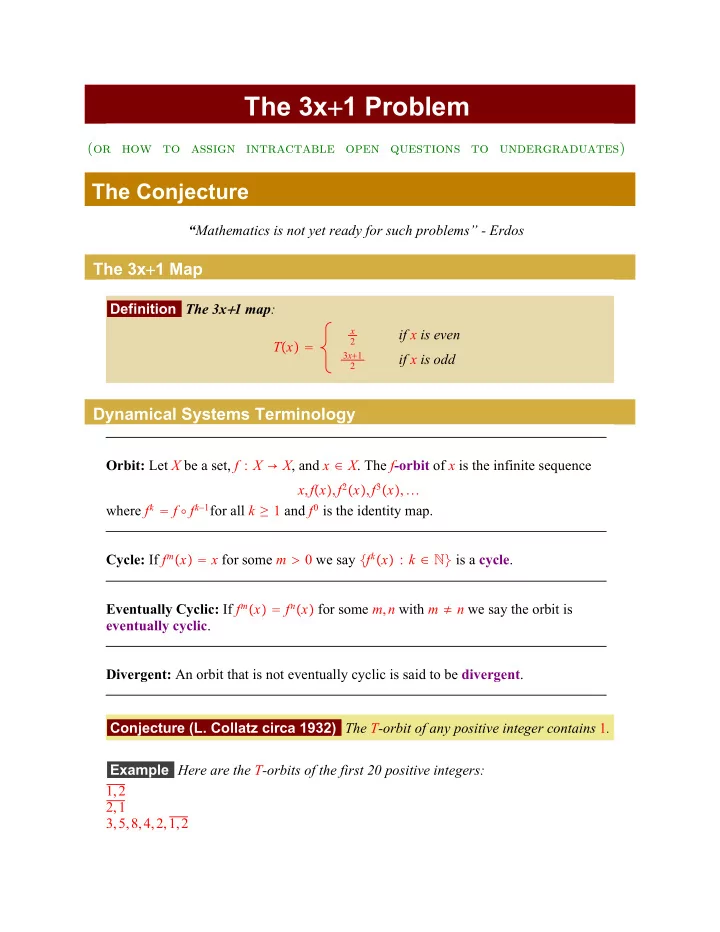
Orbit: Let X be a set, f : X  X, and x  X. The f-orbit of x is the infinite sequence x,fx,f2x,f3x, where fk  f  fk1for all k  1 and f0 is the identity map. Cycle: If fmx  x for some m  0 we say fkx : k  N is a cycle. Eventually Cyclic: If fmx  fnx for some m,n with m  n we say the orbit is eventually cyclic. Divergent: An orbit that is not eventually cyclic is said to be divergent. Conjecture (L. Collatz circa 1932) The T-orbit of any positive integer contains 1. Example Here are the T-orbits of the first 20 positive integers: 1,2 2,1 3,5,8,4,2,1,2

slide-2
SLIDE 2

4,2,1,2 5,8,4,2,1,2 6,3,5,8,4,2,1,2 7,11,17,26,13,20,10,5,8,4,2,1,2 8,4,2,1,2 9,14,7,11,17,26,13,20,10,5,8,4,2,1,2 10,5,8,4,2,1,2 11,17,26,13,20,10,5,8,4,2,1,2 12,6,3,5,8,4,2,1,2 13,20,10,5,8,4,2,1,2 14,7,11,17,26,13,20,10,5,8,4,2,1,2 15,23,35,53,80,40,20,10,5,8,4,2,1,2 16,8,4,2,1,2 17,26,13,20,10,5,8,4,2,1,2 18,9,14,7,11,17,26,13,20,10,5,8,4,2,1,2 19,29,44,22,11,17,26,13,20,10,5,8,4,2,1,2 20,10,5,8,4,2,1,2 Example The T-orbit of 27 is: 27, 41, 62, 31, 47, 71, 107, 161, 242, 121, 182, 91, 137, 206, 103, 155, 233, 350, 175, 263, 395, 593, 890, 445, 668, 334, 167, 251, 377, 566, 283, 425, 638, 319, 479, 719, 1079, 1619, 2429, 3644, 1822, 911, 1367, 2051, 3077, 4616, 2308, 1154, 577, 866, 433, 650, 325, 488, 244, 122, 61, 92, 46, 23, 35, 53, 80, 40, 20, 10, 5, 8, 4, 2, 1

More Well Known Open Problems

Conjecture Divergent Orbits Conjecture: No positive integer has a divergent T-orbit. Conjecture Nontrivial Cycles Conjecture: The only T-cycle of positive integers is: 1,2 Conjecture Finite Cycles Conjecture: The only T-cycles of integers are: 1,2 0 1 5,7,10 17,25,37,55,82,41,61,91,136,68,34

slide-3
SLIDE 3

Background

What DO we know?

Literature

Jan 1985 Lagarias, The 3x1 Problem and its Generalizations, MAA Monthly

1991 Wirsching, The Dynamical System Generated by the 3n1 Function

Aug 1999 - Eichstät, Germany International Conference on the Collatz Problem and Related Topics

Lagarias 3x1 Problem Annotated Bibliography: 95 mathematical publications since 1985 Verification

Eric Roosendaal: Verified for n  184  250  207,165,582,859,042,816

Crandall’s Result: No nontrivial cycle can have less than 338,466,909 elements!

Conway: There are similar problems which are algorithmically undecidable! Meanwhile at Scranton...

1991: Faculty Student Research Program (FSRP) formed at Scranton.

Student Publications:

  • C. Farruggia, M. Lawrence, B. Waterhouse; The Elimination of a Family of

Periodic Parity Vectors in the 3x  1 Problem, Pi Mu Epsilon Journal, 10 (4), Spring (1996), 275-280 (1996 Richard V. Andree award winner)

  • Fusaro, Marc, A Visual Representation of Sequence Space, Pi Mu Epsilon Journal,

Pi Mu Epsilon Journal 10 (6), Spring 1997, 466-481 (1997 MAA EPADEL section student paper competition winner and 1997 Richard V. Andree award winner)

  • Joseph, J.; A Chaotic Extension of the 3x  1 Function to Z2i, Fibonacci

Quarterly, 36.4 (Aug 1998), 309-316 (1996 MAA EPADEL section student paper competition winner)

  • Fraboni, M.;Conjugacy and the 3x  1 Conjecture (1998 MAA EPADEL section

student paper competition winner)

  • Kucinski, G.; Cycles for the 3x  1 Map on the Gaussian Integers, to appear, Pi Mu

Epsilon Journal

  • Yazinski, J.; Elimination of -fixed point candidates (in preparation)

Publications:

  • Monks, K.; 3x  1 minus the , Discrete Mathematics and Theoretical Computer

Science, 5, no. 1, (2002), 47-54

  • Monks, K. and Yazinski, J.; The Autoconjugacy of the 3x  1 Function, to appear in

Discrete Math

  • Monks, K.; A Category of Topological Spaces Classifying Acyclic Set Theoretic

Dynamics, in preparation

slide-4
SLIDE 4

Possible Approaches

  • 1. Extend T to other domains
  • 2. Simplify T’s iterations
  • 3. Study T’s cousins
  • 4. Study T as its own cousin!
  • 5. Study T’s distant cousins

Extending the Domain

The OddRats: Qodd  a b : a,b  Z, gcda,b  1, and b odd i.e. it is the set of all rational number having an odd denominator in reduced fraction form. The 2-adic integers: Z2  a0a1a2 2 : ai  0,1 with  and  defined by the ordinary algorithms for binary arithmetic, i.e. we interpret each element as the formal sum: a0a1a2 2  

i0 

ai2i Some Basic Facts about the 2-adics:

Z  Qodd  Z2

a 2-adic is an (ordinary) integer iff its digits end with 0 or 1

a 2-adic is an oddrat iff its digits are eventually repeating

a0a1a2 2 is even  a0  0

We can define a metric on Z2by dx,x  0 and da0a1a2 2,b0b1b2 2 

1 2k where

k  minj : aj  0 if a0a1a2 2  b0b1b2 2 Example

slide-5
SLIDE 5

13  10110 2  1  1 2 2  010 2 2/5  0101102

Simplifying the Iteration

3x1 minus the 

Results from: Monks, K.; 3x  1 minus the , Discrete Mathematics and Theoretical Computer Science, 5, no. 1, (2002), 47-54

Define T0x  x/2 and T1x 

3x1 2

so that Tx  T0x if x

2

 0 T1x if x

2

 1

T is messy to iterate... Tkn  Tvk1  Tvk2    Tv0n  3m 2k n  

i0 k1

vi 3vi1vk1 2ki where m  

i0 k1

vi , v0,vk1  0,1, and vi

2

 Tin

Compare with... Rvk1  Rvk2    Rv0n  3m 2k n where R0n 

1 2 n and R1n  3 2 n.

Q: Is there some function of the form Rn  r0n if n

d

 0 r1n if n

d

 1   rd1n if n

d

 d  1 where r1,,rd1  Q and d  2 such that knowledge of certain R-orbits would settle the 3x  1 problem?

slide-6
SLIDE 6

Theorem There are infinitely many functions R of the form shown above having the property that the Collatz conjecture is true if and only if for all positive integers n the R-orbit of 2n contains 2. In particular, Rn 

1 11 n

if 11  n

136 15 n

if 15  n and NOTA

5 17 n

if 17  n and NOTA

4 5 n

if 5  n and NOTA

26 21 n

if 21  n and NOTA

7 13 n

if 13  n and NOTA

1 7 n

if 7  n and NOTA

33 4 n

if 4  n and NOTA

5 2 n

if 2  n and NOTA 7n

  • therwise

(where NOTA means “None of the Above” conditions hold) is one such function. Corollary If x0,,xn1 is a T-cycle of positive integers, O  i : xi is odd , E  i : xi is even , and k  |O| then

iE

xi 2  

iO

xi 2  k.

Relatives of T and Conjugacies

Definition Maps f : X  X and g : Y  Y are conjugate with conjugacy h if and

  • nly if there exists a bijection h such that

X

f

 X h   h Y

g

 Y commutes. If, in addition, X, Y are topological spaces and h is a homeomorphism then we say that h is a topological conjugacy.

slide-7
SLIDE 7

Conjugacies preserve the dynamics of a map

Two Important Maps

Definition The shift map,  : Z2  Z2, is defined by x 

x 2

if x is even

x1 2

if x is odd. Facts about the shift map:

The effect of the shift map on a 2-adic is to erase the first digit, i.e. it shifts all digits one place to the left a0a1a2 2  a1a2a3 2

The -orbit of x is cyclic (resp. eventually cyclic) iff the 2-adic digits of x are periodic (resp. eventually periodic) Example The -orbit of  11

33  110102 is a cycle of period five

110102,101012,010112,101102,011012,110102, Definition (Lagarias) Define the parity vector map, 1 : Z2  Z2 by 1x  v0v1v2 2 where vi  0,1 and vi

2

 Tix for all i  N, i.e. the digits of the parity vector of x are obtained by concatenating the mod 2 values of the T-orbit of x. Example Since the T-orbit of 3 is 3,5,8,4,2,1 the parity vector of 3 is 13  1100012   23 3 Facts about 1

1 is a topological conjugacy between T and  ! (Lagarias)

Bernstein gave an explicit formula for the inverse map , namely, 2d0  2d1  2d2    

i

1 3i1 2di whenever 0  d0  d1  d2   is a finite or infinite sequence of natural numbers.

(Lagarias) 1 and  are solenoidal, that is to say that to say that for all a,b  Z2 and any k  Z

slide-8
SLIDE 8

a

2k

 b  a

2k

 b

Even More Open Problems...

Conjecture (Lagarias) Periodicity Conjecture: 1 Qodd  Qodd

Bernstein and Lagarias: Periodicity Conjecture  Divergent Orbits Conjecture. Conjecture (Bernstein-Lagarias) -Fixed Point Conjecture: The only odd fixed points of  are 1

3 and 1.

In Search of Interesting Conjugacies

Fraboni - Classification of Linear Conjugacies

Q: What other functions are there analogous to the shift map and parity vector map? Definition A function fa,b,c,d : Z2  Z2 is modular if it is of the form fa,b,c,dx 

axb 2

if x even

cxd 2

if x odd with a,b,c,d  Z2. Definition Let F be the set of modular functions, fa,b,c,d, such that a,c and d are odd and b is even. Example T  f1,0,3,1 and   f1,0,1,1 are both in F Theorem (Fraboni) (1) A modular function f is conjugate to T if and only if f  F. (2) Every element of F is topologically conjugate to T. (3) Every function that is conjugate to T by a linear map is in F.

The Nontrivial Autoconjugacy of T

slide-9
SLIDE 9

Results from: Monks, K. and Yazinski, J.; The Autoconjugacy of the 3x  1 Function, to appear in Discrete Math

Hedlund (1969): Aut  id,V where Vx  1  x and id is the identity map

Vx is the 2-adic whose digits are the bit-complement of the digits of x Example V110102  001012 Q: What is AutT?

Notice Z2

T

 Z2

1 

 1 Z2

 Z2

V 

 V Z2

 Z2

 

  Z2

T

 Z2 commutes. Definition Define  :   V  1 We call  the nontrivial autoconjugacy of T. Answer: AutT  id, Facts about :

2  id and   T  T  

 maps a 2-adic integer x to the unique 2-adic integer x whose parity vector is the

  • ne’s complement of the parity vector of x, i.e. all corresponding terms in the T-orbits of x

and x have opposite parity. Example The T-orbit of 11/3 is

slide-10
SLIDE 10

 11 3 ,5,7,10 and the T-orbit of 8/5 is 8 5 , 4 5 , 2 5 , 1 5 . By uniqueness we conclude that 11/3  8/5. Example Suppose we wish to compute 3. The T-orbit of 3 is 3,5,8,4,2,1 so that 13  110001 and its one’s complement is V  13  001110 By Bernstein’s formula for  we obtain 3    V  13  001110   4 9 whose T-orbit is  4 9 , 2 9 , 1 9 , 1 3 ,1,2.

Parity Neutral Collatz

Definition Let  : Z2  Z2 by x 

x 2

if x is even x if x is odd for all x  Z2. Example

slide-11
SLIDE 11

3

 4/9

T 

 T 5

 2/9

T 

 T 8

 1/9

T 

 T 4

 1/3

T 

 T 2

 1 Definition Define  on Z2 by x  y  x  y or x  y for all x,y  Z2

 is an equivalence relation on Z2

Z2/   x,x : x  Z2 and x is odd Example 3  4/9  3,4/9 Definition  : Z2/   Z2/  by x  Tx for all x  Z2. Theorem The following are equivalent. (a) The Collatz Conjecture. (b) The -orbit of any positive integer contains 1. (c) The -orbit of the class of any positive integer contains 1. Example The T-orbit of 3 is 3,5,8,4,2,1 while the -orbit of 3 is 3,4/9,2/9,1/9,8,4,2,1 and the -orbit of 3 is 3, 4 9 ,  2 9 ,5 ,  1 9 ,8 , 4, 1 3 ,2,1

slide-12
SLIDE 12

Application to Divergent Orbits

Conjecture Autoconjugacy Conjecture:  Qodd  Qodd Theorem The following are equivalent. (a) The Periodicity Conjecture. (b) The Autoconjugacy Conjecture. (c) No oddrat has a divergent T-orbit. Furthermore, the statement Z  Qodd is equivalent to the Divergent Orbits Conjecture.

Application to Cycles

Definition T-cycle C is self conjugate if C  C. Example 1,2 is a self-conjugate T-cycle. Theorem A T-cycle C is self conjugate if and only if C is the set of iterates of x where x  v0v1vkv0

v1 vk 

for some v0,v1,,vk  0,1 (note 0  1 and 1  0) Example To illustrate the theorem, start with any finite binary sequence, e.g. 11, and catenate its one’s complement: 1111  1100. Extend this to a periodic sequence, 1100, and compute x  1100  5/7. Then by the previous theorem the T-orbit of 5/7 is self conjugate. Indeed the T-orbit of 5

7 is

5 7 , 11 7 , 20 7 , 10 7 and 5/7  20/7.

slide-13
SLIDE 13

Self Conjugate T-cycles with ten elements or less 1,2  5

7 , 11 7 , 20 7 , 10 7  19 37 , 47 37 , 89 37 , 152 37 , 76 37 , 38 37 17 25 , 38 25 , 19 25 , 41 25 , 74 25 , 37 25 , 68 25 , 34 25 13 35 , 37 35 , 73 35 , 127 35 , 208 35 , 104 35 , 52 35 , 26 35 211 781 , 707 781 , 1451 781 , 2567 781 , 4241 781 , 6752 781 , 3376 781 , 1688 781 , 844 781 , 422 781 373 781 , 950 781 , 475 781 , 1103 781 , 2045 781 , 3458 781 , 1729 781 , 2984 781 , 1492 781 , 746 781 383 781 , 965 781 , 1838 781 , 919 781 , 1769 781 , 3044 781 , 1522 781 , 761 781 , 1532 781 , 766 781 

One immediate consequence is that any self conjugate cycle must have an even number of elements. Theorem If C is a self conjugate T-cycle then C  Qodd

 , i.e. any self conjugate

T-cycle contains only positive rational entries. Q: Are there self conjugate cycles integer cycles other than 1,2? Theorem For any self conjugate T-cycle C 0  minC  1  maxC. Hence, the only self conjugate T-cycle of integers is 1,2.

Proofs

Definition Let nx be the number of ones in the first n digits of the parity vector of x. Facts about nx

nx  nx  n

Dividing by n, nx n  nx n  1 Theorem Let x  Z2. Then

slide-14
SLIDE 14

lim nx n  lim nx n  1. The following theorem is a generalization of results of Lagarias and Eliahou. Theorem Let x  Qodd. (a) If the orbit of x is eventually cyclic then lim

n nx n

exists and ln2 ln3 

1 m   lim n

nx n  ln2 ln3 

1 M 

where m, M are the least and greatest cyclic elements in Ox. (b) If the orbit of x is divergent then ln2 ln3  lim nx n .

Distant Cousins - Changing Categories

Results from: Monks, K.; A Category of Topological Spaces Classifying Acyclic Set Theoretic Dynamics, in preparation Definition A set theoretic discrete dynamical system is a pair X,f where X is a set and f : X  X. Definition Let f : X  X and g : Y  Y. Then h : X  Y is a semi-conjugacy if and

  • nly if

X

f

 X h   h Y

g

 Y commutes. Definition Let f : X  X. Define f  A  X : fA  A Theorem f is a topology on X. Remark We call f the topology induced by f.

slide-15
SLIDE 15

Theorem Semiconjugacies are continuous with respect to the induced topologies. Conjugacies are homeomorphisms. Theorem The Collatz conjecture is true if and only if the topological space Z,T is connected.

Yazinski - Work on the -fixed point conjecture

Theorem Let b  Z2, a,t  N with 2t  a, and m the number of ones in the binary digits of a. Then a  b2t  a  b 3m 2t

32ik

2i2

 1 for all i  1, so for m  2ik with i  1 we have a  b2t

2ti2

 a  b2t Corollary There is no -fixed point of the form

2k1 ones

1111 0 2

  • r

2k1 ones

11010101011 0 2 where k  Z.

In Search of the “Collatz Fractal”

Joseph’s Extension

Extension to Z2i

Even and odd correspond to equivalence classes in Z/2Z.

Z2i/2Z2i  0,1,i,1  i Definition Let  T : Z2i  Z2i by

slide-16
SLIDE 16

 Tx 

x 2

if x  0

3x1 2

if x  1

3xi 2

if x  i

3x1i 2

if x  1  i

Kucinski - Cycles in T|Zi

Theorem (Kucinski)  T|Zi has exactly 77 distinct cycles of period less than or equal to 400 distributed as follows: Period Number T|Z Cycles Number  T|Zi Cycles 1 2 4 2 1 3 3 1 9 5 2 8 10 11 1 5 19 30 46 2 84 10 103 2 Conjecture Further computations will make it more plausible that we should make a finite cycles conjecture for  T.

Wanted: a continuous (preferably entire) function that interpolates T|Qodd or  T|Qoddi

No way!

  • M. Chamberland:

fx  x 2 cos2  2 x  3x  1 2 sin2  2 x is entire and extends T|Z. An analytic extension of T|Zi Definition: Let a0,a1,a2,   Zi be the enumeration of the points of Zi as shown:

slide-17
SLIDE 17

Theorem (Joseph, Monks) Let F : C  C by f0z  0, and for n  0 fnz  nz z an

mn

 T

nan   k0 n1

fkan , nz  

k1 n

z  ak an  ak , pn  n  1 2 , Kn   T

nan   k0 n1

fkan , mn  log2 1  2 2

n1pn n1 Kn

Fz  

n0 

fnz. F is an entire function which extends  T|Zi. Remark Not quite the kind of formula you want to use to make a fractal! A Collatz Julia set Using Chamberland’s map we get the following Julia set:

slide-18
SLIDE 18