Texas Department of Motor Vehicles (TxDMV) Fraud Thursday, October - - PDF document

texas department of motor vehicles txdmv fraud
SMART_READER_LITE
LIVE PREVIEW

Texas Department of Motor Vehicles (TxDMV) Fraud Thursday, October - - PDF document

Texas Department of Motor Vehicles (TxDMV) Fraud Thursday, October 18 9:05-9:55 a.m. Sandra Menjivar-Suddeath, Internal 73 rd Annual Audit Director on Fraud, Texas Texas Association Department of Motor Vehicles of County Auditors Charlie


slide-1
SLIDE 1

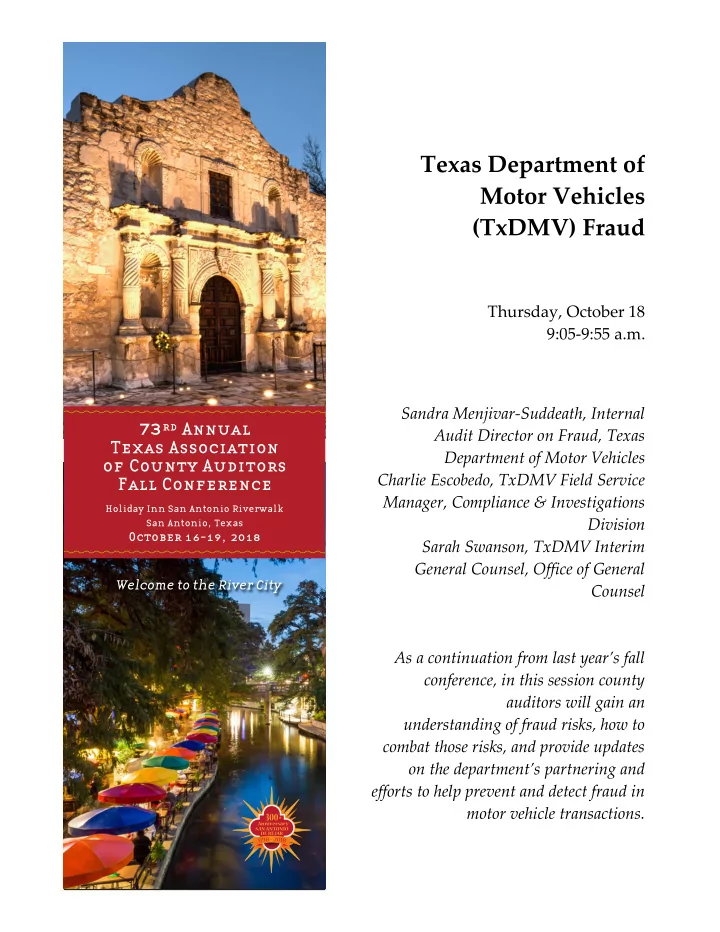
73rd Annual

Texas Association

  • f County Auditors

Fall Conference

Holiday Inn San Antonio Riverwalk San Antonio, Texas

October 16-19, 2018

Anniversary SAN ANTONIO

300

DE BÉJAR

th

Welcome to the River City

Texas Department of Motor Vehicles (TxDMV) Fraud

Thursday, October 18 9:05-9:55 a.m. Sandra Menjivar-Suddeath, Internal Audit Director on Fraud, Texas Department of Motor Vehicles Charlie Escobedo, TxDMV Field Service Manager, Compliance & Investigations Division Sarah Swanson, TxDMV Interim General Counsel, Office of General Counsel As a continuation from last year’s fall conference, in this session county auditors will gain an understanding of fraud risks, how to combat those risks, and provide updates

  • n the department’s partnering and

efforts to help prevent and detect fraud in

motor vehicle transactions.

slide-2
SLIDE 2

Sandra Menjivar-Suddeath, Internal Audit Director on Fraud, Texas Department of Motor Vehicles, Austin Menjivar-Suddeath serves as the internal audit director for the Texas Department

  • f Motor Vehicles (TxDMV). She is

responsible for leading the division that provides the TxDMV board and agency management with assurance services and information to reduce exposure to risks that may hinder the department from achieving its goals, mission, and vision. She previously was an audit manager at Texas Department of Transportation (TxDOT). In that role, she oversaw audit staff and managed internal Information Technology and operational audits. Prior to TxDOT, Menjivar-Suddeath led audits at the Texas Department of Public Safety and was a senior auditor for the Office of Inspector General, U.S. Department of Transportation, where she led and worked on audits related to grants, vehicle safety, cross-border trucking, and the Highway Trust Fund. Menjivar-Suddeath currently serves as the IT Committee Chair for the State Agency Internal Audit Forum (SAIAF). She has a bachelor’s degree from the University of Texas at Austin and a master’s degree from The University of Texas at Austin’s Lyndon B. Johnson School of Public

  • Affairs. She is a Certified Information

Systems Auditor, Certified Internal Auditor, and a Certified Government Auditing Professional.

slide-3
SLIDE 3

Texas Association of County Auditors

October 18, 2018

Agenda

 Control Environment & Ethics  RTS Access  Field Service Representative Identified Issues  Regulating Title Services

slide-4
SLIDE 4

Control Environment

“The control environment sets the tone of an organization, influencing the control consciousness of its people. It is the foundation for all

  • ther components of internal control, providing discipline and structure.

Control environment factors include the integrity, ethical values and competence of the entity’s people; management’s philosophy and

  • perating style; the way management assigns authority and

responsibility, and organizes and develops its people; and the attention and direction provided by the board of directors.”

Control Environment Components

 Management philosophy and operating style

 Local culture and values  Performance expectations

slide-5
SLIDE 5

Control Environment Components – Cont’d

 HR policies and practices

 Code of conduct and ethics  Whistleblower policy

 Ethics Reporting

 Investigation of fraud, waste, and abuse  Ombudsman  Reporting Structure  Hotline

Control Environment Components – Cont’d

 Organizational Structure

 Not allow management over-ride of established controls  Assignment of authority and responsibility

 Competence of personnel

 Staff Training  Job Descriptions  Job Roles and Functions

slide-6
SLIDE 6

Conflict of Interest

 Nepotism – including various levels of your

  • rganization (especially managers)

 Possible recusal in the event of an investigation

 If someone in the county system is under investigation,

recusal may be exercised by local law enforcement and/or prosecutors

 In that case, special prosecutors or state resources may

be employed to perform the investigation.

Ethics – Best Practices

 Hiring Guidelines  Familiarity Guidelines

 It’s not just about family.

 Out of Work Approval  Hotline

slide-7
SLIDE 7

Auditing Ethics & Control Environment

 Employee Surveys  “Auditing by walking around”  Review organizational newsletters, code of

conduct, training courses, and hotline

Auditing Ethics & Control Environment

 Use the Institute of Internal Auditors –

International Professional Practices Framework Practice Guides

 Auditing the Control Environment  Evaluating Ethics-related Programs and Activities

slide-8
SLIDE 8

RTS Access RTS Roles and Permissions

 Set roles dependent on office functions:

 Administrative (Accountants, Investigators, Auditors, etc.)  Customer Service Representatives  Supervisors / Managers

slide-9
SLIDE 9

Employee Security Report RTS Report Access

slide-10
SLIDE 10

Primary Roles

 Administrative Support

 Limit access to assigned functions  Restrict access to title and registration events

 Customer Service Representatives

 Limit access to assigned functions  Restrict access to accounting and reporting events  Evaluate access to void and modify functions

 Supervisor / Manager

 Has the most access due to multiple responsibilities

Higher Risk Roles and Permissions

 Operate on the principle of least privilege  Standard Clerk

 Registration / Title / Status Change / Inquiry /

Miscellaneous / Special Plates  Reporting

 Sales Tax / Reprints / Title Package / Exempt Audit / eTitle

/ Cognos

slide-11
SLIDE 11

Higher Risk Roles and Permissions – Cont’d

 Accounting/Funds

 Funds Remittance / Refunds / Hot Check / Seized Items /

Additional Collections  Inventory

 Allocation / Deletion / Inquiry / Receipt / Profile / Hold-

Release / Actions  Security Admin

 Local Options (Security-password admin / Account

administration)

Account Management

 Administrative Access is delegated to personnel

within the TAC office to facilitate timely provisioning and management of county personnel access

 Personnel separating employment with the TAC office

should have their RTS access removed within 24 hours

 Account passwords should be reset using the admin

interface rather than creating a second account (each RTS user should have only one account)

 Each user should have unique username and password

slide-12
SLIDE 12

Account Management

  • Cont’d

 Access should be validated at least annually

 Ensure personnel who no longer work for the county do

not still have accounts

 Check that the access individuals are assigned is

appropriate to their role

FSR Identified Issues

slide-13
SLIDE 13

Inventory

 Unsecured inventory  Periodic inventories not conducted

 Daily/Weekly - Batch Inventory Action Report (BIAR)  Monthly/Quarterly - Inventory Inquiry Report

 Central vs. Allocated Inventory

 Inventory at workstation not allocated through RTS  Plate sequences not verified prior to use

Voided and Deleted Transactions

 Voided Transactions

 Reconciliation of BIAR and Voided Transaction Reports  Visual verification of voided transactions  Inventory not defaced

 Deleted Inventory

 Accountability prior to a deletion  Description of deletion entered in RTS

slide-14
SLIDE 14

Title Transactions

 130-U filled-out by staff  Missing sales prices or SPV  Sales exemption reason not indicated  Incorrect evidence of ownership

Refunds and Insufficient Funds Transactions

 Insufficient Fund Transactions with no

supporting documentation

 Refund Authorization Receipts not signed by

TAC/Representative

 Timely remittance of refunds or credits on RTS

slide-15
SLIDE 15

Financials

 Timely remittance of fees  Retention of fee reports  Account for Miscellaneous Fees

Cash Handling

 Accountability of overages or shortages  Select proper tender type  Single cash till for multiple payment types

slide-16
SLIDE 16

Regulating Title Services

Regulating Title Services

 Texas statute (Tx. Transportation Code § 520.052)

requires counties with population >500K to regulate “title services” and “title runners.”

 Other counties may regulate these entities if

commissioners court “adopts” Subchapter E of that code.

 To regulate, the county must adopt rules and publish

them in the Texas Register for comment.

 Rules will set forth requirements for license application,

recordkeeping, revocation/suspension of licenses, etc.

 Statute has criminal penalty if a title service violates your

rules, and authorizes your DA to enjoin their operations if convicted!

slide-17
SLIDE 17

Free Lined Graph Paper from http://incompetech.com/graphpaper/lined/

slide-18
SLIDE 18

Free Lined Graph Paper from http://incompetech.com/graphpaper/lined/