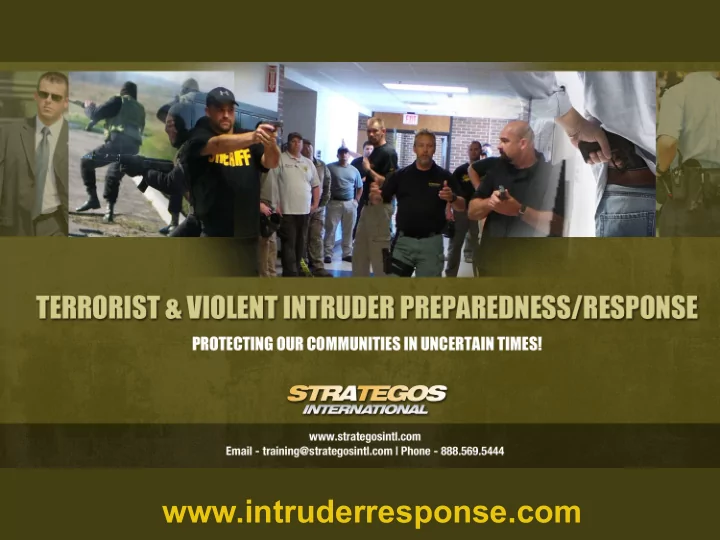
SLIDE 1
Terrorist ¡& ¡Violent ¡Intruder ¡ Preparedness/Response ¡ Simplifying ¡Your ¡Response ¡Based ¡on ¡ A6acker ¡Objec<ve ¡Commonali<es ¡ ¡
www.intruderresponse.com
SLIDE 2
Vaughn Baker – Co-Founder Strategos International
20+ years L.E. experience (SWAT, Investigations, etc.) Co-Founded Strategos International in June of 2002 1999-2002 – Deputy Dir. of Trng. – Surefire Institute
SLIDE 3
Active Shooter & Intruder Response Solutions
Strategos founded in 2002 as primarily L.E./MIL Tactical Training Company Trained over 60,000 school, healthcare, faith-based, workplace, L.E., military and government professionals in 15 countries Countries include U.S., Canada, Mexico, El Salvador, Nicaragua, Honduras, Colombia, Singapore, Japan, United Kingdom, France, Portugal, Germany, Italy, and Spain. 2007 Recognized need to train civilians as they are “true first responders” & success vs. failure is most likely dependent on their proper response
SLIDE 4
Solution Phases
Training & consulting solutions Strategos provides fall into 3 categories that organizations should address:
RESPONSE AFTER ACTION PREVENTION
SLIDE 5
COMMUNITY RESPONSE Philosophy
Based on experience we determined in late 2009 that solutions presented should be a “community response” approach Defining “Community” - a group of people, and a feeling of fellowship with others, as a result of sharing common attitudes, interests, and goals.
SLIDE 6 COMMUNITY RESPONSE Philosophy
These tragic events are community based events
- Attacker is from the community
- Victims are from the community
- Responders are from community
- SOLUTIONS must be
“community based!”
SLIDE 7 COMMUNITY RESPONSE Philosophy (continued)
“Community Response” should include:
- “Professional First Responder” as well as the “TRUE
FIRST RESPONDER” Defining Traditional “FIRST RESPONDER” - A person, such as a police officer, firefighter, or EMT, trained in emergency response procedures and prepared to move quickly to the scene of an emergency in progress
SLIDE 8 COMMUNITY RESPONSE Philosophy (continued)
“Community Response” should include:
- “Professional First Responder” as well as the “TRUE
FIRST RESPONDER” Defining the “TRUE FIRST RESPONDER” – Those persons already ON SCENE when the incident begins that have proper training, mindset and DESIRE to do WHAT is needed WHEN it is needed to de-escalate the event to those that they are responsible for
SLIDE 9 COMMUNITY RESPONSE Philosophy (continued)
“Community Response” should include:
- Organization “TRUE FIRST RESPONDER” Personnel
- “Professional First Responder” Personnel (L.E., Fire,
EMS, etc.)
- Community Groups (parents, employees, members)
- What is a threat
- When to report
- How to report
- Awareness/Indicators
- Roles & Obligations in Reporting & Response
SLIDE 10
What is the Value of TIME?
SUCCESS vs. FAILURE is most likely going to be up to the people on scene; NOT professional first responders
SLIDE 11
SLIDE 12 Active Shooter Statistics (2013 FBI Study)
160 Active Shooter Incidents from 2000-2013(14-15 per year avg.) 11.4 per year avg. – 6.4 first 7 years increasing to 16.4
69% ending in 5 min. or less / 14% ending in 2 min. or less 56% ended on shooters initiative – stopped or committed suicide 15.6% fled the scene prior to police arrival 21 incidents “unarmed” citizens restrained shooter 5 incidents armed, non-LE personnel exchanged gunfire with attacker
SLIDE 13 Active Shooter Statistics (2013 FBI Study)
2 incidents armed, off-duty LE engaged the shooters resulting in attackers death 10.6% (17) Attacker committed suicide after arrival of L.E. 28% (45) police and attacker exchange gunfire Attack Locations
- 45.6% - Commerce/Workplace – Open to public
- 24.4% - Education/Academic
- 10% - Government Facilities
- 9.4% - Open Space
- 4.4% - Residencdes
- 3.8% - Faith Based
- 2.5% - Healthcare
SLIDE 14 Active Shooter Statistics (2013 FBI Study)
160 Active Shooter Incidents from 2000-2013(14-15 per year avg.) 97.3% Male – 6 of the incidents were female attackers All but 2 incidents involved a single attacker Highest Casualty Counts
- Aurora, CO Movie Theater – 70 casualties - 12 killed, 58
wounded
- Virginia Tech – 49 Casualties – 32 killed, 17 wounded
- Ft. Hood 2009 – 45 Casualties – 13 killed, 32 wounded
- Sandy Hook – 29 Casualties – 27 killed, 2 wounded
SLIDE 15 Terrorism - Domestic/International – FBI Definition
- (1) ¡Involve ¡violent ¡acts ¡or ¡acts ¡dangerous ¡to ¡human ¡life ¡that ¡
violate ¡federal ¡or ¡state ¡law; ¡(2) ¡Appear ¡to ¡be ¡intended ¡to ¡ in<midate ¡or ¡coerce ¡a ¡civilian ¡popula<on ¡
Active Shooter – DHS Definition
- "an ¡individual ¡ac+vely ¡engaged ¡in ¡killing ¡or ¡a2emp+ng ¡to ¡kill ¡
people ¡in ¡a ¡confined ¡and ¡populated ¡area; ¡in ¡most ¡cases, ¡ac6ve ¡ shooters ¡use ¡firearm[s] ¡and ¡there ¡is ¡no ¡pa2ern ¡or ¡method ¡to ¡ their ¡selec+on ¡of ¡vic+ms.” ¡
- ¡ ¡Recent ¡trend ¡towards ¡shooter ¡becoming ¡mobile ¡and ¡not ¡in ¡
- ne ¡specific ¡confined ¡area ¡– ¡Navy ¡Yard ¡Shooter, ¡Univ. ¡of ¡
California-‑Santa ¡Barbara ¡Shooter, ¡ ¡
SLIDE 16 Overview of Terrorism Incidents
2008 MUMBAI ATTACKS
- 12 coordinated shooting & bombing
attacks lasting 4 days
- 164 killed, 308 wounded
- 10 well trained terrorists conducted attack
- Attacks were committed by 2 or 3
attackers
SLIDE 17 Overview of Terrorism Incidents
2013 Kenya Westgate Mall Attacks
- 67 killed, 175 wounded
- 4 trained terrorists conducted attack
w/ AK 47’s and explosives
SLIDE 18 Overview of Terrorism Incidents
2015 Charlie Hebdo Attack
- 12 killed, 11 wounded in initial attack – 5 others killed and
11 more wounded in related attacks in following 72 hours
- 2 trained terrorists conducted attack w/ rifles, explosives &
RPG forced coerced access/entry
SLIDE 19 Attacker Objective Commonalities
Target Selection
- Victim Specific Motivation – However do engage
targets of opportunity as well
- Target Accessibility
- Victim Types at Location Shock the Conscious (kids,
foreigners, etc.)
- Location naturally confines victims & delays LE
response (Oslo Norway)
SLIDE 20 Attacker Objective Commonalities
“God” Complex
- Active Shooter - VA Tech, UC Santa Barbara, Columbine
- Terrorist – “Hand of God” Actions
Pre-Planning
- Terrorists – Dry Run Probing
- Active Shooters – Kill lists, IED testing,
- Mass casualties in compressed time frames
SLIDE 21 Attacker Objective Commonalities
Social Media Communication
- Prior to the Act – Veiled communication
Death Acceptance
- Active Shooter - DOES NOT plan escape strategy
- Terrorist – Considers death “martyrdom”
SLIDE 22 Attacker Objective Commonalities
Set the New Record
- Body County
- Type of Death
- Who is targeted shocks the conscious
Media Hungry
- Active Shooter - Wants to be remembered –
Columbine “Basement Tapes”, VA Tech NBC Video Manifesto, UC Santa Barbara You Tube Posting
- Terrorist – Utilizes social media and and video sent
to media outlets to claim responsibility & justify actions as well as recruiting tool
SLIDE 23 Attacker Objective Commonalities
Access Denial Strategies Cause Attacker to Move On
Generally DO NOT Take Hostages No empathy for victims Generally kill up close – Want to share personal space of victim at time of death
SLIDE 24 Other Commonalities ACTIVE SHOOTER & Terrorist
- Not motivated by revenge alone
because many times the act is random in nature and not “damage to persons for damage done to them”
- r as simply acting out on their
perceived ideology
- Does not seek retribution on specific
wrong or people who have done him wrong
- Instead SEEKS:
- 1. Destruction of ANY and ALL
- 2. Notoriety
- 3. Infamy through slaughter
- 4. A moment in time vs. lifetime of moments
SLIDE 25 The PSYCHOLOGY of the ACTIVE SHOOTER
- A lot of research attempting to IDENTIFY the patterns of the
ACTIVE Shooter
- Not a lot of research on the ‘WHY” they do what they do
- 1. Such a planned “scale of violence”
- 2. Apparent “randomness of violence”
- 3. The “active killer’s” propensity of commit
suicide as the “escape strategy”
- A lot of research attempting to
identify the patterns of the ACTIVE SHOOTER
SLIDE 26 The PSYCHOLOGY of the ACTIVE SHOOTER
- Active Shooter’s WORLDVIEW
- Seeks to transition from VICTIM to the
VICTIMIZER category
- 1. VICTIM
- 2. VICTIMIZER
- Cultural forces lead the Active Killer to
believe that mass murder is a path to celebrity wanting to be remembered as a VICTIMIZER not a VICTIM
- Those acting like VICTIMS will be
perceived and treated as such by the VICTIMIZER
SLIDE 27 RESPONSE Implications for FIRST RESPONDER
- Active Shooter DOES NOT negotiate….he VICTIMIZES
- Active Shooter DOES NOT lie in wait to battle law
enforcement- Only one LEO has been killed responding to Active Shooter incidents and very few have been injured
- Even when UNARMED citizens resist and FIGHT BACK the
Active Shooter frequently retreats and crumbles
- Active Shooter incidents have primarily been aborted by a
single courageous actor
- 1. 50% UNARMED citizens
- 2. 25% armed citizens
- 3. Remainder have been Law Enforcement
SLIDE 28 RESPONSE Implications for TRUE FIRST RESPONDER
- So WHY FIGHT BACK?!!
- Active Killer perceives his life as a VICTIM in a world
- f VICTIMIZERS and desires metamorphosis.
- Swift, aggressive action y first responders exploit this
lifetime of conditioned “VICTIM-like” response
- In his brief role as VICTIMIZER he
will attack mercilessly those acting like VICTIMS but those who adopt a posture and action of an aggressor they become the act of who is has always perceived as the VICTIMIZER
SLIDE 29
Attacker Background, Goals & Objectives
Long List of Personal Failures (Who do they blame?) NOT Highly Trained (Amateur) BUT Heavily Armed! Generally does not take hostages Close Range & Multiple Shots to each Victim PRE-OCCUPIED with setting the record
SLIDE 30 Purpose - To PREVENT attacker from obtaining ACCESS either to interior of building or room/office/area where you may reside Functions of a Lockdown
- Removing persons from the threat;
- Isolating the dangerous situation from much of the building/area;
- Allowing for an accurate accounting of persons within rooms; &
- Depending on the situation, facilitating an organized evacuation
away from the dangerous area.
Lockdown Principles for Public Places
Overview & Functions of a Lockdown
SLIDE 31
- Threat OUTSIDE the building - Examples would be fugitive in
geographic area on run from law enforcement, violent crime with criminal at large in geographic area of building, etc.
- Threat INSIDE the building - Examples would be unauthorized
access by intruder with unknown intentions, active shooter with known intentions
- Notification of one of the above types of “lockdowns” should be
clear and quickly understood by students, employees, congregations members, visitors & staff
Lockdown Principles for Public Places
2 Types of Lockdowns
SLIDE 32
- 1. Leaders, supervisors or ANYONE that has been trained make
announcement such as “threat outside lockdown” or “perimeter lockdown”, etc.
- 2. Designated personnel or those closest LOCK exterior doors
- 3. Clear hallways, restrooms, & other areas that can’t be secured
- 4. Secure & cover room or office windows
- a. Move all persons away from windows
- 5. Account for all persons within room/office
- a. Leaders should prepare a list of missing and extra persons
in the room
- 6. Control all movement, but continue activities.
- 7. Once threat has subsided, the building leadership announces
“ALL CLEAR CODE” over the PA system.
Lockdown Principles for Public Places
Threat OUTSIDE – Lockdown Procedures
SLIDE 33 Considerations
- Special attention should be paid to activities that are outside of
the building, such as playgrounds, ball fields, outside activities
- Persons must be able to hear the lockdown announcement.
Make sure your exterior PA systems are installed & working properly.
- An alternate lockdown location must be identified. This location
can be indoors or outdoors. (IF person(s) can be safely hidden)
Lockdown Principles for Public Places
Threat OUTSIDE – Lockdown Procedures (continued)
SLIDE 34
- 1. Building leadership orders and announces “Threat Inside Lockdown” or
“Emergency Lockdown” over PA system.
- 2. Immediately direct students, staff, visitors, congregation members, etc. to the
nearest room or secured space.
- 3. Activities or person(s) that are outside of the building SHOULD NOT
enter the building.
- 4. Move outside person(s) to the primary evacuation site
- 5. Lock room/office doors
- 6. Layer & Reinforce Lockdown in Rooms
- 6. DO NOT lock exterior doors
- 7. Move people away from the windows and doors. Keep all
persons sitting or kneeling on the floor (good posture), & turn off the lights/ cover windows/ viewable openings.
- 8. Take attendance of persons in each room.
1. Supervisor or Leadership prepares a list of missing or extra persons
Lockdown Principles for Public Places
Threat INSIDE – “Intruder” Lockdown Procedures
SLIDE 35
- 9. DO NOT respond to anyone at the door until “all clear” CODE is announced.
- 10. Keep out of sight
- 11. Be prepared to ignore any fire alarm activation, as the building
SHOULD NOT not be evacuated using this method.
- 12. When or if students are moved out of the classroom, assist them in moving
as quietly & quickly as possible.
- 13. When the threat is over/the intruder has left the building, building
- leadership. announces “ALL CLEAR CODE” over PA system.
***NOTE - Please note that some threats, such as a confirmed fire, intruder within a room, may override lockdown procedures. Also, lockdowns may be initiated in non-threatening circumstances to keep people away from areas where there may be a medical emergency or other disturbance.***
Lockdown Principles for Public Places
Threat INSIDE – “Intruder” Lockdown Procedures (continued)
SLIDE 36
- Any effective plan or strategy should include “contingency
planning” for failure
- CORRECTLY & IMMEDIATELY implementing a “lockdown”
should be the first response
- Recognize that implementing a “lockdown” is meant to
PREVENT the intruder from having access to rooms & victims
- Everything discussed up to this point includes:
- Threat Recognition, Threat Assessment, Access Control,
Lockdown Implementation, Law Enforcement Response
- The above DOES NOT include what to do IF the shooter or
intruder makes it into the room or area that YOU ARE IN!
- Hiding under desks/tables or behind objects once the shooter is
in the area you are in has proven unsuccessful repeatedly
Lockdown Principles for Public Places
“If & When” Lockdown Procedures Fail
SLIDE 37
- Consideration, Discussion, Education & applicable implementation
should also include a “3 OUT” Approach
- LOCK OUT - Lock the shooter (or potential shooter) out
- f the building or out of the classroom. “Lockdown”
- GET OUT - If the shooter is in your area – attempt ESCAPE.
If rooms, offices or areas are on 1st or 2nd floor escape through exterior window could be an option.
- TAKE OUT - If the shooter is in your area and you cannot
run – FIGHT! Simply taking a position under a desk in the “fetal position” will do NOTHING to prevent you from being a victim.
Lockdown Principles for Public Places
“If & When” Lockdown Procedures Fail (continued)
SLIDE 38
What "3 OUT" Decision Making IS NOT!
SLIDE 39
IMMEDIATE or an INDIRECT THREAT + LOCATION
= PROPER RESPONSE!
If threat is an indirect threat and not seen LOCK OUT; or GET OUT to LOCK OUT is usually best option
REMEMBER!
SLIDE 40 CORRECT "3 OUT" Decision Making Model
- Indirect Contact or other Stimulus AND
- In an area that can be locked out quickly
- LOCK, LAYER and REINFORCE “lock out”
- Direct Contact in area that cannot be "locked out" immediately
- In area that cannot be secured
- Moving towards immediate area that can be "locked out" quickly OR
- ut and away from building where immediate exit is possible
- Immediate threat in area where GET OUT success
is not possible or probable
- LOCK OUT has failed or is failing!
- Improvised objects utilized as weapons, directing others
(teenagers or older) in directed group response
SLIDE 41
Why Fight Back?
Good ¡Guys ¡Finish ¡Last? ¡ NO! ¡. ¡. ¡. ¡. ¡UNPREPARED ¡Good ¡Guys ¡Finish ¡LAST! ¡ Survival ¡vs. ¡Prevailing ¡ Figh6ng ¡Back ¡– ¡If ¡you ¡ are ¡going ¡to ¡get ¡ ¡ BEAT ¡. ¡. ¡. ¡Get ¡BEAT ¡ doing ¡SOMETHING ¡not ¡ BEAT ¡doing ¡NOTHING! ¡
SLIDE 42
- The Take OUT approach should be considered a “last resort”
- ption and it is unrealistic to assume that people will not be
seriously hurt or killed as a result. It is FAR MORE unrealistic to think that hiding under desks or behind objects will save any lives at all however.
- YES!, fighting is an option; but it should be your LAST option
– SO prepare mentally for this option and obtain training for teachers, administrators & staff appropriately. It IS NOT recommended that training be implemented for students
- n this option as it could lead to inappropriate or VERY untimely
implementation of that “LAST RESORT” option.
Lockdown Principles for Public Places
“If & When” Lockdown Procedures Fail (continued)
SLIDE 43
- “3-OUT” Questions to Ask Yourself for the following areas:
- Your assigned room, area or office
- Common Areas such as cafeterias, auditoriums,
lobbies, gymnasiums, meeting areas, etc.
- “How could I “LOCK OUT” from this area?”
- “How could I “GET OUT” from this area?”
- “How can I “TAKE OUT” from this area?”
Lockdown Principles for Public Places
“If & When” Lockdown Procedures Fail (continued)
SLIDE 44
LOCKING ¡OUT ¡– ¡Using ¡Magnets ¡
SLIDE 45
LOCKING ¡OUT ¡-‑ ¡Bridging ¡
SLIDE 46
LOCKING ¡OUT ¡– ¡Using ¡Chair ¡Legs ¡
SLIDE 47
LOCKING ¡OUT ¡– ¡Tying ¡Off ¡Doors ¡
SLIDE 48
LOCKING ¡OUT ¡– ¡Tying ¡Off ¡Closers ¡
SLIDE 49
LOCKING ¡OUT ¡– ¡Tying ¡Off ¡to ¡Tables ¡
SLIDE 50
LOCKING ¡OUT ¡– ¡Anchoring ¡
SLIDE 51
Questions About Training or Consulting?
www.intruderresponse.com training@strategosintl.com 888-569-5444
SLIDE 52
Terrorist ¡& ¡Violent ¡Intruder ¡ Preparedness/Response ¡ Simplifying ¡Your ¡Response ¡Based ¡on ¡ A6acker ¡Objec<ve ¡Commonali<es ¡ ¡
www.intruderresponse.com