Terrestrial planet formation across the galaxy Sean Raymond - - PowerPoint PPT Presentation

terrestrial planet formation across the galaxy
SMART_READER_LITE
LIVE PREVIEW

Terrestrial planet formation across the galaxy Sean Raymond - - PowerPoint PPT Presentation

Terrestrial planet formation across the galaxy Sean Raymond Laboratoire dAstrophysique de Bordeaux planetplanet.net Image credit: NASA/Ames/JPL-Caltech Collaborators Alessandro Morbidelli Franck Selsis (Bordeaux) (Nice)


slide-1
SLIDE 1

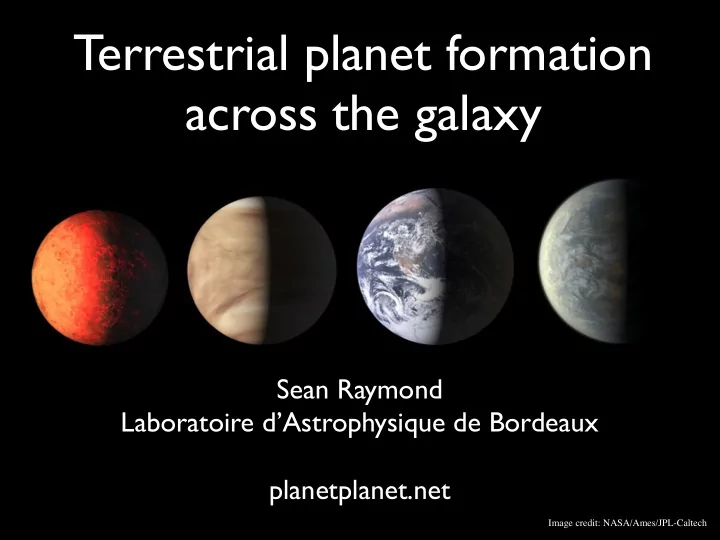
Terrestrial planet formation across the galaxy

Sean Raymond Laboratoire d’Astrophysique de Bordeaux planetplanet.net

Image credit: NASA/Ames/JPL-Caltech
slide-2
SLIDE 2

Collaborators

  • Alessandro Morbidelli

(Nice)

  • Andre Izidoro (Bordeaux)
  • Arnaud Pierens (Bordeaux)
  • Kevin Walsh (SwRI)
  • Avi Mandell (NASA

Goddard)

  • Emeline Bolmont (Namur)
  • Nate Kaib (Carnegie)
  • Tom Quinn (U. Washington)
  • Jonathan Lunine (Cornell)
  • Franck Selsis (Bordeaux)
  • Christophe Cossou

(Bordeaux)

  • Dave O’Brien (PSI)
  • Phil Armitage (U. Colorado)
  • Rory Barnes (U.

Washington)

  • Seth Jacobson (Nice)
  • Mark Wyatt (Cambridge)
  • Amaya Moro-Martin (StSci)
  • Bertram Bitsch (Lund)
slide-3
SLIDE 3

Stages of Planet Formation

slide-4
SLIDE 4

Stages of Planet Formation

Grains

slide-5
SLIDE 5

Stages of Planet Formation

Grains Planetesimals

slide-6
SLIDE 6

Stages of Planet Formation

Grains Planetesimals Planetary Embryos

slide-7
SLIDE 7

Stages of Planet Formation

Grains Planetesimals Planetary Embryos

while gas remains

slide-8
SLIDE 8

Stages of Planet Formation

Grains Planetesimals Planetary Embryos

while gas remains

Type 1 migration

slide-9
SLIDE 9

Stages of Planet Formation

Grains Planetesimals Planetary Embryos

while gas remains

Gaseous Planets

Type 1 migration

slide-10
SLIDE 10

Stages of Planet Formation

Grains Planetesimals Planetary Embryos

while gas remains

Gaseous Planets

Type 2 migration Type 1 migration

slide-11
SLIDE 11

Stages of Planet Formation

Grains Planetesimals

No more gas

Planetary Embryos

while gas remains

Gaseous Planets

Type 2 migration Type 1 migration

slide-12
SLIDE 12

Stages of Planet Formation

Grains Planetesimals

No more gas

Planetary Embryos

while gas remains

Gaseous Planets

Type 2 migration Type 1 migration Dynamical instabilities

slide-13
SLIDE 13

Stages of Planet Formation

Grains Planetesimals

No more gas

Planetary Embryos

while gas remains

Gaseous Planets Terrestrial Planets

Type 2 migration Type 1 migration Dynamical instabilities

slide-14
SLIDE 14

Stages of Planet Formation

Grains Planetesimals

No more gas

Planetary Embryos

while gas remains

Gaseous Planets Terrestrial Planets

Type 2 migration Type 1 migration Dynamical instabilities

INFLUENCE

slide-15
SLIDE 15

Stages of Planet Formation

Grains Planetesimals

No more gas

Planetary Embryos

while gas remains

Gaseous Planets Terrestrial Planets

Type 2 migration Type 1 migration Dynamical instabilities

INFLUENCE

Debris disks

slide-16
SLIDE 16
slide-17
SLIDE 17

Most stars have planets

(e.g., Cassan et al 2012)

slide-18
SLIDE 18

>15%

(Cumming et al 2008; Gould et al 2010; Mayor et al 2011)

slide-19
SLIDE 19

>15%

(Cumming et al 2008; Gould et al 2010; Mayor et al 2011)

10%

slide-20
SLIDE 20

>15%

(Cumming et al 2008; Gould et al 2010; Mayor et al 2011)

90% 10%

slide-21
SLIDE 21

>15%

(Cumming et al 2008; Gould et al 2010; Mayor et al 2011)

90% 10% <85%

slide-22
SLIDE 22

>15%

(Cumming et al 2008; Gould et al 2010; Mayor et al 2011)

90% 10% <85% 30-50+% of all stars

(Mayor et al 2011, Howard et al 2010, 2012)

slide-23
SLIDE 23

>15%

(Cumming et al 2008; Gould et al 2010; Mayor et al 2011)

90% 10% <85% 30-50+% of all stars

(Mayor et al 2011, Howard et al 2010, 2012)

Solar System(-like)

slide-24
SLIDE 24

>15%

(Cumming et al 2008; Gould et al 2010; Mayor et al 2011)

90% 10% <85% 30-50+% of all stars

(Mayor et al 2011, Howard et al 2010, 2012)

Angry gas giants Solar System(-like)

slide-25
SLIDE 25

>15%

(Cumming et al 2008; Gould et al 2010; Mayor et al 2011)

90% 10% <85% 30-50+% of all stars

(Mayor et al 2011, Howard et al 2010, 2012)

Angry gas giants Solar System(-like) “Hot super-Earths”

slide-26
SLIDE 26

Formation of the inner Solar System

slide-27
SLIDE 27

Gas giants on circular orbits

Raymond, Quinn & Lunine 2006

slide-28
SLIDE 28

Gas giants on circular orbits

Raymond, Quinn & Lunine 2006

slide-29
SLIDE 29

Wetherill 1991; Chambers 2001; O’Brien et al 2006; Raymond et al 2006, 2009, Morishima et al 2008, 2010; Nagasawa et al 2005, 2007; Thommes et al 2008; Fischer & Ciesla 2014; Izidoro et al 2014

Raymond et al 2009

slide-30
SLIDE 30

Wetherill 1991; Chambers 2001; O’Brien et al 2006; Raymond et al 2006, 2009, Morishima et al 2008, 2010; Nagasawa et al 2005, 2007; Thommes et al 2008; Fischer & Ciesla 2014; Izidoro et al 2014

The “small Mars” Problem

Raymond et al 2009

slide-31
SLIDE 31

A possible solution to the small Mars problem

(Hansen 2009; also Wetherill 1978; Chambers 2001)

slide-32
SLIDE 32

A possible solution to the small Mars problem

(Hansen 2009; also Wetherill 1978; Chambers 2001)

slide-33
SLIDE 33

A possible solution to the small Mars problem

(Hansen 2009; also Wetherill 1978; Chambers 2001)

  • A small Mars forms

naturally if inner disk is

  • nly from 0.7-1 AU
  • An edge effect

Hansen 2009, ApJ, 703, 1131

slide-34
SLIDE 34

A possible solution to the small Mars problem

(Hansen 2009; also Wetherill 1978; Chambers 2001)

  • A small Mars forms

naturally if inner disk is

  • nly from 0.7-1 AU
  • An edge effect

Hansen 2009, ApJ, 703, 1131

slide-35
SLIDE 35

Time Semi major axis Jupiter

~50 MEarth Type II migration starting ~ 200 MEarth

Jupiter in the gaseous disk

slide by Kevin Walsh

slide-36
SLIDE 36

Time Semi major axis Jupiter Saturn

~50 MEarth Fast Migration Capture in Resonance

Jupiter and Saturn in the gaseous disk

slide by Kevin Walsh

slide-37
SLIDE 37

Time Semi major axis Jupiter Saturn

Capture in Resonance

Gas disk starts to dissipate

Jupiter and Saturn in the gaseous disk

slide by Kevin Walsh Masset & Snellgrove 2001; Morbidelli & Crida 2007; Pierens & Nelson 2008; Crida et al 2009; Pierens & Raymond 2011; Pierens et al 2014

slide-38
SLIDE 38

Hydrodynamical simulation

(Pierens & Raymond 2011; Masset & Smellgrove 2001)

slide-39
SLIDE 39

Hydrodynamical simulation

(Pierens & Raymond 2011; Masset & Smellgrove 2001)

slide-40
SLIDE 40

The Grand Tack model

Walsh, Morbidelli, Raymond, O’Brien, Mandell 2011, Nature, 475, 206

slide-41
SLIDE 41

The Grand Tack model

Walsh, Morbidelli, Raymond, O’Brien, Mandell 2011, Nature, 475, 206

slide-42
SLIDE 42

Walsh et al 2011, Nature, 475, 206

The Grand Tack

slide-43
SLIDE 43

Water is delivered to Earth by same population that was implanted into asteroid belt as C types

(Walsh et al 2011; O’Brien et al 2014)

slide-44
SLIDE 44

Water is delivered to Earth by same population that was implanted into asteroid belt as C types

(Walsh et al 2011; O’Brien et al 2014)

slide-45
SLIDE 45

The Grand Tack terrestrial planets

Walsh et al 2011; Morbidelli et al 2012; O’Brien et al, 2014; Raymond et al 2014; Jacobson et al 2014; Jacobson & Morbidelli 2014; Raymond & Morbidelli 2014; Jacobson & Walsh 2015.

slide-46
SLIDE 46

Terrestrial planet formation with angry gas giants

slide-47
SLIDE 47

Giant exoplanets

Wright et al 2011

slide-48
SLIDE 48

Giant exoplanets

Wright et al 2011

  • rbital migration
slide-49
SLIDE 49

Giant exoplanets

Wright et al 2011

  • rbital migration

planet-planet scattering

slide-50
SLIDE 50

Mandell, Raymond & Sigurdsson 2007

slide-51
SLIDE 51

Mandell, Raymond & Sigurdsson 2007

slide-52
SLIDE 52

Raymond, Mandell & Sigurdsson 2006

slide-53
SLIDE 53

Raymond, Mandell & Sigurdsson 2006

slide-54
SLIDE 54

Credit: Nahks Tr’Enhl

slide-55
SLIDE 55

Planet-planet scattering

Credit: Eric Ford

slide-56
SLIDE 56

Raymond et al 2012; see also talk by A. Mustill

slide-57
SLIDE 57

Raymond et al 2012; see also talk by A. Mustill

slide-58
SLIDE 58

Formation

  • f systems
  • f hot

super-Earths

slide-59
SLIDE 59

Hot Super Earths

Raymond et al 2014 PP6 chapter; Kepler data from Batalha et al 2013 and Rowe et al 2014

slide-60
SLIDE 60

Hot Super Earths

Raymond et al 2014 PP6 chapter; Kepler data from Batalha et al 2013 and Rowe et al 2014

slide-61
SLIDE 61

Orbital distance

Hot super- Earths

1-4 REarth Size

slide-62
SLIDE 62

Orbital distance

Hot super- Earths

  • 1. In-situ

accretion 1-4 REarth Size

slide-63
SLIDE 63

Orbital distance

Hot super- Earths

  • 1. In-situ

accretion 1-4 REarth

  • 2. Radial (aerodynamic) drift

Size

slide-64
SLIDE 64

Orbital distance

Hot super- Earths

  • 1. In-situ

accretion

  • 3. Inward (type 1) migration

1-4 REarth

  • 2. Radial (aerodynamic) drift

Size

slide-65
SLIDE 65

In-situ accretion: planets form fast in high-mass disks

Bolmont, Raymond et al 2014 ~15 ME in inside 0.5 AU

slide-66
SLIDE 66

Gas disk lifetime

Planets that form in-situ should migrate

See also Inamdar & Schlichting 2015, Ogihara et al 2015; Grishin & Perets 2015

slide-67
SLIDE 67

Gas disk lifetime

Planets that form in-situ should migrate

If hot super-Earths form in-situ then they must interact strongly with gaseous disk

See also Inamdar & Schlichting 2015, Ogihara et al 2015; Grishin & Perets 2015

slide-68
SLIDE 68

Gas disk lifetime

Planets that form in-situ should migrate

If hot super-Earths form in-situ then they must interact strongly with gaseous disk Because they must migrate, hot super-Earths can’t form “in-situ”!

See also Inamdar & Schlichting 2015, Ogihara et al 2015; Grishin & Perets 2015

slide-69
SLIDE 69

Orbital distance Mass

Forming hot super-Earths by type 1 migration

slide-70
SLIDE 70

Orbital distance Mass

Forming hot super-Earths by type 1 migration

slide-71
SLIDE 71

Orbital distance Mass

Forming hot super-Earths by type 1 migration

slide-72
SLIDE 72

Type 1 migration

  • Inward or
  • utward
  • Timescale

~10-100 kyr (bigger=faster)

Golreich & Tremaine 1980; Ward 1986, 1997; Tanaka et al 2002; Kley & Crida 2008; Paardekooper et al 2010, 2011; Pierens et al 2013; Lega et al 2014; Bitsch et al 2014

Credit: A. Pierens

slide-73
SLIDE 73

Armitage 2011

slide-74
SLIDE 74

Masset et al (2006)

Migration stops at the inner edge of the disk

slide-75
SLIDE 75

Masset et al (2006)

Migration stops at the inner edge of the disk

slide-76
SLIDE 76

Masset et al (2006)

Migration stops at the inner edge of the disk

slide-77
SLIDE 77

A type 1 migration map

Cossou et al 2014; see also Lyra et al 2010, Paardekooper et al 2011; Kretke & Lin 2012; Horn et al 2012; Coleman & Nelson 2014; and especially Bitsch et al 2013, 2014ab, 2015

slide-78
SLIDE 78

A type 1 migration map

Cossou et al 2014; see also Lyra et al 2010, Paardekooper et al 2011; Kretke & Lin 2012; Horn et al 2012; Coleman & Nelson 2014; and especially Bitsch et al 2013, 2014ab, 2015

slide-79
SLIDE 79

A type 1 migration map

Cossou et al 2014; see also Lyra et al 2010, Paardekooper et al 2011; Kretke & Lin 2012; Horn et al 2012; Coleman & Nelson 2014; and especially Bitsch et al 2013, 2014ab, 2015

slide-80
SLIDE 80

A type 1 migration map

Cossou et al 2014; see also Lyra et al 2010, Paardekooper et al 2011; Kretke & Lin 2012; Horn et al 2012; Coleman & Nelson 2014; and especially Bitsch et al 2013, 2014ab, 2015

slide-81
SLIDE 81

A type 1 migration map

Cossou et al 2014; see also Lyra et al 2010, Paardekooper et al 2011; Kretke & Lin 2012; Horn et al 2012; Coleman & Nelson 2014; and especially Bitsch et al 2013, 2014ab, 2015

slide-82
SLIDE 82

A type 1 migration map

Cossou et al 2014; see also Lyra et al 2010, Paardekooper et al 2011; Kretke & Lin 2012; Horn et al 2012; Coleman & Nelson 2014; and especially Bitsch et al 2013, 2014ab, 2015

slide-83
SLIDE 83

A type 1 migration map

Cossou et al 2014; see also Lyra et al 2010, Paardekooper et al 2011; Kretke & Lin 2012; Horn et al 2012; Coleman & Nelson 2014; and especially Bitsch et al 2013, 2014ab, 2015

slide-84
SLIDE 84

Cossou, Raymond et al 2014

slide-85
SLIDE 85

Cossou, Raymond et al 2014

slide-86
SLIDE 86

Resonant chains usually go unstable as or after gas disk dissipates

Cossou, Raymond et al 2014 7:6 4:3 2:1 3:2 4:35:4 3:25:4 Resonant chain Instability Migration during 3 Myr gas disk lifetime

slide-87
SLIDE 87

Resonant chains usually go unstable as or after gas disk dissipates

Cossou, Raymond et al 2014 7:6 4:3 2:1 3:2 4:35:4 3:25:4 Resonant chain Instability

Most hot super-Earths that form by migration do not remain in resonant chains (Terquem & Papaloizou 2007; Goldreich & Schlichting

2014; Cossou et al 2014) Migration during 3 Myr gas disk lifetime

slide-88
SLIDE 88

Why no hot super-Earths in Solar System?

slide-89
SLIDE 89

Why no hot super-Earths in Solar System?

  • Fast-forming gas giants can act as a barrier

to inward-migrating super-Earths (Izidoro et al

2015)

slide-90
SLIDE 90

Why no hot super-Earths in Solar System?

  • Fast-forming gas giants can act as a barrier

to inward-migrating super-Earths (Izidoro et al

2015)

slide-91
SLIDE 91

Why no hot super-Earths in Solar System?

  • Fast-forming gas giants can act as a barrier

to inward-migrating super-Earths (Izidoro et al

2015)

Prediction: systems of hot super-Earths should be anti-correlated with giant planets

  • n more distant (1-5 AU) orbits
slide-92
SLIDE 92
slide-93
SLIDE 93

Solar System

slide-94
SLIDE 94

Solar System

The “small Mars” problem

slide-95
SLIDE 95

Solar System

The “small Mars” problem Grand Tack model: Jupiter, Saturn migrated inward then back outward

slide-96
SLIDE 96

Angry gas giants Solar System

The “small Mars” problem Grand Tack model: Jupiter, Saturn migrated inward then back outward

slide-97
SLIDE 97

Angry gas giants

Migration: terrestrial planets form WET

Solar System

The “small Mars” problem Grand Tack model: Jupiter, Saturn migrated inward then back outward

slide-98
SLIDE 98

Angry gas giants

Migration: terrestrial planets form WET Planet-planet scattering can destroy terrestrial planets

Solar System

The “small Mars” problem Grand Tack model: Jupiter, Saturn migrated inward then back outward

slide-99
SLIDE 99

Angry gas giants

Migration: terrestrial planets form WET Planet-planet scattering can destroy terrestrial planets

Solar System

The “small Mars” problem Grand Tack model: Jupiter, Saturn migrated inward then back outward

Hot super- Earths

slide-100
SLIDE 100

Angry gas giants

Migration: terrestrial planets form WET Planet-planet scattering can destroy terrestrial planets

Solar System

The “small Mars” problem Grand Tack model: Jupiter, Saturn migrated inward then back outward

Hot super- Earths

May form by inward migration of planetary embryos

slide-101
SLIDE 101

Angry gas giants

Migration: terrestrial planets form WET Planet-planet scattering can destroy terrestrial planets

Solar System

The “small Mars” problem Grand Tack model: Jupiter, Saturn migrated inward then back outward

Hot super- Earths

May form by inward migration of planetary embryos Jupiter: a barrier for inward-migrating super-Earths?

slide-102
SLIDE 102

Orbital distance Mass

slide-103
SLIDE 103

Orbital distance Mass

slide-104
SLIDE 104

Orbital distance Mass

slide-105
SLIDE 105

Orbital distance Mass

slide-106
SLIDE 106

Orbital distance Mass

slide-107
SLIDE 107

Orbital distance Mass

The Grand Tack

slide-108
SLIDE 108

Orbital distance Mass

The Grand Tack

slide-109
SLIDE 109

Orbital distance Mass

Planet-planet scattering

slide-110
SLIDE 110
  • The “small Mars” problem and the Grand Tack:
  • Raymond et al (2009, Icarus)
  • Walsh et al (2011, Nature)
  • Effect of “angry” gas giants:
  • Raymond et al (2006, Science)
  • Raymond et al (2011, 2012, A&A)
  • Formation of hot super-Earths:
  • Raymond et al (2008, MNRAS; 2014, PP6)
  • Cossou et al (2014, A&A)
  • Izidoro et al (2015, ApJ Letters)
slide-111
SLIDE 111

Extra Slides

slide-112
SLIDE 112

S-type C-type

slide-113
SLIDE 113
slide-114
SLIDE 114
slide-115
SLIDE 115
slide-116
SLIDE 116
slide-117
SLIDE 117

The late veneer as a clock for the Moon-forming impact

Jacobson, Morbidelli, Raymond, O’Brien, Walsh, Rubie 2014, Nature

slide-118
SLIDE 118

The outer Solar System

Planetesimals in movie are 100m; Raymond et al in prep

slide-119
SLIDE 119

The outer Solar System

Planetesimals in movie are 100m; Raymond et al in prep

slide-120
SLIDE 120

Raymond et al 2011

slide-121
SLIDE 121

Raymond et al 2011

slide-122
SLIDE 122

Large oscillations in e, i (“Generalized Milankovitch cycles”): impact on climate

47

Spiegel, Raymond et al 2010

Green = habitable Red = freezing Blue = supercold Key fact: orbit-averaged flux increases with e as (1-e2)-1/2

slide-123
SLIDE 123

Large oscillations in e, i (“Generalized Milankovitch cycles”): impact on climate

47

Spiegel, Raymond et al 2010

Green = habitable Red = freezing Blue = supercold Key fact: orbit-averaged flux increases with e as (1-e2)-1/2

slide-124
SLIDE 124

Orbital distance Mass

slide-125
SLIDE 125

Orbital distance Mass

slide-126
SLIDE 126

Orbital distance Mass

slide-127
SLIDE 127

Orbital distance Mass

slide-128
SLIDE 128

Orbital distance Mass

slide-129
SLIDE 129

Orbital distance Mass

slide-130
SLIDE 130

Orbital distance Mass

The Grand Tack

slide-131
SLIDE 131

Orbital distance Mass