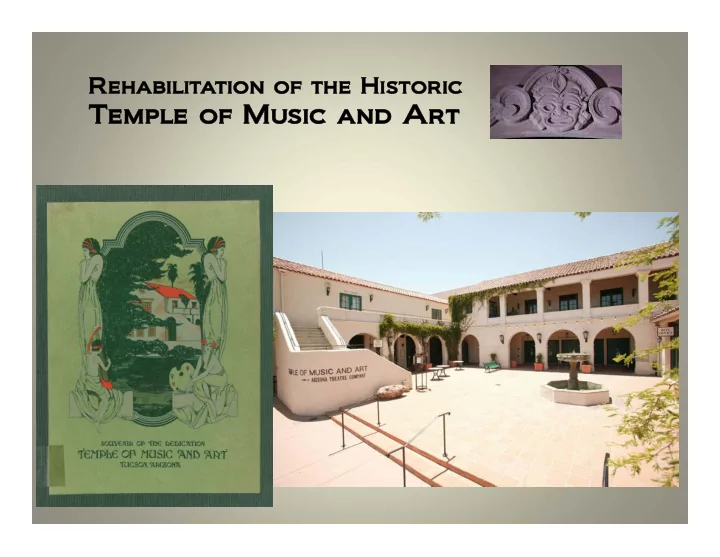
SLIDE 1
Rehabilit Rehabilitation o tion of the Historic the Historic
Temple o Temple of Mu Music and Art sic and Art
SLIDE 2
This project will rehabilitate the historic Temple of Music and Art to update this regional performance venue to make it more attractive and comfortable for audiences, performers, and attendees of special events, while preserving its historic character. The building is owned by the City of Tucson, and was listed in the National Register of Historic Places in 1976.
SLIDE 3
Cost: $900,000 Bond Funding: $900,000 Other Funding: None identified Fiscal Year Project Start and Finish Date: Will start in 2017 and be completed within 8 months. Project Management Jurisdiction: The City of Tucson will manage project. Future Operating and Maintenance Costs: O & M costs will be reduced with this project. Supervisor District of Project Location: District 2
SLIDE 4
HISTORY HIGHLIGHTS
1926‐27 • Saturday Morning Music Club builds Temple of Music and Art as performance art space. 1963 • A private for‐profit company headed by Ernest Hoffman buys building and changes its name to The Tucson Music Center. 1972 • Frances and Salvador Galvan buy building and operate it as Cine‐Azteca, a Spanish language movie theater. 1976 • William Nichols and Dan Baldenegro buy building and return it to its original name and purpose as a performing arts space. 1982 • Local Restoration Associates Ltd. and a Denver company buy building, then decide to demolish it and build a five‐story office building. 1984 • Newly formed Tucson Artists Coalition successfully demonstrates to stop demolition. 1987 • City of Tucson pays $842,800 for the building. 1989‐90 • Extensive renovations undertaken, totaling $2.6 million. 1990 • City leases building to Arizona Theatre Company.
SLIDE 5 Existing 25,000 sq ft facility includes:
- Main theatre seating 623 persons
- Cabaret Theatre seating 80 persons
- Art gallery
- Courtyard
- Lounge with a bar and food service
- Commercial kitchen
- Box Office
- Green room and dressing rooms
- Costume shop
- Rehearsal hall
- Spaces to store and operate
equipment
SLIDE 6 The Temple of Music and Art was founded by Madeline Dreyfus Heineman Berger, who started the Saturday Morning Music Club in the first decade of the 1900s after moving to Tucson from Los Angeles. In 1927, with financial backing from the brother
- f her second husband, Harry Berger, she
- pened the Temple of Music and Art.
SLIDE 7 The history of the Temple of Music and Art is made up of several stories: “One is the development of cultural institutions in a young and emerging town like Tucson in the 1920s. The other is about the role of women, as patrons, as artists, as the benefactors of a variety of different movements including the arts and culture. The third is about the architectural traditions that this building represents: this was one of the first masterpieces of the Spanish Colonial Revival style.” (R. Brooks Jeffery, UA Heritage Conservation Program)
The 1926 groundbreaking event was attended by the world-famous operatic soprano Amelita Galli-Curci from Milan, Italy. A rattlesnake stole and Tohono O’odham baskets provided local flavor for the commemorative photograph.
SLIDE 8
The building was designed by architect Arthur W. Hawes, who also designed the Pasadena Community Playhouse in California. After it was completed in 1927 the Temple became the centerpiece venue in the community for theater, music and dance performances, and fine art exhibits.
Opening night, 1927 Laying of cornerstone, 1927
SLIDE 9
In 1987 the City of Tucson acquired the building for $843,000 In 1989‐90 the City rehabilitated the building for $2.6 million In 1990 the City leased it to the Arizona Theatre Company (ATC), which invested $342,000 in improvements Since 1990, ATC has spent almost $1 million for capital improvements and equipment City of Tucson spends $178,000 annually for O & M
SLIDE 10
The rehabilitation will include major repairs and replacements for the exterior courtyard, roof, and heating, ventilation, and air conditioning (HVAC) equipment.
SLIDE 11
In the courtyard, the fountain needs to be restored, the Saltillo tile is failing and needs to be replaced, and drainage needs to be improved.
SLIDE 12
The existing HVAC equipment needs to be fully replaced because it is obsolete, inefficient, and has exceeded its expected use‐life.
SLIDE 13 The roof has numerous leaks, and areas with loose or missing clay tiles.
- Upper flat roof needs to be replaced
- Other flat roof areas need to be
repaired and recoated
- Clay tiles need to be reattached or
replaced as needed
- Underlayment needs to be repaired
- r replaced in some areas
SLIDE 14 Scope of work will meet the Secretary of the Interior’s Standards for Rehabilitation, and includes:
- New heating, ventilating, and A/C (HVAC) equipment and controls
- New upper flat roof
- Remove and replace/reuse loose and damaged roof tiles. Repair or
replace underlayment as needed
- Repair and reseal all flat roofs
- New exterior Saltillo tile (or match original tile) in courtyard
- Improve drainage from courtyard
- Improve drainage from eastside roofs
- Restore courtyard fountain
SLIDE 15 Broad Demonstrated Support by Public: During 2013, of the 6,075 donors and others on the email list of ATC‐Tucson:
- 27% lived in the City of Tucson
- 68% lived in other jurisdictions
and unincorporated areas of Pima County
County
These girls attended Margaret Cusick’s School of Dancing, housed in the Temple.
SLIDE 16 Regional Public Benefit:
- The Temple of Music and Art has been a key performance venue since it
- pened in 1927, and today it is also an important part of the historic fabric
- f our community.
The Temple was the original performance venue for the Tucson Symphony Orchestra, formed in 1928.
SLIDE 17 Regional Public Benefit:
- The last major investment in the facility was made in 1990.
- Another major investment is needed for this publicly owned theater to
continue as a viable entertainment destination in our region, and to preserve this historic community asset.
SLIDE 18 Regional Public Benefit:
- Updating this historic building to continue as a theatre will have regional
impact by providing an attractive and unique venue for performances that draw large and diverse audiences.
- During 2013, the Temple was booked for shows and events on 194 days of
the year, with attendance totaling approximately 85,000 people.
SLIDE 19 Regional Public Benefit:
- Sensitive repair and updating of this historic building will also have direct
and indirect economic benefits for the region.
- Numerous studies show that rehabilitations of historic buildings generate
higher wage jobs than new construction, increase municipal revenues, support growth in tourism, increase property values, and spur downtown revitalizations.
SLIDE 20 Regional Public Benefit:
- Well‐preserved historic buildings are a key feature of livable cities because
they contribute to the “quality of place.” This positive effect of historic preservation on livability also supports regional economic development.
Painting by Titus Castanza