Telepaediatrics: UQ research centre closely linked with the RCH - - PDF document

telepaediatrics
SMART_READER_LITE
LIVE PREVIEW

Telepaediatrics: UQ research centre closely linked with the RCH - - PDF document

15/08/2010 Centre for Online Health Telepaediatrics: UQ research centre closely linked with the RCH research activities combined with service delivery ROBOTS and telemedicine, telehealth MOBILE CLINICS in QLD teaching


slide-1
SLIDE 1

15/08/2010 1

Telepaediatrics: ROBOTS and MOBILE CLINICS in QLD

Dr Anthony Smith Deputy Director, Senior Research Fellow Centre for Online Health

APAN – Remote Medicine, Hanoi 2010

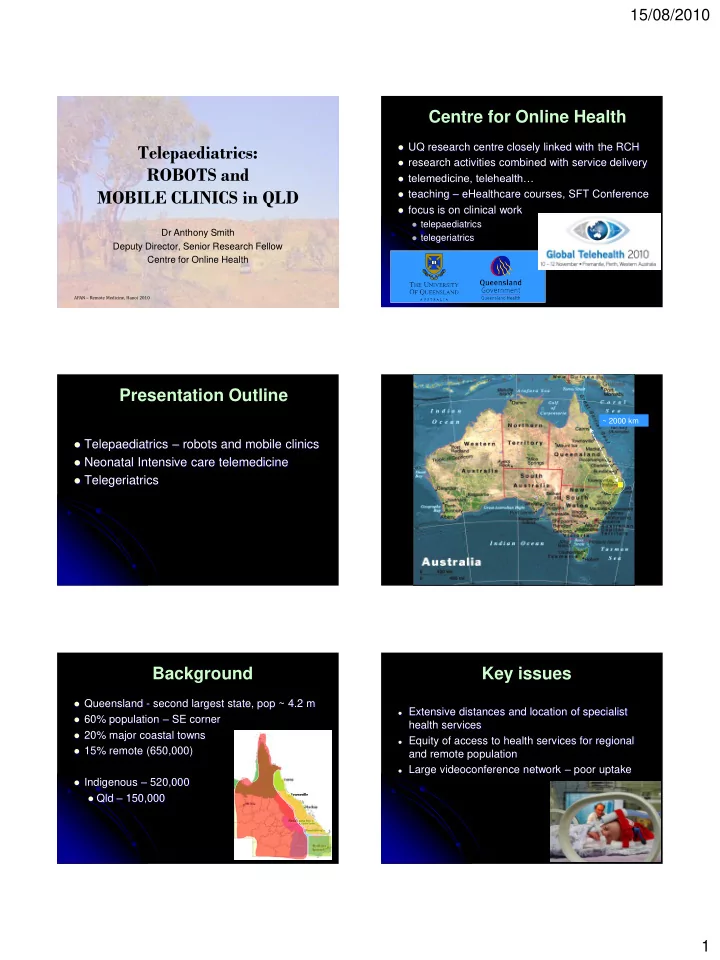
 UQ research centre closely linked with the RCH  research activities combined with service delivery  telemedicine, telehealth…  teaching – eHealthcare courses, SFT Conference  focus is on clinical work

 telepaediatrics  telegeriatrics

Centre for Online Health

 Telepaediatrics – robots and mobile clinics  Neonatal Intensive care telemedicine  Telegeriatrics

Presentation Outline

~ 2000 km

Background

 Queensland - second largest state, pop ~ 4.2 m  60% population – SE corner  20% major coastal towns  15% remote (650,000)  Indigenous – 520,000  Qld – 150,000

 Extensive distances and location of specialist

health services

 Equity of access to health services for regional

and remote population

 Large videoconference network – poor uptake

Key issues

slide-2
SLIDE 2

15/08/2010 2

 Conventional models – entrenched in the health

system – change needs to be carefully managed

 Telehealth needs to integrated with existing

services – such as OPD sessions, inpatient support, outreach

 Appropriate clinical support systems need to be

established

Managing change...

Smith AC, Isles A, McCrossin R, Van der Westhuyzen J, Williams M, Woollett H and Wootton R. The point of referral barrier - a factor in the success of telehealth, Journal of Telemedicine and Telecare 2001; 7 (Suppl.2): 75-78

 Incentive to provide telehealth services  Clinical support service – not technology driven

Telepaediatric Service

 Over 10 years - since November 2000  Central referral centre - 1800 direct phone #  Telehealth coordination  Largest reported service of its kind in Australia

Smith AC, Isles A, McCrossin R, Van der Westhuyzen J, Williams M, Woollett H and Wootton R. The point of referral barrier - a factor in the success of telehealth, Journal of Telemedicine and Telecare 2001; 7 (Suppl.2): 75-78

Telepaediatric Service

 Routine sub-specialist clinics  Home telemedicine  Email support  NICU and PICU telemedicine  Indigenous health screening  Mobile systems – robots  Benefits  Lessons learnt

Telepaediatric Service

Other 21% Cardiology 2% Dermatology 2% Nephrology 2% Orthopaedics 2% Oncology 3% Diabetes 3% Ophthalmology 3% General Paediatrics 6% ENT 6% Neurology 10% Burns 14% Child Psychiatry 26%

(n = 7602 consultations)

Telepaediatric Activity (8y)

 Neurology Respiratory   Burns Diabetes   Cardiology Oncology 

slide-3
SLIDE 3

15/08/2010 3

Smith AC, Williams J, Agnew J, Sinclair S, Youngberry K and Wootton R. Real-time telemedicine for paediatric ENT pre-admission screening. Journal of Telemedicine and Telecare 2005, 11 (Suppl. 2): 86-9

 Infant mortality - three times higher than the

national average, or 15.2 deaths per 1,000 births compared to five per 1,000.

 Middle ear infections are very common

Indigenous health

*Australian Indigenous HealthInfoNet

~90% significant disease/deafness rate Long-term impact:

 1-3y; severe disease burden (discomfort)  4-5y; slow language  5-7y; slow learning  10-11y; behaviour problems, truancy  15y; illiteracy, substance abuse

Indigenous health

 Community health services  Visiting specialists

 ENT  Dental  Dermatology  Ophthalmology  Psychiatry  Respiratory

Indigenous health screening

Outreach – physical travel to remote sites

 Indigenous health workers  Specialist outreach services and telehealth support

 ENT  Dental  Dermatology  Ophthalmology  Psychiatry  Respiratory

Indigenous health screening

 To provide routine health screening for all

Indigenous children in Cherbourg and surrounding communities

 To develop a service which can be managed

locally by dedicated Indigenous health workers.

 To improve screening rates – above 90%  To ensure early detection (assessment) and

treatment of chronic diseases.

Indigenous health screening

slide-4
SLIDE 4

15/08/2010 4

= Telepaediatric health screening unit D = Specialist site S S

Mundubbera Biloela Moura Kingaroy Woorabinda Theodore Gayndah Murgon Cherbourg

D = Database C = Telepaediatric health screening clinic C

Indigenous health screening Indigenous health screening

 Community based screening programme led by

Indigenous health workers

 Screening rates above 80%  Better understanding (quality data) of the health

status of children in the community

 Community support and ownership

Telepaediatrics “on wheels”

 Telepaediatric robots  Commenced 2004  mobile, wireless

videoconference systems

 child-friendly  direct to bedside  2005 – Gladstone Hospital, no paediatrician  daily ward rounds  sub-specialist consultations

Smith AC, Coulthard M, Clark R, Armfield N, Taylor S, Goffe R, Mottarelly I, Youngberry K, Isles A and Wootton R. Wireless telemedicine for the delivery of specialist paediatric services to the bedside. Journal of Telemedicine and Telecare 2005, 11 (Suppl. 2): 81-5

Telepaediatric robots

 2006 - 2008 funding to expand robot network  four new systems  paediatric support and education

Smith AC, Coulthard M, Clark R, Armfield N, Taylor S, Goffe R, Mottarelly I, Youngberry K, Isles A and Wootton R. Wireless telemedicine for the delivery of specialist paediatric services to the bedside. Journal of Telemedicine and Telecare 2005, 11 (Suppl. 2): 81-5

Telepaediatric robots

slide-5
SLIDE 5

15/08/2010 5

Eliza – Mt Isa Emma - Emerald ROY – Gladstone Gypsie – Gympie Tiny Tom - Townsville

Logistics:

 All referrals centrally managed through the COH  Systems operated over VPN, ISDN or DSL  Remote management of systems  Routine testing of systems and email alerts

Telepaediatric robots

 37 Clinical forums – up to 14 staff per session  Average duration 30 min

Harris V, Smith AC and Armfield N. e-Learning for regional health professionals using mobile videoconferencing in Queensland. Journal of Telemedicine and Telecare, 2007, 13 (Suppl. 3): 44-47

COH - Brisbane Staff room - Emerald

Telepaediatric robots

 Children are cared for by local health services

with the support of specialists by telemedicine – continuity of care

Telepaediatrics

 Clinical services  Infrastructure, equip and telecommunications  Administrative and clinical systems

Critical factors

 Learn from experience – successes and failures  Develop new services systematically  New applications:

 Feasibility, technical, user satisfaction  Clinical efficacy – comparable to FTF  Economic evaluation – patient, health service, society

 Start small and gradually expand

Practical tips…

slide-6
SLIDE 6

15/08/2010 6

 QLD model is likely to be useful interstate and

internationally

 Service delivery models should include a

combination of telehealth, outreach, local and tertiary services

 Opportunities to strengthen clinical networks and

deliver high quality specialist services in the most efficient manner

Conclusions

Dr Anthony Smith

Deputy Director, Senior Research Fellow Centre for Online Health Email: asmith@uq.edu.au Web: www.uq.edu.au

APAN – Remote Medicine, Hanoi 2010