Exercise 1-1 Problem: Every 100.00 g of the compound SiH 4 contains - - PDF document

exercise 1 1
SMART_READER_LITE
LIVE PREVIEW

Exercise 1-1 Problem: Every 100.00 g of the compound SiH 4 contains - - PDF document

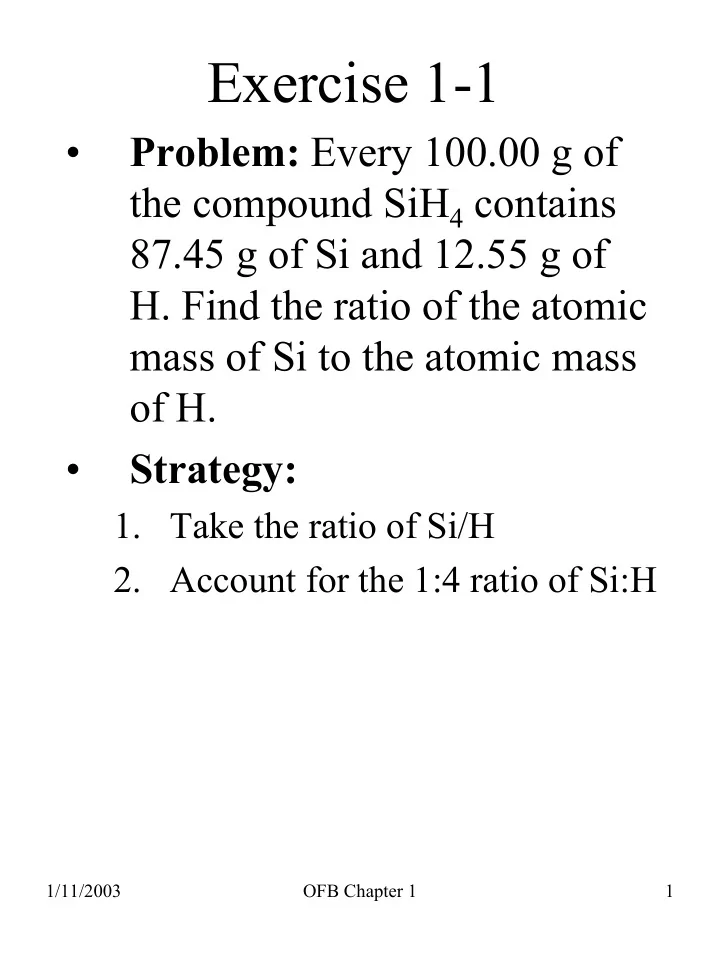
Exercise 1-1 Problem: Every 100.00 g of the compound SiH 4 contains 87.45 g of Si and 12.55 g of H. Find the ratio of the atomic mass of Si to the atomic mass of H. Strategy: 1. Take the ratio of Si/H 2. Account for the 1:4 ratio of


slide-1
SLIDE 1

OFB Chapter 1 1 1/11/2003

Exercise 1-1

  • Problem: Every 100.00 g of

the compound SiH4 contains 87.45 g of Si and 12.55 g of

  • H. Find the ratio of the atomic

mass of Si to the atomic mass

  • f H.
  • Strategy:
  • 1. Take the ratio of Si/H
  • 2. Account for the 1:4 ratio of Si:H
slide-2
SLIDE 2

OFB Chapter 1 2 1/11/2003

Exercise 1-1

  • Problem: Every 100.00 g of the

compound SiH4 contains 87.45 g of Si and 12.55 g of H. Find the ratio of the atomic mass of Si to the atomic mass of H

  • Solution:

( )

H

  • f

atom

  • f

mass Si

  • f

atom

  • f

mass H

  • f

atom

  • f

mass Si

  • f

atom

  • f

mass g g H

  • f

atom

  • f

mass Si

  • f

atom

  • f

mass g g 1 1 87 . 27 1 1 55 . 12 45 . 87 X 4 1 X 4 1 55 . 12 45 . 87 = = =

slide-3
SLIDE 3

OFB Chapter 1 3 1/11/2003

Atoms

  • Avogadro’s Number is the number
  • f 12C atoms in exactly 12 grams of

carbon

  • N0 = 6.0221420 X 10²³
  • The mass, in grams, of Avogadro's

number of atoms of an element is numerically equal to the relative atomic mass of that element (relative to carbon)

g 10 1.9926465x C atom 10 x 6.0221420 12g X C atom 1 C atom

23 23

m

= =

slide-4
SLIDE 4

OFB Chapter 1 4 1/11/2003

Exercise 1-8

  • Tetrodotoxin has the empirical

formula C11H17N3O8. Calculate the mass percentages of the four element in this compound. Solution:

1. Calculate molar mass of C11H17N3O, by finding the mass contributed by each element 2. Divide the mass for each element by the total mass of the compound.

319.1588 15.999) * (8 14.007) * (3 1.0079) * (17 12.011) * (11 = + + + = M M

40.09%O x100% 319.158 127.992 %O 13.16%N x100% 319.158 42.021 %N %H 37 . 5 x100% 319.158 17.134 %H 41.38%C x100% 319.158 132.011 %C = = = = = = = =

slide-5
SLIDE 5

OFB Chapter 1 5 1/11/2003

1 mmol = 1 millimole =1x10⁻³ mol 1mg = 1 milligram =1x10⁻³ g

slide-6
SLIDE 6

OFB Chapter 1 6 1/11/2003

Exercise 1-9

  • Heating a 150.0mg dose of a compound used to treat

rheumatism decomposes it to its constituent elements, which are separated. There are 60.29 mg of gold, 21.10 mg of sodium, 29.37 mg of oxygen, and 39.24 mg of sulfur. Determine the empirical formula of this compound.

Solution:

1. Calculate the chemical amount (in moles) of each element in the sample using the table of atomic masses. 2. Find the ratios of the moles for each element by dividing each by the smallest one, i.e., normalize to the smallest. 3. If necessary, multiply smallest factor that clears any fractions that they contain.

S mmol 1.223 Au 32.065mg S 1mmol x S mg 24 . 9 3 n O mmol 0.1836 O 15.999mg O 1mmol x O 29.37mg n Na mmol 0.910 Na 22.990mg Na 1mmol x Na 21.10mg n Au mmol 0.306 Au 196.97mg Au 1mmol x Au 60.29mg n

S O Na Au

= = = = = = = =

slide-7
SLIDE 7

OFB Chapter 1 7 1/11/2003

Exercise 1-9

Determine the empirical formula of this compound. Solution:

1. Calculate the chemical amount (in moles) of each element in the sample using the table of atomic masses. 2. Find the ratios of the moles for each element by dividing each by the smallest one, i.e., normalize to the smallest. 3. If necessary, multiply smallest factor that clears any fractions that they contain.

4 6 3

S O AuNa 4 1 . 4 306 . 223 . 1 6 1 . 6 306 . 836 . 1 3 1 a 97 . 2 306 . 910 . 1 1 1 306 . 306 . ∴ = = = = = = = = = = = = Au mol S mol n n Au mol O mol n n Au mol N mol n n Au mol Au mol n n

Au S Au O Au Na Au Au

S mmol 1.223 Au 32.065mg S 1mmol x S mg 24 . 9 3 n O mmol 0.1836 O 15.999mg O 1mmol x O 29.37mg n Na mmol 0.910 Na 22.990mg Na 1mmol x Na 21.10mg n Au mmol 0.306 Au 196.97mg Au 1mmol x Au 60.29mg n

S O Na Au

= = = = = = = =