Teaching Bartleby , the Scrivener (Even if you would prefer not to) - - PowerPoint PPT Presentation

teaching bartleby the scrivener
SMART_READER_LITE
LIVE PREVIEW

Teaching Bartleby , the Scrivener (Even if you would prefer not to) - - PowerPoint PPT Presentation

Teaching Bartleby , the Scrivener (Even if you would prefer not to) An Online Professional Development Seminar Andrew Delbanco Julian Clarence Levi Professor in the Humanities Columbia University National Humanities Center Fellow


slide-1
SLIDE 1

We will begin promptly on the hour. The silence you hear is normal. If you do not hear anything when the images change, e-mail Caryn Koplik ckoplik@nationalhumanitiescenter.org for assistance.
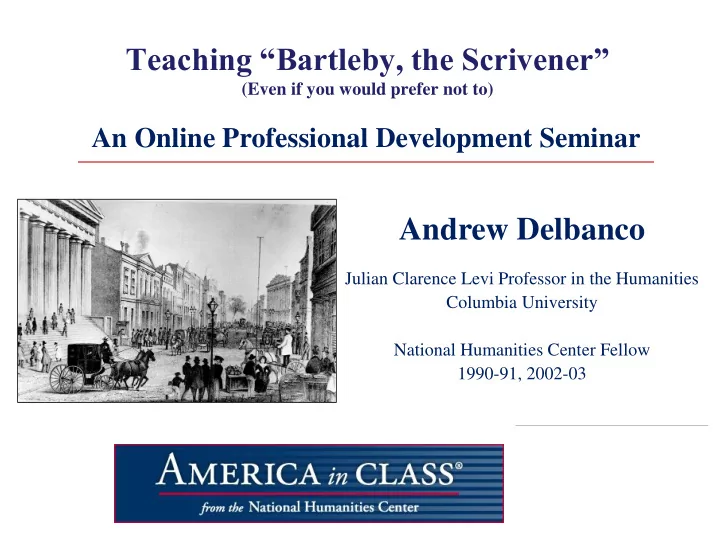
Teaching “Bartleby, the Scrivener”

(Even if you would prefer not to)

An Online Professional Development Seminar

Andrew Delbanco

Julian Clarence Levi Professor in the Humanities Columbia University National Humanities Center Fellow 1990-91, 2002-03

slide-2
SLIDE 2

americainclass.org 2

GOAL

To understand “Bartleby, the Scrivener” as a meditation on 19th-century America's transition into modernity but also as a timeless tale that is as pertinent to our lives today as it was to those who were living when it was written.

Teaching “Bartleby, the Scrivener”

slide-3
SLIDE 3

Teaching “Bartleby, the Scrivener”

americainclass.org 3

FROM THE FORUM

  • How should we judge the lawyer/narrator in this story?
  • Is he culpable in some way? Is he responsible for what happens to Bartleby?
  • Is he an innocent victim of Bartleby's recalcitrance and silent resistance?
  • What can we make of the passivity of both the narrator and Bartleby?
  • What ties the two men together?
  • How does the theme of free will enter the story?
  • What is the significance of all the walls that appear in the story?
  • Why the image of the shroud?
slide-4
SLIDE 4

americainclass.org 4

FROM THE FORUM

  • I tend to look at “Bartleby” as a story about what happens when our usual well-meaning

attempts at sympathy and human solidarity fail, and we're left with the ultimate unknowability of the other.

  • My students do not sympathize with Bartleby. I’d like to get some specific in-class

activities will help students move past this, or rather to make something out of their inability to sympathize him.

  • There are a variety of AP Open Response Prompts that “Bartleby” could address:
  • 1. Writers often highlight the values of a culture or a society by using characters who

are alienated from that culture or society......

  • 2. Select a novel in which a tragic figure functions as an instrument of the suffering of
  • thers, and how that suffering contributes to the tragic vision of the whork as a whole.

Teaching “Bartleby, the Scrivener”

slide-5
SLIDE 5

americainclass.org 5

FROM THE FORUM

  • One reason this story is always on my syllabus is because it provides a good transition in

the history of the short story from the early romantic tales to a more modern psychological

  • piece. I think Melville might have been concerned about the increased mechanization in his

world and we usually discuss how being a scrivener is similar to being a modern day copy machine--a person not able to assert his own will or creativity. Students also think this might be a case of Melville feeling he was not appreciated for the art he was producing. I would like to talk more about the narrator and what his motives are for being concerned about Bartleby.

  • We read “Bartleby” a short while back, and I quite enjoyed it again after many years. It

was a very challenging text for my students, and I found it curious that they really disliked the stubbornly independent character but didn't pick up on the flaws of the narrator at all. They were clearly frustrated by Bartleby -- what he was and what he “meant” -- maybe like the other people in the office, but I find the narrator unsettling and unreliable at a number

  • f points. I would love to get more insight into this text and how to work with it as it seems

to be quite mysterious. I do think there is a little of Bartleby and a little of the narrator in us all -- what do you think?

Teaching “Bartleby, the Scrivener”

slide-6
SLIDE 6

americainclass.org 6

FROM THE FORUM

  • I am looking for new ways to examine this great story with my young group. My approach

last year was to discuss the story over two days, assigning half of the text each night. In the first class we focused on narration and character, and in the second class we expanded into a broader conversation on work and the urban working environment. I treated the story as part of a course “unit” on American “work experience” abutting works such as “Death of a Salesman” and “Ethan Frome.”

  • One challenge in teaching this story to young people is really convincing them it's funny.

The ironies can prove a little elusive, although I am lucky in having bright students who at least try to humor me when I cue them in.

  • I have always wondered what Melville’s personal relationship with “Bartleby” might have

been -- how highly he regarded the story, or what he imagined of its lessons. I have also puzzled over one of the narrator's last lines – “With kings and counsellors,” which I read is an allusion to the book of Job -- and its possible meanings.

Teaching “Bartleby, the Scrivener”

slide-7
SLIDE 7

americainclass.org 7

FROM THE FORUM

  • My students and I found so many layers and used “Bartleby” as a wonderful way to

examine the changes that urbanization and development were presenting for a population caught in two moments.

  • Teaching “Bartleby” is an interesting proposition, as it always creates an army of “I would

prefer not to” minions, who relish being in know and getting it. I find that students relate to Bartleby more now than in the past, something they attribute to our current economic

  • situation. In the past that relationship and identification with Bartleby was my biggest
  • bstacle. Now, I find point of view to be the area where my students want to take on
  • Melville. Basically, they feel it is Bartleby's story and he should be the one to tell the tale. I

don't find this that problematic but would love to learn more about how Melville made that

  • decision. The passion with which my students discuss this work lets me know that Bartleby

is alive and well.

Teaching “Bartleby, the Scrivener”

slide-8
SLIDE 8

americainclass.org 8

FROM THE FORUM

  • “Bartleby the Scrivener” seems rich, complex, and immensely important in raising questions

about what we owe to our fellow human beings, particularly “the least among us,” about the nature of empathy and compassion, and about the ways in work and commercial life challenge

  • ur charitable and humanitarian instincts. Inspired by these questions, I find the figures of

both the narrator and Bartleby compelling, interesting, and thought-provoking. In teaching young developing professionals, who are often committed to great humanitarian ends, I am looking to learn more about how to unlock the power of this story for them, and to help them shape their own humane thinking and approaches to life.

Teaching “Bartleby, the Scrivener”

slide-9
SLIDE 9

americainclass.org 9

Andrew Delbanco

Julian Clarence Levi Professor in the Humanities, Columbia University National Humanities Center Fellow 1990-91, 2002-03 College: What is Was, Is, and Should Be (2012) Melville: His World and Work (2005) Required Reading: Why Our American Classics Matter Now (1997) The Death of Satan (1995)

slide-10
SLIDE 10

americainclass.org 10

I am one of those unambitious lawyers who never addresses a jury, or in any way draws down public applause; but in the cool tranquillity of a snug retreat, do a snug business among rich men’s bonds and mortgages and title-deeds. All who know me consider me an eminently safe man. The late John Jacob Astor, a personage little given to poetic enthusiasm, had no hesitation in pronouncing my first grand point to be prudence; my next, method. I do not speak it in vanity, but simply record the fact, that I was not unemployed in my profession by the late John Jacob Astor; a name which, I admit, I love to repeat, for it hath a rounded and orbicular sound to it, and rings like unto bullion. I will freely add, that I was not insensible to the late John Jacob Astor’s good opinion.

Teaching “Bartleby, the Scrivener”

slide-11
SLIDE 11

americainclass.org 11

Ginger Nut, the third on my list, was a lad some twelve years old. His father was a carman, ambitious of seeing his son on the bench instead of a cart, before he died.

Teaching “Bartleby, the Scrivener”

slide-12
SLIDE 12

americainclass.org 12

I should have stated before that ground glass folding-doors divided my premises into two parts, one of which was occupied by my scriveners, the other by myself. According to my humor I threw open these doors, or closed them. I resolved to assign Bartleby a corner by the folding-doors, but on my side of them, so as to have this quiet man within easy call, in case any trifling thing was to be done. I placed his desk close up to a small side-window in that part of the room, a window which originally had afforded a lateral view of certain grimy back-yards and bricks, but which, owing to subsequent erections, commanded at present no view at all, though it gave some

  • light. Within three feet of the panes was a wall, and the light came down from far

above, between two lofty buildings, as from a very small opening in a dome. Still further to a satisfactory arrangement, I procured a high green folding screen, which might entirely isolate Bartleby from my sight, though not remove him from my voice. And thus, in a manner, privacy and society were conjoined.

Teaching “Bartleby, the Scrivener”

slide-13
SLIDE 13

americainclass.org 13

In this very attitude did I sit when I called to him, rapidly stating what it was I wanted him to do—namely, to examine a small paper with me. Imagine my surprise, nay, my consternation, when without moving from his privacy, Bartleby in a singularly mild, firm voice, replied, “I would prefer not to.” I sat awhile in perfect silence, rallying my stunned faculties. Immediately it occurred to me that my ears had deceived me, or Bartleby had entirely misunderstood my

  • meaning. I repeated my request in the clearest tone I could assume. But in quite as

clear a one came the previous reply, “I would prefer not to.” “Prefer not to,” echoed I, rising in high excitement, and crossing the room with a

  • stride. “What do you mean? Are you moon-struck? I want you to help me compare

this sheet here—take it,” and I thrust it towards him. “I would prefer not to,” said he.

Teaching “Bartleby, the Scrivener”

slide-14
SLIDE 14

americainclass.org 14

“These are your own copies we are about to examine. It is labor saving to you, because one examination will answer for your four papers. It is common usage. Every copyist is bound to help examine his copy. Is it not so? Will you not speak? Answer!” . . .

Nothing so aggravates an earnest person as a passive resistance. . . . But indeed I might as well have essayed to strike fire with my knuckles against a bit of Windsor soap. . . .

Teaching “Bartleby, the Scrivener”

slide-15
SLIDE 15

americainclass.org 15

“Bartleby,” said I, “Ginger Nut is away; just step round to the Post Office, won’t you? (it was but a three minutes walk,) and see if there is any thing for me.” “I would prefer not to.” “You will not?” “I prefer not.”

Teaching “Bartleby, the Scrivener”

slide-16
SLIDE 16

americainclass.org 16

For the first time in my life a feeling of overpowering stinging melancholy seized me. Before, I had never experienced aught but a not-unpleasing sadness. The bond of a common humanity now drew me irresistibly to gloom. A fraternal melancholy! For both I and Bartleby were sons of Adam. I remembered the bright silks and sparkling faces I had seen that day, in gala trim, swan-like sailing down the Mississippi of Broadway; and I contrasted them with the pallid copyist, and thought to myself, Ah, happiness courts the light, so we deem the world is gay; but misery hides aloof, so we deem that misery there is none. These sad fancyings—chimeras, doubtless, of a sick and silly brain—led on to other and more special thoughts, concerning the eccentricities of Bartleby. Presentiments of strange discoveries hovered round me. The scrivener’s pale form appeared to me laid out, among uncaring strangers, in its shivering winding sheet. . . .

But he seemed alone, absolutely alone in the universe. A bit of wreck in the mid Atlantic.

Teaching “Bartleby, the Scrivener”

slide-17
SLIDE 17

americainclass.org 17

But when this old Adam of resentment rose in me and tempted me concerning Bartleby, I grappled him and threw him. How? Why, simply by recalling the divine injunction: “A new commandment give I unto you, that ye love one another.” Yes, this it was that saved me.

Teaching “Bartleby, the Scrivener”

slide-18
SLIDE 18

americainclass.org 18

Since he will not quit me, I must quit him. I will change my offices; I will move elsewhere; and give him fair notice, that if I find him on my new premises I will then proceed against him as a common trespasser.

Teaching “Bartleby, the Scrivener”

slide-19
SLIDE 19

americainclass.org 19

“Then sir,” said the stranger, who proved a lawyer, “you are responsible for the man you left there.” . . . “I am very sorry, sir,” said I, with assumed tranquility, but an inward tremor, “but, really, the man you allude to is nothing to me—he is no relation or apprentice of mine, that you should hold me responsible for him.”

Teaching “Bartleby, the Scrivener”

slide-20
SLIDE 20

americainclass.org 20

There would seem little need for proceeding further in this history. Imagination will readily supply the meagre recital of poor Bartleby’s interment. But ere parting with the reader, let me say, that if this little narrative has sufficiently interested him, to awaken curiosity as to who Bartleby was, and what manner

  • f life he led prior to the present narrator’s making his acquaintance, I can only reply, that in such

curiosity I fully share, but am wholly unable to gratify it. Yet here I hardly know whether I should divulge one little item of rumor, which came to my ear a few months after the scrivener’s decease. Upon what basis it rested, I could never ascertain; and hence, how true it is I cannot now tell. But inasmuch as this vague report has not been without a certain strange suggestive interest to me, however sad, it may prove the same with some others; and so I will briefly mention it. The report was this: that Bartleby had been a subordinate clerk in the Dead Letter Office at Washington, from which he had been suddenly removed by a change in the administration. When I think over this rumor, I cannot adequately express the emotions which seize me. Dead letters! does it not sound like dead men? Conceive a man by nature and misfortune prone to a pallid hopelessness, can any business seem more fitted to heighten it than that of continually handling these dead letters and assorting them for the flames? For by the cart-load they are annually burned. Sometimes from out the folded paper the pale clerk takes a ring:—the finger it was meant for, perhaps, moulders in the grave; a bank-note sent in swiftest charity:—he whom it would relieve, nor eats nor hungers any more; pardon for those who died despairing; hope for those who died unhoping; good tidings for those who died stifled by unrelieved

  • calamities. On errands of life, these letters speed to death.

Ah Bartleby! Ah humanity!

Teaching “Bartleby, the Scrivener”

slide-21
SLIDE 21

americainclass.org 21

Final slide Thank you.