TCP Client/Server Example CSCE 515: Computer Network Programming - - PDF document

tcp client server example
SMART_READER_LITE
LIVE PREVIEW

TCP Client/Server Example CSCE 515: Computer Network Programming - - PDF document

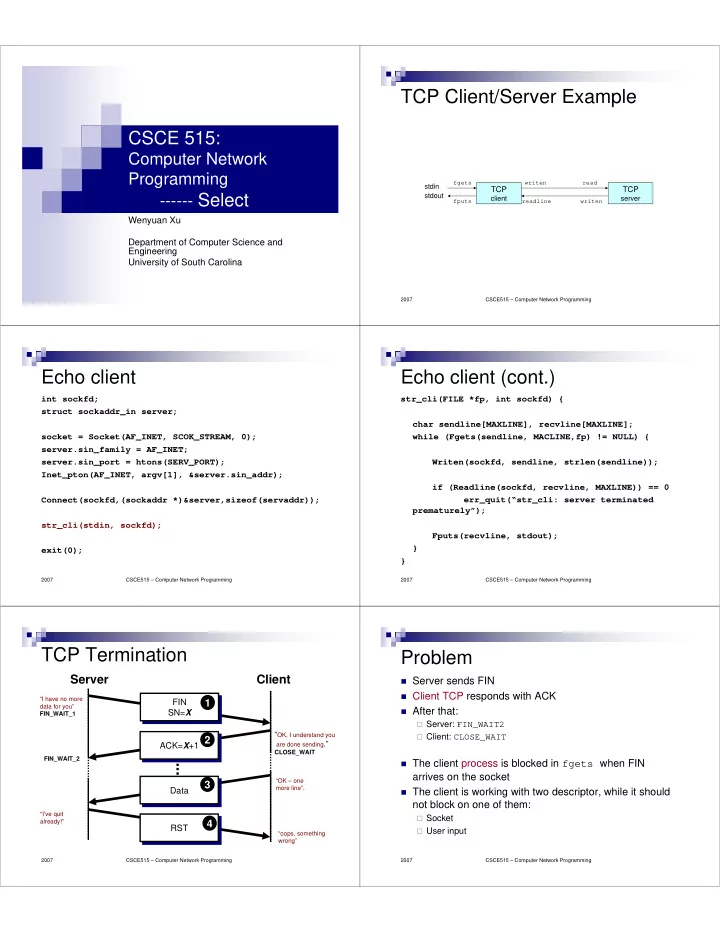
TCP Client/Server Example CSCE 515: Computer Network Programming fgets writen read stdin TCP TCP ------ Select stdout client server fputs readline writen Wenyuan Xu Department of Computer Science and Engineering University of


slide-1
SLIDE 1

CSCE 515:

Computer Network Programming

  • ----- Select

Wenyuan Xu Department of Computer Science and Engineering University of South Carolina

CSCE515 – Computer Network Programming 2007

fgets

TCP Client/Server Example

TCP

client

TCP

server

writen read readline writen fputs

stdin stdout

CSCE515 – Computer Network Programming 2007

Echo client

int sockfd; struct sockaddr_in server; socket = Socket(AF_INET, SCOK_STREAM, 0); server.sin_family = AF_INET; server.sin_port = htons(SERV_PORT); Inet_pton(AF_INET, argv[1], &server.sin_addr); Connect(sockfd,(sockaddr *)&server,sizeof(servaddr)); str_cli(stdin, sockfd); exit(0);

CSCE515 – Computer Network Programming 2007

Echo client (cont.)

str_cli(FILE *fp, int sockfd) { char sendline[MAXLINE], recvline[MAXLINE]; while (Fgets(sendline, MACLINE,fp) != NULL) { Writen(sockfd, sendline, strlen(sendline)); if (Readline(sockfd, recvline, MAXLINE)) == 0 err_quit(“str_cli: server terminated prematurely”); Fputs(recvline, stdout); } }

CSCE515 – Computer Network Programming 2007

Server Client

FIN SN=X FIN SN=X

1

ACK=X+1 ACK=X+1 2 RST RST

4

Data Data

3

...

“I have no more data for you” FIN_WAIT_1

“OK, I understand you

are done sending.” CLOSE_WAIT “OK – one more line”. “I’ve quit already!”

TCP Termination

FIN_WAIT_2 “oops, something wrong”

CSCE515 – Computer Network Programming 2007

Problem

Server sends FIN Client TCP responds with ACK After that:

Server: FIN_WAIT2 Client: CLOSE_WAIT

The client process is blocked in fgets when FIN

arrives on the socket

The client is working with two descriptor, while it should

not block on one of them:

Socket User input

slide-2
SLIDE 2

CSCE515 – Computer Network Programming 2007

I/O Multiplexing

We often need to be able to monitor

multiple descriptors:

a generic TCP client (like telnet) A server that handles both TCP and UDP Client that can make multiple concurrent

requests (browser?).

CSCE515 – Computer Network Programming 2007

Example - generic TCP client

Input from standard input should be sent

to a TCP socket.

Input from a TCP socket should be sent to

standard output.

How do we know when to check for input

from each source?

CSCE515 – Computer Network Programming 2007

Generic TCP Client

STDIN STDOUT TCP SOCKET

CSCE515 – Computer Network Programming 2007

Options

Use nonblocking I/O.

use fcntl() to set O_NONBLOCK

Use alarm and signal handler to interrupt

slow system calls.

Use multiple processes/threads. Use functions that support checking of

multiple input sources at the same time.

CSCE515 – Computer Network Programming 2007

Non blocking I/O

use fcntl() to set O_NONBLOCK:

int flags; flags = fcntl(sock,F_GETFL,0); fcntl(sock,F_SETFL,flags | O_NONBLOCK);

Now calls to read() (and other system calls)

will return an error and set errno to

EWOULDBLOCK.

CSCE515 – Computer Network Programming 2007

while (! done) { if ( (n=read(STDIN_FILENO,…)<0)) if (errno != EWOULDBLOCK) /* ERROR */ else write(tcpsock,…) if ( (n=read(tcpsock,…)<0)) if (errno != EWOULDBLOCK) /* ERROR */ else write(STDOUT_FILENO,…) }

slide-3
SLIDE 3

CSCE515 – Computer Network Programming 2007

The problem with nonblocking I/O

Using blocking I/O allows the Operating

System to put your process to sleep when nothing is happening (no input). Once input arrives, the OS will wake up your process and read() (or whatever) will return.

With nonblocking I/O, the process will

chew up all available processor time!!!

CSCE515 – Computer Network Programming 2007

Using alarms

signal(SIGALRM, sig_alrm); alarm(MAX_TIME); read(STDIN_FILENO,…); ... signal(SIGALRM, sig_alrm); alarm(MAX_TIME); read(tcpsock,…); ...

A function you write

CSCE515 – Computer Network Programming 2007

Alarming Problem

What will happen to the response time ? What is the ‘right’ value for MAX_TIME?

CSCE515 – Computer Network Programming 2007

Select()

The select() system call allows us to use

blocking I/O on a set of descriptors (file, socket, …).

For example, we can ask select to notify

us when data is available for reading on either STDIN or a TCP socket.

CSCE515 – Computer Network Programming 2007

Select()

Return when

Any of the descriptors in the set {1,4,5} are

ready for reading

Any of the descriptors in the set {2,7} are

ready for writing

Any of the descriptors in the set {1,4} have an

exception condition pending

Specify what descriptors we are interested

in and how long to wait

CSCE515 – Computer Network Programming 2007

select()

int select( int maxfd, fd_set *readset, fd_set *writeset, fd_set *excepset, const struct timeval *timeout);

maxfd: highest number assigned to a descriptor. readset: set of descriptors we want to read from. writeset: set of descriptors we want to write to. excepset: set of descriptors to watch for exceptions. timeout: maximum time select should wait

slide-4
SLIDE 4

CSCE515 – Computer Network Programming 2007

struct timeval

struct timeval { long tv_sec; /* seconds */ long tv_usec; /* microseconds */ } struct timeval max = {1,0}; struct timeval forever = NULL; struct timeval polling = {0,0}

CSCE515 – Computer Network Programming 2007

fd_set

Implementation is not important Operations you can use with an fd_set:

void FD_ZERO( fd_set *fdset); void FD_SET( int fd, fd_set *fdset); void FD_CLR( int fd, fd_set *fdset); int FD_ISSET( int fd, fd_set *fdset);

CSCE515 – Computer Network Programming 2007

Using select()

Create fd_set Clear the whole thing with FD_ZERO Add each descriptor you want to watch

using FD_SET.

Call select when select returns, use FD_ISSET

to see if I/O is possible on each descriptor.

CSCE515 – Computer Network Programming 2007

Errors -- errno

EBADF

An invalid file descriptor was given in one of the sets.

EINTR

A non blocked signal was caught.

EINVAL

n is negative or the value contained within timeout is

invalid.

ENOMEM

select was unable to allocate memory for internal

tables.

CSCE515 – Computer Network Programming 2007

shutdown()

int shutdown( int sockfd, int howto);

sockfd is the TCP socket howto:

SHUT_RD: close the read half of the connection SHUT_WR: close the write half of the connection SHUT_RDWR: close both the read and write half of the

connection.

shutdown() returns -1 on error (otherwise 0).

CSCE515 – Computer Network Programming 2007

shutdown()vs close()

Reference counter:

close() decrements the descriptor’s reference

count and close the socket only if the count reaches 0.

shutdown() initiate TCP connection termination

sequence regardless of the reference count.

Directions:

close() terminate both directions of data

transfer, reading and writing.

shutdown() can close one-half of the TCP

connection, either reading or writing.

slide-5
SLIDE 5

CSCE515 – Computer Network Programming 2007 CSCE515 – Computer Network Programming

Assignment & Next time

Reading:

UNP 5.12, 6.3-6.9**

Next Lecture:

thread