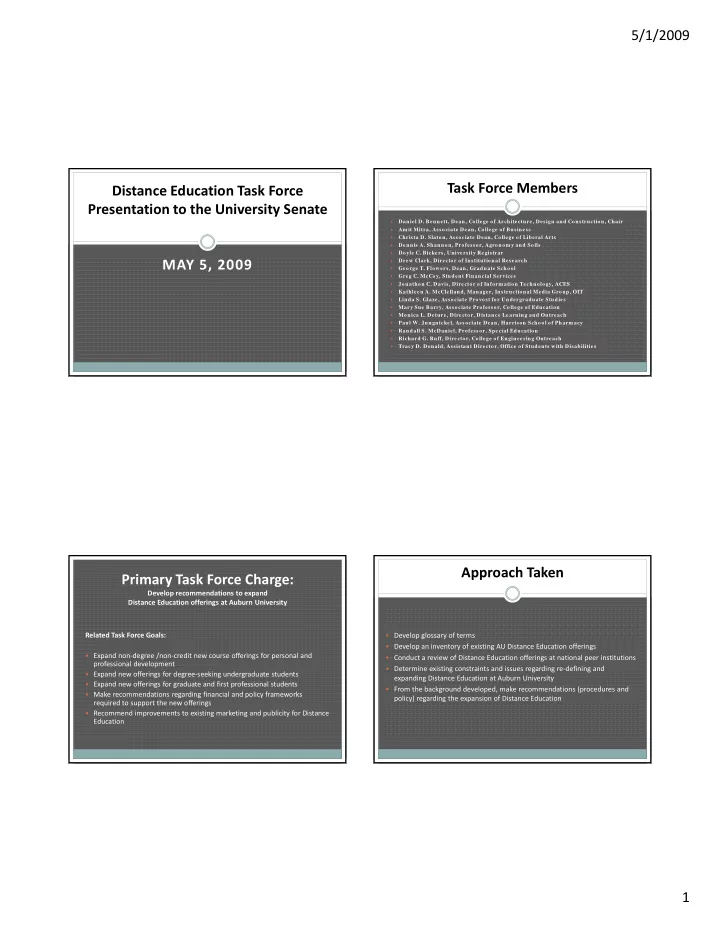
Task Force Members Distance Education Task Force Presentation to the - - PDF document

task force members distance education task force
SMART_READER_LITE
LIVE PREVIEW

Task Force Members Distance Education Task Force Presentation to the - - PDF document

5/1/2009 Task Force Members Distance Education Task Force Presentation to the University Senate Daniel D. Bennett, Dean, College of Architecture, Design and Construction, Chair Am it Mitra, Associate Dean, College of Business


slide-1
SLIDE 1

5/1/2009 1 MAY 5, 2009 Distance Education Task Force Presentation to the University Senate

Daniel D. Bennett, Dean, College of Architecture, Design and Construction, Chair

Am it Mitra, Associate Dean, College of Business

Christa D. Slaton, Associate Dean, College of Liberal Arts

Dennis A. Shannon, Professor, Agronom y and Soils

Doyle C. Bickers, University Registrar

Drew Clark, Director of Institutional Research

George T. Flowers, Dean, Graduate School

Greg C. McCoy, Student Financial Services

Jonathon C. Davis, Director of Inform ation Technology, ACES

Kathleen A. McClelland, Manager, Instructional Media Group, OIT

Linda S. Glaze, Associate Provost for Undergraduate Studies

Mary Sue Barry, Associate Professor, College of Education

Monica L. Deture, Director, Distance Learning and Outreach

Paul W. Jungnickel, Associate Dean, Harrison School of Pharm acy

Randall S. McDaniel, Professor, Special Education

Richard G. Ruff, Director, College of Engineering Outreach

Tracy D. Donald, Assistant Director, Office of Students with Disabilities

Task Force Members

Related Task Force Goals:

 Expand non‐degree /non‐credit new course offerings for personal and

professional development

 Expand new offerings for degree‐seeking undergraduate students  Expand new offerings for graduate and first professional students  Make recommendations regarding financial and policy frameworks

required to support the new offerings

 Recommend improvements to existing marketing and publicity for Distance

Education

Primary Task Force Charge:

Develop recommendations to expand Distance Education offerings at Auburn University

Approach Taken

 Develop glossary of terms  Develop an inventory of existing AU Distance Education offerings  Conduct a review of Distance Education offerings at national peer institutions  Determine existing constraints and issues regarding re‐defining and

expanding Distance Education at Auburn University

 From the background developed, make recommendations (procedures and

policy) regarding the expansion of Distance Education

slide-2
SLIDE 2

5/1/2009 2 Policy Recommendations

 For those disciplines where tuition rates cannot cover required costs and

whose offerings are desired by AU for distance delivery, funds should be made available to cover the required costs

 The university should review the general fund distribution in consideration of

needs required to support distance education (the library, OIT, Office of Students with Disabilities, etc.)

 Provision of campus facilities for distance delivery by participating academic

units is recommended (to include production studios, technical staff, equipment, etc.)

 Financial support should be provided to the Office of Distance Learning and

Outreach Technology to ensure appropriate technical and marketing support. Marketing should occur through the University web site and other appropriate print and media venues

 Implement a university‐wide assessment of Distance Education. This should be

done in a manner that is consistent across the campus (the same for all colleges and schools) and developed in a way that learning can be compared between distance and traditional delivery formats

Policy Recommendations: Tuition

The offering unit will determine: A) Students will be subject to tuition rates set by the offering unit and determined by market forces and internal cost analysis OR B) Students will pay tuition rates based on status

Procedural Recommendations

Graduate, First Professional Degree and Certificate Programs:

  • Existing graduate courses and programs will continue to be offered

to off‐campus students in formats developed by the offering unit

  • All regularly admitted graduate students will be eligible to take

distance courses

  • Off‐campus degree/non‐degree‐ seeking students must meet AU’s

minimum admission requirements

Funding

 The Office of the Provost, the Graduate School, colleges/schools and

departments, along with the Office of Distance Learning and Outreach Technology, will identify subject areas where new distance delivery courses are desirable

 Start‐up funds and costs incurred for developing and offering blocking courses

(including faculty salaries, prep time, IT needs, etc.) will be provided by the Central Administration from funds obtained through revenue‐ sharing agreements

slide-3
SLIDE 3

5/1/2009 3

The following Five Tier Revenue Sharing Plan is proposed:

  • The offering unit assumes all of the risk and keeps all revenues (minus the

rate to be returned to the Central Administration as set by the Board of Trustees (currently set at $63 per credit hour)

  • The Central Administration assumes all of the risk and guarantees recovery
  • f all costs. The offering unit receives 10% of the revenue … the Central

Administration retains 90% of the revenue

  • The offering unit funds all instructional costs. The offering unit retains 50%
  • f the revenue … the Central Administration retains 50%
  • The offering unit funds all instructional and production costs. The offering

unit retains 66% of revenue … the Central Administration retains 34%

  • The offering unit assumes all financial risk and guarantees recovery of
  • costs. The offering unit receives 90% of revenue … the Central

Administration retains 10%

Faculty Compensation

 The offering unit will determine, through negotiation with faculty, whether

compensation for course development will be through release time or through extra compensation

 Subject to approval by the Dean and Provost, the offering unit will determine

whether faculty will be compensated for teaching a distance course on a “per course basis”, a “per student enrollment/per course basis”, or as part of the faculty member’s regular on‐load assignment