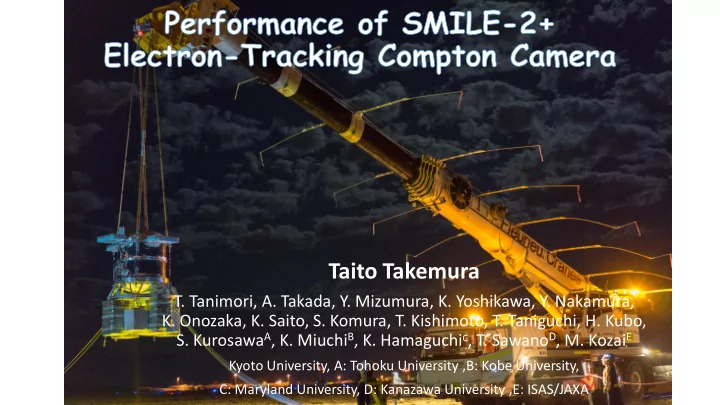
Taito Takemura T. Tanimori, A. Takada, Y. Mizumura, K. Yoshikawa, Y. - - PowerPoint PPT Presentation

taito takemura
SMART_READER_LITE
LIVE PREVIEW

Taito Takemura T. Tanimori, A. Takada, Y. Mizumura, K. Yoshikawa, Y. - - PowerPoint PPT Presentation

Taito Takemura T. Tanimori, A. Takada, Y. Mizumura, K. Yoshikawa, Y. Nakamura, K. Onozaka, K. Saito, S. Komura, T. Kishimoto, T. Taniguchi, H. Kubo, S. Kurosawa A , K. Miuchi B , K. Hamaguchi C , T. Sawano D , M. Kozai E Kyoto University, A:


slide-1
SLIDE 1

Taito Takemura

  • T. Tanimori, A. Takada, Y. Mizumura, K. Yoshikawa, Y. Nakamura,
  • K. Onozaka, K. Saito, S. Komura, T. Kishimoto, T. Taniguchi, H. Kubo,
  • S. KurosawaA, K. MiuchiB, K. HamaguchiC, T. SawanoD, M. KozaiE

Kyoto University, A: Tohoku University ,B: Kobe University, C: Maryland University, D: Kanazawa University ,E: ISAS/JAXA

slide-2
SLIDE 2

INDEX

  • 1. MeV gamma-ray astronomy
  • 2. Electron-Tracking Compton Camera
  • 3. SMILE Project
  • 4. Ground Calibration of SMILE-2+
slide-3
SLIDE 3

MeV gamma-ray Astronomy

MeV sky map GeV sky map

Requirements for the next-generation observation are

  • Wide-band detection
  • Large Field of View
  • High quality image

Particle Acceleration

SNR (Radio-isotopes) Galactic Plane (26Al, 60Fe, and annihilation ) Jets in AGN, GRB (Synchrotron radiation and Inverse Compton) SNR (π0-decay and Inverse Compton) GRB of first stars

Nucleosynthesis Early universe

~ 100 mCrab

~ several mCrab

slide-4
SLIDE 4

Problem and Answer of difficulties

Huge Background

The TOF distribution of COMPTEL (left) on the ground (right) in low earth orbit

Incomplete Reconstruction

Compton Camera loses electron track

Imaging by superposition

  • f event circles

Well-defined Point Spread Function (PSF) and Low BG are necessary for MeV gamma-ray telescope

Well-defined PSF

Answer: measure electron track Answer: particle identification

  • T. Tanimori+ ,

ApJ.(2015)

  • T. Tanimori+ , ApJ.(2017)

Peter von Ballmons+ (2014)

event circle

slide-5
SLIDE 5

deposited energy

Electron-Tracking Compton Camera (ETCC)

Reconstruct Compton scattering event by event completely

  • Gaseous Time Projection Chamber

Tracker: 3-D track and energy of electrons

2D imaging (x,y) + Drift Time (z) =>3D

  • Pixel Scintillator Arrays

Absorber: absorption position and energy of scattered gamma-ray

a

  • Back ground rejection

Two-Dimensional PSF Particle identify with dE/dX Compton Kinematical test with a

  • Without heavy VETO
  • Large FOV (~ 3 str)

Cosmic-ray counts 103 102 10 1

=

track length deposited energy [keV]

slide-6
SLIDE 6

Sub-MeV gamma-ray Imaging Loaded-on-balloon Experiment

  • We obtained diffuse cosmic/atmospheric gamma-ray spectra
  • Success in rejection with dE/dX

SMILE

All sky survey with an ETCC loaded on a satellite SMILE-3 SMILE-2+ 1-day flight @ Alice Springs (Apr. 7th 2018)

SMILE-I @ Sanriku (Sep. 1st 2006)

  • Certification of imaging spectroscopy in MeV Astrophysics
  • observation of bright objects (Crab & Galactic Center)

Effective area a few cm2 PSF (50% included) ~ 10 deg @ 662 keV

  • Scientific observation loaded on a long duration balloon

several time with better sensitivities of COMPTEL

SMILE-2: Only ground test

  • A. Takada+. ApJ,2011
  • T. Tanimori+. ApJ,2015

Requirement (detect 5s ) ~ sub-mCrab sensitivity

radius

slide-7
SLIDE 7

To improve effective area of SMILE-2+

① Positioning scintillators inside the gas vessel to measure high energy electron escaping from TPC ② Addition of scintillator length (Bottom 1 R.L.=> 2 R.L.) ③ Addition of gas pressure (Ar 1 atm => Ar 2atm)

Simulated effective area of SMILE-2+

  • nly fully-contained

electron event

Prototype ETCC (SMILE-2 ETCC)

②+③ ①

(30 cm)3 (30 cm)3

  • T. Tanimori+ , ApJ.(2015)

SMILE-2+ ETCC and prototype ETCC are the same at the points of the size of TPC and the number of scintillators

slide-8
SLIDE 8
  • q

sealed gas vessel

Gas purification system

Circulation pump

Many materials such as scintillator is in gas vessel

  • utgas is a serious problem

SMILE-2+ ETCC equipped with gas purification system

slide-9
SLIDE 9

Gas purification system

Zeorum: (AlO2)x・(SiO2)y used as a molecular sieve

slide-10
SLIDE 10

SMILE-2+ Flight System

  • Battery

Power: ~490 Ah

Power consumption:~214 W The capabilities of operation ~32 h

  • Attitude sensor

GPS: position and time Clinometer x2: zenith angle Geomagnetic aspectmeter x3 : azimuth & zenith angle

Geomagnetic aspectmeter GPS

MLI Without Active gamma-ray VETO

FSK 1200 bps Bi-phase 8 kbps

slide-11
SLIDE 11

Imaging check for various angles using 137Cs

source position ~ 0°

137Cs energy spectrum Zenith ~0°

Image cut inner the radius of 10 °

Scattered Angle 60 120 measured angle [deg]

Ground Calibration of SMILE-2+ ETCC

60 120 direct gamma scattered gamma counts 160 120 80 40 counts

source position ~ 30° source position ~ 60° reconstructed map

Selected event of ΔE/E <10% 30° 60° 90° 30° 60° 90° 30° 60° 90°

100 200 100 200 40 80 counts counts counts

expected angle [deg]

slide-12
SLIDE 12

High Energy Electron Event

Example of the event of electron absorbed by scintillator  Reconstructed position agreed with source position

a value (angle between scattered

gamma-ray & recoil electron)

Compton kinematics akin geometry ageo

△a = 0.9°

TPC spectrum of electrons fully contained

137Cs source

normalized in total counts counts [A.U.] deposited energy [keV]

slide-13
SLIDE 13

Summary

  • We developed SMILE-2+ as hard as possible

to make shift with launching balloon

Schedule of SMILE-2+

Now we are doing best to analyze the data of ground test and flight data

  • We are developing ETCC to meet the requirements
  • Next generation require BG rejection & Well defined PSF
slide-14
SLIDE 14

Summary

  • We developed SMILE-2+ as hard as possible

to make shift with launching balloon

Schedule of SMILE-2+

Now we are doing best to analyze the data of ground test and flight data

  • We are developing ETCC to meet the requirements
  • Next generation require BG rejection & Well defined PSF