SLIDE 1
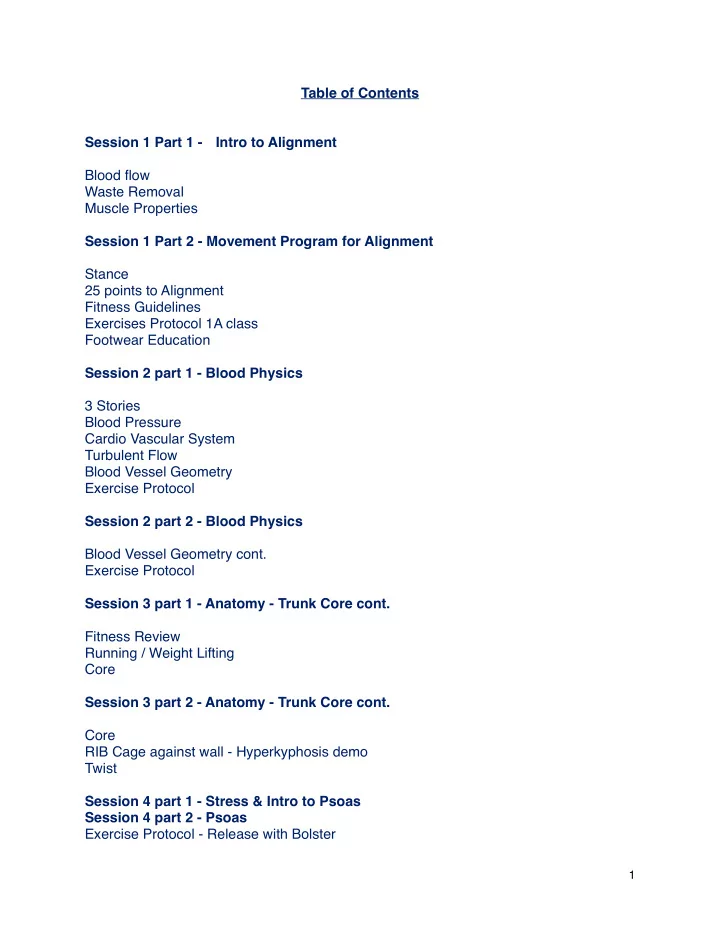
Table of Contents Session 1 Part 1 - Intro to Alignment Blood flow Waste Removal Muscle Properties Session 1 Part 2 - Movement Program for Alignment Stance 25 points to Alignment Fitness Guidelines Exercises Protocol 1A class Footwear Education Session 2 part 1 - Blood Physics 3 Stories Blood Pressure Cardio Vascular System Turbulent Flow Blood Vessel Geometry Exercise Protocol Session 2 part 2 - Blood Physics Blood Vessel Geometry cont. Exercise Protocol Session 3 part 1 - Anatomy - Trunk Core cont. Fitness Review Running / Weight Lifting Core Session 3 part 2 - Anatomy - Trunk Core cont. Core RIB Cage against wall - Hyperkyphosis demo Twist Session 4 part 1 - Stress & Intro to Psoas Session 4 part 2 - Psoas Exercise Protocol - Release with Bolster
1
SLIDE 2
Session 5 part 1 - Shoulder Girdle HyperKyphosis Flexible Ruler Demo # 1 - slide 7 **FLEXIBLE RULER - DEMO #2** - slide 15 Breathing Session 5 part 2 - Shoulder Girdle Thoracic Cavity and Breathing cont. Winging Session 6 part 1 - Shoulder Girdle Exercises: Active Discussion on Valsalva maneuver Session 6 part 2 - Shoulder Girdle Exercises: Active Session 7 part 1 - Walking Rowing Your Boat Proprioception Session 7 part 2 - Proprioception cont. Tennis Ball with the foot - 1 hr. 7 minutes Advanced Top of the Foot Stretch on half dome Forward Bend 1 hr. 28 minutes Session 8 - SENSORY PERCEPTION, GAIT, FOOT ANATOMY, CALF MUSCLES Interneurons Proprioception Session 9 - SQUAT EXERCISE FOR YOUR OWN BODY Squat Preps Session 10 - BONE DENSITY & GAIT Osteoporosis Session 11 - Review Forward Bend Psychology of People Blood Physics
2
SLIDE 3
Muscle Properties Movement Program Fitness Guidelines Importance of Flow Lymph Physical Goals Metabolism Session 12 - ALGORITHM Exercise Protocols Form K
3
SLIDE 4 SESSION 1 - Part 1 SLIDE 3 - How Can I increase the longevity of my machine?
- Understand what your “factory” needs to produce and what situations can
decrease or delay units of production. Minimize those situations to increase factory productivity. SLIDE 4 - What Does “Optimal Function” Mean? – Cells regenerate quickly:
- This requires oxygen saturation to all tissues
- Quantity of blood:
- Quantity of oxygen in blood
Cells regenerate Correctly
- This requires an Optimal environment
- Waste/acid free
- Heat/compression
SLIDE 5 - Blood Flow & Waste Removal – Cardiovascular System:
- heart
- lungs - exhale is acidic
- blood vessel system
- LYMPH SYSTEN:
- Waste removal happens at the capillary level
- Has no pumping mechanism, depends solely on muscle action to bring “flow” into
the area
- SLIDE 6 - Lymph and Capillaries - diagram
SLIDE 7 - Whole-Body Lymph System Diagram SLIDE 8 & 9 - Blood Physics – THE MOTOR UNIT (MOTOR NEURON) diagram SLIDE 10 - Blood Physics Muscle Structure - diagram SLIDE 11 - ALIGNMENT THEORY There is ONE POSITION OF THE BODY THAT ENSURES OPTIMAL FLOW: Electricity Blood Lymph This alignment is based on the laws of physics and engineering and is free from cultural input: Dance Race /Anthropometric Dimensions Athletics/Fitness SLIDE 12 - Muscle Properties 101
- 1. Muscle can be a force-generating tissue.
4
SLIDE 5
- 2. Muscle requires flowing electricity (potential energy) to move (kinetic energy),
generating force.
- 3. healthy muscle has both STRENGTH AND YIELD.
- 4. Muscle without STRENGTH is weak (cannot generate force.)
- 5. Muscle without YIELD IS weak (cannot generate force).
- 6. the amount of force a muscle can generate is equal to the quantity of electricity
flowing thru it.
- 7. The amount of electricity flowing through a muscle depends on the length of the
muscle (not too short, and not too long). SLIDE 13 - Muscle Properties 101 - diagram SLIDE 14 - Muscle Properties 101 The amount of force a muscle can generate is equal to the quantity of electricity flowing through it. The amount of electricity flowing through a muscle depends on the length of the muscle (not too short, and not too long). Diagram of Length-Force relationship in Skeletal Muscle SLIDE 15 - Muscle Properties 101 – Quantity & rate of blood is determined by localized muscle activity. The quantity of electricity flowing thru an area is = to the range of motion of the area. Yield + Strength =^ E flow =^ blood flow ^blood flow =^ Rate of Tissue Regeneration Tissue Regeneration = Tissue Health SLIDE 16 = Questions SESSION 1 - PART 2 Q&A until slide 17 - 14 minutes. SLIDE 17 - The Movement Program for Alignment These objective markers are free from cultural context, designed with the engineering of your body in mind, are appropriate for everyone with a human machine. SLIDE 18 Alignment is not for the purpose of aesthetics, conveying an emotion, or to identify
- culture. Is is the required skeletal position to achieve the desired outcome of accessing
your full potential energy. The quantity of kinetic energy available to you is equal to your potential. If you would like your neurological, skeletal, muscular, tissues to give you long-lasting motion, you must increase potential energy. SLIDE 19 - FITNESS GUIDELINES CardiovascularExercise - increase ‘strength’ of heart and increase vascular tissue (capillary) to working tissues.
5
SLIDE 6 Strength/Resistance Ex -- maintain muscle tissue for BMR/ maintain bone density/ maintain function Flexibility - maintain joint range of motion for ease of functional movement Slide 20 - The “New” Bio mechanical Model of Health Motor Skill Acquisition: Increase # of muscles innervated = increase in capillaries to more musculature = decrease in blood pressure. Increase in working motor units = increase in neurological tissue Increase in innervated muscles = increase BMR Strength to Weight Ration
- increase in balance (fall risk reduction) = increase in self efficacy
- increase in bone Density
- increase in functional daily task ability -- walk 5 miles a day
Whole Body Movement
- increase in waste removal
- chance for all over simultaneous innervation & “daily feeding” of tissues
- Maintains bone density & innervates muscles responsible for structural integrity.
SLIDE 21 -Alignment Matters: 25 POINTS to Optimal Function & Health` SLIDE 22 - Where to begin: 1A Stance Education (5-8 minutes) Exercise Protocol (20 minutes)
- Monster Walk
- Calf Stretch
- Double Stretch
- Toe Stretch
Footwear Education (2 minutes) SLIDE 23 - Female vs. Male Skeleton (female with feet together) SLIDE 24 - Female Stance SLIDE 25 - Excessive Lateral Torque - pictures female skeleton ‘s stance SLIDE 26 - STANCE - Photo of Katy SLIDE 27 - Posture vs. Alignment - Photo of Katy SLIDE 28 - Stance (intro to 1A) Foot Position: Deep pelvic, groin, and gluteal muscles require correct position of the foot, shank, and femur to innervate.
- Lateral borders of the feet should be parallel
Weight: Back in the heels - off of the fore and mid-foot
6
SLIDE 7
- Creates appropriate load on soft tissues of intrinsic foot musculature and fascial
- system. Also stimulates bone correctly (vertically) for femoral bone generation
Full Knee Extension: Quadriceps should be able to relax and contract on command - not be in constant hyper-tonic state. Indication of constant spinal flexion or anterior pelvis SLIDE 29 - EXERCISE PROTOCOL SLIDE 30 - Monster Walk Lateral Walking
- To maintain foot position
- lateral border must be maintained
- To strengthen lateral hip musculature
- Practice stance (landing in heel first)
- Can be done loaded or unloaded
SLIDE 31- Calf Stretch Demonstrates posterior force generation in locomotion.
- If stride length during calf stretch is negative, patient is:
- in spinal flexion to generate momentum
- is walking from the knee joint
- has little frontal plane pelvic motion
- has little innervation in lateral hip
- IT BAND SYNDROME
Slide 32 - Double-Calf Stretch Allows you to assess pelvic and lumbar spine mobility with full knee extension - functional! Add quadruped variation for spinal mobility in knee flexion Slide 33 - Foot Stretch Increases range of motion in INTRINSIC muscles. Replace arch in foot. Arch supports correct hip rotation. Correct femur placement supports deep lumbo-pelvic muscles. Slide 34 - Footwear Education **There is a direct relationship between positive heel displacement and human joint
- displacement. 1 degree of footwear = 1 degree of joint adjustment.
SESSION 2 PART 1 -Discussion and lecture begins at 1 hr. SLIDE 2 = Questions SLIDE 3 = “Science” & “Evidence” SLIDE 4 = Three Stories
7
SLIDE 8 The Beekeeper www.beesource.com/point-of-view/adrian-wenner The Challenger Shuttle www.science.ksc.nasa.gov/shuttle/missions/51-1/docs/rogers-commission/Appendix Euclid. SLIDE 5 - The Honey Bees The Elusive Honey Bee Dance “Language” Hypothesis Journal of insect Behavior, Vol. 15, No. 6, November 2002- pages 859-878 In the mid 1930’s, Karl von Frisch proposed the equivalent of an odor-search hypothesis for honey bee recruitment to food sources. A decade later he switched to the equivalent
- f a ‘dance language’ hypothesis. The later and more exotic hypothesis rapidly gained
acceptance, but it failed its first experimental tests in the mid 1960’s. Language advocates then ignored basic precepts of scientific process, rejected and/or ignored results not in accord with their favored hypothesis, and instead repeatedly sought additional supportive evidence. while so doing, they inadvertently accumulated yet more evidence counter to von Frisch’s original intent. By invoking ad hoc modifications and qualifications, advocates weakened, rather than strengthened, the hypothesis has had an unfortunate result; the exclusive investment in that line of research by various governmental agencies has failed to provide practical help to beekeepers or growers in the past half-century, SLIDE 6 - NASA Out of a total of 2,900 flights, 121 had failed (1 in 25) With the increase in technology, a reasonable number for success could be increased to 1 in 1000 The manufacturer of the O-Ring gave specs that the ring would fail 1 in 10,000 in normal conditions. The engineers calculated that with all of the current engine troubles, the shuttle has a 1 in 200 chance of failure. NASAs mathematical model software calculated flight risk to be 1 in 100,000. All these were for normal conditions. The mathematical model, while correct in mathematics was not correct in modeling all the elements of nature. SLIDE 7 - This is a line, with points A, B, and C: (not to scale here) _________________________________________________________ A B C Consider; AB + BC = AC Is this true? How do we know? SLIDE 8 - “Science and Evidence”
8
SLIDE 9 The scientific PROCESS is one, that when utilized correctly, increases our understanding of things we don’t understand. The CONCLUSIONS OF research studies are still limited to the realm of understanding of the researcher, the limitations of the design, and the integrity of the scientific community. It has nothing to do with absolute validity. SLIDE 9 - Why Align?
- 1. Preserve and protect the spine
- 2. Optimize circulation.
- 3. Minimize joint damage.
- 4. To meet these objectives, we need to thoroughly understand forces such as pressure,
friction, fluid dynamics, and geometry. SLIDE 10 - HIgh Blood Pressure What is it? Why is it? What can I do about it? SLIDE 11 - Cardiovascular System WHAT IS THE CARDIOVASCULAR SYSTEM DOING? Delivering oxygenated blood from the heart to all tissues in the body, and returning de-
- xygenated blood back to the lungs to recharge with oxygen. The movement of blood is
also integral to the waste removal system (removing byproducts resulting from the break down of energy units). Oxygen in the necessary “food” for all cells, and delivery of the minimal quantity for survival is essential for living. Delivery of the optimal quantity is the goal, SLIDE 12 - The Blood Highway - diagram SLIDE 13 - The Blood Highway - photos from BodyWorks SLIDE 14 - The Blood Highway - photo from Bodyworks - head SLIDE 15 - The Blood Highway - photo of intestines SLIDE16 - Pressure What is it? Pressure is the force on an object that is spread over a surface area. P = F/A - diagram SLIDE 17 - Blood Pressure What is it? Blood Pressure is the force exerted on the walls of blood vessels by the circulating
SLIDE 18 - HAEMODYNAMICS Blood Vessel organization
9
SLIDE 10 Blood Tissue Properties -
Smooth Muscle Properties Blood Velocity
- Rate of flow
- Type of Flow (Laminar vs. Turbulent)
Blood Vessel Geometry Resistance
- Diameter
- Length
- Wall Smoothness
- Viscosity
Blood Viscosity (sticky)
- Blood Sugar
- Aspirin: NOT BLOOD THINNER but anti-coagulate
SLIDE 19 - BLOOD TISSUES - diagram of blood cells Actually TWO tissues, 55% Plasma (fluid), 45% Solids (blood cells) Greatest amount of blood supply - Face & Feet due to most of amt. of musculature. SLIDE 20 - Blood Vessel Organization - Parent Arteries and Daughters - photo SLIDE 21 - Blood Vessel Organization Biggest to Smallest - diagram Artery, Arteriole, Meta-Arteriole, Capillary SLIDE 22- Arteriole and Capillary Location - Structure of a skeletal muscle diagram SLIDE 23 - WHY IS FLOW IMPORTANT? Laminar Flow diagram Turbulent Flow diagram Blood Cell are objects that can interact with the walls of the blood vessels. In non- laminar flow, the velocity of the blood cells changes, causing more cell-wall interaction, increasing wall-wounding and the injury cycle. SLIDE 24 - WHAT CAUSES TURBULENT FLOW? Smoking, Stress (adrenaline cycle), Sudden changes inflow rate, vasodilation, vasoconstriction SLIDE 25 - Other Considerations: photos and diagrams BLOOD VESSEL GEOMETRY
- natural changes of flow rate
- centrifugal force
- natural and un-natural geometry
SESSION 2 - PART 2 - Blood Physics
10
SLIDE 11 Discussion of Blood Vessel Geometry SLIDE 25 cont. SLIDE 26 - Other factors: Resistance changes with:
- diameter
- length
- Wall smoothness
- viscosity*
Blood Viscosity
- blood sugar
- DEHYDRATION
- Aspirin: NOT BLOOD THINNER, but anti-coagulate
SLIDE 27 - Haemodynamics See slide 18 SLIDE 28 - What is really going on? Why is blood pressure high? SLIDE 29 - Whole Body Perspective The bulk of the average person’s blood in the arteries s/b evenly distributed thru out all blood vessels (relatively speaking)
- Blood Flow depends on muscle activity
- Muscle activity is required to ‘open’ smaller vessels.
SLIDE 30 What has SCIENCE told us about correct exercise prescription for CV health?
- Cardiovascular exercise strengthens the heart
- CV exercise grows more capillaries
- CV exercise decreases Blood Pressure - this is all true,(in the moment)
but is CV exercise the correct exercise prescription for long-term CV function NO! In fact there are NO actual long term, well designed studies that show that CV exercise decreases death from CV exercise. Surprised? SLIDE 31 - Alignment Matters: 25 points to Optimal Function and Health SLIDE 32 - Exercise Protocol SLIDE 33 - Foot Alignment - photo of Feet Straight and With External Femoral Rotation (arches lifted) SLIDE 34 - Calf Stretch - photo and diagram SLIDE 35 - Top of The foot Stretch = several photos SLIDE 36 - Monster Walk = diagram (description of what is a hip replacement)
11
SLIDE 12 SLIDE 37 - Knee Cap Release - Photo SLIDE 38 - Pelvic List - photos SLIDE 39 - Strap Stretch - diagrams SLIDE 40 - Double Calf Stretch - Photo SLIDE 41- Thoracic Stretch - Photo SLIDE 42- The Head Hang Photo SESSION 3 - PART 1 Anatomy - The Trunk Discussion, begin lecture at 42 minutes. slide 10 SLIDE 3 - Fitness Review SLIDE 4 - Running, Good or Bad? Healthy or un-healthy? SLIDE 5 - Clarence de Mar 1888-1958 As far back as 1961, Currens and White published a study in the New England Journal
- f Medicine on the autopsy results of Clarence de Mar. De Mar was something of a
legend in American marathon running, winning Boston seven times and finishing third in the 1924 Pairs Olympic Marathon. He had been a runner for over 50 years, and hence the interest in his physiology and his heart upon his death. “We have been unable to document a single death from ischaemic heart disease among marathon finishers of any age”..... Dr. Bassler Bassler, T. J. 1977, Marathon running and immunity to atherosclerosis. Annals of the New York Academy of Sciences 301:579-592 SLIDE 6 - Dr. Tim Noakes Annals of the New York Academy of Sciences, Volume 301 - The Marathon: Physiological, Medical, Epidemiological, and Psychological pages 593-619, October 1977. Disputed earlier claims regarding Running and Coronary Heart Disease by providing research on FOUR marathoners who had died from CAD. Whoops. Main issues were, this info had already tricked to medical and media “experts” and was not retracted . Running as a pastime swept the nation as “the best heart conditioning exercise”. SLIDE 7 - The Research on Running and Heart Health Continues to show, over and over again, that while running does not contribute to the reduction of risk factors for CHD. What has Running Research really shown? Aaaaaaaaand, we haven’t even talked about the increased joint forces :) So, is running “Good” or Bad”? Healthy or Unhealthy? SLIDE 8 - The Position Stand of the ACSM and the AHA “No sufficiently powered, randomized controlled studies have evaluated the contribution
- f exercise training to reducing CAD events Nevertheless, a variety of epidemiological,
basic scientific, and clinical evidence suggests that habitual physical activity decreases
12
SLIDE 13 the risk of fatal and non fatal CAD events and that the benefits of regular physical activity outweigh its risks. Consequently, physical activity should be encouraged for most individuals in accordance with the Centers for Disease Control and Prevention/ ACSM recommendations for > 30 minutes of moderate intensity physical activity such as brisk walking on most, preferably all, days of the week.” CAD: Coronary Artery Disease America College of Sports Medicine: American Heart Assoc. Exercise and acute cardiovascular events: placing the risks into perspective. Medicine and Science in Sports and Exercise. 2007 May: 39(5): 886-97. more references...... SLIDE 9 - Weight Lifting, Good or Bad? Healthy or Unhealthy? SLIDE 10 - Weight Lifting Conditioning a muscle for health implies increasing the force production of that muscle and or innervating that muscle to aid our cardiovascular system. What are potential health “negatives” when it comes to body building or weight lifting?
- 1. Creating muscle tension patterns that increase friction inside the joint, accelerating
joint degeneration and reducing life of body part.
- 2. Reinforcement of non-functional movement patterns (training brain to move further
from natural movement)
- 3. Increasing total body mass without actually increasing strength-to weight ratio,
decreasing ability to move body fluidly. SLIDE 11 - THE RESEARCH ON MUSCLE STRENGTH Of course, increasing muscle activity can have a positive impact on items like whole body metabolism, wast removal, etc. But there is a way to get all the things we want from a conditioning program without the negatives??? Is weight lifting good or bad? Healthy or Unhealthy? SLIDE 12 - QUESTIONS SLIDE 13 - CORE RE Institute defines the core as everything the arms and legs attach to The core goes beyond (way beyond) the abdominals! Because the trunk is void of solid bony structure, core musculature often use aponeuroses to connect (instead of tendons.) Also, core musculature need to connect to something (when there is no bone) so the abdominal group fasten to connective tissue raphe. SLIDE 14 - The Abdominals, Deep to Superficial - diagram 4 layers in abdomen SLIDE 15 - The Transversalis - diagram SLIDE 16 - The Internal Obliques - diagram SLIDE 17 - The External Obliques - diagram
13
SLIDE 14 SLIDE 18 - Rectus Abdominals - diagram SLIDE 19 - How does alignment affect abdominal muscle?
- 1. What affect length in the trunk muscles
- 2. What affects muscle fiber direction in the trunk muscles?
SESSION 3 -PART 2 Anatomy - Trunk Core cont. SLIDE 20 - HOW YOU HOLD YOUR RIBS AFFECTS YOUR CORE STRENGTH (Maybe more than anything!) Photo of Katy RIB Cage against wall - Hyperkyphosis demo Test your thrust: www.alignedandwell.com/katysays/rua-rib-thruster SLIDE 21 - Alignment Matters: 25 Points to Optimal Function and Health SLIDE 22 - Questions SLIDE 23 - The CORE ..AND Cardiovascular Health What is it about the TRUNK that affects CVD so much?
- 1. What measurement of the body is in itself a risk factor for CVD. Waist larger than
hips Why?
- 2. What area of the body develops the MOST PLAQUE ?
SLIDE 24 - The Abdominal Aorta - diagram Why is this significant? SLIDE 25 - The Pelvis - Diagram 1 hour 18 minutes to TWIST CHAPTER 4 - PART 1 Stress & Intro to Psoas Lecture begins at slide 7 1 hr. SLIDE 2 - Questions! Once arterial plaque is formed, can the plaque be decreased or ‘scrubbed” clean? If so, can it be done through Restorative Exercise? Is it ever too late to correct alignment? I have many elderly clients ranging from age 60-90. I’m wondering if their kyphosis and/or pelvic rigidity can ever be reversed. Of course, you bring up men have more narrow pelvis than woman, which creates less movement in the pelvic girdle. Also, couldn’t one add, culturally, men have less pelvic and shoulder girdle movement because they don’t want to come off looking feminine. And, this lack of movement over time, restricts the pelvic region, right?
14
SLIDE 15 SLIDE 3 - Question.... talk about cvd and intra abdominal fat...waist circumference .. Transversalis and Oblique compresses the tiny blood vessels within them and that pulls blood in the aorta. There s a genetic amt. of adipose sites (fat cells) The state of the mother’s body while in uetero will set the tone for temperature, abundance or lack of food adipose sites never go away and are always desired to be full. You can grow more, but can never go below what you came with. FAT IS A 1) heat regulator , 2) cushioner 3) energy source All necessary for HOMEOSTASIS Fat accumulates in poorer tone area or poor ranges of motion. Get feet strengthened and that will help with hip external rotation. the Psoas can resist twist. Replace the word ‘exercise’ with movement Alignment RX - Keeps joints sage (exception - joint replacement) SLIDE 4 - Question Is blood pressure an accurate indicator of cv health? SLIDE 5 -Question How to walk in alignment? and with external rotation? SLIDE 6 -Question Is sore SI joint doing spinal twist mean tight Psoas? Discussion re Good & Bad Cholesterol SLIDE 7 - STRESS SLIDE 8 - What Stress is Biologically A chemical secretion, resulting from the failure of an organism to respond appropriately to a biological or natural signal such as: hunger fatigue temperature danger noise What stress is NOT - a feeling or state of mind - something that’s happening to you - a “type” of situation - SLIDE 9 - Stress Progression
- 1. State of Alarm
- 2. Adrenaline production HPA axis, Cortisol
- 3. Short term resistance as a coping mechanism
- 4. Exhaustion *
*If exhaustion stage is extended, glands begin to fail (especially adrenal gland), and body will decompensate (functional deterioration).
- Eg. Stress related decompensation
CVD Diabetes, memory loss, depression, Fybromyalgia,
15
SLIDE 16
digestive system problems SLIDE 10 - HPA Axis - Hypothalmic - Pituitary - Adrenal Axis A complex set of interactions between the hypothalamus (a part of the brain), the pituitary gland (also part of the brain) and the adrenal or suprarenal glands (at the top of each kidney.) The HPA axis helps regulate things such as your temperature, digestion, immune system, mood, sexuality and energy usage. SLIDE 11 - STRESS... and the Psoas SLIDE 12 - Psoas - diagram SESSION 4 - PART 2 PSOAS ALIGNMENT ANGEL - DE-FRAG YOUR PHYSIOLOGY BEFORE YOUR NEUROLOGICAL HARD DRIVE CRASHES http://www.katysays.com/videos/ 2010-09-09_MyMeetingRoom/ SLIDE 13 - The Psoas TWO LAYERS DEEP: Attaches to the costal processes of lumbar vertebrae L-V. SUPERFICIAL: Attaches originates from the lateral surfaces of T-12, LI - IV and from the neighboring interveterbral discs. **Both layers blend with the iliacus and all attach at the lesser trochanter of the femur. The illiopsoas is surrounded by the iliac fascia. Plexus = group of nerves - lots in psoas muscle. myeline Sheath protects nerves (like plastic) fat Every cell has fat and fat protects the nervous system. Lumbar plexus dependent on psoas working properly. The Lumbar Plexus - knowing what you now know about how tissues regenerate and how electrical signals are conducted, what would happen to the various functions of the lumbar plexus if the psoas was a low-circulating tissue? Slide 14 - The Lumbar Plexus - diagram Slide 15 - The Lumbar Plexus Knowing what you now know about how tissues regenerate and how electrical signals are conducted, what would happen to the various functions of the lumbar plexus if the psoas was a low-circulating tissue? Slide 16 - Lumber Plexus Muscular Responsibility Transversus abdominis* (Ab) Abdominal internal oblique * (Ab) Cremaster* (PF)
16
SLIDE 17 Obturator externus * (PF) Adductor longus* (Ad) Gracilis*(Ad) Pectineus* (Ad) Illiopsoas* Sartorius* (Ad) Quadriceps femoris* Psoas major* (Ab) Quadratus lumborum* (Ab) Illiacus* Lumbar intertransverse* Big Rib thrusters and pelvis forward would indicate a very tight psoas. Sway Back is Rib Thrust SLIDE 17 - Psoas: Direction of Pull - diagram Important: When muscle contracts, the ends of that muscle move toward each other. The net skeleton movement depends on other factors, such as habits, anthropometric dimensions, and other muscles firing. Don’t feel our psoas - NOT stretching - we need to release it. Stress response shortens psoas. SLIDE 18 - PSOAS: Direction of Pull photos and diagram of chronic knee flexion and wide spread knees Important: when muscle contracts, the ends of that muscle move toward each other. The net skeleton movement depends on other factors, such as habits, anthropometric dimensions, and other muscles firing. What you see differs from person to person . Here are 2 examples: (Katy with bent knees/Gymnast with rib thrust) SLIDE 19 - Lumbar Spine: The opposition? -- diagram “Muscle Balancing” is often used in strength training because it “makes sense” if something is pulling you out of alignment that the solution would be to strengthen the
- pposition, right?
- r, is there another way to balance the equation????
SLIDE 20 - EXERCISE PROTOCOL Why the “releases” are crucial to health......... SLIDE 21 - Spinal Twist - Photo SLIDE 22- Psoas Release (version 1) SLIDE 23 - Psoas Release (version 2) SLIDE 24 - Psoas Release (version 3) SLIDE 25 - Crescent Stretch photo Last 20 minutes of this chapter = Instructions on Release with bolster, blocks, and crescent stretch. Extremely contracted psoas can lead to knee replacement.
17
SLIDE 18 SESSION 5 - PART 1 Shoulder Girdle SLIDE 4 - The Shoulder Girdle “Parts” Head Neck Rib Cage Scapula Arms Latissiumus - (as the connector to the trunk/lower body) SLIDE 5 - Some Basic Motions. Finger Joints Flexion Extension - (do 3 on every finger - 2 on thumb) Wrists: Flexion & Extension Lower Arm: - Pronation, Supination Humerus: - Int/Ext - Rotation, Abduction & Adduction Gleno - Humeral Joint: Flexion & Extension Scapula: Elevation (up) Depression (down) Retraction (back), Protraction SLIDE 6 - So, What is the Big Deal with Shoulder Girdle SLIDE 7 - Hyperkyphosis. (FLEXIBLE RULER demo on Michael) How is it typically measured? How SHOULD it be measured? When does it start? How is it hidden? WHY is it hidden? Relates to: Osteoporosis, fractures, choking, difficulty swallowing, thyroid function, blood vessel geometry, morality predictor..... SLIDE 8 - The Components SLIDE 9 - The Head - photo Most important thing is to maintain the position of the head.
- weight
- vestibular System
- Blood Vessel Geometry
SLIDE 10 - The Neck - photos Most Important thing is to maintain: The correct cervical curvature (lordosis) Blood Vessel geometry The correct disk space SLIDE 11 - The Rib Cage - diagram Most important thing is to maintain:
18
SLIDE 19 Motor skill in the muscles between the ribs (intercostals Bone density of the ribs SLIDE 12 SCAPULA - photos of winging Most important thing is to maintain: Correct position of these bones relative to the entire body SLIDE 13 - Latissimus - diagram Most important thing is to maintain: LENGTH/Strength SLIDE 14 - Anatomy Posterior Arm Reach- DEMO SLIDE 15 - The Spine -diagram We have developed an over-dependency when it comes to the spine, thinking only of the spinal muscles when we work with (or research, or describe) posterior motion. **FLEXIBLE RULER - DEMO #2** SLIDE 16 - Levator Scapula What net skeletal motions can the Levator Scapula accomplish? Direction #1 Can elevate scapula (towards base of skull Direction #2 Can pull the head relative to the scapula (head ramping) SLIDE 17 - Rhomboids Pects What net skeletal motions can the Rhomboids accomplish? SLIDE 18 - Pectorals Minor and Major What net skeletal motions can the pectoralis minor accomplish? Pectoralis major? Direction #1 Direction 2? SLIDE 19 = BREATHING SESSION 5 -PART 2 - Shoulder Girdle cont. Further discussion on slides 15, 16, 17, 18 & 19 SLIDE 20 - Pressure - diagram (oxygen molecules in box) SLIDE 21 - How does the Thoracic Cavity Decrease Pressure? There are 3 Ways to Increase the space created by the thoracic cavity
- 1. The diaphragm dropping down and away from the ribcage.
- 2. The ribcage, lifting away from the diaphragm
- 3. The ribs moving individually, expanding the ribcage
19
SLIDE 20 SLIDE 22 - How does Thoracic Cavity Decrease Pressure? There are 3 ways in increase the space created by the thoracic cavity:
- 1. The diaphragm dropping down and away from the ribcage. STRUCTURAL
SACRIFICE: Increases intra-abdominal and intra-pelvic pressure.
- 2. The rib cage, lifting away from the diaphragm
- 3. The ribs moving individually, expanding the ribcage.
SLIDE 23 - How does the thoracic cavity decrease pressure? There are 3 Ways to Increase the space created by the Thoracic Cavity
- 1. The diaphragm, dropping down and away from the rib cage
- 2. The rib cage, lifting away from the diaphragm
STRUCTURAL SACRIFICE: - creates a cervical disc compression with each breath (uses scalenes)
- 3. The ribs moving individually, expanding the ribcage.
SLIDE 24 - How does the Thoracic Cavity Decrease Pressure? There are 3 Ways to Increase space created by the Thoracic Cavity
- 1. The diaphragm, dropping down and away from the rib cage
- 2. The rib cage, lifting away from the diaphragm
- 3. The ribs moving individually, expanding the ribcage. NO PENALTY!
Limited by mal-alignment of the shoulder girdle, thoracic, spine, and rib cage. SLIDE 25 - Rib Cage diagram These are the breathing muscles! But, they can’t work without their anchor..... SLIDE 26 Latissimus - Diagram The posterior core. Spinal curvature is essential even for the thoracic functions of the body! SLIDE 27 - Homework http://www.alignedandwell.com/katysays/is-it-freezing-in-here-
- r-is-it-just-your-shoulder/
1 hour 18 minutes Demo on Pronation/Supination & External / Internal Rotation of arm and keeping hand still 1 hr. 20 minutes Discussion on Winging.... slide 12 again SESSION 6 - PART 1 & 2 Shoulder Girdle Exercises: Active Discussion on Valsalva maneuver Alignment & Markers
20
SLIDE 21 Certain ranges of Motions more important than the exercise. Basic Hand Placement - see manual quadruped - begin 7 minutes Elbow Pitts/Alignment Make an L with you mid finger and thumb Hand Stretching begin at 25 minutes Rhomboid Push-up Forearm push-up Posterior Arm Reach & Posterior arm reach w/supination SESSION 6 - Part 2 Shoulder Girdle Exercises: Active Scapula (retraction/protraction/) - Demo on model Posterior Block Hold: 16 minutes Windmill 21 minutes Floor Angels - 35 minutes Supine Thoracic Stretch over Dome Humeral Head Review http://www.alignedandwell.com/katysays/is-it-freezing-in-here-or-is-it-just-your- shoulder/ www.alignedandwell.com/katysays/all-about-your-knees/ SESSION 7 - PART 1 WALKING 1st 8 minutes questions SLIDE 3 - All About Walking SLIDE 4 - QUANTITY Now: 1.69-4.83 km (1-3 miles/day) Then: 6-18km/day (3.7-10 mi) SLIDE 5 - Why “walking” is so important
- 1. Symmetrical
- 2. Involves most amount of musculature
- Innervates most amount of muscles - compresses the most amount of blood vessels.
- Removes the greatest amount of waste
- Continuously requires balance
- 3. Fully Weight Bearing
SLIDE 6 - BUT..... In order for walking to have all of these benefits, however, one needs to have a REFLEX-DRIVEN gait pattern, or “natural gait pattern” that is WALKING and not FALLING
21
SLIDE 22 Our Years of locomoting with our acquired posture and gait patterns has left us “unable to walk” SLIDE 7 -WALKING QUALITIES SLIDE 8 & 9 & 10 - WALKING: Part by Part HEAD: - s/b aligned to the horizon to allow full operation of sensory input. This is very important, which is why you have a “righting reflex” that will correct head position at all times. TORSO: S/B stacked vertical to maximize weight and minimize torque (rotational effect
ARMS: S?B free to swing. The natural reflex is called “reciprcal arm swing” and is there to balance out any potential spinal rotation. SPINE & PELVIS: The neurological system should be completely protected from bumps in the road, free from rotations, jarring, and anything else that would disturb the complicated activities going on. So, these parts s/b moving as LITTLE AS POSSIBLE. Legs: Working - leg is carrying the entire body weight forward until it transforms to the awaiting vertical leg. This requires continuous listing through both legs (lateral thigh muscle, contraction and posterior push-off (hip extension) FEET: The feet play an integral and dynamic roll in gait, both is sensing the shape of the round, deforming themselves to convey the information to the brain for minimal adjustments and in offering a long-lasting platform to “zero” the rest of the body against. SLIDE 11 - Questions SLIDE 12 - THE GROUND REACTION FORCE: The natural acquisition of motor sill is the interaction between YOU and your environment. Because we have altered our environment (clothing shoes, flooring, parenting) our reflexes are not creating the same results as “designed” Your first step should have been a push off, resulting in your first walking program, and hardwire of your neuromuscular patterns. WAS IT? SLIDE 13 - WALKING - Requires all alignment points, posterior push off and balance. SLIDE 14 - ALIGNMENT MATTERS: 25 Points to Optimal Function and Health SLIDE 15 - ROWING YOUR BOAT - Paddling requires:
22
SLIDE 23
- 3. a boat (or gliding object)
- 4. Force to be applied
Walking requires:
- 1. Traction
- 2. A leg (oar) has to push back behind you - foot bind your leg to the ground
- 3. The rest of your body (your gliding object)
- 4. Force to be applied to the leg - need to push back with foot
SLIDE 16 - Questions SLIDE 17 - “PROPRIOCEPTION - from Latin proprius, meaning "one's own" and perception, is the sense of the relative position of neighboring parts of the body...... from Wikipedia Unlike the exteroceptive senses, by which we perceive the outside world, and interceptive senses, by which we perceive the pain and movement of internal organs, proprioception is a 3rd distinct sensory modality that provides feedback solely on the status of the body internally. It is the sense that indicates whether the body is moving with the required effort, as well as where the various part of the body are located in relation to each other. SESSION 7 -PART 2 Active - KATY SAYS How well does your body know where it is? If muscles not at proper length may seem like imbalance. Can you stand in alignment with eyes closed? What happens. If you are moving or feeling unbalanced, that shows how unstable you are. Can you hold body weight on one leg? Need to able to lift and lower knee-cap while standing on 1 leg Foot stretch - pelvis back- stacked plum over leg holding you up. Stand on block will show lack of strength & stability - move knee-caps do you have the muscle endurance to hold up your body weight - no bent knees! If unbalanced with eyes closed while doing list - you are using your vision to keep you balanced instead of muscle strength. Proprioception communicates where your muscles are - when they are not at the right length to receive and send information - you receive faulty info and you receive a skewed picture of what is really happening. Electricity is the precursor for the force generation - don’t get compression without it. Also can’t recruit a muscle unless electricity is communicating back & forth. Poor alignment gets you into a cycle that is almost impossible to get out of. Need to begin with a checklist of basics to get back into
- alignment. to get optimal waste removal and oxygen delivering.
Wobbly ankle while doing list with eyes closed - walking probably on outside of feet. Instead of using back to front you are using left to right/right to left. Affects gait. becomes a hinderance to stability. What ever is happening when your eyes are closed,
23
SLIDE 24 is what is happening all of the time when you are walking and body goes into compensation and it does not feel stable Hip implies that it is the hip ‘joint’ We want push off from the hip - NOT the spine walking from the spine puts compression on the vertebrae and wobbles the nervous system Toe gripping indicates lack of strength to weight ratio. Ankle does stabilize itself - supposed to be done by thigh muscles. Muscles that don’t yield - don't have electricity When you are in internal rotation the hamstrings roll to outside and how can these muscles extend you? Can’t strengthen hamstrings, until you lengthen hamstrings.The foot has been limited in its complex development - to make good progress for running need to be able to lift toes individually. CONSIDER YOUR FOOTWEAR Hamstrings are tight because feet are tight. Tennis Ball with the foot - 1 hr. 7 minutes Advanced Top of the Foot Stretch on half dome Pelvic list not for hip replacements Forward Bend 1 hr. 28 minutes SESSION 8 - SENSORY PERCEPTION,GAIT, FOOT ANATOMY, CALF MUSCLES Discussion on Inversion..... There is difference between muscle flexibility and joints mobility - different bio mechanically......... SLIDE 3 - Where are YOU in your environment? SLIDE 4 - Do you know without looking? - SLIDE 5 - You are monitoring, responding, and adapting..... all of the time. SLIDE 6 Simple Monitoring - If you were a data collection box you would be gathering information or from your
- environment. Stimulus is a detectable change in the environment i.e. noise,
Temperature Wind Smell Pressure, etc. SLIDE 7 - Sensory Input: - Senses monitor the environment via sensory receptors:
- Mechanoreceptors: hearing and balance, stretching.
- Photoreceptors: light
- Chemo receptors: smell and taste mainly, as well as internal
sensors in the digestive and circulatory system
24
SLIDE 25
- Thermoreceptors: - change in temperature
- Electroreceptors: detect electrical currents in the surrounding environment.
The afferent nerves (sensory) move this information to the CNS for processing. Information is processed and then the decision is executed by the efferent nerves (motor). SLIDE 8 - When it Becomes more complicated: When the data box begins moving, (thru space) it creates its own stimulation It is important that these stimuli are clearly differentiated in the body to clearly understand the ‘physiological decision” (A breeze stimulates mechanical receptor but not temperature. You could create a breeze by swinging your arm, or you could blow on your arm - different. You are causing the breeze or the breeze is happening to you). So these nerves meet at the interneuron, to reconcile information before sending it to the brain. A “characteristic” of interneuron is to monitor for consistent stimulation and remove it from data processing. (Your brain is on a need to know basis. Taking care of what needs to be processed). SLIDE 9 - INTERNEURONS Can take consistent environmental information and remove it from our processing to allow for to help focus higher attention on relative sensory input and help block out behaviorally irrelevant or unchanging input. IS THIS GOOD OR BAD? SLIDE 10 - PROPRIOCEPTION PROPRIOCEPTION - from Latin proprius, meaning "one's own" and perception, is the sense of the relative position of neighboring parts of the body... Unlike the exteroceptive senses by which we perceive the outside world and the interoceptive senses by which we perceive the pain and movement of internal organs, proprioception is a third distinct sensory modality that provides feedback solely on the status of the body; is moving with the required effort as well as where the various parts
- f the body are located in relation to each other
SLIDE 11 PROPRIOCEPTION How does it work? When you move there are receptors that are located in your muscles and tendons that send information to the spinal cord about the degree, angle and velocity of a movement. The nervous system can then create an “image” of the human form in space and make correct sensitive movements that maintain stability at all times. Because information is energy, it moves in waves. Waves conduct differently, depending on conductor tension - tin-can Telephone.
25
SLIDE 26 Your working ‘image’ (held in your brain) is dependent on the ‘clarity’ of information coming in. Each receptor contributes to the pixel-quantity of the image and therefore, the clarity. SLIDE 12 - So, HOW IS YOUR SOFTWARE? HOW IS YOUR HARDWARE? WHAT INFORMATION ARE YOU PROVIDING TO YOUR CNS, to which your physiology is reacting? SLIDE 13 - GAIT BASICS, LEG & FOOT SLIDE 14 - ANATOMY - THE FOOT Extrinsic vs. Intrinsic Extrinsic muscles move the foot relative to the SHIN (also known as shank or lower leg). One origin must therefore be located outside of the foot. Intrinsic muscles move the foot relative to the foot. Both attachments must be located within the foot. f Which do we use more? Why? SLIDE 15 - Anatomy the Feet - plantar diagram Each foot/ankle has 26 bones, 33 Joints and over 100 muscles, tendons, & ligaments SLIDE 16 - Anatomy - The Calf muscle - diagram Actually 2 (1/2) muscles Gastrocnemius - attaches to the lateral & medical condyle of the femur and becomes (with the soleus) the achilles tendon. (gastroc means stomach) Condyles makes the top
SLIDE 17 - Anatomy - The Calf Muscle - diagram Soleus -- attaches (partly) to the bones of the lower leg and then continues on to become the Achilles tendon. (Soleus means sandal) attaches to lower leg bones. SLIDE 18- Calf Muscle Movement Gastrocnemius can plantar flex (point) the ankle or flex the knee. Soleus - can plantar flex the ankle AND/OR pull the shank (shin) posterior. SLIDE 19 = Anatomy - The Calf Muscle - Diagram PLANTARIS - - Long, super thin muscle (looks like a thin tendon or a nerve) Attaches to the femur above the later condyle (where the gastro attaches) and continues down to the calcaneus. Aids in plantar flexion and knee flexion. Note: this muscle does not seem to have large force generating capabilities but has large (abnormal) amounts of muscle spindles (proprioceptors) And Where Does it All Attach?
26
SLIDE 27 SLIDE 20 - Plantar Fascia - (and fasciitis) Achilles Tendon diagram SLIDE 21 - Questions SLIDE 22 - Photo of Click Clack SLIDE 23 - Photo of Legs on the Wall SESSION 9 - SQUAT EXERCISE FOR YOUR OWN BODY - SLIDE 2 -QUESTIONS! In going through Session 6 again, you spoke briefly about the soreness of muscles when pressure is applied over tight areas (this was when you were discussing the supine thoracic stretch over the half-dome). You said it had something to do with the displacement of fluids. Could you explain further what happens when pressure is applied over a tight muscle? Will you talk about the Peroneus Longus and the Tibialis posterior muscles? And what exercise/stretches to do? SLIDE 3 -QUESTIONS! In the upper body hanging series, stretches 1 & 2: Am I supposed to be engaging my lats, or just letting everything go loose? For all the other ones, I should keep my scapula as far apart as possible, right? If I let my let my scapula come together, in the reverse arm stretch, I feel a stretch in my traps, which could use it. If I keep them pulled apart, I only feel the stretch in in my arms, is that ok, or am I doing something wrong? I can understand about keeping the less-active leg under the body when taking the 1st step but not on subsequent steps. When I push off, my leg is now behind me, it has to swing forward to get back underneath my trunk. Can you demonstrate step 2 and beyond? Is bending the leg acceptable during this motion (from posterior to underneath) or not? SLIDE 4 - Questions! I can push off correctly with my pelvis in neutral, but that position gives me an extreme sensation in the lumbar vertebrae. I was a little worried about that because I am already experiencing tension there beginning at mile 3 (of my walk) and increasing from
- there. I went for a walk today to practice gait, and kept my pelvis neutral, and although
I continued to feel lumbar sensation when I came home and stretched, my lower back wasn’t tight Why is that? SLIDE 5 - Questions! Here is a link which seems to contradict what we were talking about last RES session (8). What position should we be encouraging a baby’s spine to be in, it were that simple? www.sleepywrap.com/benefits-of-babywearing/ (talking about walking with bent knees from 20-46 minutes) SLIDE 6 -Inversion/Eversion - diagram
27
SLIDE 28 SLIDE 7 - Question - diagram of leg muscles
- 1. Will you talk about The peroneus Longus an the Tibialis posterior muscles? And what
exercise/stretches to do? It attaches to the fibula and after going underneath the sole of the foot, it attaches to the 1st metatarsal. The peroneals are most associate with ANKLE EVERSION SLIDE 8 -Diagram - Tibialis posterior Runs from the tibialis and fibula, underneath the foot and then to the heel and
- metatarsals. The tibialis posterior is commonly associate with INVERSION
SLIDE 9 - And what exercise/stretches to do? 1.What are these muscles supposed to be doing? And what ARE they doing?
- 2. What if we add the intrinsic muscles into the mix?
SLIDE 10 There is no official terms for the movement of the FOOT ..only the ANKLE. Out entire anatomical science dos not recognize the movements of the other 33 joints. Let’s add FOREFOOT EVERSION..... SLIDE 11 - So...the stretches/exercises to do Calf Stretch Top of the Foot Stretch Stance Pelvic List Ext/ Rotation Intrinsic Strengtheners (toe lifters) SEE a TREND? SLIDE 12 - THE SQUAT SLIDE 13 - There are TWO things a squat requires: Full range of motion of all of your joints and The correct strength -to-weight ratio of your lower body. SLIDE 14 - Every exercise done this far is basically a “squat prep,” but the next five exercises begin to target (or analyze) the large joints and their possible limitations. SLIDE 15 - Squat Prep #1 Supine Full Knee & Hip Flexion SLIDE 16 - Squat Prep #2 Shank Rotation SLIDE 17 - Popliteus Attaches tibia to femur Action: When the knee is flexed, it will rotate the shank inward. The muscle that helps you to un-bend your knee. SLIDE 18 - Squat Prep # 3 90-Degree Squat with Elevated Heels
28
SLIDE 29 SLIDE 19 - Squat Prep #4 full Knee/Hip Flexion squat with Elevated Heels SLIDE 20 - Squat Prep #5 Full Knee/Hip Flexion Squat with door SESSION 10 - BONE DENSITY & GAIT (begin slide 5) SLIDE 2 - Questions:
- 1. Is there an optimal stride length in gait?
- 2. Can our bodies repair torn ligaments or tendons? I was taught that once ligaments
and tendons have become damaged or over-stretched, the damage is irreversible, but then I’ve read some info on prolotherapy and platelet rich plasma therapy that claims repair is possible. Do you have any opinions on these therapies? SLIDE 3 - Questions! When I perform squat prep 5 (with door) I can get my heels on the ground and maintain neutral pelvis BUT I can not get into full hip flexion (by this I mean I start to tuck my pelvis when I lower my butt all the way) Are some of the relevant muscles still not at the right length? Which? Should the work of the quads be in the lowering (eccentric contraction) of the pelvis to the floor: and, then when you are in full hip flexion should the quad be able to relax and should the work then be in the posterior muscles to maintain alignment/position and raise the pelvis up again? SLIDE 4 - BONE SLIDE 5 - Bone Health WHAT DOES BONE DO? Supports, Moves, Protects They give us our integrity and provides leverage They house: Blood making (in the marrow), minerals, fat They participate in: Heavy mineral detoxification, Ph regulation, blood sugar balance (osteocalcin) SLIDE 6 - BONE CHARACTERISTICS Bone is technically a SOFT TISSUE. Although perceived as ‘brittle’, bone has quite a bit of elasticity (or, it should have), which comes from its high quantity of collagen. Bone has the greatest COMPRESSIVE strength, loser TENSILE strength, and very little resistance to SHEAR STRESS. SLIDE 7 - OSTEOGENESIS THE PROCESS OF DEVELOPING BONE REQUIRES (VERY SIMPLIFIED) (Bone laying down) OSTEO(B)LASTS: BONE (b) building cells
29
SLIDE 30
and OSTEO (C)LASTS: Bone (c)hewing (break down) bone After an osteoblast has been a blast for awhile, it eventually becomes surrounded by the material it has created. At this point, it becomes an OSTEOCYTE. SLIDE 8 - OSTEOCYTES The osteocytes are not so much ‘worker bees’ at this point, but commanders of the process (regulate bone building) These osteocytes begin to regulate the process much more that execute it. The main communication for “build more bone” comes from a mechanical signal that notes the quantity of loading, and responds with the correct amount of bone remodeling** ** BONE REMODELING: is the process of resorption followed by replacement of bone with little change in shape. SLIDE 9 -- WHAT IS OSTEOPOROSIS? - RISK OF FRACTURE A reduction in bone mineral density. (2.5) standard deviations below) WHAT IS OSTEOPENIA? A reduction in BMD 1 Standard Deviation below normal for a 30 yr. old SLIDE 10 - PHOTO OF NORMAL BONE AND BONE WITH OSTEOPOROSIS SLIDE 11 - Why are these a big deal? The main health risk is fracture. Most commons sites: Ribs Wrists Vertebrae Hips (head/neck of femur SLIDE 12 - Compression Fracture Vertebrae - photo of Low density in the spine SLIDE 13 - HIP FRACTURE - Photo of Femoral neck fracture and Intertrochanteric fracture (weight bearing entity of the body = centre of mass within the body. Osteoporosis is not necessarily in all bones in the body. It is stress riser in the bone. Osteoporosis is a map showing where bones/muscles have been over or UNDER used.) SLIDE 14 - OSTEOPOROSIS Osteoporosis is a systemic disease.
30
SLIDE 31
- FALSE. Bone density is a local phenomenon. Your bone mineral density is a map
that shows the wear and tear you have placed on your body of a lifetime - including over-used and under-used areas! SLIDE 15 - Osteoporosis causes kyphosis
- FALSE. Research shoes that kyphosis is a risk factor for developing osteoporosis - not
the other way around! Mobilizing and stretching your shoulders and upper back allow the upper spine to Shoulder girdle important for getting out of osteoporosis **NOTE: This does not mean over-pull the shoulders together. The ris should always remain down..... SLIDE 16 - Bone Density And gait....... Katy says...... What is High Frequency Loading? 1 hr. 35 minutes There is a way to walk to maximize bone density..1hr. 44 minutes When audio stops at 1hr. 47 min/ 14 sec. forward to 1 hr.50 minutes 4 Points in a Gait Cycle = Heal strike, flat foot, heal off, toe off Discussion of Dexa machine - 2 hours SESSION 11 REVIEW SLIDE 2 - Question When you talk about keeping the spine static to protect it, while the hips and knees and arms move freely. I am assuming that you mean that the way the spine moves shouldn't be beholden to these other parts of the body. This is not to say that the spine should always be static -- it should move and bd flexible as well -- just not while walking Is that correct? Katy’s Questions: When should the spine be moving? Does static mean ‘inert’ or can we have stability with muscle force generation? (Just because something is not moving does mean that it is not active) SLIDE 3 - Question I have been struggling with the whole issue of to bend or ‘not to bend the knees in forward bends - the tight hamstring thin. As a yoga teacher, you watch students bodies and try to see what is going on with them. for myself, I have SI joint instability - years of poor posture as a dental hygienist ... I see in some theories that folks with low back or SI mischief are advised to avoid FB almost altogether. What is your experience, theory and advice on this? Obviously, bending the knees in FB to ‘keep the back safe’ doesn’t help the hamstrings lengthen! I’ve also been working extensively in my own practice with the psoas these last 6 months - and have to say my low back is much better!
31
SLIDE 32
What are you thoughts and suggestions? SLIDE 4 - Mobility vs. Stability Mobility requires a hypertonic muscle release (or group of tissues) We move from the JOINT Stability requires a hypotonic muscle innervate, or bony markers to be controlled to not bypass musculature. SLIDE 5 - FORWARD BEND...... An excellent bending technique to master. Movement is *Hip Flexion* on the way down and “Hip Extension* on the way up Force generation comes primarily from hamstrings (and a little glute), and is an excellent test of an upper to lower body strength-to-weight ratio. (using hip flexor = using psoas) To do it correctly means to do it without damage, which requires, of course, optimal muscular length. SLIDE 6 - Forward Bend Pics SLIDE 7 - Questions? How to strengthen intercostals I have a friend in her 40’s who had severe asthma as a child. She no longer has asthma, but retains the barrel chest--the permanently splayed ribs. Obviously, this causes all kinds of weakness throughout her torso--she has winged scapula, flaccid abdominal muscles, etc. She told me sometimes her ribs are a little better than others. Have you had any experience improving asthma induced structural changes. I’m told sometimes the ribs fuse, but if she sees improvements some days, maybe it is a muscular tension pattern than can be eased to some extent? Learning about this made me wonder if some aspect of childhood asthma wouldn't be helped by strengthening the intercostals so that air could be effectively pushed out of the lungs? SLIDE 8 - Question? I’ve been helping people with the restorative exercise with good results. But some people are resistance to change and don’t believe, even though I explain to them about their stance, gait and tightness. They are believers of pills, cortisone shots and even wanting to do surgery, even though x-rays, MRI’s blood & urine test are all negative. Some of the people (knee, pelvic and stomach issues) have gone to Dr. after Dr. Are people just stubborn and resistant to change? Do You deal with this? (YES!) SLIDE 9 - Art or Science? Exercise RX SLIDE 10 THE PSYCHOLOGY OF PEOPLE When it comes to exercise or movement, people are motivated either intrinsically or extrinsically.
32
SLIDE 33 A person motivated extrinsically will have a difficult time beginning or adhering to ANY
- program. To be successful, you must either: Find the intrinsically motivated person, or,
Realize that every person has intrinsic motivators that you can correlate to the material you’ve just learned. (People are motivated by: weight loss, Aesthetics, performance, health, vitality Can you correlate any of the above to the result people will achieve through alignment?) SLIDE 11 - What ARE people motivated by? Weight loss (Health, Mating, Self Esteem) Aesthetics Performance Health Vitality Can you correlate any of the above to the results people will achieve through alignment? SLIDE 12 What ELSE people are motivated by? Balance , fall reduction, injury prevention, surgery prevention, post rehab assistance, self efficiency, child delivery, bone building, metabolism boost, better breathing DO YOU OFFER THESE AS OPTIONS TO YOURSELF OR CLIENTELE? SLIDE 13 - Suggestions for all..... What are your physical - experience goals? Assuming your long-term goal is optimal human function, so your current activities should not detract from the bigger picture, what are three goals you can set to meet in next 90 days? 1. 2. 3. You cannot design a plan for yourself or clientele if you don’t know where you want to go! SLIDE 14 - Questions?? - R U Ready to Review the entire Course? SLIDE 15 - HOW CAN I INCREASE THE LONGEVITY OF MY MACHINE? METABOLISM ETC. Understand what your ‘factory’ needs to produce and what situations can decrease or delay units of production. Minimize those situations to increase factory productivity. SLIDE 16 - WHAT DOES ‘OPTIMAL FUNCTION’ MEAN? Cells regenerate quickly This requires oxygen saturation to all tissues Quantity of blood Quantity of oxygen in blood
33
SLIDE 34 Cells regenerate correctly This requires an optimal environment waste/acid free heat/compression free SLIDE 17 - Blood FLOW AND WASTE REMOVAL Cardiovascular System: Heart Lungs Blood vessel system Lymph System: Waste removal happens at the capillary level Has no pumping mechanism, depends solely on muscle action to bring ‘flow’ into the area. SLIDE 18 - Lymph and Capillaries - diagram SLIDE 19 - Whole- Body Lymph System - diagram SLIDE 20 BLOOD PHYSICS
- Innervation
- A motor unit carries an electrical signal from the brain to the muscle fibers
- When the muscle fiber receives the signal, the sarcomere shortens, causing
compression of the smooth muscle
- When smooth muscle is compressed (from the surrounding skeletal muscle, the
artery/arteriole vasodilates, pulling more fluid (and flow) into the area. The flow serves 2 purposes:
- Feeding the cells
- Removing waste.
The more flow into the area means more oxygen - more oxygen = greater number of capillaries needed. SLIDE 21 - Blood Physics: Motor Unit - diagram SLIDE 22 - Blood Physics: Muscle Structure - diagram SLIDE 23 - ALIGNMENT THEORY There in ONE position of the body that ensures optimal flow:
This alignment is based on the laws of physics and engineering and is free from cultural input: Dance Race/Anthropometirc Dimensions Athletics/Fitness SLIDE 24 - MUSCLE PROPERTIES 101
34
SLIDE 35
- 1. Muscles can be a force-generating tissue.
- 2. Muscle requires flowing electricity (potential energy) to move (kinetic energy),
generating force.
- 3. Healthy muscle has both STRENGTH (Stability) and YIELD (MOBILITY).
- 4. Muscle without STRENGTH is weak (cannot generate force = low flow
- 5. Muscle without YIELD is week (cannot generate force-low flow).
- 6. The amount of force a muscle can generate is equal to the quantity of electricity
flowing through it.
- 7. The amount of electricity flowing through a muscle depends on the length of the
muscle (not too short, and not too long). SLIDE 25 - Muscle Properties 101 - diagram SLIDE 26 - Muscle Properties 101 - diagram The amount of force a muscle can generate is the quantity of electricity flowing through it. The amount of electricity flowing through a muscle depends on the length of the muscle (not too short and not too long SLIDE 27 - Muscle Ability 101 Quantity & rate of blood flow is determined by localized muscle activity. The quantity of electricity flowing thru an area is equal to the range of motion of the area. Yield + Strength = E Flow = Blood Flow Blood Flow= Rate of Tissue Regeneration Tissue Regeneration = Tissue Health SLIDE 28 -The Movement Program for Alignment These objective markers are free from cultural context, designed with the engineering of your body in mind, and are appropriate for everyone with a human machine. SLIDE 29 - A movement Program (which should be synonymous with Living) FOR WHOLE BODY FLOURISHING REQUIRES ALIGNMENT PARAMETERS And, these objective markers need to be free from cultural context, designed with the engineering of your body in mind, and are appropriate for everyone with a human machine ‘Fitness Guidelines’ rationale - cardio, strength/resistance and flexibility BUT SLIDE 30 - Alignment Matters - 25 Points SLIDE 31 - “Fitness Guidelines”
- CardioVascular Exercise
- Increasing “strength” of heart
- Increasing vascular tissue (capillary) to working tissues
- Strength/Resistance Exercise
35
SLIDE 36
- Maintain muscle tissue BMR
- Maintain Bone density
- Maintain function
- Flexibility
- Maintain joint range of motion for ease of functional movement
SLIDE 32 - WHAT IS THE CARDIOVASCULAR SYSTEM DOING? Delivering oxygenated blood from the heart to all tissues in the body, and returning de-
- xygenated blood back to the lungs to recharge with oxygen. The movement of blood is
also integral to the waste removal system (removing byproducts resulting from the break down of energy units). Oxygen in the necessary ‘food’ for all cells, and delivery of the minimal quantity for survival is essential for living. Delivery of the optimal quantity is the goal, however, for physical thriving. SLIDE 33 + 37- The Blood Highway - Diagram SLIDE 34 + 38 - The Blood Highway - Photo from Body Works SLIDE 35 - WHY IS FLOW IMPORTANT? - diagram Laminar flow is what we what. Turbulent flow precursor for CVD Blood Cells are objects that can interact with the walls of the blood vessels. In non- laminar flow, the velocity of the blood cells changes, causing more cell-wall interaction, increasing wall - wounding and the injury cycle. SLIDE 36 - WHAT CAUSES NON-LAMINAR FLOW? Smoking, drugs, (sugar, caffeine** included) stress (adrenaline cycle**) dehydration, unnatural changes to blood vessel geometry, sudden changes in flow rate **
- vasodilation
- vasoconstriction
To improve CV health, laminar flow needs to be restored (for plaque reasons) and to decrease pressure... SLIDE 39 - How do we do that? Whole-body motion throughout the day, with the entire musculoskeletal system innervated maximize flow. The musculature system needs to be moving you with an “ON-ON MORE” model we are used to thinking about. When everything is On-On you have everything you need for optimal flow - circulatory, neurological and lymph SLIDE 40 - “Fitness Guidelines” Cardiovascular Exercise
36
SLIDE 37
- increasing “strength” of heart
- increasing vascular tissue (capillary) to working tissues
Strength/Resistance Exercise
- maintain muscle tissue for BMR
- maintain Bone density
- maintain function
Flexibility
- maintain joint range of motion for ease of functional movement
SLIDE 41 - METABOLISM - Is based, primarily, on the energy being consumed by your musculoskeletal system Large bouts of exercise is what is needed when the resting metabolism is LOW ... not HIGH. To increase your BMR the most simple (but not easy) place to start is by lengthening the muscles out to start generating their share of force. Instant metabolic increase. SLIDE 42 - BONES & MUSCLES Bones require loading in the appropriate places to maximize structural density. While muscle plays the primary role in HOW the body is loaded, the alignment of segment-to segment is the primary catalyst for osteogenesis. Arbitrarily adding muscle does not impact the disease in a functional, life-improving way. SLIDE 43 - FUNCTION The musculoskeletal and connective tissue systems are force/leverage systems. There is an appropriate amount of force production for every body, based on their genetic anthropometric dimensions. We call this:
What we typically think of a as ‘balance’ or ‘stability is really an indication of how our muscles are doing in regards to controlling our mass as we move through space. SLIDE 44 - “Fitness Guidelines” Cardiovascular Exercise
- increasing “strength” of heart
- increasing vascular tissue (capillary) to working tissues
Strength/Resistance Exercise
- maintain muscle tissue for BMR
- maintain Bone density
- maintain function
Flexibility
- maintain joint range of motion for ease of functional movement
SLIDE 45 - FLEXIBILITY Is over simplified
37
SLIDE 38 In fact, having muscle flexibility without joint stability (or the appropriate strength to weight rations) experience excessive joint damage --EVEN-MORE if they were active as
- pposed to sedentary.
- Recreational Dancers
- Athletes
- Yogis
SLIDE 46 The new RXEX,,,,,,, Motor Skill Acquisition (All the exercises we have been doing)
- Increase number of muscles innervated=increase in capillaries to more
musculature=decrease in blood pressure
- Increase in working motor units=increase in neurological tissue-I
- Increase in innervated muscles=increase in BMR
- Strength to Weight Ratio
- Increase in balance (fall risk reduction)=increase in self efficacy
- Increase in bone density
- Increase in functional, daily task-ability
Whole Body Movement
- Increase in waste removal
- Chance for all-over simultaneous muscular innervation and ‘daily feeding’ of tissues
- Maintains bone density and innervates muscles responsible for structural integrity
SLIDE 47 - REMEMBER, THOUGH.... That while the exercises are necessary to convert a non-reflex driven mover to reflex- driven mover, they are NOT THE POINT. Your body, had it not been ‘interrupted’ by modern living, would not require these contrived movements. And, natural amounts of WHOLDE BODY MOVEMENT is the end goal, so make sure your current program reflects that. SLIDE 48 - This is not just alignment for walking or sporting, but LIVING. You need to **Live Aligned** SLIDE 49 - Questions?? Discussion SLIDE 50 - Your legs are probably your weakest link! The last hour is ACTIVE Forward Bend with Pelvic List - floor, block, dome Quad stretch = 3 hrs. 6 min. Hamstring Stretch 3 hr. = 17 min., prep and Single Leg hamstring stretch with wall. Exercise 48 & 49.
38
SLIDE 39 SESSION 12 - ALGORITHM Trying to change paradigm of exercise being necessary instead of just being able to move our whole body. SLIDE 3 - Question & photo of flat feet SLIDE 4 & 5- showing flat feet and back of knee pits Flat feet, no arch = THIGHS don’t rotate shin, start with the hips - they need to rotate the hip SLIDE 6 - Compartment Syndrome If a person has compartment syndrome, can they follow the foot protocol, or is it too late and do they need surgery? If they follow the foot protocol, they would have never got the compartment syndrome? Cause, incidence, and risk factors (from PubMed) Thick layers of tissue called fascia separate groups of muscles in the arms and legs from each other. Inside each layer of fascia is a confined space called a compartment. The compartment includes the muscle tissue, nerves and blood vessels. Fascia surrounds these structures similar to the way in which insulation covers wires. Fascia do not expand. Any swelling in a compartment will lead to increased pressure in the area which will press on the muscles, blood vessels and nerves. If this pressure is high enough, blood flow to the compartment will be blocked. This can lead to permanent injury to the muscle and nerves If the pressure lasts long enough the muscles may die and the limb may need to be amputated. Swelling that leads to compartment syndrome occurs from traumas such as a car accident or crush injury, or surgery. Swelling can also be caused by complex fractures
- r soft tissue injuries due to trauma.
Long term (chronic) compartment syndrome can be caused by reparative activities, such as running. The pressure is a compartment only increases during he activity. Compartment syndrome is most common in the leg and foreman, although it can also
- ccur in the hand, foot, thigh and upper arm.
SLIDE 7 - Question ? I once saw a 20/20 segment with woman getting surgery to deaden nerves in their pelvic region/groin that was irritating them. Tis was an unnecessary surgery, right? all they needed to do was release the muscles in the pelvic region and it would release the nerve, right?
39
SLIDE 40
What is the structural difference between someone who has a long waist versus a short waist? I know we all have the same number of disc and vertebrae so what makes one person’s spine longer/tall than others? Are joint positions for alignment derived from the study of Biomechanics, Physics, etc.? When I show people the alignment points, their response range from disbelief to astonishment and these are people who have been to chiropractors, orthopedists, physical therapists, etc. I’m really surprised that these professionals do not educate patients on these positions. As a personal trainer, I was only aware of the plumb line alignment points in the sagittal plane. In yoga, the other planes of alignment was taught but not to the detail and clarity that you offer in your lectures. I really appreciate the information you offer int your lectures. SLIDE 8 -Questions. Some of my clients tell me that they can’t feel what their shoulder blades are doing in the Rhomboid Push-Up. I tried to provide tactile cues by placing my hand between their scapulae and asking them to pinch my hand and then push my hand upward but have minimal success. Do you have any ‘special tricks’ on cueing this movement? some of my clients have sacrum's and tailbones that are so tucked that they are unable to sit on their ischial tuberosities. When I have them do the Thoracic Stretch, they start to tuck immediately, even when their knees are bent. Any suggestions on how to get them to untuck? SLIDE 9 - Art or Science? Exercise RX SLIDE 10 - How to Design a program? SLIDE 11 - USE GOALS IN CONJUNCTION WITH THIS BASIC ALGORITHM: 1A 1B then 2A, 2B, 2C, and 2D in no particular order 3A, 3B, in no particular order Supplement with additional exercises as needed Modify cues as needed. Slide 12 FORM K (K FOR KID) Donna demo’s the protocol ````````````````````````````````````````````````````````` Feet straight - draw arrow on their feet - begin at mid axle of ankle end around 2nd toe teach feet straight - straight ahead walk - one foot in front of the other Use towel for smaller kids instead of 1/2 dome after calf stretch - do double calf stretch on the towel. Look for spinal flexion (round back) Bend down and place hands on shins - notice curve Go to quadruped and notice spine carve. Let spine hang and let head hang
40
SLIDE 41 Do double calf stretch again Kids need balance. Trace their foot on the flat part of the half dome with foot lined up with the side of the dome. Legs on the wall - can place a rolled towel under sacrum to avoid tucking Pelvic floor disorder in kids is lack of core strength because their legs are so tight. Rolling like a ball - Lie on back and place hands under knees and then roll back and forth - Hold on to elbows under the knees to avoid too much hip flexion - want to be using core. Now hands over legs on shins and roll like a ball. Arms back under the knees. Can you roll up and not have teach touch the mat? SLIDE 13 - Form 2C Pelvic Girdle SLIDE 14 - CLICK CLACK! PELVIC FLOOR RELAXATION SLIDE 15 - FORM 1A Stance/Gait Essentials SLIDE 16 - FORM 1B STANCE/GAIT ESSENTIALS SLIDE 17 - FORM 2A CVascular/Hips SLIDE 18 - Form 2B Shoulder Girdle SLIDE 19 - 2D Psoas Form - no demo SLIDE 20 - 3A Balance - no demo SLIDE 21 - 3B Foot Health - no demo SLIDE 22 - 25 Points of Alignment SLIDE 23 When will I get Better? The answer to this question is .... it depends. The time it takes for your muacles to strengthen to restore in length depends on:
- 1. What shape your body is in now.
- 2. The types of movement you have done throughout your life.
- 3. How much you pay attention to your habits.
- 4. Your particular gait pattern.
- 5. How frequently you do your exercises.
- 6. How frequently you think about (and respond to) where you carry your body.
- 7. How much time you spend doing counter-productive activities/movements/habits.
Slide 24 - Identify Counter-productive habits and modify Sitting time Screen time Furniture
41
SLIDE 42
Cars Purses/bags Shoes Sucking it in Stress/Tension Jaw Clenching Shoulder Lifting Fitness
42