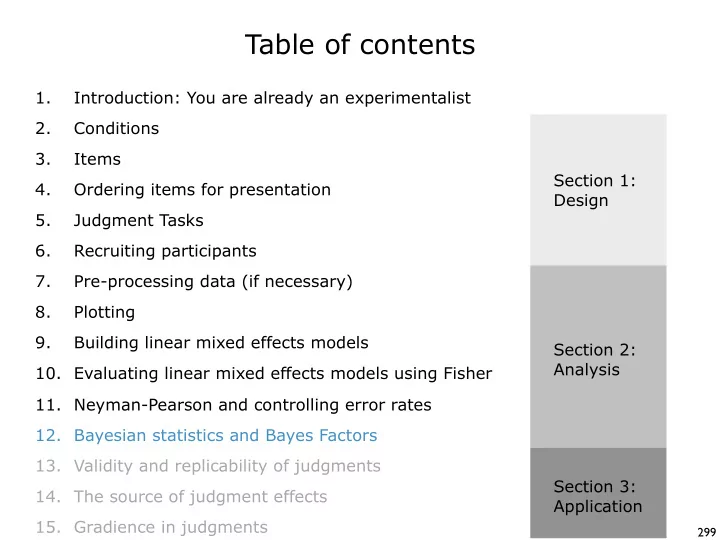
SLIDE 1 Table of contents
299
Conditions Items Ordering items for presentation Judgment Tasks Recruiting participants Pre-processing data (if necessary) Introduction: You are already an experimentalist 1. 2. 3. 4. 5. 6. 7. Plotting 8. Building linear mixed effects models 9. Evaluating linear mixed effects models using Fisher 10. Bayesian statistics and Bayes Factors 12. Validity and replicability of judgments 13. The source of judgment effects 14. Gradience in judgments 15. Section 1: Design Section 2: Analysis Section 3: Application Neyman-Pearson and controlling error rates 11.
SLIDE 2
Bayes Theorem
SLIDE 3 Probability Basics
A mathematical statement about how likely an event is to
- ccur. It takes a value between 0 and 1, where 0 means the
event will never occur, and 1 means the event is certain to
- ccur. (You can also think of it as a percentage 0% to 100%)
Probability: Here is an example: 2 3 4 5 6 7 8 9 10 J Q K A
♠
- ♣
- ♦
- ♥
- Let’s say you have a standard deck of cards. Cards have values and suits.
There are 13 values and 4 suits, leading to 52 cards: Let’s say you pull a card at random from the deck. What is the probability of drawing a Jack?
SLIDE 4 Probability Basics
2 3 4 5 6 7 8 9 10 J Q K A
♠
- ♣
- ♦
- ♥
- There are 52 possible cards. 4 of them are Jacks. So the probability of drawing
a Jack is: number of events you care about total number of events = 4 52
≅ .08
And what is the probability of drawing a heart? P(♥) = number of events you care about total number of events = 13 52 .25 = P(J) = This means “probability of J”
SLIDE 5 Conditional Probability
2 3 4 5 6 7 8 9 10 J Q K A
♠
- ♣
- ♦
- ♥
- The probability of an event given that another event has
- ccurred.
Conditional Probability: Let’s say you draw a card, but can’t see it. Your friend tells you it is a heart. What is the probability that it is a Jack? This is a conditional probability. It is asking what the probability of a Jack is given that the card is a heart. number of events that are both Jack and heart number of heart events = 1 13 P(J | ♥) = The pipe symbol means “given that”
SLIDE 6 Conditional Probability
The probability of an event given that another event has
Conditional Probability: P(B|A) = P(A and B) P(A) Probability(Event) =
total possible outcomes Notice that the format is very similar to the general probability equation that we’ve already seen: The difference is that the denominator is not all possible outcomes, but just the outcomes that have the first event (A). This is the mathematical way of saying that we are restricting our attention to just the A outcomes, and then looking for a specific event that is a subset of A outcomes.
SLIDE 7 Reversing the order makes a difference!
2 3 4 5 6 7 8 9 10 J Q K A
♠
- ♣
- ♦
- ♥
- Notice that we can ask two different questions about Jacks and hearts:
P(J | ♥) = 1 13 What is the probability of a Jack given that the card is a heart? What is the probability of a heart given that the card is a Jack? P(♥ | J) = 1 4
SLIDE 8
Reversing the order makes a difference!
What is the probability of being a movie star given that you live in LA? number of movie stars in LA number of people that live in LA = 250? ~4,000,000 = very low! What is the probability of living in LA given that you are a movie star? number of movie stars in LA number of movie stars = 250? ~300 = very high!
SLIDE 9
Reversing the order makes a difference!
What is the probability of being a dark wizard given that are in slytherin? number of dark wizards from Slytherin number of students from slytherin = 30? 5,000? = fairly low! What is the probability of being from Slytherin given that you are a dark wizard? number of dark wizards from Slytherin number of dark wizards = 30? 30? = very high!
SLIDE 10 Bayes Theorem states the relationship between inverse conditional probabilities
Even though the two directions of the probabilities are not identical, Bayes Theorem tells us that they are related to each other: P(J|♥) P(♥|J) = x P(J) P(♥) Since we already have these numbers, we can verify this pretty easily: 2 3 4 5 6 7 8 9 10 J Q K A
♠
x 1 13 1 4 4 52 13 52 = x 1 4 1 13 1 4 Bayes Theorem
SLIDE 11 Bayes Theorem, general form
P(B|A) P(A|B) = * P(B) P(A) Bayes Theorem: Historical Note: Thomas Bayes (1701-1761) was a minister in England who was the first to use the rules
- f probability to show us this relationship. It is now
called Bayes’ Theorem in his honor. I know it seems like I pulled this equation out of thin air, but it is actually a very simple (algebraic) consequence of the definition of conditional probabilities.
SLIDE 12 Deriving Bayes Theorem
Here is the derivation of Bayes Theorem. As you can see, it is actually fairly
- simple. (The real work is in calculating the different components when you
want to use it.) P(B|A) = P(A and B) P(A)
- 1. Definition of conditional probability:
Algebra - multiply by denominator: P(B|A)*P(A) = P(A and B) P(A|B) = P(A and B) P(B)
- 2. Definition of conditional probability:
Algebra - multiply by denominator: P(A|B)*P(B) = P(A and B)
- 3. Set 1 and 2 equal to each other:
P(B|A)*P(A) = P(A|B)*P(B) P(B|A) P(A|B) = * P(B) P(A) Algebra - divide by P(A):
SLIDE 13
Some philosophy
SLIDE 14 Two approaches to probability
Philosophically speaking, there are two ways of thinking about probabilities. People disagree about labels for these, but two common ones are objective and subjective. Roughly speaking, objective probabilities are descriptions of the lack of predictability that is inherent in some events, like flipping a coin. This unpredictability can be measured with real-world observations. Objective probabilities can be thought of as long-run relative frequencies. If you were to repeat the event over and over, probability is the proportion that you would get.
1 5 10 50 500 Number of Flips 0.0 0.2 0.4 0.6 0.8 1.0 Proportion Heads
Here is a plot of coin flips over time (run four times). As you can see, objective probabilities don’t tell you anything about individual events, but over time, the proportion becomes .5
SLIDE 15 Two approaches to probability
Roughly speaking, subjective probabilities are descriptions of our uncertainty
- f knowledge about an event. We use subjective probabilities when we say
“there is a 10% chance of rain tomorrow”. This is not about long-run relative
- frequency. We aren’t going to repeat the event each day to see if it rains 10%
- f the time. Instead, we are talking about the strength of our beliefs in an
event. NHST approaches to statistics (Fisher and Neyman-Pearson) are (mostly) aligned with the objective approach to probability. The probabilities that we calculate are the hypothetical proportions that we would obtain if we actually ran the experiments over and over again. They are intended to be interpreted as long-run relative frequencies. This is why people call NHST approaches to statistics frequentist. The probabilities are related to objective frequencies. Bayesian statistics are aligned with the subjective approach to probability. The probabilities in Bayesian statistics are not intended to be interpreted as long-run relative frequencies. For Bayesians, it makes no sense to talk about hypothetical repeated experiments. There is one experiment, and we want to know how strong our beliefs should be in different theories (similar to the example about rain).
SLIDE 16
Bayes Theorem for Science
SLIDE 17
Bayes Theorem for science
We can use Bayes Theorem to tell us how strongly we should believe in a hypothesis given the data that we observed. P(hypothesis | data) P(data | hypothesis) = x P(hypothesis) P(data) likelihood prior posterior evidence The idea here is that you have a prior belief about a hypothesis (the prior probability). Then you get some evidence (data) from an experiment. Bayes Theorem tells you how to update your beliefs using that evidence. Your updated beliefs are then called your posterior beliefs, or posterior probability.
SLIDE 18
A real world example
100% of people with HIV will test positive using an HIV test. Medical tests are a classic example of trying to prove a theory (that you have a disease) with positive evidence (that you have symptoms of the disease). This example is about updating beliefs. Prior to the test, you have beliefs about being HIV positive. After the test, you have more evidence, and need to update those beliefs. The question is what the new beliefs should be. Most people, and an unfortunately large number of doctors, will say 98.5%. But this is wrong! To really calculate the probability of our theory, we need to use Bayes Theorem to calculate the posterior probability! Let’s use HIV tests as an example. 1.5% of people without HIV will also test positive using an HIV test. Let’s say someone goes to the doctor to take an HIV test, and the result comes back positive. What is the probability that they have HIV?
SLIDE 19 Bayes Theorem and Medical Tests
P(having HIV | a positive test) = P(a positive test | having HIV) x P(having HIV) P(a positive test) This is what we want to know This is how good the test is when the disease is present. For HIV, it is 100% or 1. This is the likelihood
US, period. It is 0.35% or .0035. People often ignore this number! This is a tricky number to calculate. It is the total likelihood of getting a positive result, whether you have HIV or not. You add up all of the true positives (0.35%) and all of the false positives (1.5% of the 99.65% of the population that doesn’t have HIV). For HIV, this total is 1.84% or .0184.
SLIDE 20
Plugging in the numbers
P(having HIV | a positive test) = 1 x .0035 .0184 The probability that any random person in the US has HIV is 0.35%. P(having HIV | a positive test) = .19 = 19% Given the numbers that I gave you (which are fairly accurate), we see that a positive HIV test means that the probability of having HIV increases from 0.35% to 19%. So we update our beliefs from .35% to 19%. This is not great news, but it is a far cry from the 98.5% that many people (and some doctors) believe when they hear about a positive HIV test.
SLIDE 21 A fun example: the Monty Hall problem
1 2 3 There was a gameshow in the 70s hosted by Monty Hall that had a game as
- follows. There are 3 doors. One has money behind it, the other two have
goats. The contestant picks door number 1. Monty then opens door 2, and shows them a goat. He then offers them a choice: keep their door, or switch to door
- 3. What should they do? The question is about conditional probabilities. What
is the probability that the money is behind door 1 given that Monty showed us a goat behind door 2? And what is the probability that the money is behind 3? 1 3 contestant’s door
SLIDE 22
The Bayes solution
P(prize 1 | open 2) P(open 2 | prize 1) = x P(prize 1) P(open 2) We want to calculate two conditional probabilities: P(prize 3 | open 2) P(open 2 | prize 3) = x P(prize 3) P(open 2) 1 3 1 3 $$$ $$$
SLIDE 23
The first conditional probability
P(prize 1 | open 2) P(open 2 | prize 1) = x P(prize 1) P(open 2) 1 3 $$$ P(prize 1) This is 1/3. There are 3 doors, and the TV show could choose any of them. The starting probability (prior probability) for each door is 1/3. P(open 2 | prize 1) This is 1/2. If the prize is behind door 1, then Monty can choose either door 2 or door 3. P(open 2) This is the tricky one. The answer is 1/2, but I need the entire next slide to show you how we get that.
SLIDE 24 Calculating p(open 2)
If the prize is behind door 1, the probability of
The tricky for calculating the evidence is that you have to consider every possible theory (prize 1, prize 2, prize 3), and calculate the probability of the data (open 2) under each theory.
1 2 3
$$$
1 2 3
$$$
If the prize is behind door 2, the probability of
- pening 2 is 0. Monty can’t open that door.
1 2 3
$$$
If the prize is behind door 3, the probability of
- pening 2 is 1. Monty can’t open door 1 because the
contestant chose it. He can’t open 3 because it has the prize. So he has to choose door 2. There are 3 theories, each with a prior probability of 1/3. So we multiply each
- f the answers above by 1/3 and add them up:
(1/3 x 1/2) + (1/3 x 0) + (1/3 x 1) = 1/2 P(open 2) =
SLIDE 25
The first conditional probability
P(prize 1 | open 2) P(open 2 | prize 1) = x P(prize 1) P(open 2) 1 3 $$$ P(prize 1 | open 2) 1/2 = x 1/3 1/2 P(prize 1 | open 2) = 1/3 We can actually take a shortcut now. Since the prize has be behind door 1 or door 3, and we know door 1 is 1/3, that means that door 3 must be 2/3! But let’s do the calculation anyway.
SLIDE 26
The second conditional probability
1 3 $$$ P(prize 3) This is 1/3. There are 3 doors, and the TV show could choose any of them. The starting probability (prior probability) for each door is 1/3. P(open 2 | prize 3) This is 1. Monty can’t choose 1 because the contestant chose it. He can’t choose 3 because it has the prize. He has to choose 2 P(open 2) We already know that this is 1/2. P(prize 3 | open 2) P(open 2 | prize 3) = x P(prize 3) P(open 2)
SLIDE 27
The second conditional probability
1 3 $$$ P(prize 3 | open 2) P(open 2 | prize 3) = x P(prize 3) P(open 2) P(prize 3| open 2) 1 = x 1/3 1/2 P(prize 3 | open 2) = 2/3 This is exactly what we calculated with our shortcut. So we can see that Bayes Theorem really works.
SLIDE 28 The Monty Hall problem
1 2 3 When we begin the gameshow, each door has the same probability of having a prize. But once Monty chooses a door, he is actually (perhaps unintentionally) giving us more information with which to update our beliefs. We can use Bayes Theorem to figure out how to update our beliefs. 1 3 contestant’s door 1/3 1/3 1/3 1/3 2/3 Bayes Theorem tells us that we should switch doors. If we switch, we’ll win 2/3
- f the time. If we stay, we’ll only win 1/3 of the time.
SLIDE 29 Bayesian updating is NOT intuitive
1 2 3 In 1990, a reader asked columnist Marilyn vos Savant to solve Monty Hall’s
- problem. She did, correctly (using logic rather than Bayes Theorem):
But people didn’t believe her. The problem is that the result is not intuitive. With two choices left, many people believe that the answer is 1/2 for both door 1 and door 3. 1 3 1/3 1/3 1/3 1/3 2/3 You can read some of the responses that people wrote to her answer. The embarrassing thing is that a number of them were academics/math teachers. http://marilynvossavant.com/game-show-problem/ Today, we can run simulations to prove this. The script monty.hall.r contains a simulation to show you that the answer is 1/3 and 2/3, not 1/2 and 1/2.
SLIDE 30 Bayesian Statistics
Doing full Bayesian statistics can be very complicated, because some of the components of Bayes Theorem are difficult to calculate for real-world scientific hypotheses. P(hypothesis | data) P(data | hypothesis) = x P(hypothesis) P(data) Kruschke’s Doing Bayesian Data Analysis is a great
- ne-stop shop for beginning Bayesian statistics. It has a
gentle introduction to probability and Bayes, and even
- rganizes Bayesian models around the NHST tests that
they are most like. It is a great way to transition, but it makes it clear that Bayesian statistics is more about modeling than about creating statistical tests. This is why Bayesian analysis is very common in the computational modeling world (where they develop tools to estimate complex probabilities), but less common in the experimental world.
SLIDE 31
Bayes Factors
SLIDE 32
Bayes Factors
Because full Bayesian statistics can be very complicated, some statisticians have suggested that experimentalists could use Bayes Factors to do a Bayesian analysis without having to become computational modelers. Bayes Factors are the ratio of the probability of the data under one hypothesis to the probability of the data under a second hypothesis. Typically, the two hypotheses are the experimental hypothesis (H1) and the null hypothesis (H0), though they could be any hypothesis that you want: P(data | H1) P(data | H0) You can setup the ratio in whichever direction is most convenient for your question (do you care more about H1, or more about H0): Bayes Factor1,0 = P(data | H0) P(data | H1) Bayes Factor0,1 =
SLIDE 33
Interpreting Bayes Factors
Bayes Factors are a ratio, so they will range from 0 to infinity. For example, a BF1,0 of 3 means that the data is 3x more likely under H1 than H0. Jeffries (1939/1961) suggested some rules of thumb for interpreting Bayes Factors. P(data | H1) P(data | H0) BF1,0 = P(data | H0) P(data | H1) BF0,1 =
BF Evidence 0 to .01 extreme for H0 .01 to .1 strong for H0 .1 to .33 substantial for H0 .33 to 1 anecdotal for H0 1 to 3 anecdotal for H1 3 to 10 substantial for H1 10 to 100 strong for H1 100 to ∞ extreme for H1 BF Evidence 0 to .01 extreme for H1 .01 to .1 strong for H1 .1 to .33 substantial for H1 .33 to 1 anecdotal for H1 1 to 3 anecdotal for H0 3 to 10 substantial for H0 10 to 100 strong for H0 100 to ∞ extreme for H0
SLIDE 34 Deriving Bayes Factors from Bayes Theorem
Bayes Factors come directly from Bayes theorem. The basic idea is to setup a ratio between two tokens of Bayes theorem - one for H1 and one for H0: P(H1 | data) P(data | H1) = x P(H1) P(data) P(H0 | data) P(data | H0) = x P(H0) P(data) This is the ratio of the probability of H1 to H0. In
- ther words, this would tell
us how much more likely H1 is than H0. That would be really useful, but it is difficult to calculate. Then we can simplify: P(H1 | data) P(data | H1) = x P(H1) P(data) P(H0 | data) x P(data | H0) x P(H0) P(data) P(H1 | data) P(data | H1) = P(H0 | data) x P(data | H0) P(H0) P(H1)
SLIDE 35
Deriving Bayes Factors from Bayes Theorem
P(H1 | data) P(data | H1) = P(H0 | data) x P(data | H0) P(H0) P(H1) Bayes Factor Prior Odds Posterior Odds One neat thing about seeing how Bayes Factors are derived is that you can see how useful they can be. They are useful on their own. They tell you the (odds) ratio of the data under the two hypotheses. They are also useful in combination with the priors. If you know the prior odds (the ratio of the two priors to each other), then BFs tell you how to update those priors into posteriors! For example, a BF of 10 tells you that you should multiple your prior odds by 10 to get your posterior odds. So, if you thought H1 was 2 times more like than H0, a BF of 10 tells you to update this to 20x more likely!
SLIDE 36 Using Bayes Factors
There are two practical reasons to use Bayes Factors over full Bayesian models.
- 1. Bayes Factors don’t require priors.
Jeff Rouder and colleagues have developed an R package that will calculate (simplified) BFs for you for a number of standard designs in experimental
- psychology. It is as easy as any test in R.
Prior probabilities are often very subjective. They are simply how likely you think a theory is. Different scientists will disagree on the priors for any given
- hypothesis. Bayes Factors sidestep this issue by sidestepping priors. They
simply tell you how to update your priors based on the evidence.
- 2. Bayes Factors are very easy to calculate under certain assumptions
If you are willing to grant some simplifying assumptions, BFs are much easier to calculate than full Bayesian models. The BayesFactor R package and accompanying blog at bayesfactor.blogspot.org
SLIDE 37 Why the excitement?
335
One reason that so many people are excited about Bayesian statistics is that it appears to give us (scientists) the information that we really want. We want to know how likely a theory is to be true based on the evidence we
- have. That is what Bayes promises us.
This is in stark contrast to NHST, which gives the probability of the data assuming the uninteresting theory is true. It is only through logical acrobatics (Fisher’s distjunction, or hypothetical infinite experiments) that we can convert that into something usable. P(experimental hypothesis | data) P(data | null hypothesis) Bayesian statistics: NHST: Bayesian statistics also overcomes some other limitations of NHST, such as not being able to test the null hypothesis directly (for Bayes, it is just another hypothesis), and not being able to peak at the data without increasing Type I errors (it is called the optional stopping problem; for Bayes, data is data). There is no space to cover these here, but I want to mention them so you can search for them.
SLIDE 38 Where to find more about Bayes
336
Kruschke’s Doing Bayesian Data Analysis is a great
- ne-stop shop for beginning Bayesian statistics. It has a
gentle introduction to probability and Bayes, and even
- rganizes Bayesian models around the NHST tests that
they are most like. It is a great way to transition, but it makes it clear that Bayesian statistics is more about modeling than about creating statistical tests. The BayesFactor R package and accompanying blog at bayesfactor.blogspot.org Bayes factors are a way of deriving a measure of strength of evidence without the complexity of building a complete Bayesian model (to be clear, a complete model is built in the background, using various assumptions that you should be aware of, but the creators of the package did the work for you). A Bayes factor is an odds ratio. It tells you how much more likely the observed data is under one hypothesis compared to another. For example, a Bayes factor of 10 says that the data is 10x more likely under the experimental hypothesis than the null hypothesis. This is an interesting piece of information to have, and it is easy to calculate for most designs using the BayesFactor R package.
SLIDE 39
Comparing Frequentist and Bayesian statistics
SLIDE 40 Subjectivity, Subjectivity, and the Null
The comparison of frequentist and Bayesian stats is a large and complex topic. I can’t do it justice here, but I can mention three major differences:
- 1. The philosophy of probability
As previously mentioned, frequentists are more closely aligned with objective probability, and Bayesians are aligned with subjective probability.
- 2. The “subjectivity” of the calculation
Fisher explicitly developed his NHST in response to Bayesian statistics! He thought the specification of priors was too “subjective”, so he focused on the likelihood, which he found to be more “objective”. P(hypothesis | data) P(data | hypothesis) = x P(hypothesis) P(data)
NHST can’t make any claims about the null hypothesis, because it is assumed to be true. Bayesian stats can “prove the null”. It is simply another hypothesis.