
SLIDE 1
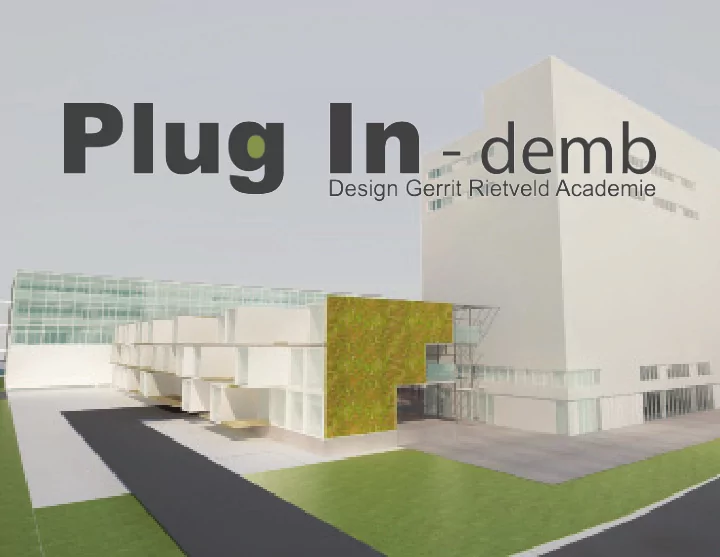
TABLE OF CONTENT VISION NESTING => connect ing => provide - - PowerPoint PPT Presentation
CONCEPT SUSTAINABILITY RESILIENT ACCOMODATION URBAN DEVELOPMENT CHARACTER FUNCTIONALITY SUSTAINABLE PRINCIPLE FUTURE PROOF ENGINEERING DRAWINGS TECHNICAL INSTALLATION MATERIALIZATION ARCHITECTURAL FEASIBILITY FINANCIAL FEASIBILITY COST
PLUG IN – demb Resilience; a strategy for future proof engineering? Our concept is based on a strategy of resilience. Awareness arose that the specifjcatjons for the ad- ditjonal space to be built are based on assumptjons and predictjons made for the future. These assumptjons and predictjons are under infmuence of the politjcal, economical, sociocultural and even technological developments. It was Steward Brand who noted ‘all buildings are predic- tjons, and all predictjons are wrong’ (How Buildings Learn, 2001). Therefore it might not be the most logical to build the 3500 m2 directly as specifjed, but instead build a minimal critjcal structure with adaptjve capacity. In our concept it is a structure that holds the possibility to make extensions by means of plug-ins (e.g. Le Corbusier; unite d’habitatjon). In case more volume is required plug-ins can be added to the
nario is that the demand for space decreases. When this happens the plugins can be removed and the volume can shrink to the minimal critjcal threshold. This minimum critjcal threshold will accom- modate all the basic needs. The designed structure forms a physical connector between the two existjng buildings and func- tjons itself as a hub and meetjng place. It is designed to fjt as much sustainable features as possible; ranging from green facade to grey water circuit (recycled water for fmushing toilets), a waste disposal and recycle area. All of these components are laid out to have an as small as possible carbon foot-
concrete foundatjon.
Depart ment s GRA Expo Project spaces
Wood WS Met al WS CAD / CAM St aff At eliers Cant ine Audit orium Depart ment s SI Depart ment s GRA Recycle/ wast e direct ory Mat erial loading/ unloading
The at t ained knowledge and gained experience changes over t ime depending on t he rout e t he st u- dent t akes. We will focus on t he st imulat ion of use of t he space and creat ion of t he niche on t wo lev- els: by creat ing an adapt able const ruct ion and opening up t he exist ing spaces. Flexibly deployable depart ment specific furnit ure will act as a mediat ing inst rument t o creat e more cross-influence and reference in t he academy. The base or st art ing point for our design concept is t hat we want t o creat e a sort of nest , based on t he idea of nest ing. This met aphorical nest brings people (st udent s, t eachers, counselors, et c.) and also provides t hem t oget her also (part ially) shelt er t o out side influences. The st udent s are nurt ured and encouraged t o spread t heir wings and on t he edge of t he nest t o look and event ually t heir wings and leave t he nest . We find t hat a t ruly flexible space (niche) is a concept t hat adapt s t o t he sit uat ion and not vice versa. Wit h open spaces and clust ering of depart ment s we would like t o enhance t he cross-influence t hat can occur bet ween depart ment s and dicisplines. The space will t herefore be able t o open up and quickly t ransform a niche. Using open spaces wit h deployable furnit ure has an advant age as t he avail- able space is ut ilized by a larger group of people. To define clearly know what we want and t hat are needed by a design quest ion or assignment t owards t he users. Among ot hers, we will gain advice on t hese issues at t he core t eam and a survey wit hin t he academy. Wit h t he new open layout smaller cores for t he depart ment s are creat ed t o have personal cont act and exchange of informat ion. In addit ion, t here will be various sizes of workspaces ranging from a unit on wheels t o bigger project areas. The unit s we like t he st udent t o make and cust om t oget her wit h t he depart ment . They should be unique t o each depart ment . Here t he depart ment will be cont act ed for reflect ion. We see t he st udent s but also t eachers and all st aff and enabling users of t he archit ect ural st ruct ure
everyone and t o be flexible, since one user t o use different circumst ances t han t he ot her user. The pict ure here is t hat spaces are flexible and t hat (physical) boundaries bet ween depart ment s are limit ed. However, t his should also be t aken int o account t hat some users may just want t o be t oo isolat ed from t he rest . Flexible spaces wit hin t his provision must be made. The end result will not be a work of art t hat should be imposed t o t he users, but t o serve as a t ool deployable infrast ruct ure. For t his very reason it is import ant t hat users are closely involved in t he implement at ion of t his flexibilit y.
Technical installation BC
Possibilities of connection technical installations BC and new building: 1) Roof level of new building 2) Bridge at 1 floor 3) Underneath ground level, via basement Front view from Fred Roeskestraat (facing north)
parking basement (new)
Possibilities of connection technical installations GRAC and new building: 1) Roof level of new building and 1 floor 2) 1 floor 3) Underneath ground level, via basement *) GRAC tech.installation GRAC is spread over 3 locations Side view from Loyens & Loeff (facing east)
glass beton steel green wood
Financial- and process manager / project developer
Financial feasibility The feasibility whether the “Plug-in” building can be achieved for the available budget of EUR 1,300 p/m2 was briefmy investjgated by Ir. E.D. (Elsert) Sikma. (Financial- and processmanager / project manager) The design of the building is not yet fully developed so that the feasibility can be determined only in an
structjon of the building and facilitjes for the “hanging” of the containers and the realizatjon of the contain- ers themselves need to be further developed. The constructjon costs of a regular school building range from EUR 1,200 to EUR 1,400 p/m2 gross fmoor area (excluding VAT and fees of consultants, including market-based cost-tail) (source Archidat). The available budget therefore corresponds to the constructjon costs for similar propertjes. The questjon is whether the constructjon cost of the plug-in building difger from a regular school building, yet it is not expected that the design is expensive to realize. First, the containers or an alternatjve form of are relatjvely inexpensive to acquire and rebuild. “Sea Contain- ers” are cheap to buy second hand (only EUR 1,200). Implementatjon costs are low because a container can be converted on site at the workplace of a constructjon company. This can be carried out effjciently per- mittjng all available equipment and tools and without external (weather) infmuences. The preparatjon and implementatjon will be further boosted by the standardizatjon of the basic design of the containers, such as fmoor, wall and ceiling fjnishes, equipment, window cutouts, etc. The cost for the basic constructjon of the hall with the glass facade and roof are expected in a cost compara- ble to a ‘standard’ constructjon. Additjonal costs may arise in the constructjon required by the suspension of the containers and the necessary facilitjes for containers to connect tjghtly to the building. The suspension
structure so that the additjonal costs are relatjvely limited. Provisions for connectjon to the building have yet to be clarifjed. Again the expectatjon is that by fjnding a standard will not lead to very high costs.
Original Dutch text: De haalbaarheid of het “Plug-in” building kan worden gerealiseerd voor het beschikbare budget van EUR 1.300 p/m2 is kort onderzocht. (Financieel- en procesmanagement van vastgoed- en gebiedsontwikkelingen). Het ontwerp van het gebouw is nog niet volledig uitgewerkt waardoor de haalbaarheid slechts op hoofdlijnen kan worden bepaald. Belangrijke invloedfactoren op de kostprijs dienen nog te worden bepaald en/of nader te worden onderzocht. Zo is de constructje van het gebouw nog niet doorgerekend en dient de constructje en voorzieningen voor het ‘inhangen’ van de containers en de realisatje van de containers zelf nog verder te worden uitgewerkt. De bouwkosten van een regulier onderwijsgebouw variëren tussen de EUR 1.200 tot EUR 1.400 p/m2 BVO (ex. BTW en honoraria van adviseurs, inclusief marktconforme staartkosten) (bron Archidat). Het beschik- bare budget komt dus overeen met de bouwkosten voor vergelijkbare objecten. De vraag is in hoeverre de bouwkosten van het ‘plug-in’ building afwijken van een ‘regulier onderwijsgebouw’, vooralsnog is het niet de verwachtjng dat het ontwerp kostbaar is om te realiseren. In de eerste plaats zijn de containers of een alternatjeve vorm relatjef goedkoop om te bouwen. ‘Zeecontain- ers’ zijn tweedehands goedkoop in aanschaf (slechts EUR 1.200). De uitvoeringskosten zijn laag doordat con- tainers op locatje (werkplaats van een bouwbedrijf) kunnen worden omgebouwd. Dit kan dan effjciënt (met al het beschikbare materieel en gereedschappen) en zonder externe (weer)invloeden worden uitgevoerd. De uitvoeringskosten en voorbereidingskosten worden verder positjef beïnvloed door de standaardisering van de basisinrichtjng van de containers, zoals vloer-wand en plafondafwerking, installatjes, raamuitsparingen etc. De kosten voor de basisconstructje van de hal met de glazengevel en -dak zullen naar verwachtjng qua kostprijs vergelijkbaar zijn met een ‘standaard’ constructje. Meerkosten in de constructje ontstaan mogelijk door het benodigde ophangsysteem van de containers en de benodigde voorzieningen om de containers goed aan het gebouw aan te sluiten. Het ophangsysteem met IPE-liggers is relatjef eenvoudig vormgegeven en daardoor eenvoudig te realiseren. Dit kan mogelijk goed in de constructje worden geïntegreerd waardoor de meerkosten relatjef beperkt blijven. De voorzieningen voor de aansluitjng op het gebouw dienen nog nader te worden uitgewerkt. Ook hiervoor geldt de verwachtjng dat dat door het vinden van één standaardoplossing dit niet tot zeer hoge kosten zal leiden.
Bouwdeel lengte Breedte Area Verdiepingen Area totaal Module Aantal Totaal Module Aantal Totaal Module Aantal Totaal m2 m m 1 containergebouw 3 23 69 3 3 9 9 69 621 3 1863 2 voorzone 3 23 69 3 1 3 9 23 207 4 828 3 atrium 3 23 69 3 1 3 9 23 207 5 1035 3726
Directe bouwkosten Parkeergarage bovengronds Citadel - drijvende containers Rietveld 3 verd 3 verd 3 verd prijs m2 prijs/m2 % prijs m2 prijs/m2 % prijs m2 prijs/m2 % Fundering € 400,000.00 7800 € 51.28 14% € 1,030,000.00 9000 € 114.44 4% € 300,000.00 2500 € 120.00 9% Constructie € 1,200,000.00 7800 € 153.85 42% € 7,000,000.00 9000 € 777.78 27% € 1,400,000.00 2500 € 560.00 42% Installatie € 500,000.00 7800 € 64.10 17% € 3,000,000.00 9000 € 333.33 12% € 600,000.00 2500 € 240.00 18% Bouwkunde gevels/wanden € 0.00 7800 € 0.00 0% € 11,000,000.00 9000 € 1,222.22 42% € 800,000.00 2500 € 320.00 24% Bouwkunde algemeen € 780,000.00 7800 € 100.00 27% € 4,000,000.00 9000 € 444.44 15% € 250,000.00 2500 € 100.00 7% Atrium € 0.00 2500 € 0.00 0% Bouwkundige kosten € 2,880,000.00 7800 € 369.23 100% € 26,030,000.00 9000 € 2,892.22 100% € 3,350,000.00 2500 € 1,340.00 100% 20% bijkomende kosten € 3,456,000.00 7800 € 443.08 € 31,236,000.00 9000 € 3,470.67 € 4,020,000.00 2500 € 1,608.00 Budget € 4,550,000.00 3500 1300 resterend bedrag € 530,000.00
€ 530,000.00 100 € 5,300.00 per stuk
€ 530,000.00 100 xxx per stuk
The other sustainability aspects are not really creatjve ideas, but more sustainable optjons. Ofuen this pay- back tjmes and linked with a suffjciently short period applied (PV cells). My experience is as follows:
systems in atrium example, it is much more efgectjve
relatjvely small and therefore less interestjng.
Original Dutch text De andere duurzaamheidsaspecten zijn niet echt creatjeve ideeën, maar meer duurzame optjes. Vaak worden hier terugverdientjjden aan gekoppeld en bij voldoende korte tjjd toegepast (PV cellen). Mijn ervaring is als volgt:
systemen bijv in atrium, dat is veel efgectjever
school lijkt mij relatjef beperkt en daardoor minder interessant.