
SLIDE 1
1
Physics Potential
- f the
Advanced Scintillation Detector Concept
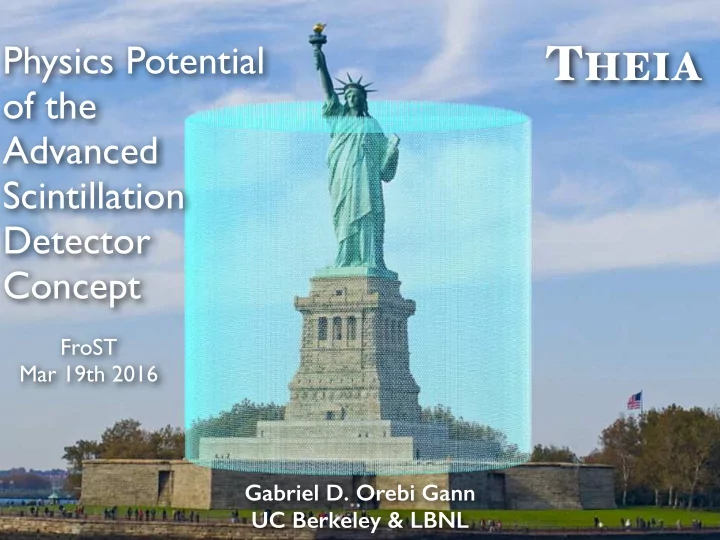
FroST Mar 19th 2016 Gabriel D. Orebi Gann UC Berkeley & LBNL
T ransformational Opportunity High-intensity, long-baseline beam - - PowerPoint PPT Presentation
Physics Potential T HEIA of the Advanced Scintillation Detector Concept FroST Mar 19th 2016 Gabriel D. Orebi Gann UC Berkeley & LBNL 1 Physics Potential T HEIA of the Advanced Scintillation Detector Concept FroST Mar 19th 2016
1
FroST Mar 19th 2016 Gabriel D. Orebi Gann UC Berkeley & LBNL
2
FroST Mar 19th 2016 Gabriel D. Orebi Gann UC Berkeley & LBNL
3
High-intensity, long-baseline beam aimed at deep underground lab
ν
Fully-equipped, deep underground lab
Investment in LBNF facility makes possible a broad program Should be fully exploited What other physics can we do here?
ν
World-class facility (soon to be) open for business!
4
5
Already demonstrated at 1–50 kt-scale (SNO, SuperK)
SNO D2O
6
7
Already demonstrated at kt-scale (KL, Borexino)
Energy (keV) Borexino Nature article
(2011) 685-732
Low Energy Neutrino Astronomy
8
House light-producing target inside large monolithic detector Novel, breakthrough target medium
9
House light-producing target inside large monolithic detector Novel, breakthrough target medium
Water-based liquid scintillator — Minfang
Yeh et al.
10
11
Neutrino Electron Neutrino Electron
12
arXiv:1409.5864
Methods to enhance separation:
(LAPPDs)
fraction & spectrum (fluor)
water-based LS fast Cherenkov component slow scintillation component
1.3ns TTS 0.1ns TTS
See Z. Wang talk for recent results
with high coverage
13
Detector image product of RAT
60m 60m
Concept paper - arXiv:1409.5864
Detector image product of RAT
Concept paper - arXiv:1409.5864
60m 60m
with high coverage
14
Detector image product of RAT
Concept paper - arXiv:1409.5864
60m 60m
with high coverage
15
Detector image product of RAT
Concept paper - arXiv:1409.5864
60m 60m
with high coverage
16
17
Remarkably, the same detector could show that neutrinos and antineutrinos are the same, and that “neutrinos” and “antineutrinos” oscillate differently
Physics over 5
magnitude
Nuclear Physics
18
High- Energy Physics
19
ROI
Asymmetric ROI (-0.5 - 1.5 σ): Background dominated by 8B solar neutrinos!
Builds on critical developments by KLZ & SNO+ collaborations
Phys.Rev.Lett.110 : 062502 (2013); SNO+ white paper (in progress);
50kt detector 50% reduction of 8B Particle ID / coincidence tags for int r/a Rfit > 5.5m from PMTs (30kt fid) 0.5% loading (natTe) in 50kt ➾ 50t 130Te
Projected spectrum in SNO+: 5 years, 0.5% natTe
SNO+ collaboration
➾ 3σ discovery for mββ=15meV in 10 yrs
arXiv:1409.5864
[Chen, Biller, Manecki talks]
20
1996, W.C. Haxton: isotope loading for CC interaction (water) 2000s, M. Yeh et al.: water-based liquid scintillator CC detection in WbLS: high-precision spectral measurement to low energy! ⇒ search for new physics, solar metallicity, MSW effect
“Salty water Cherenkov detectors” W.C. Haxton PRL 76 (1996) 10
arXiv:1409.5864
Spectral Sensitivity (CC)
cosθ⊙< 0.4
30kt fiducial 1% 7Li by mass Conservative 100 pe/MeV Unprecedented low-energy statistics (ES)
Similar to LENA — Astropart. Phys. 35 (2011) 685-732 + directionality from Cherenkov Enabled by use of WbLS (7Li, CC)
[Smy talk]
21
Geo Neutrinos
< 10kt-yr (KL + Borexino)
complementary geographical location
DSNB
[Wurm, Gratta talks]
22
10 kpc (50 kt volume)
Highly complementary to νe-dominated LAr signal
23
Early warning (PR value) [Vagins talk]
24
15% (E) & 50cm (R)
Figs from arXiv:1409.5864
detection
Sub-Chr t/h detection ⇒ Directly visible K+
THEIA DUNE
(reduce bkg in IBD searches)
[Link, Svoboda talks]
Images from arXiv:1204.2295
in the LBNF beam
LArTPC (DUNE)
(arXiv:1204.2295)
25
Production at FNAL 1300km
Ring-imaging of a water Cherenkov detector Particle ID from Cher/scint separation n and low-E hadron detection (low threshold) reduce wrong-sign component (nu vs anti-nu) reduce NC background by detecting π0→γγ Large size ⇾ sensitivity to 2nd oscn max [Worcester talk]
26
Study by E. T. Worcester using same GLOBES package used for ELBNF
All figs from E. Worcester
MH sensitivity for 50kt WbLS alone > 5σ Assumes 75% additional NC rejection (beyond SK-I) ~300 kt-MW-yr exposure (40kt LAr) Performance competitive with 40kt LAr TPC !!
27
Size (kt) Loading Resolution (light yield * coverage) Direction / rings Cleanliness Depth Bag
NLDBD
10 Te, Nd…
Solar
10 Li
Geo
100 Gd
DSNB
50 Gd
Supernova
50 Gd
Nucleon decay
100
Sterile
10
Long baseline
50
Critical Important Nice to have / not important
28
light yield, scattering, quenching, timing
size, depth, photocathode coverage
29
Extensive, exciting R&D program
Fast photon detectors (LAPPDs, MCPs) [M. Wetstein]
30
(Selection of)
WbLS production & development [M. Yeh, L. Bignell] Material compatibility, stability [M. Yeh] Purification [M. Yeh] Isotope loading [M. Yeh,
0.3% 0.5% 1% 3% 5%
PMT development [A. Cabrera, Y. Hotta] Containment Technology [F. Calaprice,
31
Ben Land, Berkeley
32
Ben Land, Berkeley
Site Scale Target Measurements Timescale
UChicago bench top H2O fast photodetectors Exists CHIPS 10 kton electronics, readout, mechanical infrastructure 2019 EGADS 200 ton H2O+Gd isotope loading, fast photodetectors Exists ANNIE 30 ton 2016 WATCHMAN 1 kton 2020 UCLA/MIT 1 ton LS fast photodetectors 2016 Penn 30 L (Wb)LS light yield, timing, loading Exists SNO+ 780 ton 2016 LBNL (CheSS) bench top WbLS signal separation, tracking, reconstruction / light yield, loading, attenuation 2016 BNL 1 ton 2016
33
34
CHIPS WATCHMAN EGADS
Gd loading and purification Water-based liquid scintillator Te loading Neutron yield, LAPPD deployment Infrastructure, underwater integration WbLS, Gd, LAPPD, HQE PMT, full integration prototype
Brookhaven National Laboratory Brunel University University of California, Berkeley University of California, Davis University of California, Irvine University of Chicago Columbia University University of Hawaii at Manoa University of Hamburg Hawaii Pacific University Iowa State University Johannes Gutenberg- University Mainz Lawrence Berkeley National Laboratory Lawrence Livermore National Laboratory Los Alamos National Laboratory University of Maryland MIT University of Pennsylvania Princeton University RWTH Aachen University Sandia National Laboratories TUM, Physik-Department Virginia Polytechnic Inst. & State University University of Washington
35
New participation welcome
contact G. D. Orebi Gann, B. Svoboda, E. Blucher, J. R. Klein
Concept paper - arXiv:1409.5864
36
technology
conventional neutrino physics with rare-event searches in a single detector
adapt to new directions in the scientific program as the field evolves
discovery
37