
Mon-Af-Po1.01-05 1
Design and Fabrication of the 1.9 K Magnet Test Fa- cility at BNL, and Test of the First 4 m-Long MQXF Coil
- J. Muratore, M. Anerella, P. Joshi, P. Kovach, A. Marone, P. Wanderer
Abstract— The future high luminosity upgrade of the Large Had- ron Collider (LHC) at CERN will include twenty 4.2 m-long Nb3Sn high gradient quadrupole magnets which will be compo- nents of the triplets for two LHC insertion regions. In order to test these and four pre-production models, the vertical supercon- ducting magnet test facility of the Superconducting Magnet Divi- sion (SMD) at Brookhaven National Laboratory (BNL) has been upgraded to perform testing in superfluid He at 1.9 K and 1 bar, the operational condition at the LHC. This has involved extensive modification of the 4.5 K cryogenics plant, including piping, compressors, and other upgraded components; a new vertical test cryostat which can accept larger diameter magnets; a modern- ized power supply system upgraded with IGBT switches and fast shutoff capability, and that can supply 24 kA to test high field Nb3Sn magnets; and completely new data acquisition, signal analysis, and control software and hardware, allowing for fast, high precision, large volume data collection. This paper reports
- n the design, assembly, and commissioning of this upgraded test
facility, and presents results of the first magnet test performed. Index Terms—accelerator magnet, superconducting coils, quench protection, test facilities
- I. INTRODUCTION
he future high luminosity (HiLumi) upgrade of LHC at CERN will include twenty 4.2 m-long Nb3Sn high gradi- ent quadrupole magnets which will be components of the Q1 and Q3 triplets for two insertion regions of the LHC. These magnets, denoted as MQXFA, will be supplied by the US Ac- celerator Upgrade Project (AUP), a collaboration of BNL, Fermi National Accelerator Laboratory, and Lawrence Berke- ley National Laboratory. Each magnet will have four two- layer coils wound with 40-strand Nb3Sn Rutherford cable in
- rder to generate the high field gradients necessary for the
LHC HiLumi upgrade. Table I shows required operational pa- rameters for these magnets, which include operating at cur- rents up to 17.89 kA, known as the ultimate current. More in- formation about the MQXFA magnets and the test require- ments can be found in [1], [2]. In order to test these and four pre-production models, the
This work was supported by the U.S. Department of Energy, Office of Sci- ence, Office of High Energy Physics, through the US LHC Accelerator Re- search Program and by the High Luminosity LHC project at CERN. The U.S. Government retains and the publisher, by accepting the article for publication, acknowledges that the U.S. Government retains, a non-exclusive, paid-up, ir- revocable, world-wide license to publish or reproduce the published form of this manuscript, or allow others to do so, for U.S. Government purposes. The authors are with the Superconducting Magnet Division, Brookhaven National Laboratory, Upton, NY 11973 USA (e-mail: Muratore@bnl.gov).
vertical superconducting magnet test facility of the SMD at BNL has been upgraded to perform testing in superfluid He at 1.9 K and 1 bar, the operational condition at the LHC. This has involved extensive modifications of the 40-year old, 4.5 K cryogenics plant and vertical test facility at the SMD. These upgrades include new piping, compressors, and other critical components; a new vertical test cryostat with a top plate and hanging fixture which can accept larger diameter and longer magnets, up to an actual length of 5 m; a 1.9 K heat exchang- er; a newly designed warm bore tube; and a lambda plate de- signed with a novel sealing scheme to provide for both strength and minimum heat loss. In addition, the former short sample cable test facility 30 kA power supply has been up- graded with an energy extraction system using IGBT switches and fast shutoff capability, and new high energy dump resis- tors, and has been reconfigured to supply 24 kA to test high field Nb3Sn magnets. We have also assembled completely new data acquisition, signal analysis, and control software and hardware, allowing for faster, higher precision, and larger volume data collection. This paper describes the design, assembly, and commis- sioning of the upgraded test facility, and reports on the first magnet test performed, on a mirror model, which consists of a single coil quadrant and an iron yoke which fills the space of the other three quadrants. The test facility and its upgrades can be discussed in four general areas: 1) cryogenics facility, 2) vertical test cryostat and magnet fixture, 3) power supply system with quench protection, and 4) data acquisition, con- trol, and analysis hardware and software.
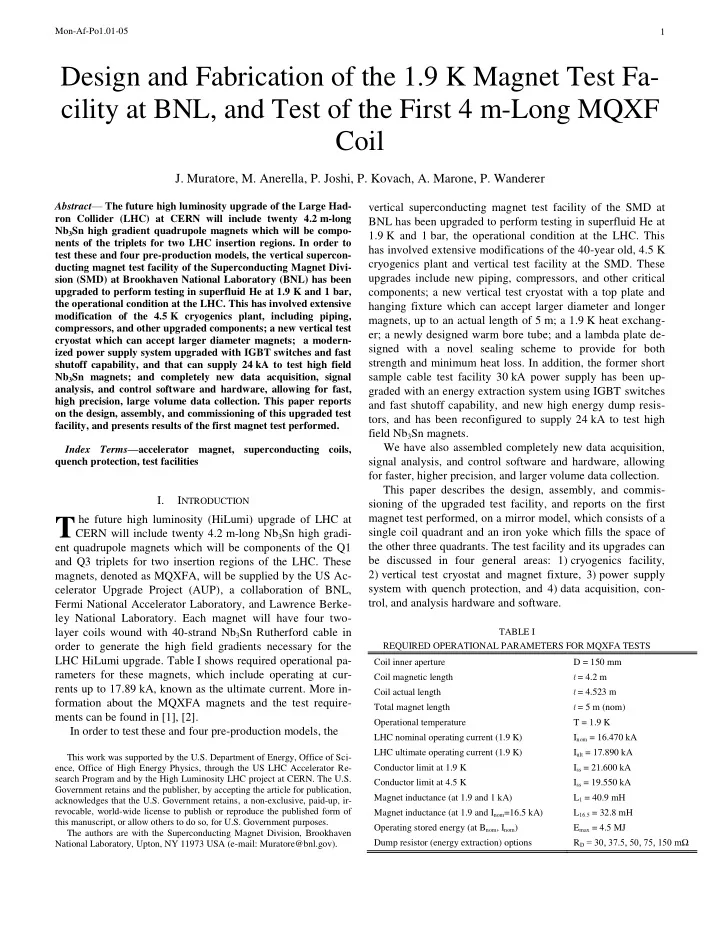
TABLE I REQUIRED OPERATIONAL PARAMETERS FOR MQXFA TESTS Coil inner aperture D = 150 mm Coil magnetic length l = 4.2 m Coil actual length l = 4.523 m Total magnet length l = 5 m (nom) Operational temperature T = 1.9 K LHC nominal operating current (1.9 K) Inom = 16.470 kA LHC ultimate operating current (1.9 K) Iult = 17.890 kA Conductor limit at 1.9 K Iss = 21.600 kA Conductor limit at 4.5 K Iss = 19.550 kA Magnet inductance (at 1.9 and 1 kA) L1 = 40.9 mH Magnet inductance (at 1.9 and Inom=16.5 kA) L16.5 = 32.8 mH Operating stored energy (at Bnom, Inom) Emax = 4.5 MJ Dump resistor (energy extraction) options RD = 30, 37.5, 50, 75, 150 mΩ