T he Filon Simpson Code or : Numerical Integration of Highly - - PowerPoint PPT Presentation

t he filon simpson code or numerical integration of
SMART_READER_LITE
LIVE PREVIEW

T he Filon Simpson Code or : Numerical Integration of Highly - - PowerPoint PPT Presentation

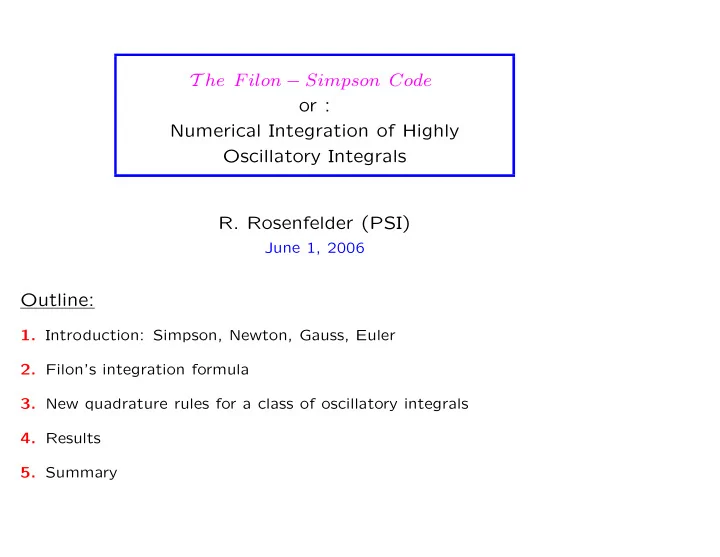
T he Filon Simpson Code or : Numerical Integration of Highly Oscillatory Integrals R. Rosenfelder (PSI) June 1, 2006 Outline: 1. Introduction: Simpson, Newton, Gauss, Euler 2. Filons integration formula 3. New quadrature rules for a


slide-1
SLIDE 1

T he Filon − Simpson Code

  • r :

Numerical Integration of Highly Oscillatory Integrals

  • R. Rosenfelder (PSI)

June 1, 2006

Outline:

  • 1. Introduction: Simpson, Newton, Gauss, Euler
  • 2. Filon’s integration formula
  • 3. New quadrature rules for a class of oscillatory integrals
  • 4. Results
  • 5. Summary
slide-2
SLIDE 2
slide-3
SLIDE 3
  • R. Rosenfelder (PSI) :

T he Filon − Simpson Code 3

  • 1. Introduction: Simpson, Newton, Gauss, Euler

Numerical Integration:

  • ne-dimensional

multidimensional functional ⇓ (aliter ...) (totaliter aliter ...) finite limits infinite limits singularities of integrand

  • scillatory integrands

. . . fixed number of integration points adaptive (automatic) integration

slide-4
SLIDE 4
  • R. Rosenfelder (PSI) :

T he Filon − Simpson Code 4

Some integration rules:

Trapezoidal rule (h = x1 − x0 , fi ≡ f (xi))

x1

x0

dx f(x) = h 2

  • f0 + f1
  • − h3

12f ′′(ξ) , x0 < ξ < x1 Extended trapezoidal rule ( h = xN−x0

N

, x0 < ξ < xN )

xN

x0

dx f(x) = h

1

2f0 + f1 + . . . + fN−1 + 1 2fN

  • − Nh3

12 f ′′(ξ) Simpson’s rule

x2

x0

dx f(x) = h 3

  • f0 + 4f1 + f2
  • − h5

90f (4)(ξ)

slide-5
SLIDE 5
  • R. Rosenfelder (PSI) :

T he Filon − Simpson Code 5

Extended Simpson’s rule

x2N

x0

dx f(x) = h 3

  • f0 + 4 (f1 + f3 + . . . + f2N−1)

+2 (f2 + f4 + . . . + f2N−2) + f2N

  • − Nh5

90 f (4)(ξ) Newton-Cotes formulas (examples) closed type:

x4

x0

dx f(x) = 2h 45

  • 7f0 + 32f1 + 12f2 + 32f3 + 7f4
  • − 8h7

945f (6)(ξ)

  • pen type:

x4

x0

dx f(x) = 4h 3

  • 2f1 − f2 + 2f3
  • − 28h5

90 f (4)(ξ)

slide-6
SLIDE 6
  • R. Rosenfelder (PSI) :

T he Filon − Simpson Code 6

Gauss-Legendre integration

+1

−1

dx f(x) =

N

  • i=1

wi f(xi) + RN with PN(xi) = 0 , wi = 2 [P ′

N(xi)]2

1 − x2

i

RN = 22N+1(N!)2 (2N + 1)[(2N)!]3 f (2N)(ξ) , −1 < ξ < +1 Arbitrary interval: y = b+a

2

+ b−a

2 x

Different weight functions = ⇒ Gauss-Laguerre, Gauss-Hermite etc.

slide-7
SLIDE 7
  • R. Rosenfelder (PSI) :

T he Filon − Simpson Code 7

Euler & tanh sinh-integration

from Borwein et al. : Experimentation in Mathematics: Computational Paths to Discovery (2004) p. 309 “Read Euler, read Euler ! He is the master of all of us” (Laplace) Euler-Maclaurin summation formula

b

a

dx f(x) = h

N

  • i=0

f(a + ih) − h 2 [f(a) + f(b)] −

m

  • j=1

h2jB2j (2j)!

  • f (2j−1)(b) − f (2j−1)(a)
  • + Rm

with Rm = −h2m+2(b − a)B2m+2 (2m + 2)! f (2m+2)(ξ)

slide-8
SLIDE 8
  • R. Rosenfelder (PSI) :

T he Filon − Simpson Code 8

When f(x) and all its derivatives vanish at the endpoints a and b then the error of step-function approximation to integral is Rm for all m − → error goes to zero more rapidly than any power of h ! Achieved by special transformation x = g(t)

+1

−1

dx f(x) =

+∞

−∞

dt g′(t) f(g(t)) = h

+∞

  • j=−∞

wj f(xj) + R with xj = g(jh) and wj = g′(jh) For functions which are analytic in a strip |Im t| < d R = O

  • e−πd/h

Recommended transformation: x = tanh [ λ sinh t ] , t ∈ [−∞, +∞] , λ > 0

slide-9
SLIDE 9
  • R. Rosenfelder (PSI) :

T he Filon − Simpson Code 9

Fast convergence also for |j| → ∞ since wj − → 2λ exp

  • −λ e|j| h

Examples: ( λ = 1) h

π/2

dx sin x

1

0 dx (− ln x)

1

0 dx 1 2√x

1.0000 0.997 818 863 766 531 1.006 175 595 0 1.000 562 2 0.5000 0.999 999 556 735 862 0.999 999 700 1 0.999 999 5 0.2500 1.000 000 000 000 006 0.999 999 998 9 0.999 991 5 0.1250 0.999 999 999 999 999 0.999 999 990 6 0.999 978 2

slide-10
SLIDE 10
  • R. Rosenfelder (PSI) :

T he Filon − Simpson Code 10

  • 2. Filon’s integration formula
  • L. N. G. Filon: “On a quadrature formula for trigonometric integrals”,
  • Proc. Royal Soc. Edinburgh 49 (1928), 38 – 47

x2

x0

dx f(x) cos xy = h

  • α(hy)
  • −f0 sin(x0y) + f2 sin(x2y)
  • + β(hy) 1

2

  • f0 cos(x0y) + f2 cos(x2y)
  • + γ(hy) f1 cos(x1y)
  • + R

with α(Θ) = 1 Θ + sin 2Θ 2Θ2 − 2 sin2 Θ Θ3

Θ→0

− → 2Θ3 45 + . . . β(Θ) = 2

1 + cos2 Θ

Θ2 − sin 2Θ Θ3

  • Θ→0

− → 2 3 + . . . γ(Θ) = 4

  • −cos Θ

Θ2 + sin Θ Θ3

  • Θ→0

− → 4 3 + . . . i.e. for y → 0 : = ⇒ Simpson’s rule, analogous formula for x2

x0 dx f(x) sin xy

slide-11
SLIDE 11
  • R. Rosenfelder (PSI) :

T he Filon − Simpson Code 11

How to derive this formula ? Write

x2

x0

dx f(x) cos xy ≃ w0f0 + w1f1 + w2f2 and require that it is exact for polynomials x0, x1, x2 . = ⇒ system of 3 equations for 3 unknowns

2

  • i=0

wi xk

i

=

x2

x0

dx xk cos(xy) =: Jk , k = 0, 1, 2, elementary integrals ! Result: w0 = 1 2h2 [ x1 x2 J0 − (x1 + x2) J1 + J2 ] w1 = 1 2h2 [ −2x0 x2 J0 + 4 x1 J1 − 2J2 ] w2 = 1 2h2 [ x0 x1 J0 − (x0 + x1) J1 + J2 ]

slide-12
SLIDE 12
  • R. Rosenfelder (PSI) :

T he Filon − Simpson Code 12

Asymptotic behaviour for y → ∞ : exact:

x2

x0

dx f(x) cos(xy) = f(x) sin(xy) y

  • x2

x0

− 1 y

x2

x0

dx f ′(x) sin(xy)

y→∞

− → 1 y

  • f2 sin(x2y) − f0 sin(x0y)
  • + O

cos

y2

  • Filon:

y→∞

− → h

  • α(hy)

→1/(hy)

  • −f0 sin(x0y) + f2 sin(x2y)
  • + . . .
  • is correct since the endpoints are included in quadrature formula !
slide-13
SLIDE 13
  • R. Rosenfelder (PSI) :

T he Filon − Simpson Code 13

  • 3. New quadrature rules for a class of oscillatory integrals

“In mathematics, I recognize true scientific value only in concrete truths, or to put it more pointedly, only in mathematical (computations)” (Kronecker) Motivation: Worldline variational approach to QFT: describe relativistic particles by their worldlines xµ(t) , t = proper time and not by fields Φ(x) Quadratic trial action St ∼ dt dt′ ˙ x(t) A(t − t′) ˙ x(t′) + Feynman-Jensen variational principle exp(−∆S) ≥ exp(−∆S) = ⇒ pair of non-linear variational equations for A(E) = 1 + const. 1 E2

dσ δV δµ2(σ) sin2

2

  • “profile function”

µ2(σ) ∼

dE 1 A(E) sin2(Eσ/2) E2 “pseudotime”

slide-14
SLIDE 14
  • R. Rosenfelder (PSI) :

T he Filon − Simpson Code 14

V [µ2] ∼ SI is the interaction term averaged over the trial action, specific for the field theory under consideration, δV [µ2] δµ2(σ)

σ→0

− → const. σ2+r the ”force” ( r = 0 for super-renormalizable, r = 1 for renormalizable theories) µ2(σ = t − t′) ∼

  • x(t) − x(t′)

2

mean square displacement dµ2(σ) dσ ∼

dE 1 A(E) sin(Eσ) E mean ”velocity” (also needed for QED) Large-E, σ limit of A(E) and µ2(σ) may be obtained analytically = ⇒ restriction to finite integration limits , add the analytically calculated asymptotic contribution to the numerical result

slide-15
SLIDE 15
  • R. Rosenfelder (PSI) :

T he Filon − Simpson Code 15

Therefore consider I1[f](a, b, y) : =

b

a

dx f(x) sin(xy) xy I2[f](a, b, y) : =

b

a

dx f(x) 4 sin2(xy/2) x2y2 i.e. Ij[f](a, b, y) =

b

a

dx f(x) Oj(xy) , Oj(0) = 1 Numerical evaluation of Fourier integrals with infinite upper limits is much more demanding: see NAG routine D01ASF based on strategy in: Piessens et al.: QUADPACK, A Subroutine Package for Automatic Integration, Springer (1983) requires a delicate extrapolation procedure, not suitable for a numerical solu- tion of the variational equations

slide-16
SLIDE 16
  • R. Rosenfelder (PSI) :

T he Filon − Simpson Code 16

“As long as right methods are used, quadrature of highly-oscillatory integrals is very accurate and affordable !” (A. Iserles) strategy: Choose N points x(j)

i

in the interval [a, b], two of them identical with the endpoints and require that the integral over xkOj(xy) is exact. For simplification: N = 2, equally spaced points xi = a + ih = ⇒ as in Filon’s case w(j) = 1 2h2

  • x1 x2 J(j)

− (x1 + x2) J(j)

1

+ J(j)

2

  • w(j)

1

= 1 2h2

  • −2x0 x2 J(j)

+ 4 x1 J(j)

1

− 2J(j)

2

  • w(j)

2

= 1 2h2

  • x0 x1 J(j)

− (x0 + x1) J(j)

1

+ J(j)

2

  • but now moments involve special functions

J(j)

k

= 1 yk+1

  • F (j)

k

(by) − F (j)

k

(ay)

  • with F (j)

k

(z) =

z

dt tk Oj(t)

slide-17
SLIDE 17
  • R. Rosenfelder (PSI) :

T he Filon − Simpson Code 17

We have F (1) (z) = Si(z) , F(1)

1 (z) = 1 − cos z , F(1) 2 (z) = sin z − z cos z

F (2) (z) = 2

  • Si(z) − 1 − cos z

z

  • , F (2)

1

(z) = 2 [ γ + ln z − Ci(z) ] , F (2)

2

(z) = 2 [ z − sin z ] with γ = 0.5772156640 . . . (Euler’s constant) and Si(z) : =

z

dt sin t t Sine integral Ci(z) : = γ + ln z +

z

dt cos t − 1 t Cosine integral y → 0: obtain Simpson weights = ⇒ new quadrature rules may be called Filon-Simpson rules Divide [a, b] in N intervals and apply FS-rules in each interval = ⇒ Extended Filon-Simpson quadrature rules

slide-18
SLIDE 18
  • R. Rosenfelder (PSI) :

T he Filon − Simpson Code 18

Asymptotic behaviour for y → ∞ : Exact: I1[f](a = 0, b, y)

y→∞

− → πf(0) 2y + 1 y2

  • f ′(0) − f(b)cos yb

b

  • + O

sin by

y3

  • I2[f](a = 0, b, y)

y→∞

− → πf(0) y + 2 y2

  • f ′(0) ln y + C(b)
  • + O

sin by

y3

  • with

C(b) = ( γ + ln b ) f ′(0) − f(0) b +

b

dx f(x) − f(0) − xf ′(0) x2 Filon-Simpson rules: give the exact asymptotic and the correct (for h → 0) sub-asymptotic behaviour – including the logarithmic terms !

slide-19
SLIDE 19
  • R. Rosenfelder (PSI) :

T he Filon − Simpson Code 19

  • 4. Results

Test functions fl = xle−x , l = 0, 1 upper limit of integration = 20 asymptotic contribution obtained analytically and added Need fast & reliable routine for Sine & Cosine integral Use expansion in Chebyshev polynomials Tn(x) = cos(n arccos(x)), |x| < 1, e.g. for x ≤ 8 Si(x) =

  • n=0

bn T2n+1

x

8

  • Ci(x)

= γ + ln x −

  • n=0

an T2n

x

8

  • and similar expansions for x ≥ 8
slide-20
SLIDE 20
  • R. Rosenfelder (PSI) :

T he Filon − Simpson Code 20

  • Y. L. Luke: The Special Functions and Their Approximations, vol. II,

Academic Press (1969), p. 325 n bn 1.95222 09759 53071 08224 1

  • 0.68840 42321 25715 44408

2 0.45518 55132 25584 84126 3

  • 0.18045 71236 83877 85342

4 0.04104 22133 75859 23964 5

  • 0.00595 86169 55588 85229

6 0.00060 01427 41414 43021 7

  • 0.00004 44708 32910 74925

8 0.00000 25300 78230 75133 9

  • 0.00000 01141 30759 30294

10 0.00000 00041 85783 94210 11

  • 0.00000 00001 27347 05516

12 0.00000 00000 03267 36126 13

  • 0.00000 00000 00071 67679

14 0.00000 00000 00001 36020 15

  • 0.00000 00000 00000 02255

16 0.00000 00000 00000 00033

slide-21
SLIDE 21
  • R. Rosenfelder (PSI) :

T he Filon − Simpson Code 21

slide-22
SLIDE 22
  • R. Rosenfelder (PSI) :

T he Filon − Simpson Code 22

slide-23
SLIDE 23
  • R. Rosenfelder (PSI) :

T he Filon − Simpson Code 23

slide-24
SLIDE 24
  • R. Rosenfelder (PSI) :

T he Filon − Simpson Code 24

slide-25
SLIDE 25
  • R. Rosenfelder (PSI) :

T he Filon − Simpson Code 25

slide-26
SLIDE 26
  • R. Rosenfelder (PSI) :

T he Filon − Simpson Code 26

  • 5. Summary
  • Oscillatory integrals can be calculated precisely & reliably for all values
  • f the frequency by Filon-type rules if the endpoints are included
  • Filon-Simpson rules have been derived for particular weight functions

Oj(xy) which have removable (“hebbare”) singularities

xN

x0

dx f(x) Oj(xy) ≃

N

  • i=0

w(j)

i

(x0, h; y) f (xi) , h ≡ xN − x0 N Oj = j2 sinj(xy/j) (xy)j , j = 1, 2

  • Exact for y → ∞ !
  • Increase accuracy by applying extended Filon-Simpson rules with

N (even) integration points

slide-27
SLIDE 27
  • R. Rosenfelder (PSI) :

T he Filon − Simpson Code 27

  • Weights w(j)

i

(x0, h; y) are given in terms of elementary functions + Sine & Cosine integrals and have to be calculated for each value of the frequency parameter y (bad ?)

  • However, fast & accurate routines for these special functions are available

= ⇒ CPU time nearly neglible (e.g. 3 sec on 600 MHz Alpha for N = 288 and 200 y-values) (good !)

  • The Filon-Simpson Code is available to the public – both to

IGNORANTI ET COGNESCENDI