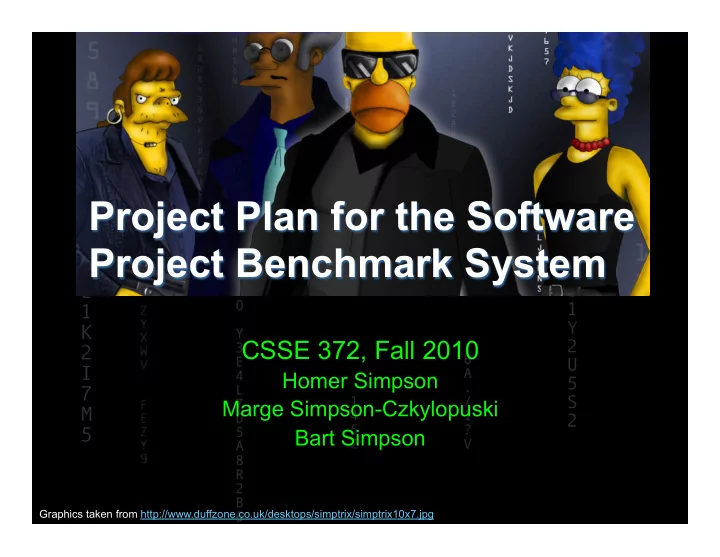
Project Plan for the Software Project Benchmark System CSSE 372, - - PowerPoint PPT Presentation

project plan for the software project benchmark system
SMART_READER_LITE
LIVE PREVIEW

Project Plan for the Software Project Benchmark System CSSE 372, - - PowerPoint PPT Presentation

Project Plan for the Software Project Benchmark System CSSE 372, Fall 2010 Homer Simpson Marge Simpson-Czkylopuski Bart Simpson Graphics taken from http://www.duffzone.co.uk/desktops/simptrix/simptrix10x7.jpg Simptrix 1999 Homer


slide-1
SLIDE 1

Project Plan for the Software Project Benchmark System

CSSE 372, Fall 2010

Homer Simpson Marge Simpson-Czkylopuski Bart Simpson

  • Graphics taken from http://www.duffzone.co.uk/desktops/simptrix/simptrix10x7.jpg
slide-2
SLIDE 2

2

Simptrix

  • 1999 – Homer changes his image and

creates Simptrix in Terre Haute, IN

  • Teams with Marge – background in

metrics and process improvement

– Collects metrics on every project - 5 year history – Acquires Bart, a budding new developer

  • 7 people and growing – mostly

seasoned, versatile developers

  • Specialize in any and all applications
slide-3
SLIDE 3

3

Agenda

  • Team and Product Overview
  • Project Management Approach
  • Estimates
  • Risks
  • Schedule of Deliverables
  • Current Status
slide-4
SLIDE 4

4

Product Overview

  • SPBS is a software development metric repository
  • Permits authorized organizations to add data to

repository and to request benchmark reports.

  • 2 kinds of reports – automatic (free) and manually

generated (charged)

  • Allows authorized students access to data for research.
slide-5
SLIDE 5

5

Project Management Approach

  • Iteration & Incremental with WinWin Spiral Model[1]
  • Startup & Initial Planning
  • 3 Iterations

– 1 - Infrastructure, Core functionality, Security – 2 - Membership, Projects, Metrics Input, Security – 3 - Validation, Review, Reports, Security

  • Each iteration

– Stakeholders discuss project status, goals and requirements for current iteration, Build functionality, – Stakeholders evaluate executable baseline, including documentation

  • CCPM safety buffers

– Absorbs overruns – Provides health indicator

slide-6
SLIDE 6

6

Members & Burdened Labor Rate

Staff Title Responsibility

Software Engineer III

Salary (year): $96,664

Project Manager Architect Software Engineer II

Salary (year): $81,439

Process and Metrics SQA Engineer Developer Database Analyst II

Salary (year): $73,310

DBA Developer

Graphics taken from http://www.duffzone.co.uk.

slide-7
SLIDE 7

7

Members & Burdened Labor Rate

Staff Title Roles

Programmer II

Salary (year): $47,385

Programmer Interface Designer

Salary (year): $74,061

Web Designer Programmer Average Salary (Monthly) : $ 6,214.31 (plus 50% overhead ) Burdened Labor Rate: $ 9,321.47

Graphics taken from http://www.duffzone.co.uk.

slide-8
SLIDE 8

8

Process-Based Estimate

Bottom-Line

Startup 1.25 Iteration 1 & Buffer 4.91 Iteration 2 & Buffer 9.19 Iteration 3 & Buffer 7.01 Project Buffer 1.68 SUBTOTAL 24.04 20% reduction for Reuse

  • 4.81

TOTAL (in months) 19.23 TOTAL Cost, BLR = $9,321.47

$179,251.87

slide-9
SLIDE 9

9

Bottom Line – Estimation Results

Cost

Hardware:

$ 6,886

COCOMOII Cost Estimate: $ 180,900 Total: $ 187,786

Effort

18.33 staff months

Duration 4-5 months

(with a 5 person team)

slide-10
SLIDE 10

10

Risk Management

  • Analyze risk at the beginning of every iteration

– Weekly risk evaluation

  • 8 key risks identified

– Vulnerable security – Third-party payment system fails – Estimation is wrong – Staff turnover – Reliance on open source software

  • Top Risk: Security Vulnerability

– Probability: 30% Impact: Catastrophic – Threat Model: mitigate probability from 70%  30%  1%

  • Risk-based testing strategy
  • Put hardware in secure room
  • Emphasis on security during development
slide-11
SLIDE 11

11

Project Deliverables Schedule

Iteration Iteration Complete Deliverables/Milestones Milestone Complete Startup and Initial Planning 9/08/00 Project Plan Risk Management Plan 9/08/09 9/08/09 Iteration 1 01/06/09 Life-Cycle Objectives Life-Cycle Architecture Initial Operational Capability 9/17/04 10/21/09 10/30/09 Iteration 2 02/11/10 Life-Cycle Objectives Life-Cycle Architecture 2nd Operational Capability 11/30/09 01/6/09 02/11/09 Iteration 3 05/21/10 Life-Cycle Objectives Life-Cycle Architecture Final Operational Capability 03/8/10 04/1/10 05/21/10 Project Complete 05/27/10

slide-12
SLIDE 12

Any Questions?