Minnesota Buffers Initiative September 16, 2015 Legislative Citizen - - PDF document

minnesota buffers initiative
SMART_READER_LITE
LIVE PREVIEW

Minnesota Buffers Initiative September 16, 2015 Legislative Citizen - - PDF document

9/15/2015 Minnesota Buffers Initiative September 16, 2015 Legislative Citizen Commission on Minnesota Resources John Jaschke, BWSR Executive Director Sarah Strommen, DNR Assistant Commissioner Nutrient Reduction Strategy Priority Areas


slide-1
SLIDE 1

9/15/2015 1

Minnesota Buffers Initiative

September 16, 2015

Legislative‐Citizen Commission on Minnesota Resources

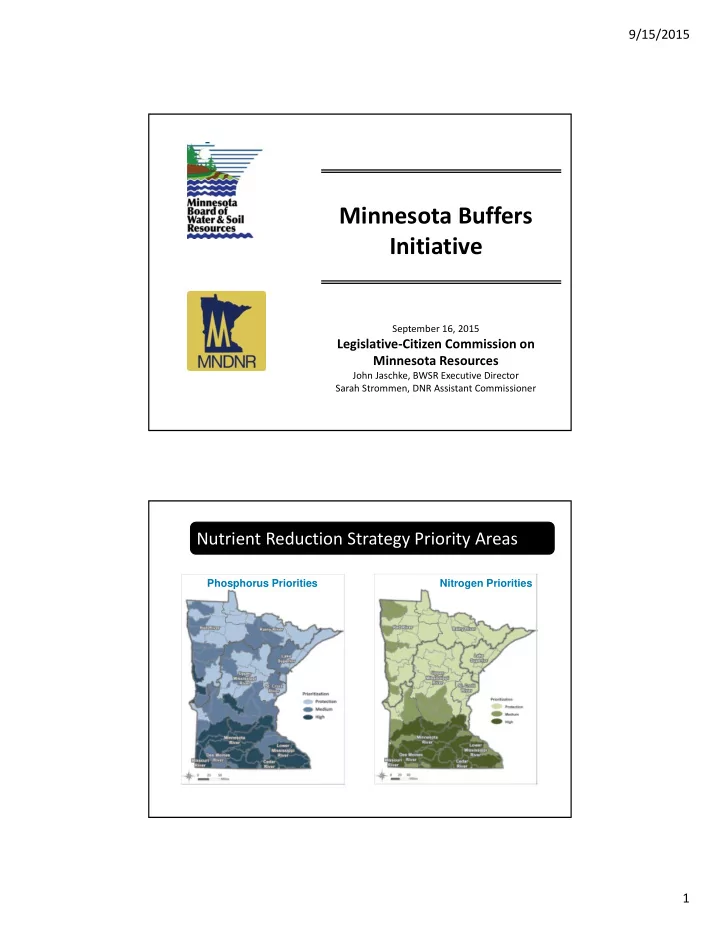
John Jaschke, BWSR Executive Director Sarah Strommen, DNR Assistant Commissioner Phosphorus Priorities Nitrogen Priorities

Nutrient Reduction Strategy Priority Areas

slide-2
SLIDE 2

9/15/2015 2

Buffers: Existing Rules and Laws

Riparian classification Linear miles % Total stream/ ditches Buffer required (feet) Shoreland Requirement 21,642 30% 50.0 Ditch Buffer Requirement 4,022 6% 16.5 No Buffer Requirement 44,850 64% 0.0

Buffer Analysis Results

slide-3
SLIDE 3

9/15/2015 3

~1/3 of 50‐foot buffers in the Temperate Prairies Ecoregion are composed of less than 60% perennial vegetation (~11,000 stream miles)

Results Results

Buffer Zone Vegetation Analysis

Photo Credit: Cannon River Watershed Partnership, 2008 Slide Credit MN DNR, 2015

10 20 30 40 50 60 70 80 90 50 100 150 200

Buffer Width (ft) Nitrogen Removal Effectiveness (%)

Buffers Improve Water Quality

slide-4
SLIDE 4

9/15/2015 4

Minnesota’s Buffer Initiative

A Statewide, basic standard approach: Maps DNR will create buffer protection maps Waters Covered and Buffer Widths

  • Public waters – 50‐foot average, 30‐foot minimum
  • Public ditch systems ‐ 16.5‐foot minimum
  • Or alternative practices
  • Other waters determined by SWCDs

Compliance

  • County or watershed district provides correction letters

when noncompliance identified.

  • Local/state $500 administrative penalty
  • State program funds can be withheld for failure to

implement

Minnesota’s Buffer Initiative

slide-5
SLIDE 5

9/15/2015 5

A Statewide, basic standard approach: Timeline

  • Public waters – Nov 2017
  • Public ditch systems – Nov 2018
  • Extension if waiting for funding

Exemptions

  • Roads, trails, building and structures. Inundated crops, alfalfa

seeding

  • Enrolled in CRP
  • Areas covered by NPDES water‐quality permits

Minnesota’s Buffer Initiative Buffer Protection Map

slide-6
SLIDE 6

9/15/2015 6

Alternative Practices

Alternative water quality practice, or combination of practices, may be used to sufficiently meet water quality goals. In these instances, buffers may not be needed.

Landowner Financial Assistance

Is there financial assistance available for landowners? There are many programs at the local, state, and federal level that provide assistance for establishing buffers.

slide-7
SLIDE 7

9/15/2015 7

Exemptions

Will any general exemptions to the 50 foot buffer requirement be considered?

  • Yes. The following areas would be exempt:
  • Land enrolled in the federal Conservation Reserve Program

(CRP)

  • Public or private water access or recreational use areas
  • Areas covered by a road, building or other structures
  • Municipalities or others in compliance with federal and state

storm sewer or storm water law

  • Clean Water Fund

– $22M for SWCD Local Capacity – ‐$5M for Buffer Compliance Assistance – $33M for Long Term Water Quality Protection (RIM, CREP) – $20M for Projects and Practices Grants – $12M for Targeted Resource Protection and Enhancement – $1.5M Conservation Drainage

  • Outdoor Heritage Fund: $4.5M for buffers for wildlife

and water quality

  • Environmental and Natural Resource Trust Fund: $1M

for Farm Bill Assistance Program

State Financial Commitments ‐ next two years

slide-8
SLIDE 8

9/15/2015 8

  • Expanding the scope of waters covered
  • Setting timelines for implementation
  • Providing for enforcement
  • Strengthening soil erosion statutes
  • Appropriating Funding

Buffer Initiative – What’s New?

2015 Buffer Law

For more information:

http://bwsr.state.mn.us/buffers/

slide-9
SLIDE 9

9/15/2015 9

John Jaschke BWSR Executive Director P: 651‐296‐0878

john.jaschke@state.mn.us

http://www.bwsr.state.mn.us

Sarah Strommen DNR Assistant Commissioner P: 651‐259‐5021

sarah.strommen@state.mn.us

http://www.dnr.state.mn.us

For more information