T evatron Highlights FERMILAB-SLIDES-18-094-E D CDF Fermilab - - PowerPoint PPT Presentation

t evatron highlights
SMART_READER_LITE
LIVE PREVIEW

T evatron Highlights FERMILAB-SLIDES-18-094-E D CDF Fermilab - - PowerPoint PPT Presentation

T evatron Highlights FERMILAB-SLIDES-18-094-E D CDF Fermilab Users Meeting This document was prepared by [CDF and D0 Collaborations] using the resources of the Fermi National Accelerator Laboratory (Fermilab), a U.S. Department of Energy,


slide-1
SLIDE 1

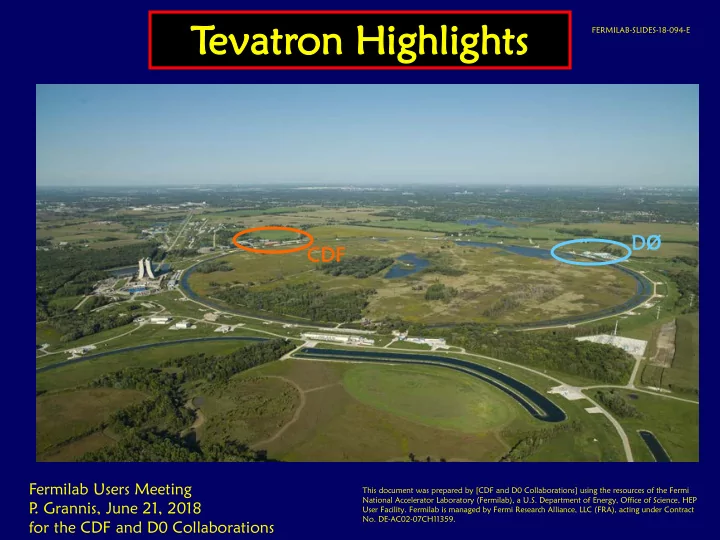
Fermilab Users Meeting P . Grannis, June 21, 2018 for the CDF and D0 Collaborations

T evatron Highlights

CDF DØ

FERMILAB-SLIDES-18-094-E This document was prepared by [CDF and D0 Collaborations] using the resources of the Fermi National Accelerator Laboratory (Fermilab), a U.S. Department of Energy, Office of Science, HEP User Facility. Fermilab is managed by Fermi Research Alliance, LLC (FRA), acting under Contract

  • No. DE-AC02-07CH11359.
slide-2
SLIDE 2

Run 0 1987 – 1988: 1.8 T eV, CDF only, 4 pb−1 Run I 1992 – 1996: 1.8 T eV, CDF+D0: 120 pb−1 Run II 2001 – 2011: 1.96 T eV, 12 fb−1. Added Main Injector, Recycler, helical orbits, magnet alignment …

  • Max. Instantaneous L ≈ 4.3x1032

cm-2 s-1 (30M collisions/s)

10 fb-1

The superb performance of the T evatron complex was the foundation for the physics accomplishments of CDF and D0. We are indebted to the scientists and engineers of the Accelerator Division.

The T evatron Collider

CDF DØ

17

slide-3
SLIDE 3

The experiments

CDF and DØ were quite different in Run I. Major detector upgrades for Run II: CDF: new tracker, new Si vertex det, upgraded forward calorimeter and muons DØ: add solenoid, fiber tracker, Si vertex and preshower detectors, new forward muon detectors. The upgraded experiments looked more like each other, but still with complementary strengths. Cross checks with >1 experiment were crucial!

39

16

slide-4
SLIDE 4

1. Search for fermiophobic Higgs: Phys. Rev. D 93, 112010 (2016) CDF 2. WW and WZ XSs with l± and heavy flavor jets: Phys. Rev. D 94, 032008 (2016). CDF 3. Spin correlation between top and antitop: Phys. Lett. B 757, 199 (2016). D0 4. Bs

0 lifetime in the CP-odd Bs→J/ψ f0(980): Phys. Rev. D 94, 012001 (2016). D0

5. Evidence for a Bs π state: Phys. Rev. Lett. 117, 022003 (2016), D0 6. T

  • p mass using matrix element method in dileptons: Phys. Rev. D 94 , 032004 (2016). D0

7. Inclusive ttbar XS and top quark pole mass: Phys. Rev. D 94, 092004 (2016). D0 8. T

  • p quark polarization in ttbar lepton + jets: Phys. Rev. D 95, 011101(R) (2017).)

D0 9. Direct CPV charge asymmetry in B± →µ± νµ D0: Phys. Rev. D 95, 031101(R) (2017). D0

  • 10. D+ meson cross section at low pT : Phys. Rev. D 95, 092006 (2017). ** CDF pub.# 700
  • 11. Combination of D0 measurements of top mass: Phys. Rev. D 95, 112004 (2017). D0
  • 12. Observation of Y(4140) in B±→J/ψφπ K decays, Mod. Phys. Lett. A32, 1750139 (2017) CDF
  • 13. Inclusive Isolated prompt photon cross section: Phys . Rev. D 96, 092003 (2017). CDF
  • 14. Combined F-B asymmetry in ttbar production: Phys. Rev. Lett. 120, 042001 (2018). CDF + D0
  • 15. Search for exotic meson X(5568): Phys. Rev. Lett. 120, 202006 (2018). CDF
  • 16. Study of X(5568)→Bs π in semileptonic Bs decays: Phys. Rev. D 97, 092004 (2018). D0
  • 17. Effective weak mixing angle in Z→l+l−: Phys. Rev. Lett. 120, 241802 D0
  • 18. T

evatron combination of sin2θeff

lept: Phys. Rev. D, in press (2018). ). CDF + D0

Publications since Users Meeting 2016

(No report in 2017 due to Fermilab’s 50th ) 15
slide-5
SLIDE 5

1

Publications since Users Meeting 2016

The T evatron results over the past two years still represent 40% of the physics papers based on Fermilab accelerator operations. (The rest are almost all neutrino cross sections and oscillation measurements.) Even during the LHC era, the T evatron papers have added significantly to our understanding of:

  • QCD
  • Heavy flavor physics
  • Electroweak interactions
  • Top quark
  • Higgs boson
  • (but very little to searches for new phenomena! )

We have benefitted greatly from the Computing Division’s support of the CDF and D0 hardware platforms and software systems, particularly in keeping our aging systems going.

14

The highlights to follow cover some of the T evatron legacy results, as well as some since the last Users’ meeting report (marked **)

slide-6
SLIDE 6

1

Highlights – QCD

** CDF prompt isolated photon XS pT

γ<0.5 T

eV (1/2 Ebeam) Many measurements of W/Z + jets vs. pT

jet,

ηjet, Njets, jet flavor … ** recent CDF WW/ WZ production with decays to lν + bq/cq Many textbook results on jet production: good agreement with pQCD over 9 orders of magnitude Inclusive jet XS vs pT Running of αS Double parton scattering in single pp collision for various processes implies that gluons occupy smaller volume than quarks _

  • -

13

slide-7
SLIDE 7

Highlights – Heavy Flavor

Surprisingly strong T evatron contributions to heavy flavor. 2006: First evidence and subsequent observation of Bs mixing, consistent with SM prediction, thus constraining sources of new physics. Discovery of Bc (& Σb, Ξb, Ωb), charmless Bs decay, evidence for CP violation in µ+µ+/µ−µ− asymmetry …

CDF CDF

_ The mixing of D and D was difficult to

  • bserve since the mixing period >> decay
  • time. The 2013 CDF measurement found

6.1σ significance for mixing.

CDF

12

slide-8
SLIDE 8

Highlights – Heavy Flavor

Exotic hadrons with additional qq pairs to the usual qq (meson) or qqq (baryon) have long been predicted but only recently seen, both in e+e− and hadron collisions. Those with heavy flavor are easier to identify than purely light quark exotics due to distinctive decays and lower backgrounds. CDF and D0 have added important new information on exotics’ production mechanisms (e.g. **prompt vs. in decay products). ** In 2016 D0 published strong evidence for a new state X(5568)+→Bs

0 π+ with Bs 0 →J/ψ φ. The minimal quark

content is bsud – the first exotic state with 4 quark flavors. LHC experiments did not see it in pp collisions. _ _ _ _

Bs→J/ψ φ Bs→Ds µν

but ** D0 did see it in Bs

0 →Ds + µ− ν. A combined fit of

the two channels gives significance=6.7σ.

11

** In 2018, CDF did not observe X(5568) in Bs

0 →J/ψ φ

A puzzling situation: D0 signal comes primarily when at least one µ from J/ψ is outside CDF coverage.

slide-9
SLIDE 9

Highlights – Electroweak

W boson mass (CDF+D0) measured 16 MeV (0.02%) uncertainty – one of the most powerful tests of the EW sector of the Standard Model.

RAZ

Many measurements of vector boson trilinear

  • couplings. Here, the

first observation of Radiation Amplitude ** (2018, PRD in press): Measure the weak mixing angle that governs EWSB using the Z→l+l− F-B asymmetry. Combined T evatron result (δsin2θeff=0.00033) rivals the precision of 20-year old LEP-1 and SLD measurements (δ=0.00029 and δ=0.00026) and is midway between them, and also in excellent agreement with world average. Zero in WWγ coupling due to interference of s- and t-channel processes.

10

slide-10
SLIDE 10

1

Highlights – Top Quark

1995 at discovery (13 D0 tt events) 2013 near final ∫Ldt (~3000 CDF tt events) 1995 top quark discovery by CDF and D0 was the most notable T evatron result. Early measurements of forward-backward tt asymmetries showed excess over SM prediction both vs. mtt and ytt, suggesting possible non-SM physics.

  • ** Recent combination
  • f final CDF and D0

measurements agree with new Standard Model NNLO(QCD) +NLO(EW) theory.

9

slide-11
SLIDE 11

1

Highlights – Top Quark

** D0 combination of top mass using comparison to MC templates (based on the matrix element method) for all channels: mt = 174.95 ± 0.75 GeV (0.4%) (CDF analysis is in progress). Also measure theoretically well-defined top pole mass by comparing measured σtot with mt-dependent QCD NNLO/NLL calculations. The fact that top decays before hadronizing allows measurements of top charge, polarization, spin correlations, lifetime, CPT violation, decay W helicity, and searches for FCNC, resonances, anomalous couplings etc. Single top quark production via EW reactions was first discovered in 2009. Both s- and t-channel W exchange processes were observed. Although single top cross section is about ½ of pair production, fewer final particles and higher backgrounds make this an exquisitely difficult measurement. Multivariate methods to separate signal and background were essential. Comparison of s- and t-channel XS constrain new physics.

8

slide-12
SLIDE 12

The top and W masses measured in the T evatron are modified in the SM by loop corrections involving the Higgs, and thus told us where to look for the Higgs. CDF & D0 combined to exclude 149 < MH < 182 GeV in direct searches.

11

Highlights – Higgs boson

The Higgs was discovered in 2012 at LHC in the γγ & ZZ decays. Simultaneously, CDF & D0 obtained the first 3σ evidence for H→bb using the combined W(lν)H, Z(ll)H and Z(νν)H channels. This preceded the LHC evidence for fermionic Higgs decays by 4 years and was the first direct evidence for the Higgs Yukawa coupling. Higgs analyses validated by

  • bserving W(lν)Z(bb) &

Z(ll)Z(bb) at the SM level in the same final states.

T evatron 1σ ellipse Locus of mt vs. MW for MH=125 GeV

7

** CDF rules out fermi-

  • phobic Higgs partner

for 10 < Mh < 100 GeV

MW mtop

slide-13
SLIDE 13

1

Highlights – New phenomena

LHC limits improving LHC has overtaken T evatron in almost all aspects of searches T evatron squark gluino limits LHC squark gluino limits (already in 2011)

6

slide-14
SLIDE 14

1

Highlights – New phenomena

“400 Physicists Fail to Find Supersymmetry”

LHC has overtaken T evatron in more ways than one LHC limits improving

“400 Physicists Fail to Find Supersymmetry”

(NYTimes, ca 1992)

5

slide-15
SLIDE 15

1

Highlights – New phenomena

“400 Physicists Fail to Find Supersymmetry”

(NYTimes, ca 1992)

“600 6000 Physic icists s Fail il to Fin ind d Supe persymmetr try”

(Tri ribune de e Gen enev eve, e, 2 2018)

LHC limits improving LHC has overtaken T evatron in more ways than one

4

slide-16
SLIDE 16

1

(7) (11) (7) (7 nations) (11) (8)

The World of CDF and D0

3

slide-17
SLIDE 17

1

The T evatron by the Numbers

 40 years since inception of the T evatron program (and still counting)  35 experiment-years of colliding beams delivered  Almost 12 fb−1 delivered to CDF and D0 (about 10 fb−1 in analyses)  7 Accelerator Division Heads during the T evatron era  ~1200 CDF and D0 publications; including 6 joint PRLs and 8 joint PRDs.  Almost 600 total Physical Review Letters  About 3000 collaborators over the lifetimes of the two experiments  1128 PhD theses  26 nations collaborated in CDF and D0 (including 7 in both)  26 people served as spokespersons (3 did so twice)  About 2x10¹⁵ antiprotons (300 µC) died a horrible death at BØ and DØ

2

slide-18
SLIDE 18

The T evatron experiments have provided a significant legacy in validating the Standard Model and dramatically increasing our knowledge of its particles and forces. Their contributions still continue.

3

Summary

Thanks to all those in CDF and D0, and the Fermilab staff, who made it possible.

slide-19
SLIDE 19

Thanks