Systems within Systems within Systems The hydrosphere is the system - - PowerPoint PPT Presentation

systems within systems within systems
SMART_READER_LITE
LIVE PREVIEW

Systems within Systems within Systems The hydrosphere is the system - - PowerPoint PPT Presentation

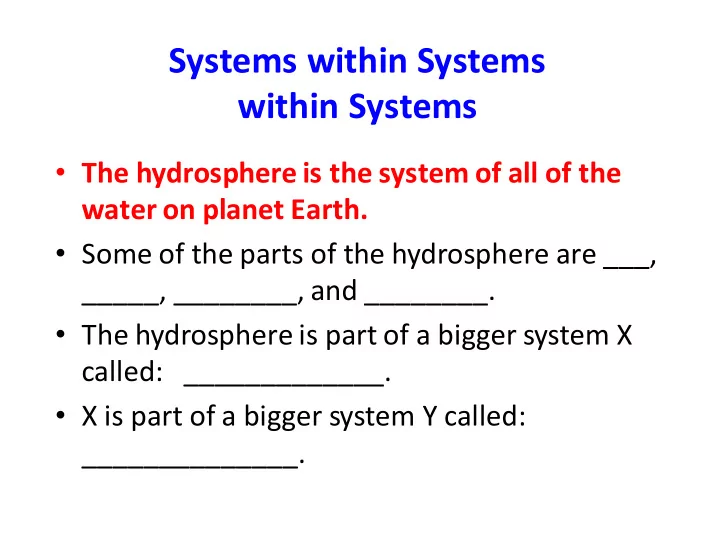
Systems within Systems within Systems The hydrosphere is the system of all of the water on planet Earth. Some of the parts of the hydrosphere are ___, _____, ________, and ________. The hydrosphere is part of a bigger system X


slide-1
SLIDE 1

Systems within Systems within Systems

  • The hydrosphere is the system of all of the

water on planet Earth.

  • Some of the parts of the hydrosphere are ___,

_____, ________, and ________.

  • The hydrosphere is part of a bigger system X

called: _____________.

  • X is part of a bigger system Y called:

______________.

slide-2
SLIDE 2

The Hydrosphere

  • DEFINITION: The hydrosphere is all of the water
  • n planet Earth.
  • The hydrosphere is a part of a bigger system

called Earth’s Matter.

  • The hydrosphere is itself a system that is made of

parts.

  • Some of the parts of the hydrosphere are the
  • cean, ice, water vapor in the air, water

underground, and water in living things.

  • Each of these parts is called a reservoir of the

hydrosphere.

slide-3
SLIDE 3

Names of Different Sized Numbers

  • Look at the numbers on page 27 of the reading.
  • Work in groups to fill out the table of Names of

Different Sized Numbers. No % or page numbers.

  • Put a star next to a number that you can say the

whole number in your local language.

slide-4
SLIDE 4

Make Two Small Cubes

  • Make a cube that is 1 centimeter (cm) long

by 1 cm wide by 1 cm high

  • Make another cube this time 2 cm long by 2 cm

wide by 2 cm high.

  • How much bigger is the larger cube compared

with the smaller cube?

  • Is there a math equation that you can use as

evidence for your answer?

slide-5
SLIDE 5

How Big Is A Cubic Meter?

  • Look at the cubic centimeter and the cubic meter.

How much bigger is the volume of the cubic meter?

  • A centimeter (cm) is one hundredth of a meter

(0.01 meter). Another way of saying this is that a meter is equal to 100 cm.

  • A cubic meter is equal to 100 times 100 times 100,

which is equal to 1,000,000 (one million).

  • We could fit one million cubic centimeter boxes

inside the cubic meter box.

slide-6
SLIDE 6

How Big Is A Cubic Kilometer?

  • Look at the one cubic meter box. How much bigger is the

volume of one cubic kilometer?

  • A meter (m) is one thousandth of a kilometer (0.001 km).

Another way of saying this is that a kilometer is equal to 1,000 meters.

  • A cubic kilometer is one thousand times longer on each

side than the cubic meter.

  • A cubic kilometer is equal to 1000 times 1000 times

1,000. This is equal to 1,000,000,000 (one billion) cubic meters.

  • We could fit one billion cubic meter boxes inside a cubic

kilometer box.

  • Could we make a cubic kilometer box?
slide-7
SLIDE 7

Could We Make a Cubic Kilometer Box?

  • A kilometer (km) is a thousand meters. It is a

little more than half a mile (1 km = 0.62 miles).

  • Think about two Majuro places that are

separated by 0.6 miles. A box would have to be that long, that wide and that high.

  • The Majuro airport reservoir holds a lot of water

(about 37 million gallons). It would take 1,000 Majuro airport reservoirs to fill a box that has a volume of one cubic kilometers.

slide-8
SLIDE 8

Visual Features in Books

  • Visual Features are things we can see in books

such as drawings, graphs, photos, tables of information, and lists with • marks.

  • With a partner, look through pages 26 through

31 to find at least four different kinds of visual features.

  • Be prepared to share the visual features you

have found.

slide-9
SLIDE 9

Interact With A Visual Feature

  • BEFORE READING: Look at your assigned visual
  • feature. Write at least one question that you have

about it.

  • AFTER READING: What are one or two big ideas

that the graph or other visual feature explains?

  • Do you still have any questions about the visual

feature?

  • What would be hard for RMI Grade 6-9 students

to understand about the visual feature?

  • Each member of the group fills out the answers

to each of the four questions for that group.

slide-10
SLIDE 10

Jig Saw Activity

  • Form four new groups.
  • Each new group has at least one member from

each of the four groups.

  • In the new group, the member from Group A

explains Visual Feature A and the group responses to the questions, then the member from Group B does the same, etc.

  • After all groups have had four reports , there is a

whole class discussion of the visual features and what they have learned about the water cycle.

slide-11
SLIDE 11

Reservoirs and Flows of The Water Cycle

  • Water is located in different reservoirs in

different amounts.

  • Water enters and leaves each reservoir but the

amount of water in the reservoir tends to stay the same.

  • Water can change physical states as part of

entering or leaving a reservoir.

  • The water cycle involves physical changes but

does not involve chemical changes. The water cycle is all about H2O.

slide-12
SLIDE 12

First Ideas About the Carbon Cycle

  • What are the main reservoirs of the carbon

cycle? In other words, where is carbon located

  • n our planet?
  • List the names of molecules or any kinds of

molecules that are part of the carbon cycle.

  • How is the carbon cycle similar to the water

cycle?

  • How is the carbon cycle different from the water

cycle?

slide-13
SLIDE 13
slide-14
SLIDE 14
slide-15
SLIDE 15
slide-16
SLIDE 16
slide-17
SLIDE 17
slide-18
SLIDE 18
slide-19
SLIDE 19
slide-20
SLIDE 20
slide-21
SLIDE 21

http://pbslearningmedia.org Search for PCEP Carbon Cycle Interactive

slide-22
SLIDE 22

Reservoirs and Flows of The Carbon Cycle

  • Carbon is located in different reservoirs in

different amounts.

  • Carbon can change physical states and chemical

bonds as part of entering or leaving a reservoir.

  • The carbon cycle involves physical changes and

chemical changes. The carbon cycle is all about carbon in different chemical forms.

  • Carbon enters and leaves each reservoir.
  • The amount of carbon in some reservoirs can

change significantly because of human activities.