Systems for Resource Management Corso di Sistemi e Architetture per - - PDF document

systems for resource management
SMART_READER_LITE
LIVE PREVIEW

Systems for Resource Management Corso di Sistemi e Architetture per - - PDF document

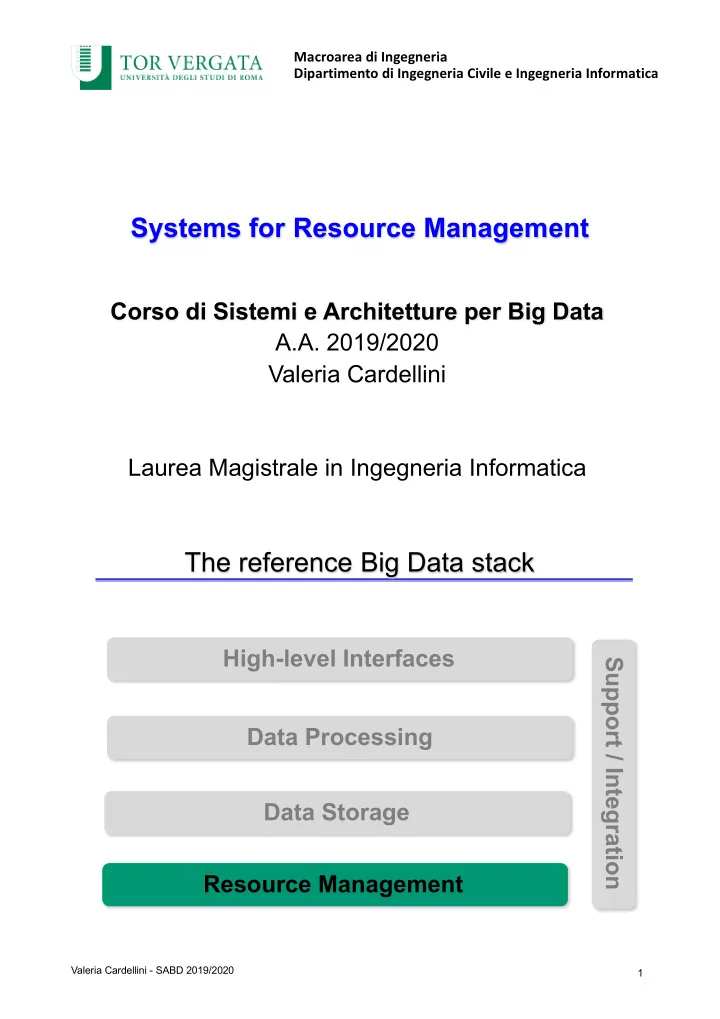
Macroarea di Ingegneria Dipartimento di Ingegneria Civile e Ingegneria Informatica Systems for Resource Management Corso di Sistemi e Architetture per Big Data A.A. 2019/2020 Valeria Cardellini Laurea Magistrale in Ingegneria Informatica The


slide-1
SLIDE 1

Corso di Sistemi e Architetture per Big Data A.A. 2019/2020 Valeria Cardellini Laurea Magistrale in Ingegneria Informatica

Systems for Resource Management

Macroarea di Ingegneria Dipartimento di Ingegneria Civile e Ingegneria Informatica

The reference Big Data stack

Valeria Cardellini - SABD 2019/2020 1

Resource Management Data Storage Data Processing High-level Interfaces Support / Integration

slide-2
SLIDE 2

Outline

  • Cluster management system

– Mesos

  • Resource management policy

– DRF

Valeria Cardellini - SABD 2019/2020 2

Motivations

  • Rapid innovation
  • No single framework optimal for all Big Data

applications

  • Running each framework on its dedicated

cluster:

– Expensive – Hard to share data

Valeria Cardellini - SABD 2019/2020 3

slide-3
SLIDE 3

A possible solution

4

  • Run multiple frameworks on a single cluster
  • How to share the (virtual) cluster resources

among multiple and non homogeneous frameworks executed in virtual machines/containers?

  • The classical solution:

Static partitioning

  • Efficient?

Valeria Cardellini - SABD 2019/2020

What we need

  • “The datacenter is the computer” (D. Patterson)

– Share resources to maximize their utilization – Share data among frameworks – Provide a unified API to the outside – Hide the internal complexity of the infrastructure from applications

  • The solution:

A cluster-scale resource manager that employs dynamic partitioning

Valeria Cardellini - SABD 2019/2020 5

slide-4
SLIDE 4

Apache Mesos

6 Valeria Cardellini - SABD 2019/2020

Dynamic partitioning

  • Cluster manager that provides a common

resource sharing layer over which diverse frameworks can run

“Program against your datacenter like it’s a single pool

  • f resources”

⎼ Abstracts the entire datacenter into a single pool of computing resources, simplifying running distributed systems at scale ⎼ Distributed system to build and run fault-tolerant and elastic distributed systems on top of it

Apache Mesos

Valeria Cardellini - SABD 2019/2020 7

  • Designed and developed at Berkeley Univ.
  • Top open-source project by Apache mesos.apache.org
  • Used by Twitter, Uber, Apple (Siri) among the others
  • Cluster: a dynamically shared pool of resources

Dynamic partitioning Static partitioning

slide-5
SLIDE 5

Mesos goals

  • High utilization of resources
  • Support for diverse frameworks (current and

future)

  • Scalability to 10,000's of nodes
  • Reliability in face of failures

Valeria Cardellini - SABD 2019/2020 8

Mesos in the data center

  • Where does Mesos fit as an abstraction layer

in the datacenter?

Valeria Cardellini - SABD 2019/2020 9

slide-6
SLIDE 6

Computation model

  • A framework (e.g., Hadoop, Spark) manages

and runs one or more jobs

  • A job consists of one or more tasks
  • A task (e.g., map, filter) consists of one or

more processes running on same machine

Valeria Cardellini - SABD 2019/2020 10

What Mesos does

Valeria Cardellini - SABD 2019/2020 11

  • Enables fine-grained resource sharing (at the

level of tasks within a job) of resources (CPU, RAM, …) across frameworks

  • Provides common functionalities:
  • Failure detection
  • Task distribution
  • Task starting
  • Task monitoring
  • Task killing
  • Task cleanup
slide-7
SLIDE 7

Fine-grained sharing

  • Allocation at the level of tasks within a job
  • Improves utilization, latency, and data locality

Valeria Cardellini - SABD 2019/2020 12

Coarse-grain sharing Fine-grain sharing

Frameworks on Mesos

  • Frameworks must be aware of running on

Mesos

– DevOps tooling: Vamp

  • Deployment and workflow tool for container orchestration

– Long running services: Aurora (service scheduler), … – Big Data processing: Hadoop, Flink, Spark, Storm, … – Batch scheduling: Chronos, … – Data storage: Alluxio, Cassandra, ElasticSearch, … – Machine learning: TFMesos

  • Framework to help running distributed Tensorflow ML tasks
  • n Apache Mesos with GPU support

Full list at mesos.apache.org/documentation/latest/frameworks/

Valeria Cardellini - SABD 2019/2020 13

slide-8
SLIDE 8

Mesos: architecture

Valeria Cardellini - SABD 2019/2020 14

  • Master-worker

architecture

  • Workers publish

available resources to master

  • Master sends

resource offers to frameworks

  • Master election

and service discovery via ZooKeeper

Source: Mesos: a platform for fine-grained resource sharing in the data center, NSDI'11

Mesos component: Apache ZooKeeper

  • Coordination service for maintaining configuration

information, naming, providing distributed synchronization, and providing group services

  • Used in many distributed systems, among which

Mesos, Storm and Kafka

  • Allows distributed processes to coordinate with each
  • ther through a shared hierarchical name space of

data (znodes)

– File-system-like API – Name space similar to a standard file system – Limited amount of data in znodes – Not really: file system, database, key-value store, lock service

  • Provides high throughput, low latency, highly

available, strictly ordered access to the znodes

Valeria Cardellini - SABD 2019/2020 15

slide-9
SLIDE 9

Mesos component: ZooKeeper

  • Replicated over a set of machines that maintain an

in-memory image of the data tree

– Read requests processed locally by the ZooKeeper server – Write requests forwarded to other ZooKeeper servers and consensus before a response is generated (primary-backup system) – Uses Paxos as leader election protocol to determine which server is the master

  • Implements atomic broadcast

– Processes deliver the same messages (agreement) and deliver them in the same order (total order) – Message = state update

Valeria Cardellini - SABD 2019/2020 16

Mesos and framework components

Valeria Cardellini - SABD 2019/2020 17

  • Mesos components
  • Master
  • Workers or agents
  • Framework components
  • Scheduler: registers with

master to be offered resources

  • Executors: launched on

agents to run the framework’s tasks

slide-10
SLIDE 10

Scheduling in Mesos

Valeria Cardellini - SABD 2019/2020 18

  • Scheduling mechanism based on resource
  • ffers
  • Mesos offers available resources to frameworks
  • Each resource offer contains a list of <agent ID,

resource1: amount1, resource2: amount2, ...>

  • Each framework chooses which resources to use and

which tasks to launch

  • Two-level scheduler architecture
  • Mesos delegates the actual scheduling of tasks to

frameworks

  • Why? To improve scalability
  • Master does not have to know the scheduling intricacies of

every type of supported application

Mesos: resource offers

  • Resource allocation is based on Dominant Resource

Fairness (DRF) algorithm

Valeria Cardellini - SABD 2019/2020 19

slide-11
SLIDE 11

Mesos: resource offers in details

Valeria Cardellini - SABD 2019/2020 20

  • Workers continuously send status updates about

resources to master

Mesos: resource offers in details (2)

Valeria Cardellini - SABD 2019/2020 21

slide-12
SLIDE 12

Mesos: resource offers in details (3)

Valeria Cardellini - SABD 2019/2020 22

  • Framework scheduler can reject offers

Mesos: resource offers in details (4)

Valeria Cardellini - SABD 2019/2020 23

  • Framework scheduler selects resources and provides

tasks

  • Master sends tasks to workers
slide-13
SLIDE 13

Mesos: resource offers in details (5)

Valeria Cardellini - SABD 2019/2020 24

  • Framework executors launch tasks

Mesos: resource offers in details (6)

Valeria Cardellini - SABD 2019/2020 25

slide-14
SLIDE 14

Mesos: resource offers in details (7)

Valeria Cardellini - SABD 2019/2020 26

Mesos fault tolerance

  • Task failure
  • Worker failure
  • Host or network failure
  • Master failure
  • Framework scheduler failure

Valeria Cardellini - SABD 2019/2020 27

slide-15
SLIDE 15

Fault tolerance: task failure

Valeria Cardellini - SABD 2019/2020 28

Fault tolerance: task failure (2)

Valeria Cardellini - SABD 2019/2020 29

slide-16
SLIDE 16

Fault tolerance: worker failure

Valeria Cardellini - SABD 2019/2020 30

Fault tolerance: worker failure (2)

Valeria Cardellini - SABD 2019/2020 31

slide-17
SLIDE 17

Fault tolerance: host or network failure

Valeria Cardellini - SABD 2019/2020 32

Fault tolerance: host or network failure (2)

Valeria Cardellini - SABD 2019/2020 33

slide-18
SLIDE 18

Fault tolerance: host or network failure (3)

Valeria Cardellini - SABD 2019/2020 34

Fault tolerance: master failure

Valeria Cardellini - SABD 2019/2020 35

slide-19
SLIDE 19

Fault tolerance: master failure (2)

Valeria Cardellini - SABD 2019/2020 36

  • When the leading master fails, the surviving masters

use ZooKeeper to elect a new leader

Fault tolerance: master failure (3)

Valeria Cardellini - SABD 2019/2020 37

  • The workers and frameworks use ZooKeeper to detect

the new leader and reregister

slide-20
SLIDE 20

Fault tolerance: framework scheduler failure

Valeria Cardellini - SABD 2019/2020 38

Fault tolerance: framework scheduler failure (2)

Valeria Cardellini - SABD 2019/2020 39

  • When a framework scheduler fails, another instance

can reregister to the master without interrupting any of the running tasks

slide-21
SLIDE 21

Fault tolerance: framework scheduler failure (3)

Valeria Cardellini - SABD 2019/2020 40

Fault tolerance: framework scheduler failure (4)

Valeria Cardellini - SABD 2019/2020 41

slide-22
SLIDE 22

Cluster resource allocation

  • 1. How to assign the cluster resources to the

tasks?

– Main design alternatives

  • Centralized scheduler

– Global (monolithic) scheduler – Two-level scheduler

  • Fully decentralized scheduler

– Let’s focus on centralized scheduler

  • 2. How to allocate resources of different types?

Valeria Cardellini - SABD 2019/2020 42

Global (monolithic) scheduler

  • Job requirements

– Response time, throughput, availability

  • Job execution plan

– Task DAG, inputs/outputs

  • Estimates

– Task duration, input sizes, transfer sizes

Valeria Cardellini - SABD 2019/2020 43

  • Pros

– Can achieve optimal schedule (global knowledge)

  • Cons:

– Complexity: hard to scale and ensure resilience – Hard to anticipate future frameworks requirements – Need to refactor existing frameworks

slide-23
SLIDE 23

Two-level scheduler in Mesos

  • Idea: push task placement to

frameworks

  • Resource offer

– Vector of available resources on a node – E.g., node1: <1CPU, 1GB>, node2: <4CPU, 16GB>

  • Master sends resource offers to

frameworks

  • Frameworks select which offers

to accept and which tasks to run

Valeria Cardellini - SABD 2019/2020 44

  • Pros:

– Simple: easier to scale and make resilient – Easy to port existing frameworks and support new ones

  • Cons:

– Two-level decision made by different entities: can be suboptimal

Mesos: resource allocation

  • How to determine which frameworks to make

resource offers?

  • Dominant Resource Fairness (DRF)

algorithm

– Implemented in the allocation module

Valeria Cardellini - SABD 2019/2020 45

slide-24
SLIDE 24

DRF: background on fair sharing

  • Consider a single resource: fair sharing

– n users want to share a resource, e.g., CPU – Solution: allocate each 1/n of the shared resource

  • Generalized by max-min fairness

– Handles if a user wants less than its fair share – E.g., user 1 wants no more than 20%

  • Generalized by weighted max-min

fairness

– Gives weights to users according to importance – E.g., user 1 gets weight 1, user 2 weight 2

Valeria Cardellini - SABD 2019/2020 46

Max-min fairness: example

  • 1 resource type: CPU
  • Total resources: 20 CPU
  • User 1 has x tasks and wants <1CPU> per task
  • User 2 has y tasks and wants <2CPU> per task

max(x, y) (maximize allocation) subject to x + 2y ≤ 20 (CPU constraint) x = 2y (fairness) Solution: x = 10 y = 5

Valeria Cardellini - SABD 2019/2020 47

slide-25
SLIDE 25

Why is fair sharing useful?

  • Proportional allocation

– User 1 gets weight 2, user 2 weight 1

  • Priorities

– Give user 1 weight 1000, user 2 weight 1

  • Reservations

– Ensure user 1 gets 10% of a resource, so give user 1 weight 10, sum weights 100

  • Isolation policy

– Users cannot affect others beyond their fair share

Valeria Cardellini - SABD 2019/2020 48

Why is fair sharing useful? (2)

  • Share guarantee

– Each user can get at least 1/n of the resource – But will get less if its demand is less

  • Strategy-proof

– Users are not better off by asking for more than they need – Users have no reason to lie

  • Max-min fairness is the only reasonable

mechanism with these two properties

  • Many schedulers use max-min fairness

– OS, networking, datacenters (e.g., YARN)

Valeria Cardellini - SABD 2019/2020 49

slide-26
SLIDE 26

Max-min fairness drawback

  • When is max-min fairness not enough?
  • Need to schedule multiple, heterogeneous resources

(CPU, memory, disk, I/O)

  • Single resource example

– 1 resource: CPU – User 1 wants <1CPU> per task – User 2 wants <2CPU> per task

  • Multi-resource example

– 2 resources: CPUs and memory – User 1 wants <1CPU, 4GB> per task – User 2 wants <3CPU, 1GB> per task

  • In the latter case what is a fair allocation?

Valeria Cardellini - SABD 2019/2020 50

A first (wrong) solution

  • Asset fairness: gives weights to resources (e.g., 1

CPU = 1 GB) and equalizes total allocation (i.e., sum) to each user

  • Total resources: 28 CPUs and 56GB RAM (e.g., 1

CPU = 2 GB)

– User 1 has x tasks and wants <1CPU, 2GB> per task – User 2 has y tasks and wants <1CPU, 4GB> per task

  • Asset fairness yields:

max(x, y) (maximize allocation) x + y ≤ 28 2x + 4y ≤ 56 4x = 6y – User 1: x = 1, i.e., <43%CPU, 43%GB> (sum = 86%) – User 2: y = 8 i.e., <29%CPU, 57%GB> (sum = 86%)

Valeria Cardellini - SABD 2019/2020 51

slide-27
SLIDE 27

A first (wrong) solution (2)

  • Problem: violates share guarantee

– User 1 gets less than 50% of both CPU and RAM – Better off in a separate cluster with half the resources

Valeria Cardellini - SABD 2019/2020 52

What Mesos needs

  • A fair sharing policy that provides:

– Share guarantee – Strategy-proofness

  • Challenge: can we generalize max-min

fairness to multiple resources?

  • Solution:

Dominant Resource Fairness (DRF)

Valeria Cardellini - SABD 2019/2020 53

Source: “Dominant Resource Fairness: Fair Allocation of Multiple Resource Types”, NSDI'11

slide-28
SLIDE 28

DRF

  • Dominant resource of a user: the resource

that user has the biggest share of

– Example:

  • Total resources: <8CPU, 5GB>
  • User 1 allocation: <2CPU, 1GB>
  • 2/8 = 25%CPU and 1/5 = 20%RAM
  • Dominant resource of user 1 is CPU (25% > 20%)
  • Dominant share of a user: the fraction of the

dominant resource allocated to the user

– User 1 dominant share is 25%

Valeria Cardellini - SABD 2019/2020 54

DRF (2)

  • Apply max-min fairness to dominant shares: give

every user an equal share of its dominant resource

  • Goal: equalize the dominant share of the users

– Total resources: <9CPU, 18GB> – User 1 wants <1CPU, 4GB> – Dominant resource for user 1: RAM (1/9 < 4/18) – User 2 wants <3CPU, 1GB> – Dominant resource for user 2: CPU (3/9 > 1/18)

max(x, y) x + 3y ≤ 9 4x + y ≤ 18 (4/18)x = (3/9)y

  • User 1: x = 3 <33%CPU, 66%GB>
  • User 2: y = 2 <66%CPU, 16%GB>

Valeria Cardellini - SABD 2019/2020 55

slide-29
SLIDE 29

Online DRF

  • Whenever there are available resources and tasks to

run: Choose the framework with the lowest dominant share among all frameworks

Valeria Cardellini - SABD 2019/2020 56

DRF: efficiency-fairness trade-off

Valeria Cardellini - SABD 2019/2020 57

Efficiency-Fairness Trade-off

  • DRF has under-utilized resources
  • DRF schedules at the level of tasks

(lead to sub-optimal job completion time)

  • Fairness is fundamentally at odds

with overall efficiency (how to trade-

  • ff?)
slide-30
SLIDE 30

References

  • B. Hindman et al., Mesos: a platform for fine-grained

resource sharing in the data center, NSDI 2011. https://bit.ly/2LJ7t2z

  • A. Ghodsi et al., Dominant resource fairness: fair

allocation of multiple resource types, NSDI 2011. https://bit.ly/2Jqqhae

Valeria Cardellini - SABD 2019/2020 58