Synthesizing Robust Adversarial Examples Anish Athalye*, Logan - - PowerPoint PPT Presentation

synthesizing robust adversarial examples
SMART_READER_LITE
LIVE PREVIEW

Synthesizing Robust Adversarial Examples Anish Athalye*, Logan - - PowerPoint PPT Presentation

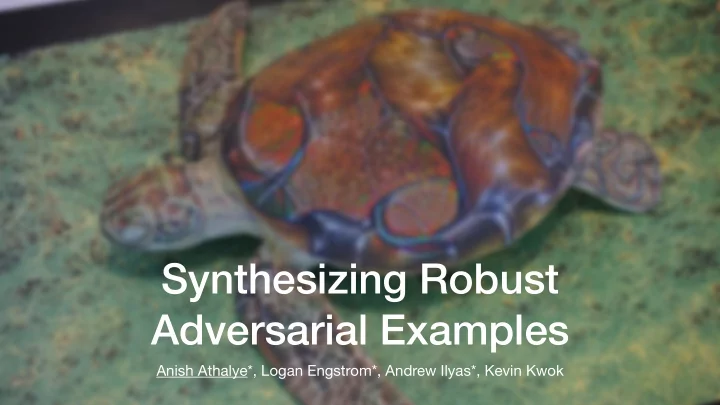
Synthesizing Robust Adversarial Examples Anish Athalye*, Logan Engstrom*, Andrew Ilyas*, Kevin Kwok Adversarial examples Adversarial examples Imperceptible perturbations to an input can change a neural network's prediction adversarial

slide-1
SLIDE 1

Synthesizing Robust Adversarial Examples

Anish Athalye*, Logan Engstrom*, Andrew Ilyas*, Kevin Kwok

slide-2
SLIDE 2

Adversarial examples

slide-3
SLIDE 3

Adversarial examples

  • Imperceptible perturbations to an input can change a

neural network's prediction

88% tabby cat 99% guacamole

adversarial perturbation

slide-4
SLIDE 4

Adversarial examples

Given: Input image x, target label y Optimize:

arg max

x′

P (y ∣ x′) subject to d(x, x′) < ϵ

slide-5
SLIDE 5
slide-6
SLIDE 6

Do adversarial examples work in the physical world?

slide-7
SLIDE 7

Adversarial examples in the physical world

(Kurakin et al. 2016)

slide-8
SLIDE 8

... or not?

Foveation-based Mechanisms Alleviate Adversarial Examples (Luo et al. 2015) NO Need to Worry about Adversarial Examples in Object Detection in Autonomous Vehicles (Lu et al. 2017)

slide-9
SLIDE 9

Standard examples are fragile

slide-10
SLIDE 10

Are adversarial examples fundamentally fragile?

slide-11
SLIDE 11

Image processing pipeline

PREDICTIONS MODEL IMAGE

  • ptimize P(y ∣ x′) using gradient descent
slide-12
SLIDE 12

Physical world processing pipeline

Challenge: No direct control over model input PREDICTIONS IMAGE TRANSFORMATION

PARAMETERS

MODEL

these are randomized

slide-13
SLIDE 13

Attack: Expectation Over Transformation

PREDICTIONS IMAGE TRANSFORMATION

PARAMETERS

MODEL

  • ptimize 𝔽t∼T [P(y ∣ t(x′))]

these are randomized but the distribution T is known is differentiable

using gradient descent

(sampling, chain rule, differentiating through t)

slide-14
SLIDE 14

EOT produces robust examples

T = {rescale from 1x to 5x}

slide-15
SLIDE 15

T = {rescale + rotate + translate + skew}

EOT produces robust physical-world examples

slide-16
SLIDE 16

Can we make this work with 3D objects?

slide-17
SLIDE 17

Physical world 3D processing pipeline

PREDICTIONS TEXTURE RENDERING MODEL

is this differentiable?

PARAMETERS 3D MODEL

zoom: 1.3x rotation: [60°, 30°, 15°] translation: [1, 5, 0] ...

slide-18
SLIDE 18
  • For any pose, 3D rendering is differentiable with respect to texture
  • Simplest renderer: linear transformation of texture

Differentiable rendering

slide-19
SLIDE 19

EOT produces 3D adversarial objects

slide-20
SLIDE 20
slide-21
SLIDE 21
slide-22
SLIDE 22

EOT reliably produces 3D adversarial objects

Inputs Classification accuracy Attacker success rate Distortion (l2) 2D Original 70% N/A Adversarial 0.9% 96.4% 5.6 ⨉ 10-5 3D Original 84% N/A Adversarial 1.7% 84.0% 6.5 ⨉ 10-5

slide-23
SLIDE 23

Implications

  • Defenses based on randomized input transformations are insecure
  • Adversarial examples / objects are a physical-world concern

Poster (and live demo): 6:15 – 9:00pm @ Hall B #73