Synchronous Colorectal Liver Colorectal Cancer with Hepatic - - PowerPoint PPT Presentation

synchronous colorectal liver
SMART_READER_LITE
LIVE PREVIEW

Synchronous Colorectal Liver Colorectal Cancer with Hepatic - - PowerPoint PPT Presentation

Synchronous Colorectal Liver Colorectal Cancer with Hepatic Metastases: The Primary Should be Metastases Resected First Approximately 20% to 30% will have liver-only metastases on initial evaluation. Synchronous Metastasis: Definition


slide-1
SLIDE 1

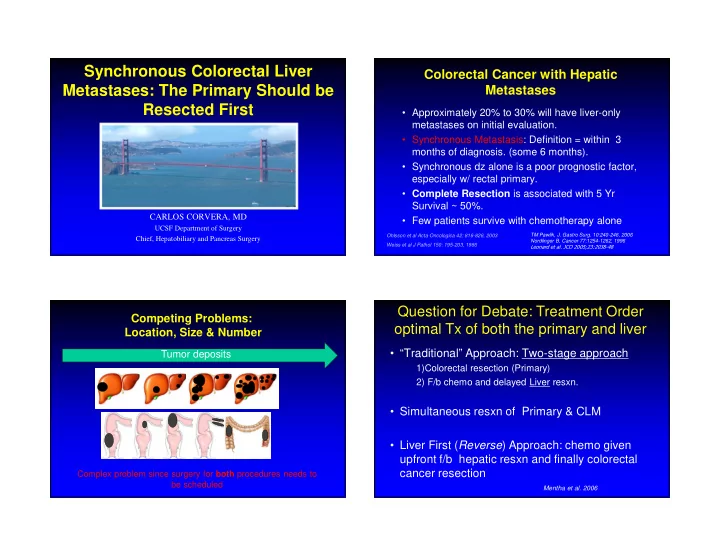
Synchronous Colorectal Liver Metastases: The Primary Should be Resected First

CARLOS CORVERA, MD

UCSF Department of Surgery Chief, Hepatobiliary and Pancreas Surgery

Colorectal Cancer with Hepatic Metastases

  • Approximately 20% to 30% will have liver-only

metastases on initial evaluation.

  • Synchronous Metastasis: Definition = within 3

months of diagnosis. (some 6 months).

  • Synchronous dz alone is a poor prognostic factor,

especially w/ rectal primary.

  • Complete Resection is associated with 5 Yr

Survival ~ 50%.

  • Few patients survive with chemotherapy alone

Ohlsson et al Acta Oncologica 42: 816-826, 2003 Weiss et al J Pathol 150: 195-203, 1986 TM Pawlik, J. Gastro Surg. 10:240-246, 2006 Nordlinger B, Cancer 77:1254-1262, 1996

  • Tumor deposits

Competing Problems: Location, Size & Number

Complex problem since surgery for both procedures needs to be scheduled

Question for Debate: Treatment Order

  • ptimal Tx of both the primary and liver
  • “Traditional” Approach: Two-stage approach

1)Colorectal resection (Primary) 2) F/b chemo and delayed Liver resxn.

  • Simultaneous resxn of Primary & CLM
  • Liver First (Reverse) Approach: chemo given

upfront f/b hepatic resxn and finally colorectal cancer resection

Mentha et al. 2006

slide-2
SLIDE 2

Data shows that the order doesn’t Matter!

Primary First vs Liver First

Problems / Pitfalls of Traditional approach

  • A. Treatment duration can be long (months ~3);

risk dz progression in the liver progress beyond resection.

  • B. Complications from Primary surgery: prevents

delivery of systemic chemoRX in ~ 50 %.

Sauer R, N Engl J. Med.2004;351:1731-1740 Ayez N, Dis Colon Rectum, 2013;56 (3):281-287 Bosset JF N Engl J Med 2006;355:1114-1123

Argument for Liver first approach?

  • A. Prognosis with synchronous disease is driven

by the extent of liver metastases.

  • B. Pre-operative ChemRx is administered in >

80% patients.

– Improves the intention-to-treat survival since ~ 80% complete treatment.

  • C. Biology is declared– Extrahepatic disease

would preclude resection.

– Can avoid rectal surgery in patients who progress

  • n chemotherapy.

Sauer R, N Engl J. Med.2004;351:1731-1740 Ayez N, Dis Colon Rectum, 2013;56 (3):281-287

  • Primary tumor is large and near-obstructing.

– Prevents local complications: Obstruction/bleeding.

  • Liver First is associated with Dz recurrence ~ 25-67 %
  • Survival data is Limited for the Liver First

approach = no difference in outcomes.

Resect Primary First

slide-3
SLIDE 3

Author N= Patients % 5 yr survival % Recurrence Brouquet 27 39 % 46 % De Jong 22 41% (3yr) 38 % Mentha 36 31 % 70 % De Rosa 37 30 % (3yr) 52 % Broquet et al, J Am Coll Surg 2010; 210:934-941 Mechteld, HPB 2011, 13,745-752 Mentha, Dig Surg 2008;25:430-435 Ayez, Dis Colon Rectum. 2013;56 (3):281-287

Retrospective Studies: Liver-First approach

Broquet et al, J Am Coll Surg 2010; 210:934-941 N=156

N= 27 N= 43 N= 72

MD Anderson experience Problems with Liver first approach

  • A. Primary tumor can progress beyond resection

– Perforation or direct invasion

  • B. Chemo responsiveness does not always

persist.

– Regrowth of “Disappearing” tumors – Regrowth of Primary Obstruction.

  • C. Chemotherapy associated toxicity.
  • D. Disappearing Colorectal Primary.

BORDERLINE

Initially unresectable and unlikely convertible Unresectable but likely convertible with response Resectable dz by standard approach

*Extended approach

  • Staged resections
  • Preop PVE
  • Resection plus RFA
  • ALPPS
  • Hepatic Arterial Infusion Pump

*

Categories of Resectability

slide-4
SLIDE 4

Response to Chemotherapy

Adam, Ann Surg 2004; 240:1052--61

Chemo ChemoXRT Ch-XRT Chemo

Colorectal Surgery

Recovery

Liver Resection

Recovery

Liver 2nd stage

Recovery Completion Chemotherapy Dx SCLM

Traditional/ Classical/ Historical Approach

Chemo ChemoXRT Ch-XRT Chemo

Colorectal Surgery & Liver (“easy” side)

Recovery

Liver 2nd stage

Recovery Completion Chemotherapy Dx SCLM

Simultaneous/ Combined Approach

Liver Resection

Recovery

Colorectal Surgery

Recovery

Liver 2nd stage

Recovery Completion Chemotherapy Dx SCLM

“Reversed” or Liver First Approach

Ch-XRT

First Line Chemo (3-6 cycles)

Ch-XRT Chemo

“Contemporary” Strategies

Conclusions

  • Hepatic resection remains critical to the long-term
  • utcome of patients with synchronous colorectal

metastases.

  • These patients are complex and should be managed by

multidisciplinary teams:

  • Customized Treatments: individualized and based
  • n extent and location of disease, and tumor biology.
  • Prioritizing Tx should be based on the problematic

component of the patient’s dz Management should be CHEMOTHERAPY-first and not “Liver-first”

CONTACT INFORMATION: Carlos U. Corvera M.D. Associate Professor Department of Surgery Gastrointestinal Surgical Oncology Chief, Liver, Biliary and Pancreatic Surgery University of California, San Francisco School of Medicine Helen Diller Family Comprehensive Cancer Center Email: carlos.corvera@ucsfmedctr.org Phone: Mobile # (415) 317-4602 Direct Line: (415) 502-1690 Clinic Line (referrals) Fax: (415) 353-9931 Tel: (415) 353-9888 Academic Address: Room U-370 521 Parnassus Avenue San Francisco, CA. 94143 Assistant (Marjorie Galicha) email: Marjorie.Galicha@ucsfmedctr.org tel: (415) 415-476-0762