Lynch Syndrome (HNPCC) Who to test? Disclosures: None How to - - PowerPoint PPT Presentation

lynch syndrome hnpcc who to test
SMART_READER_LITE
LIVE PREVIEW

Lynch Syndrome (HNPCC) Who to test? Disclosures: None How to - - PowerPoint PPT Presentation

Lynch Syndrome (HNPCC) Who to test? Disclosures: None How to test? Jonathan P. Terdiman, M.D. Professor of Clinical Medicine and Surgery University of California, San Francisco Clinical Features of Lynch Causes of Hereditary Susceptibility


slide-1
SLIDE 1

1

Lynch Syndrome (HNPCC) Who to test? How to test?

Jonathan P. Terdiman, M.D. Professor of Clinical Medicine and Surgery University of California, San Francisco

Disclosures: None

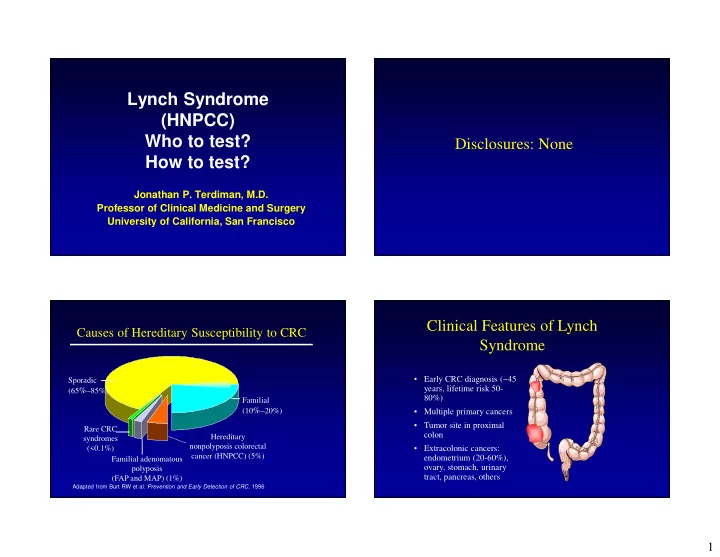
Causes of Hereditary Susceptibility to CRC

Adapted from Burt RW et al. Prevention and Early Detection of CRC, 1996

Sporadic (65%–85%) Familial (10%–20%) Hereditary nonpolyposis colorectal cancer (HNPCC) (5%) Familial adenomatous polyposis (FAP and MAP) (1%) Rare CRC syndromes (<0.1%)

Clinical Features of Lynch Syndrome

  • Early CRC diagnosis (~45

years, lifetime risk 50- 80%)

  • Multiple primary cancers
  • Tumor site in proximal

colon

  • Extracolonic cancers:

endometrium (20-60%),

  • vary, stomach, urinary

tract, pancreas, others

slide-2
SLIDE 2

2

Lynch – Screening Recommendations

Birth 10 years 20 years 30 years 50 years

Colonoscopy every 1-2 years Annual TVUS / endometrial aspiration Annual TVUS, CA-125

Colorectal cancer Endometrial cancer Ovarian cancer Stomach cancer

EGD (Optional)

Kidney / Ureteral cancer

MRI Urogram +/- urine cytology (?) Annual H&P, ROS, education, counseling

Jama 2007;296:1507-17

Cumulative Proportion Free of CRC

Jarvinen HJ et al., Gastro 2000; 118:829

Aspirin Chemoprevention

Burn J, et al. Lancet 2011;378:2081-87 Schmeler KM et al., NEJM 2006; 354:261

Cumulative Incidence: Endometrial CA

slide-3
SLIDE 3

3

Schmeler KM et al., NEJM 2006; 354:261

Cumulative Incidence: Ovarian CA

Lynch syndrome results from failure of mismatch repair (MMR) gene function

Base pair mismatch Normal DNA repair Defective DNA repair (MMR+) = MSI-H T CT A C A G C T G T C G A C A G C T G T CT A C A G C T G A G A T G T C T A C

MSI Testing

Immunohistochemistry

  • Identify MMR proteins
  • Normally present
  • If protein is absent,

gene is not being expressed (mutation or methylation)

  • Helps direct gene

testing by predicting likely involved gene

  • If abnormal IHC

(absent), MSI+

MSH2 MLH1 MSH6 PMS2

slide-4
SLIDE 4

4

Contribution of Gene Mutations to Lynch Families

MSH2 ~35% MLH1 ~35% PMS2 (< 5%) MSH6 ~ 10% Unknown ~20%

So, Who to Test and How?

  • First select by clinical criteria, or test all

CRC patients?

  • Tumor MSI or IHC or combination?
  • When to do germline genetic test?
  • What if clinical suspicion high but lab

tests normal?

Amsterdam II criteria

  • 3 or more relatives with verified HNPCC-

associated cancer in family

  • Two or more generations
  • One case a first-degree relative of the
  • ther two
  • One CRC dx <50
  • FAP excluded

Vasen HFA et al. Gastroenterology. 116:1453, 1999

Bethesda Guidelines

  • Individual with CRC dx <50
  • Individual with synchronous or metachronous CRC,
  • r other HNPCC-associated tumors regardless of age
  • Individual with CRC with MSI-H histology dx <60
  • Individual with CRC with >1 FDR with an HNPCC-

associated tumor, with one cancer dx <50

  • Individual with CRC with >2 FDRs or SDRs with an

HNPCC-associated tumor, regardless of age

Umar A, et al. JNCI. 2004;96(4):261-268.

slide-5
SLIDE 5

5

JAMA Sept 2006 Diagnostic Models for Lynch

Warning: Family Histories can be Deceiving

  • Family size is getting smaller
  • Wider use of colonoscopy likely to prevent

many colon cancers

  • MSH6/PMS2 may have lower cancer risks
  • Population-based case ascertainment may

be associated with lower cancer risks

MSI-H and L MSI stable No further action IHC 4 proteins Methylation MLH1 promoter/BRAF Mutation analysis of selected patients for PMS2 based on IHC Mutation analysis by sequencing MLH1, MSH2, MSH6 and deletion analysis by MLPA Germline mutations MSI unselected newly diagnosed patients Columbus OH

The Columbus Area Lynch Study Flow

Columbus-Area Lynch Study

MSI positive (high & low) N = 307 (19.6%) Colorectal cancer Total accrued N = 1600 Testing completed N = 1566 MSI negative N =1259 (80.4%) Mutation positive N = 44* 2.7% (1/35) Mutation result not yet interpretable N =55 3.5% Sequence MLH1, MSH2, MSH6 Immunohistochemistry Methylation of MLH1 promoter Mutation negative or polymorphism found N =209 13.4% Hampel et al. NEJM 2005;352:1851-60.; Unpublished

slide-6
SLIDE 6

6

Summary of Findings

  • 1 out of 35 colon cancer patients has Lynch

syndrome

  • 50% of CRC patients with LS are diagnosed
  • ver age 50
  • 24% of CRC patient with LS do not meet

any family history criteria

  • IHC easier logistically, cheaper, predicts the

mutated MMR gene when screening cancer patients

All Present 80%

CRC dx <45; OR FDR with CRC; OR Multiple primaries

MSH2& MSH6,

  • r

MSH6 or PMS2 Absent - 5%

Refer to Clinical Cancer Genetics

Recommended Approach in 2013

CRC dx >60 & No suggestive history, BRAF +

Stop MLH1 & PMS2 Absent 15%

CRC dx <60; OR Family or personal history

  • f Lynch cancer

BRAF (-)

Stop

Refer to Clinical Cancer Genetics CRC dx >45 & No personal or family history

Ladabaum et al, Ann Intern Med 2011;155:69

Conclusions

  • Important to identify Lynch Syndrome

– Different outcomes for probands and relatives with more intensive surveillance – Lynch = hereditary defective mismatch repair

  • Best method for detection?

– UNIVERSAL TUMOR TESTING OF CRC CASES AND ENDOMETRIAL CANCER TOO – GERMLINE TESTING FOR THOSE WITH POSITIVE TUMORS – GERMLINE TESTING OF NON AFFECTED RELATIVES ONCE MUTATION FOUND IN PROBAND – COMPREHENSIVE CANCER FAMILY HISTORY STILL IMPORTANT TO DETECT LYNCH IN NON CRC CANCER PATIENTS AND NON LYNCH CANCER FAMILIES

slide-7
SLIDE 7

7

UCSF - 2013

  • Universal Testing
  • Testing Protocol

– MSI and 4 protein IHC – If MLH1 is absent, we do BRAF testing

  • Reflex genetics referral for “positives” based on this screening

procedure

  • 278 colon cancers tested

– 45/278 (16%) with abnormal results – 13/45 with BRAF mutations found- so no Lynch – 13/45 refused further genetic work-up – 19/45 underwent genetic counseling and testing for Lynch

  • Mutations: MSH2 in 7, MLH1 in 5, MSH6 in 1, no mutation found in 3 and pending in 3
  • So 12 (4%) of entire population with confirmed Lynch